


More news on this day
Flights to and from the United Arab Emirates are facing rolling delays and scattered cancellations as renewed US–Iran tensions and evolving airspace advisories keep Gulf aviation in a prolonged state of disruption.
Get the latest news straight to your inbox!
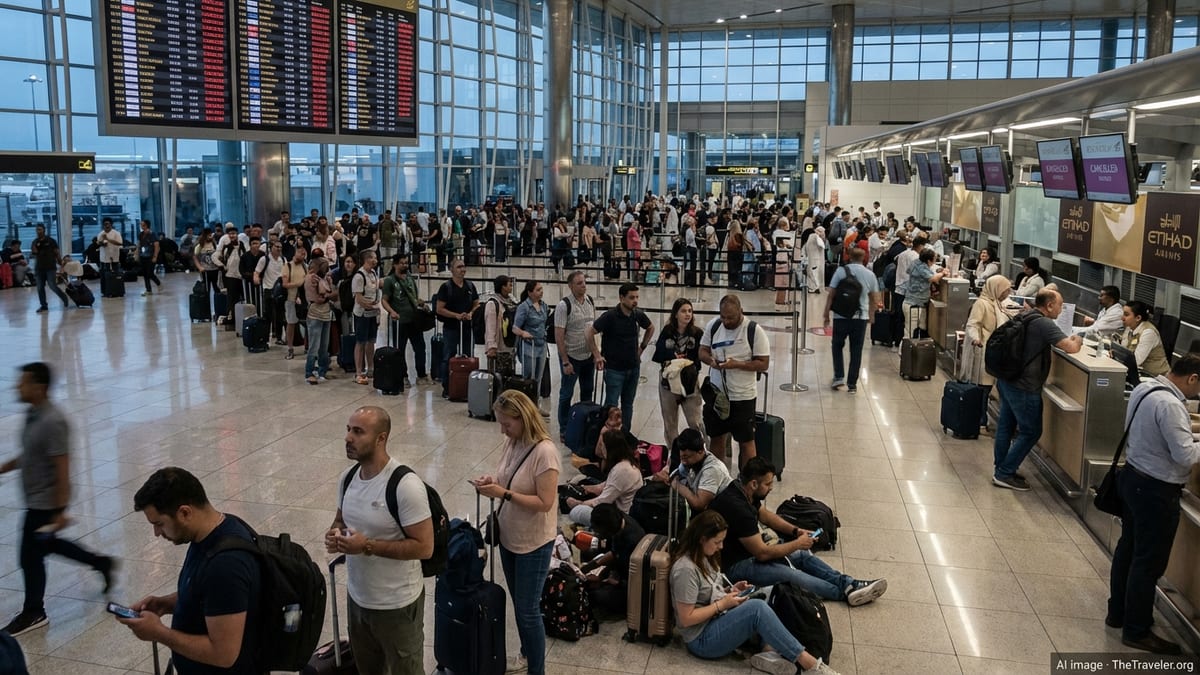
Mixed picture at UAE hubs as schedules keep shifting
Data from Dubai International and Abu Dhabi’s Zayed International airports shows a patchwork of operating, delayed and cancelled flights, with patterns changing throughout the day rather than following a single, short-lived disruption window. Recent coverage indicates that nearly 20 services were delayed or cancelled across UAE airports on Thursday alone, affecting regional routes to destinations such as Bahrain, Kuwait and several Indian cities.
Publicly available flight-status information compiled in local media reports points to a particular concentration of delays on services operated by major Gulf carriers, including Emirates, Etihad Airways, flydubai and Air Arabia. While the majority of flights are still operating, even confirmed services have been leaving later than scheduled, occasionally missing planned connection banks and forcing aircraft and crew rotations to be reworked on short notice.
Reports from Dubai suggest that several international flights have also been cancelled or delayed, including at least one Air France departure to Paris, despite airports themselves remaining open and fully staffed. Airlines have been advising passengers to complete online check-in where possible and to arrive earlier than usual, as security, check-in and rebooking queues lengthen during peak disruption periods.
In Abu Dhabi, coverage from UAE-based outlets describes a similar pattern at Zayed International, with delays on both arrivals and departures to regional destinations as well as select services into Europe and South Asia. While the scale of disruption has eased compared with the immediate aftermath of the latest escalation, schedules remain vulnerable to further changes over the coming days.
Regional tensions and airspace advisories underpin uncertainty
The latest round of disruption follows renewed escalation in the long-running standoff between the United States and Iran, including US strikes on Iranian targets and retaliatory missile and drone attacks aimed at US-linked sites in Bahrain, Kuwait, Jordan and Iraq. Travel advisories from several governments refer to a risk of further incidents and warn that airspace restrictions could be imposed at short notice across parts of the Middle East.
According to recent government travel guidance, British nationals and other travelers in the region are being urged to prepare for possible flight cancellations, diversions and periodic airspace closures as tensions ebb and flow. Conflict-zone bulletins from European aviation regulators have also extended warnings for parts of Gulf airspace, signaling that commercial operations must continue to factor in potential threats and routing constraints at least through the end of the month.
Industry analyses note that the Gulf’s dense network of long-haul connections is highly sensitive to any constraints on key air corridors near the Strait of Hormuz and across neighboring states. Even when airports in the UAE remain fully operational, rerouting around affected zones can add flying time, disrupt crew duty limits and reduce the flexibility airlines have to recover from earlier delays.
Advisories from regional travel management companies echo this picture, describing “evolving airspace restrictions and occasional flight suspensions” across parts of the Middle East. While they state that the UAE, Saudi Arabia and Oman are currently operating normally, they also highlight that schedules are being adjusted frequently in response to new security assessments.
Airlines juggle reduced frequencies, suspensions and day-of-flight changes
Public updates from aviation regulators and airline notices compiled in local media show a fragmented operating environment, with each carrier adapting its network differently. Several European airlines, including KLM and other major flag carriers, have extended suspensions of services to Dubai and other Gulf points, in some cases pushing tentative restart dates further into September.
Other international airlines have taken more targeted measures. Coverage in UAE-based outlets notes that Air France, for example, has temporarily paused flights to Dubai until early September, citing the wider regional security picture. At the same time, some long-haul operators that previously suspended Middle East services remain cautious about when to fully restore their pre-crisis schedules.
By contrast, UAE-based carriers continue to operate the bulk of their networks while trimming or cancelling select regional flights. Recent reporting highlights cancellations on Air Arabia services linking the UAE with Kuwait and Bahrain, and adjustments on Etihad and flydubai routes into certain Gulf and Levant destinations. Airlines are simultaneously rerouting and retiming flights where necessary to avoid constrained airspace and to keep connection banks viable at their hubs.
This uneven mix of normal, reduced, delayed and suspended services leaves passengers facing a high degree of uncertainty. A route that appears to be operating normally on one day may be delayed or cancelled the next, and airlines have been clear in public advisories that timings remain subject to change at short notice as the security situation evolves.
What travelers should expect in the coming days
Travel advisories and airline alerts converge on a consistent message for passengers planning to fly to or from the UAE in the near term: remain flexible and closely monitor bookings. Carriers are repeatedly urging customers to keep contact details up to date, check flight status before heading to the airport, and allow extra time for check-in and security, particularly if connecting onward through Dubai or Abu Dhabi.
Some airlines have introduced temporary flexible rebooking and refund policies for travellers affected by cancellations on specific routes, particularly to Kuwait, Bahrain and parts of the Levant. Eligibility varies by carrier and fare type, and passengers are being encouraged to consult airline websites or official communication channels to understand their options.
Government travel advice also stresses the importance of contingency planning, recommending that visitors build additional time into itineraries and consider the possibility of overnight stays if onward connections are missed. For those transiting through the region, experts suggest avoiding tightly timed layovers on complex itineraries, especially where multiple tickets or separate airlines are involved.
While there is no indication from public information that the UAE’s main airports are facing long-term closures, the combination of security concerns, airspace rerouting and high seasonal demand means that further short-notice disruptions cannot be ruled out. Observers note that the situation remains fluid, and that the pattern of delays and cancellations could shift quickly if regional tensions either flare up or begin to ease.
Impact on the wider Middle East aviation network
The knock-on effects of the current disruption extend well beyond the UAE’s borders, given the central role that Gulf hubs play in linking Europe, Asia, Africa and the Americas. Coverage from regional media shows that airports in Bahrain, Kuwait and Jordan have all reported delays or cancellations on services to and from the UAE and other nearby markets in recent days.
In Bahrain, delayed and cancelled flights have been recorded on both Gulf carriers and South Asian airlines, reflecting the ripple effect of any change in the wider regional security posture. Kuwait has seen intermittent disruption as well, with local and foreign carriers adjusting schedules in response to evolving airspace conditions and periodic operational pauses at Kuwait International Airport.
Farther afield, several international carriers have extended suspensions or reduced frequencies on routes into multiple Middle Eastern destinations, in some cases reshaping broader network strategies for the coming months. Aviation analysts point out that this could temporarily reduce capacity on certain long-haul corridors, especially for travellers relying on one-stop connections through the Gulf.
For now, publicly available information suggests that most airports in the region, including those in the UAE, remain open and functional, but the cumulative strain on aircraft, crews and passengers is significant. Industry watchers expect airlines to continue recalibrating schedules day by day, balancing safety considerations with the need to maintain critical travel links across the Middle East and beyond.
Khaleej Times: Nearly 20 UAE flights delayed or cancelled after renewed US–Iran attacks
The National: UAE travel advisory on Dubai and Abu Dhabi airport delays and cancellations