


The United Arab Emirates (UAE) is consistently ranked among the safest countries globally, yet relocating there involves a distinct profile of legal, digital, and geopolitical risks that differ markedly from many Western jurisdictions. This relocation risk dashboard summarizes the main categories of exposure for expatriates, helping decision makers evaluate whether the UAE’s risk environment aligns with their personal profile, business activities, and risk tolerance.
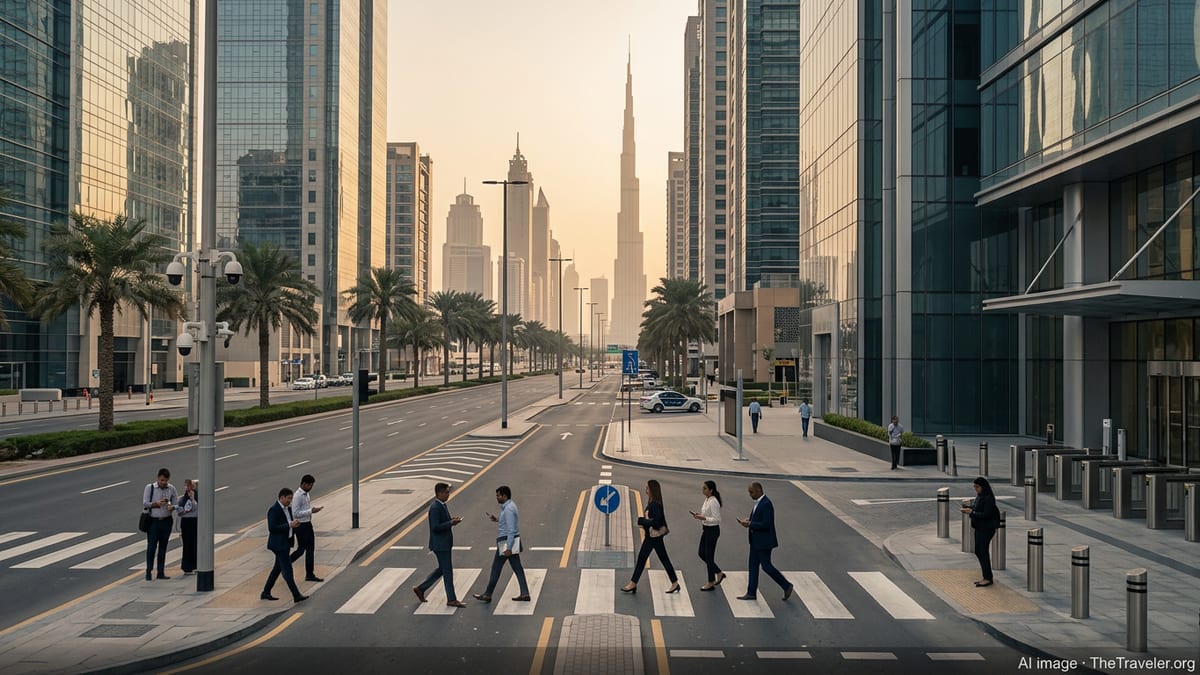
Overview of the UAE Risk Environment for Expats
The UAE combines very low conventional crime with a highly controlled legal and information environment and exposure to regional geopolitical shocks. For many expatriates, day-to-day personal safety is strong, but regulatory and reputational risks can be materially higher than in their home country. This duality is central to any relocation assessment.
Independent safety indices and crime surveys regularly place the UAE among the safest countries worldwide, with safety scores in the mid‑80s on a 0–100 scale and crime indices in the mid‑teens, well below global averages. Several UAE cities, including Abu Dhabi, Dubai and Sharjah, repeatedly appear in rankings of the world’s safest urban areas, with reported crime index figures generally under 20 on a 0–100 scale in recent years.
At the same time, the UAE enforces strict public order, cybercrime, and media laws. Activities that might attract only civil liability or no sanction in North America or Europe, such as critical social media posts, unauthorized photography, or casual online comments, can trigger criminal proceedings, financial penalties, and potential deportation. In addition, the events of early March 2026, when Iran launched missile and drone strikes that hit targets in the UAE, highlighted the country’s exposure to regional security escalation despite its strong internal policing and air defense capabilities.
For expats, the practical question is not whether the UAE is “safe” in an absolute sense, but how its specific risk configuration interacts with their professional sector, online footprint, and appetite for regulatory constraint. The following sections break this into distinct risk dimensions.
Personal Safety, Crime and Physical Security
From a conventional personal safety perspective, the UAE generally presents low risk by global standards. Reported violent crime levels are very low, and petty crime such as street theft and burglary remains comparatively rare in major cities. Safety indices often exceed 85 out of 100 for Abu Dhabi and Dubai, with crime indices in the low to mid‑teens, indicating a perception of safety substantially better than in many large Western cities.
City‑level data show a consistent pattern: multiple emirates record crime indices below 20 and safety indices in the mid‑80s, with recent measurements showing incremental year‑on‑year improvements. This reflects a combination of high police visibility, extensive CCTV coverage, robust enforcement of drug and weapons laws, and strong penalties for violent and property crimes. Expats typically report feeling safe walking in business districts and residential areas at most hours, including late at night.
Nonetheless, certain crime categories remain relevant. Human trafficking and sex trafficking networks have been documented in the UAE, particularly in Dubai, often targeting foreign nationals with fraudulent job offers. While these activities are primarily directed at vulnerable populations rather than corporate assignees, they illustrate that criminal exploitation of migrants exists beneath an otherwise orderly surface. There are also periodic high‑profile crackdowns on organized crime groups operating in or through the country.
For a typical expatriate professional or family, the personal security risk profile is generally favorable, provided normal urban precautions are followed. The primary relocation question is not about everyday street crime, but about how comfortable an individual is living under a security model that relies heavily on surveillance, strict policing, and expansive state powers in the name of public safety.
Legal and Regulatory Risk for Personal Conduct
The UAE applies a legal framework that prioritizes public order, social cohesion, and respect for institutions over expansive free expression. For expats, this creates pronounced legal risk around behavior that in other jurisdictions might be treated as minor or protected speech. Several decree‑laws, including those governing cybercrimes, rumors, and discrimination, carry penalties ranging from substantial fines to multi‑year prison sentences and mandatory deportation for non‑citizens.
Public criticism of the state, its rulers, or government institutions, as well as content deemed to insult religion or promote sectarianism, can fall under defamation, security, or cybercrime provisions. Individuals have faced significant sentences for social media posts judged insulting or destabilizing. Anti‑discrimination and anti‑hate legislation imposes jail terms that can extend to 10 years and fines up to several million dirhams for speech or online content that is considered discriminatory or incites hatred.
Everyday scenarios that can create legal exposure for expats include taking and sharing photos or videos of other individuals without consent, posting about accidents or security incidents, forwarding unverified information during crises, and making disparaging remarks about companies, officials, or local customs online. Recent enforcement actions and public advisories have highlighted that even resharing or commenting on problematic posts can trigger liability. Fines for certain content‑related offenses have been publicized in the six‑figure dirham range, with potential imprisonment.
From a relocation risk standpoint, expats must be prepared to adapt conduct across social media, workplace communications, and community interactions to a less permissive environment. Companies should incorporate legal briefings on acceptable speech and content into onboarding. Individuals who are accustomed to outspoken political engagement or investigative activism face materially higher risk and should evaluate whether their activities can realistically be curtailed.
Digital, Cyber and Social Media Risk
Digital behavior is a central element of the UAE risk profile for expats. Federal Decree‑Law No. 34 of 2021 on combating rumors and cybercrimes, updated via subsequent amendments, establishes detailed offenses relating to hacking, data breaches, financial cybercrime, “spreading false information,” and online defamation. Penalties typically involve fines in the approximate range of 100,000 to 500,000 dirhams, with imprisonment possible for more serious offenses and aggravating factors such as harm to national interests or public order.
The scope of cybercrime definitions is broad. Unlawful access to IT systems, distribution of malware, phishing, and financial fraud are predictably criminalized. However, the law also covers non‑technical behavior such as posting “rumors,” sharing misleading information about security incidents, disseminating content that conflicts with approved media standards, or publishing images of individuals and accident scenes without authorization. Recent public statements from authorities have emphasized that AI‑generated content and deepfakes are treated equivalently to conventional media if they cause harm or spread false news.
Newer decrees and regulations have introduced sanctions for misuse of virtual private networks (VPNs) in relation to illegal activities, promotion of unlicensed cryptocurrencies, and certain forms of unlicensed digital advertising. Penalties can include large fines, account bans, and, for non‑citizens, deportation orders. Influencer and content‑creator regulations require licensing for commercial promotion; breaches can lead to monetary penalties and business disruption.
For expats, this creates several digital risk categories: technical cyber risk (such as being targeted in financial scams or corporate breaches), legal risk from their own online conduct, and reputational risk if content is interpreted as disrespectful or destabilizing. Relocating individuals, especially those in public‑facing roles, should review and adjust social media use, understand local expectations around consent for images and recordings, and ensure corporate IT practices comply with local data and security requirements.
Political, Security and Geopolitical Risk
The UAE scores relatively highly on measures of political stability and internal security, with limited domestic unrest and no recent history of large‑scale internal conflict. Governance is centralized and decision making tends to be predictable, which contributes to investor and expatriate confidence. However, the country sits in a volatile region and is engaged in complex security dynamics with neighboring states.
This regional exposure materialized sharply in early March 2026, when Iranian missile and drone attacks reached targets in the UAE, damaging properties in Dubai and affecting operations at Abu Dhabi’s airport. While Emirati air defenses intercepted many projectiles and casualties were limited, the incident undercut the long‑standing perception of the UAE as an unassailable safe haven insulated from regional conflict. Analysts have described it as a structural shock to the country’s safety narrative, with implications for investor and expatriate risk assessments over the medium term.
Beyond direct attacks, broader geopolitical tensions involving Iran, Israel, and Gulf Cooperation Council states generate general security risk, including potential disruptions to air travel, commercial shipping, and energy markets. The UAE also faces information‑security and espionage challenges as a regional hub, with past incidents involving foreign intelligence activities and targeted surveillance of dissidents. These dynamics rarely affect day‑to‑day life for typical expats but can influence corporate continuity planning and personal comfort with regional escalation risk.
On balance, political risk for resident expats is better characterized as “low volatility, high consequence.” Major security incidents remain infrequent, but when they occur, the impact can be significant. Decision makers should factor in corporate evacuation planning, crisis communication protocols, and personal tolerance for living in a high‑profile state in a sensitive geopolitical corridor.
Social Cohesion, Discrimination and Community Risk
The UAE hosts more than 200 nationalities and promotes itself as a diverse, multicultural environment. Anti‑discrimination legislation prohibits hate speech and discrimination on religious or racial grounds, supported by criminal penalties that include multi‑year imprisonment and substantial fines. In public messaging, authorities emphasize equal treatment and social harmony as core principles.
For many skilled expats, this translates into a generally welcoming, low‑crime environment with limited visible street‑level discrimination. High levels of surveillance and enforcement mean that overt hate crimes and public disorder incidents are relatively rare compared with global averages. Surveys of resident sentiment consistently show high levels of trust in law enforcement and a strong perception of public safety.
However, the labor market is sharply segmented. Lower‑paid migrant workers from South Asia and Africa may experience different risk profiles, including dependence on employers, accommodation in more crowded areas, and higher vulnerability to exploitation. While this may not directly affect corporate assignees or high‑income relocations, it is part of the broader social risk context and informs how authorities balance worker protections with economic priorities.
Another social risk dimension is the expectation of cultural conformity in public spaces. Behavior considered acceptable in some Western cities, such as public displays of affection, overtly provocative dress, or loud political debates, can attract unwanted attention or intervention from authorities or private security. Expats who relocate with families should weigh their comfort with these norms and the potential for inadvertent breaches by teenagers or visiting relatives unfamiliar with local expectations.
Risk Management Strategies for Expats and Employers
For individuals and organizations considering relocation to the UAE, the primary task is not to eliminate risk but to align it with realistic mitigation strategies. The low baseline of conventional crime reduces the need for extensive personal security measures in everyday life. Instead, emphasis should be placed on legal, digital, and geopolitical preparedness.
At the individual level, concrete steps include pre‑arrival briefings on local laws and customs, structured training on social media and content risks, and clear guidelines on photography, public commentary, and participation in demonstrations or political activities abroad that might intersect with local sensitivities. Expats should maintain updated emergency contacts, register with their home country’s embassy or consulate where possible, and understand evacuation or relocation options in the event of regional escalation.
For employers, a UAE‑specific risk framework should be embedded into global mobility policies. This can include role‑based risk assessments for high‑profile executives, journalists, or technology professionals; contingency plans for cyber incidents involving local infrastructure; and crisis management protocols addressing both sudden security events and reputational or legal incidents related to employee conduct. Clear communication about disciplinary and support mechanisms in cases of legal trouble is important for setting expectations.
Ultimately, the UAE can be a low‑incidence but high‑consequence risk environment. With appropriate preparation around legal compliance and digital conduct, most expats will experience high levels of day‑to‑day security. Without such preparation, seemingly minor actions can escalate into serious legal and reputational problems, especially in the current climate of heightened sensitivity around information and security.
The Takeaway
The UAE relocation risk dashboard for expats reveals a distinctive pattern. Conventional crime and personal safety indicators are strongly positive by global standards, supported by intensive policing and sophisticated surveillance infrastructure. At the same time, the legal framework governing speech, digital activity, and public order is stringent, with penalties that are significantly more severe than many newcomers anticipate.
Recent regional developments, especially the missile and drone strikes that reached the UAE in March 2026, underscore that the country is not isolated from broader Middle Eastern security dynamics. While such events remain rare, they alter the long‑term risk calculus for individuals and companies that had treated the UAE as a virtually risk‑free base. This does not necessarily argue against relocation, but it does call for more explicit contingency planning.
For relocation decision makers, the key question is alignment. Expats who value low street crime, predictable urban order, and strong infrastructure, and who are comfortable with tighter regulation of speech and online activity, may find the UAE’s risk environment acceptable or even attractive. Individuals whose professional or personal identities rely heavily on open political expression, investigative work, or experimental digital activities may judge the non‑financial risks to be comparatively high.
In practical terms, successful relocation to the UAE depends less on physical security measures and more on informed adaptation to its legal and informational ecosystem. With realistic expectations, structured briefings, and robust corporate support, many of the country’s unique risks can be managed, allowing expats to benefit from its stability while remaining alert to its constraints and regional exposure.
FAQ
Q1. How safe is the UAE for day‑to‑day life as an expat?
The UAE is generally very safe, with low rates of violent and property crime and strong police presence, though expats must still observe normal urban precautions.
Q2. What are the biggest legal risks expats face in the UAE?
The most significant legal risks relate to strict laws on speech, social media, public order, and cybercrime, where behavior tolerated elsewhere can lead to criminal charges.
Q3. Can social media posts really lead to fines or jail time?
Yes. Critical, defamatory, or misleading posts and even resharing unverified or offensive content can trigger fines in the hundreds of thousands of dirhams and possible imprisonment.
Q4. How did the March 2026 Iranian strikes change the risk picture?
The strikes showed that the UAE, despite strong defenses, is exposed to regional conflict, prompting companies and expats to reassess evacuation, insurance, and contingency planning.
Q5. Are certain professions at higher risk in the UAE?
Public‑facing roles such as journalists, influencers, activists, and some technology or security specialists face higher exposure due to scrutiny of speech, content, and data handling.
Q6. Do expats face discrimination or community safety issues?
Skilled expats usually report good personal safety and limited overt discrimination, though lower‑income migrant workers can face more vulnerability and dependence on employers.
Q7. How strict are UAE cybercrime and VPN rules for residents?
Cybercrime laws are stringent, penalizing hacking, financial fraud, spreading false information, and misuse of VPNs for illegal purposes with high fines and potential deportation.
Q8. Is it safe to photograph in public places?
Photography in public is common, but taking and sharing identifiable images of people, accident scenes, or security facilities without consent can create legal risk.
Q9. What personal preparations should expats make before relocating?
Expats should receive legal and digital conduct briefings, review their online presence, learn local norms, register with their embassy, and understand employer security protocols.
Q10. How should companies update risk policies for staff in the UAE?
Employers should build UAE‑specific guidance into mobility policies, covering legal compliance, social media use, cyber risk, crisis response, and support in case of legal issues.