


More news on this day
The United Arab Emirates has suspended overstay penalties for travelers stranded in the country after sweeping Middle East airspace closures triggered sudden waves of flight cancellations and diversions, creating an urgent new layer of complexity for passengers already navigating a volatile regional travel environment.
Get the latest news straight to your inbox!
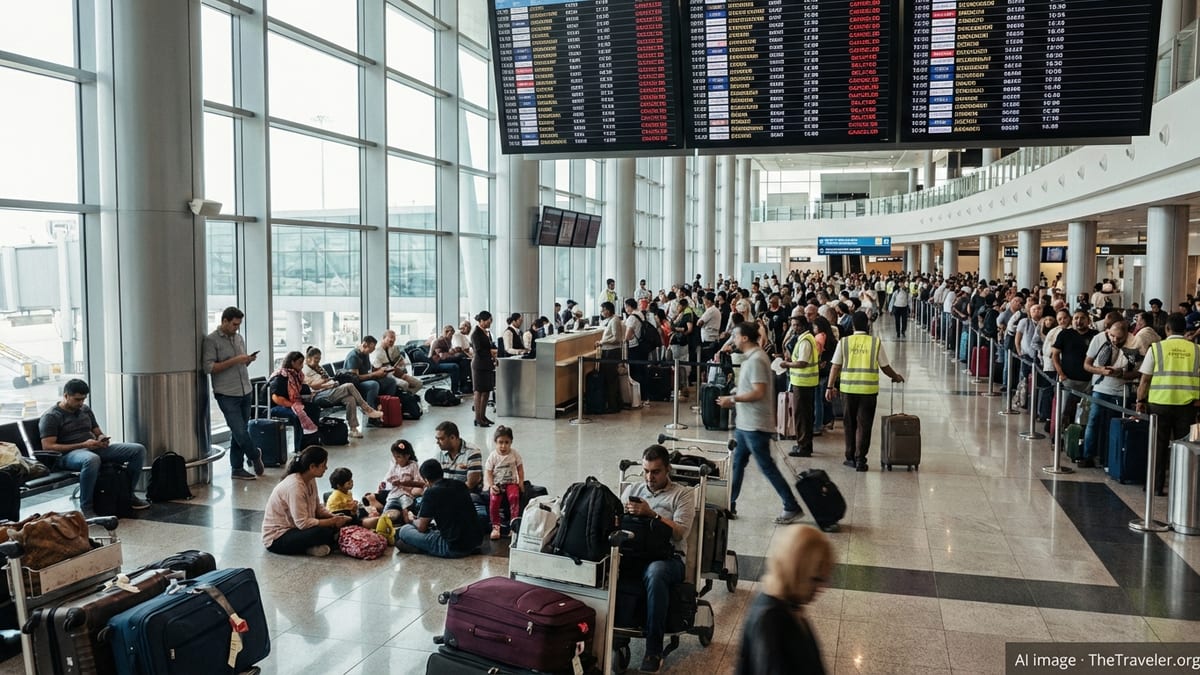
New Relief Measure for Stranded Visitors and Residents
Publicly available information from the Federal Authority for Identity, Citizenship, Customs and Port Security indicates that the UAE introduced an exceptional waiver of overstay fines earlier this year for people who could not leave the country as planned after regional airspace was abruptly shut or heavily restricted. The relief applied to visitors on tourist and visit visas, as well as certain residents whose permits were cancelled or expired while they were attempting to depart.
According to guidance cited in recent immigration and travel advisories, the measure covered penalties that would normally accrue from 28 February 2026 onward, when a sharp escalation in the regional security situation led to widespread route suspensions and last minute schedule changes across the Gulf. Travelers who held confirmed bookings but saw their flights cancelled or diverted found themselves temporarily unable to exit the UAE, placing them at risk of breaching visa conditions through no fault of their own.
Reports indicate that the UAE authorities responded by pausing the application of overstay fines for this specifically affected group. The step was framed as a limited and exceptional response to what officials described in public statements as extraordinary circumstances, rather than a long term change to the underlying visa or immigration framework.
Regional coverage also shows that similar temporary arrangements were adopted in other Gulf hubs that experienced heavy disruption, underscoring how closely immigration policy and air traffic management have become intertwined during the current period of heightened tension.
Final 30 Day Grace Period as Airspace Reopens
As airspace across the UAE and wider Gulf has gradually reopened and airlines restore regular schedules, the government has now shifted from emergency relief to a final grace period. Local media and official bulletins report that individuals who previously benefited from the overstay fine exemption have been granted a last 30 day window, running from 10 June to 9 July 2026, to either regularize their status in the UAE or depart the country.
This means that stranded travelers who remained in the Emirates after the initial wave of cancellations, and whose fines were previously suspended, are being asked to take concrete steps within this timeframe. Options include applying for new residency where eligible, arranging a status correction through recognized channels, or booking outbound travel as commercial flights normalize.
Immigration advisories highlight that no special application is generally required to benefit from the grace period if a person already falls within the defined affected categories. Instead, the emphasis is on making use of the short window while it remains open. After 9 July, the standard overstay regime, including daily fines and potential immigration penalties, is expected to apply once again.
The timing reflects the broader stabilization of regional air traffic. Aviation updates from carriers and monitoring services show that, while some routings remain adjusted to avoid sensitive airspace, major UAE gateways such as Dubai and Abu Dhabi have resumed near normal operations, with long haul connections rebuilt to much of Europe, Asia and Australasia.
How Airspace Closures Disrupted Travel Plans
The latest immigration steps cannot be separated from the sequence of aviation restrictions that unfolded from late February. A combination of missile and drone activity, heightened military alerts and precautionary risk assessments prompted multiple Gulf states to temporarily close or curtail their airspace earlier in the year. At peak disruption, large portions of the region were subject to no fly zones or severe routing constraints, affecting both point to point and transit traffic.
Industry updates and airline advisories from March and April describe rolling cancellations, last minute diversions and extended flight times as carriers attempted to route around closed corridors. Some long haul services bypassed the region entirely, while others operated with fuel stops or reduced frequency. This led to thousands of passengers finding themselves unexpectedly grounded at Gulf hubs, including Dubai and Abu Dhabi, sometimes for days at a time.
Travel risk consultancies and corporate travel managers reported that business itineraries, family trips and religious travel were all affected. Passengers on short term visit visas were especially exposed, because even a delay of a few days could push them past their permitted length of stay. Without targeted relief, those travelers would have faced accumulating fines each day they remained in the country.
The decision to suspend overstay penalties for those demonstrably caught up in these operational shocks has therefore been viewed in many travel industry commentaries as a pragmatic response to an unprecedented regional aviation event, helping to prevent travelers from incurring large debts that might otherwise deter future visits.
Who Is Covered by the Overstay Penalty Suspension
Based on immigration circulars and explanatory notes issued in recent months, the overstay suspension is narrowly defined. It applies to people who were physically present in the UAE, whose visas or permits expired after 28 February 2026, and who can show that their departure was prevented by flight cancellations, diversions, or airspace closures linked to the regional security situation.
This typically includes holders of tourist and visit visas with confirmed outbound bookings that were scrapped or repeatedly rescheduled, as well as residents whose visas were cancelled in preparation for departure but who then found no viable route out. In some cases, people with departure permits or exit passes have also been referenced in published coverage as being within scope.
Immigration specialists emphasize that the measure does not equate to a blanket amnesty on all overstays in the UAE. Travelers who remained in the country for reasons unrelated to the airspace disruption, or who overstayed long before the crisis period, remain subject to standard fines and, where applicable, bans. Documentation such as original flight confirmations, airline cancellation notices, and updated itineraries is widely recommended by advisory firms as evidence to carry when dealing with local immigration desks or airline counters.
Travel forums and community platforms show that experiences can vary, with some passengers reporting automatic recognition of the waiver at exit control, and others being asked to clarify their situation in more detail. In all cases, the consistent advice from legal and immigration commentators is to verify status in advance through official channels and to avoid assumptions based on anecdotal reports alone.
Practical Guidance for Travelers Planning UAE Trips
The suspension of overstay penalties for stranded passengers and the subsequent 30 day grace period provide important reassurance, but they do not remove the need for careful planning. Current travel alerts from airlines, foreign ministries and risk consultancies still point to a fluid security environment across parts of the Middle East, with the potential for renewed airspace adjustments at short notice.
Prospective visitors are being encouraged in public advisories to monitor both their airline communications and government travel advice in the days leading up to departure. Checking whether a flight is scheduled to operate, whether routings have changed and whether transit points remain open can help reduce the risk of becoming stranded in the first place.
Travel insurers are also updating policy language to reflect conflict related disruption. Some carriers serving the UAE have launched enhanced coverage or included extended trip interruption benefits to address scenarios where passengers are forced to remain in the country longer than planned. Travelers are advised by consumer groups to scrutinize exclusions related to war, civil unrest and government ordered closures when purchasing cover.
For those already in the UAE who believe they fall within the affected group, specialist immigration advisories stress the importance of acting before the 9 July 2026 cut off. That means confirming eligibility for the waiver, gathering documentation of disrupted flights, and either exiting the country or filing any necessary status corrections. Once the grace period expires, the UAE’s standard fine regime is expected to reassert itself, and overstays linked to earlier airspace closures may no longer be treated as an exceptional case.