


Few cities in Europe confront you with tougher art choices than Florence. With limited time and soaring ticket prices, many travelers quietly ask the same question: if I want one museum that truly leaves a mark, should it be the vast Uffizi Gallery or the more intimate Accademia, home of Michelangelo’s David? Both are world class, both can feel crowded, and both demand some planning. Yet they deliver very different emotional experiences. This guide walks you through what each museum actually feels like in 2026, so you can decide which one is more likely to stay with you long after your trip is over.
Get the latest updates straight to your inbox!
The Big Picture: Two Icons, Two Very Different Experiences
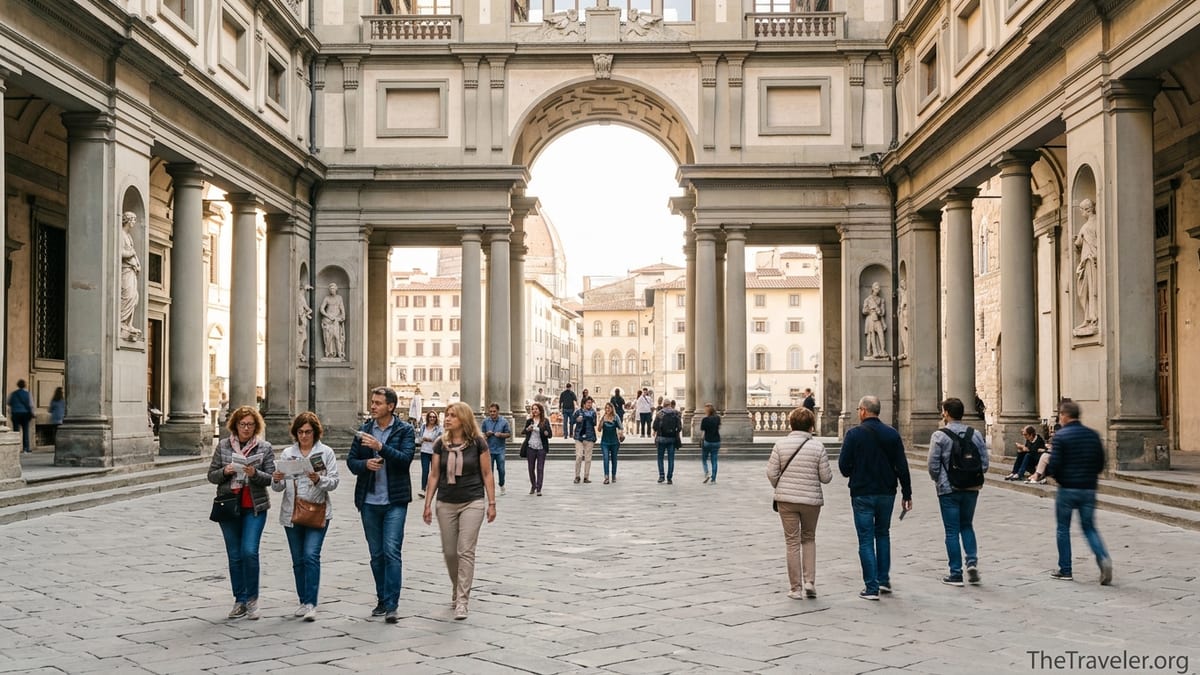
If you imagine a full panorama of Italian Renaissance painting, you are picturing the Uffizi Gallery. Housed in a 16th century Medici office complex beside the Arno, it holds one of the most important collections of Renaissance painting anywhere, from Giotto and Cimabue to Botticelli, Leonardo, Michelangelo and Caravaggio. Walking its long corridors can feel like flipping through the greatest-hits album of European art.
The Accademia Gallery is smaller and laser focused. Historically tied to Florence’s art academy, it is now best known as the home of a single, era-defining masterpiece: Michelangelo’s David, framed dramatically under a skylit dome. Around it are other Michelangelo sculptures, religious paintings and musical instruments, but for most visitors the experience builds to that one encounter.
In practical terms, the Uffizi usually demands more time and energy. Expect at least two to three hours to see the main highlights without rushing, and more if you enjoy lingering. The Accademia, by contrast, can be meaningfully visited in about an hour if your focus is David and the adjacent Michelangelo sculptures, though art lovers often stretch that to 90 minutes or more.
This contrast shapes the kind of impression each museum leaves. The Uffizi often overwhelms with richness and context. The Accademia hits with one distilled emotional punch. Which stays with you longer depends a lot on how you like to experience art.
What You Actually See: Highlights That Stay in Your Memory
At the Uffizi, the emotional center for many visitors is the cluster of Botticelli rooms. In June 2026, the museum unveiled a new arrangement for The Birth of Venus and Primavera, placing the two works in adjoining rooms so that visitors can move between them rather than crowding in one space. This rehang improves sightlines and makes it slightly easier to contemplate the paintings without jostling shoulder to shoulder with dozens of phones held aloft.
Beyond Botticelli, specific moments tend to lodge in memory: the eerie, luminous portraits by Leonardo da Vinci; the muscular Holy Family by Michelangelo; the serene Madonnas of Raphael; and Caravaggio’s dark, theatrical canvases that pull you into the drama of their light and shadow. Many travelers recall the long U-shaped corridor lined with ancient statues and views over the Arno almost as strongly as the paintings themselves.
In the Accademia, memories are more concentrated. You enter a long gallery where Michelangelo’s unfinished “Prisoners” or “Slaves” line the approach to David, figures seemingly struggling to free themselves from rough marble. This slow build-up leads your eye and your emotions to the 5.17 meter David under the central dome. Seeing it in person, with its fine chisel marks, veins suggested under the skin, and the tension in the neck and hands before battle, often provokes a visceral response that reproductions simply do not.
Travelers sometimes describe leaving the Uffizi with a notebook full of artists’ names and references, while leaving the Accademia with one overpowering image: that of David, remembered in physical detail, from the curve of the torso to the scale that makes nearby visitors look almost diminished.
Atmosphere and Crowds: Where You Can Actually Breathe
Both museums are popular, and both require some crowd tolerance. Yet the way crowds feel is not the same. The Uffizi’s long corridors can spread people out, but the star rooms bottleneck sharply. The Botticelli rooms, Leonardo’s works and Caravaggio’s paintings are frequent pressure points, especially in mid-morning. Even with timed tickets, you should expect to maneuver around tour groups and selfie clusters.
The Accademia is more compact, and the flow is easier to understand. Nearly everyone is heading toward David, pausing briefly at the Prisoners. It can be jammed in the central Tribuna where David stands, but because the focus is on a single sculpture, visitors cycle through faster. If you time your visit for the first or last hour of opening, you may manage a few quiet minutes sitting on the benches around David, watching the sculpture in changing light from the skylight above.
Noise levels differ as well. The Uffizi can feel like a low, constant murmur that never quite subsides, broken by the explanations of guides in multiple languages. The Accademia, by contrast, spikes around David but can be surprisingly peaceful in side rooms devoted to late medieval and Renaissance panel paintings or the museum’s small but intriguing collection of musical instruments, including historic violins and cellos connected to the Medici court.
If your idea of a powerful art experience involves some mental space to absorb what you see, the Accademia may have the edge, especially when carefully timed. If you thrive on immersion and do not mind a little chaos for the sake of comprehensiveness, the Uffizi offers more to chew on, even if you never find a truly quiet corner.
Time, Tickets and Money: How Each Fits into a Florence Itinerary
In 2026, ticket prices and booking logistics have become an important part of the Florence museum experience. The official Uffizi ticket structure now encourages later-day visits by offering an afternoon rate, with standard daytime tickets priced higher in peak season and reduced to around 16 euros for entries after 4 p.m. if you buy directly. Third-party resellers and guided tours often cost more but may bundle audio guides or skip-the-line services.
The Accademia’s standard ticket has risen to around 20 euros for adults in 2026. New combined options link the Accademia with the Bargello Museum, whose collection includes important Renaissance sculptures by Donatello and others. These combined tickets can be good value if you are especially interested in sculpture and want to build a themed day around Michelangelo’s David in the morning and the Bargello’s Donatello David or Verrocchio works in the afternoon.
For visitors planning to see both the Uffizi and Accademia, several passes exist. One common solution is a combined Uffizi and Accademia pass or tour, which can run into the high double digits per person once guide and booking fees are factored in. Another is a broader Florence pass that covers Uffizi, Accademia and the Duomo complex for roughly the cost of three individual tickets purchased separately, but with the benefit of pre-booked time slots and a single purchase process.
If you are on a tight budget and must choose, the Accademia offers a shorter, more contained expense: one ticket, roughly an hour of your day, and a clear sense of what you are going for. The Uffizi, while not necessarily much more expensive, asks for more time and energy. When you factor in the opportunity cost of a half day you could otherwise spend exploring neighborhoods, markets or the Oltrarno’s artisan workshops, it becomes clear that the Uffizi is an investment in both euros and hours.
Which Leaves the Bigger Emotional Impact?
Travelers commonly report that the deepest, most personal jolt of emotion comes from the Accademia. Standing at eye level with David’s face, or walking around the sculpture and noticing the tension in his right hand and the subtle twist of the torso, can feel uncannily like encountering a living presence. Many visitors, including those with little prior interest in art, remark on the sense of awe that descends when they realize the scale of the work and the fact that Michelangelo carved it from a single flawed block of marble.
By contrast, the Uffizi’s impact is broader and more cumulative. You may not experience a single lightning-bolt moment, but rather a series of realizations: that Botticelli’s Venus has a delicacy of line you never saw in textbooks, that Caravaggio’s lighting makes you feel almost complicit in his scenes, that Renaissance portraits can reveal as much about class, fashion and religion as any history book. The impression you take away is of a civilization’s visual memory unfolding room after room.
If you are a first-time visitor to Europe, or to major Old Master museums, the Uffizi’s vast sweep may feel like the more important cultural experience. It helps you place Florence in the context of the wider Renaissance. Yet for many travelers, the memory that resurfaces years later, unsummoned, is the look of David from a particular angle, or the feeling of walking up that central aisle between the rough-hewn Prisoners toward the fully liberated figure.
In that sense, the Accademia often wins when the criterion is raw, unforgettable impact, while the Uffizi wins on depth and range. A serious art lover might say that the Uffizi changes how you see Western painting permanently, whereas the Accademia changes how you think about what a single human being can do with stone.
Matching the Museum to Your Travel Style
The choice also depends on your travel style and constraints. If you are in Florence for only one full day, trying to “do it all” can leave you exhausted. In that scenario, the Accademia is often the more sensible pick: it delivers a profound experience in a manageable time, leaving the rest of the day free for wandering the historic center, climbing the Duomo dome, or crossing the Arno to explore quieter streets and piazzas.
For a longer stay of three or more days, the Uffizi becomes easier to justify. You can dedicate a morning to it, ideally with a reserved entry right after opening at 8:15 a.m. or a later slot after 4 p.m. when the special reduced rate sometimes applies. A paced visit with a short coffee break inside the museum cafe and a clear list of must-see rooms can make the experience feel rich rather than overwhelming.
Your personal interests matter too. If you are fascinated by biblical stories, mythology and symbolism in painting, the Uffizi is a treasure chest. If sculpture, the human body and questions of technical mastery interest you more, the Accademia and its associated passes that include the Bargello may fit you better. Families with children or teens who are lukewarm on art often report that the Accademia is the easier sell: one famous piece, strong visuals, and not too much walking.
Finally, consider your tolerance for museum fatigue. Some travelers find that after about 90 minutes of intense looking, everything blends together. If that is you, a shorter, focused visit to the Accademia plus a walk through Florence’s open-air sculpture in Piazza della Signoria and the Loggia dei Lanzi may leave a stronger overall impression than pushing yourself through three hours of masterpieces at the Uffizi when your concentration has already lapsed.
Planning Strategies: How to Make Either Museum Unforgettable
Whichever museum you choose, a little planning can dramatically heighten the impression it leaves. For the Uffizi, book a timed ticket in advance through the official site, then sketch a simple route focused on a handful of anchors: the early Renaissance rooms, the Botticelli rooms, a stop with Leonardo and Raphael, the Michelangelo room, and at least one Caravaggio. Give yourself permission to walk past entire sections more quickly, knowing that you are choosing depth over total coverage.
Consider scheduling the Uffizi early in the day when your mind is fresh, then giving yourself a low-key afternoon in the Oltrarno or the Boboli Gardens. Many visitors find that stepping into open air after an intense museum visit helps the art settle into memory. Even something as simple as an espresso at a modest bar off Piazza della Signoria can become the moment you mentally replay what you just saw.
For the Accademia, timing is everything. Early morning or the last hour before closing usually offer the best chance of less crowded conditions. If you can, resist the urge to photograph David immediately. Walk slowly around the sculpture once or twice, paying attention to details like the slung stone pouch over his shoulder, the tension in the right hand and the asymmetric stance. Only after that, if you wish, take a few photos and then sit for five minutes on a bench just to look.
An effective strategy is to visit the Accademia and then, later that same day, seek out other Michelangelo works in Florence, such as his Medici tomb sculptures in the Medici Chapels. Even if you do not buy a dedicated sculpture pass, merely noticing the echo of his style in churches and squares around the city can reinforce the impression left by David.
The Takeaway
If you are forced to choose, the Accademia Gallery often delivers the bigger, more concentrated emotional impact, especially for travelers who are not seasoned museum-goers. One hour with Michelangelo’s David and the surrounding Prisoners can feel like a revelation, and the experience fits more easily into a packed Florence itinerary.
The Uffizi Gallery, however, is the more transformative choice for those who care deeply about painting, history and the broader story of the Renaissance. It may not hinge on a single artwork, but its cumulative power can permanently change how you read images in churches, books and films for years afterward.
In an ideal world, you would see both: the Accademia for its visceral encounter with human genius in marble, and the Uffizi for its sweeping narrative of how that genius unfolded across centuries and canvases. If time or budget dictates otherwise, decide whether you want one unforgettable face-to-face meeting with David, or a long, demanding conversation with the Renaissance itself. Either way, Florence will leave its mark.
FAQ
Q1. If I only have time for one museum, should I pick the Uffizi or the Accademia?
If you want a single, intense highlight and have limited time, the Accademia is usually the better choice. If you want a broader understanding of Renaissance art and can devote several hours, choose the Uffizi.
Q2. How long should I plan for a visit to each museum?
Most visitors spend about two to three hours at the Uffizi to see key highlights without rushing, and roughly one to one and a half hours at the Accademia, depending on how long they linger with David.
Q3. Which museum is more crowded in 2026?
Both are busy, but the Uffizi’s star rooms can feel more consistently crowded across many galleries. The Accademia’s heaviest congestion is usually around David, with calmer pockets in other rooms.
Q4. Is it worth booking a guided tour instead of a standard ticket?
Guided tours cost more but can add context and help you navigate efficiently. They are especially useful at the Uffizi, where a guide can focus your attention on a curated set of works instead of trying to see everything.
Q5. Are there combined tickets for Uffizi and Accademia?
Yes, there are combined passes and guided tours that include both museums, sometimes along with the Duomo or other sights. These can simplify booking and save time, though they are typically more expensive than individual tickets.
Q6. Which museum is better for visitors who are not very interested in art?
The Accademia is often more appealing for casual visitors, families and those short on attention span. One iconic sculpture, seen up close, is easier to appreciate than many rooms of paintings.
Q7. Can I comfortably visit both museums on the same day?
It is possible to see the Uffizi in the morning and the Accademia in the afternoon, but it makes for an intense, museum-heavy day. Many travelers prefer to split them across two days to avoid fatigue.
Q8. Which museum is better value for money?
Value depends on your interests. The Accademia delivers a concentrated experience for roughly an hour of your time. The Uffizi offers a much larger collection for a similar ticket price but requires more hours and energy to appreciate fully.
Q9. How far in advance should I book tickets?
In peak months, it is wise to book at least one to two weeks ahead for either museum, especially for morning slots or if your travel dates are not flexible. Last-minute tickets sometimes exist but are not guaranteed.
Q10. Is there a best time of day to visit for fewer crowds?
Early morning right after opening and late afternoon toward the last entry times typically have fewer visitors. This is true at both the Uffizi and the Accademia, though it can vary with season and day of the week.