


Few museums shape the way we imagine Italian art quite like the Uffizi Gallery in Florence. Housed in a 16th century Medici office complex overlooking the Arno River, it holds one of the world’s richest collections of Renaissance painting. Yet the Uffizi is not a time capsule. With newly redesigned Botticelli rooms, a reopened Vasari Corridor, and a steady push to improve how visitors experience its masterpieces, it remains a living laboratory for how an art museum can honor the past while speaking to today’s travelers.
Get the latest updates straight to your inbox!
A Medici Power Project That Became a Modern Pilgrimage Site
The Uffizi began life in the 1560s as something very different from a museum. Cosimo I de’ Medici commissioned architect Giorgio Vasari to build new “uffizi,” or offices, for Florence’s magistrates along the riverfront. Above this administrative complex, the Medici family gradually assembled a private gallery of paintings, ancient sculpture, scientific instruments, and curiosities. Over time, what was once a dynastic trophy cabinet became the backbone of one of Europe’s first public art museums when the Medici line ended and their collections passed to the state in the 18th century.
For today’s visitors, that history is not abstract. Walking the long upper corridors, you still move through Vasari’s original U shaped building, with its distinctive gray pietra serena stone and high windows framing the Arno and Palazzo Vecchio. Portrait busts of Roman emperors look down as school groups shuffle past and guides quietly point out details in Italian, English, and Spanish. The architecture is a reminder that the Uffizi is not just a storehouse of famous canvases, but a historic stage on which Florence’s political power and artistic prestige were once performed.
This layered identity helps explain why the Uffizi continues to draw millions of people each year. You are not only seeing individual masterpieces. You are stepping into the setting where the Medici curated an image of themselves as enlightened patrons at the center of European culture. It is that feeling of walking through living history, rather than a neutral white cube, that has kept the Uffizi at the heart of Italy’s museum landscape.
At the same time, planners and curators in Florence know that no institution can rely forever on prestige alone. In recent years they have invested heavily in climate control, security, and redesigned galleries, trying to make sure that the grandeur visitors experience is matched by modern standards of conservation and crowd management.
Where the Renaissance Comes Into Focus Room by Room
What sets the Uffizi apart from many other great art museums is how clearly it traces the story of the Italian Renaissance in a single building. Rather than scattering key works across separate wings, the core itinerary leads you from late medieval altarpieces through early experiments with perspective and naturalism to the high Renaissance summit of Leonardo, Michelangelo, and Raphael.
In practice, this means you might begin your visit in galleries filled with gold ground panel paintings and solemn Madonnas, then turn a corner and suddenly encounter Giotto’s more human figures, already hinting at volume and emotional depth. A little farther on, you arrive at early Renaissance works by Fra Angelico and Filippo Lippi, where faces soften and landscapes begin to recede into believable space. By the time you reach Botticelli, the evolution of style and ideas has become almost tangible.
Travelers often describe this progression as one of the Uffizi’s most powerful experiences. A visitor following a standard 2 to 3 hour itinerary can grasp in a single afternoon how artists moved from symbolic, strictly religious imagery toward a world in which mythological subjects, portraiture, and secular themes took center stage. Few museums make that arc as legible using original artworks rather than reproductions or wall texts.
The museum’s own labels and room groupings increasingly reinforce this narrative. Recent rehanging projects have reorganized works by period and school, so that Florentine paintings speak directly to Venetian and Northern European counterparts nearby. For first time visitors, this means less time puzzling over room numbers and more time feeling how artistic ideas traveled across cities and generations.
Botticelli’s Reimagined Rooms: Why They Still Stop Visitors in Their Tracks
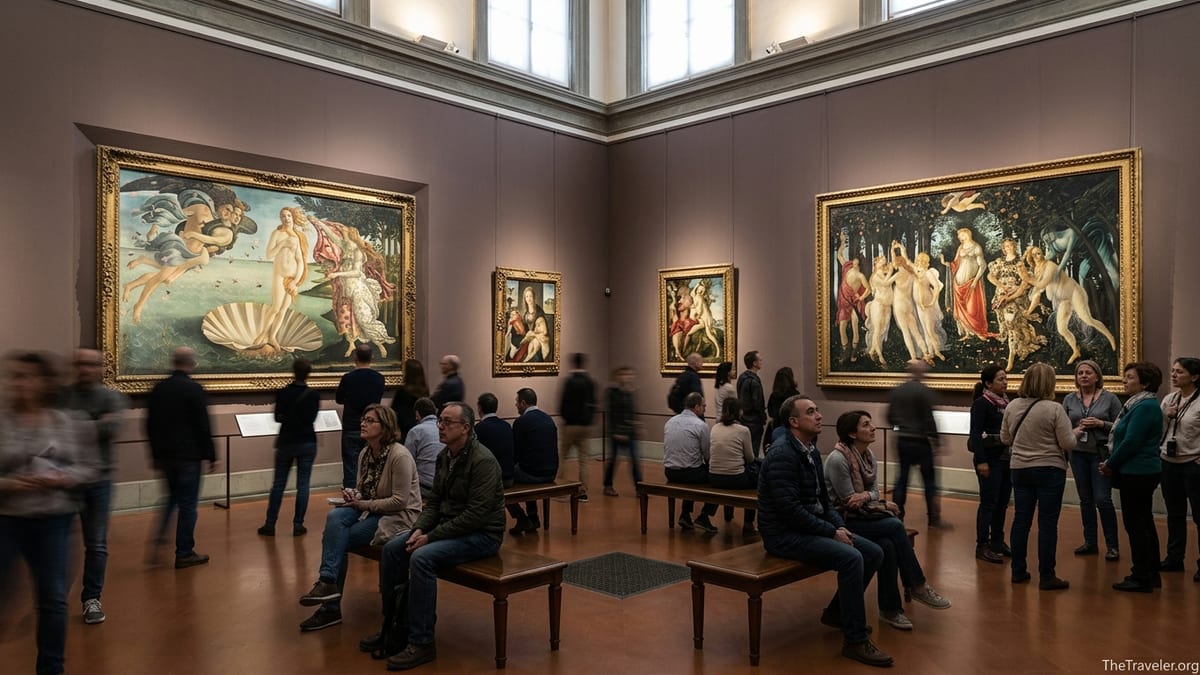
No single artist shapes the popular image of the Uffizi more than Sandro Botticelli. His Birth of Venus and Primavera are not only icons of the museum but emblems of the Renaissance itself, appearing on everything from guidebook covers to silk scarves in the gift shop. In June 2026, the Uffizi unveiled a completely redesigned suite of Botticelli rooms, giving these masterpieces a new setting that underlines just how central they are to the museum’s identity.
In the new layout, the Birth of Venus and Primavera now face one another across adjoining spaces, allowing visitors to pivot between the two mythological visions instead of glimpsing them crowded on the same wall. Updated lighting softens glare on the paintings’ surfaces, while darker wall tones push the pale skin of Venus and the lush greens of Primavera’s orange grove into sharper relief. Benches modeled on 16th century designs invite visitors to sit rather than simply snap a photo and move on.
The redesign goes beyond these two showstoppers. Works such as Botticelli’s Adoration of the Magi, with its Medici family portraits and the artist’s own self portrait, now open the sequence, situating the painter firmly in Florence’s political and social world. Smaller panels like the Stories of Judith and Man with a Medal of Cosimo the Elder have been repositioned in new display cases that slow visitors down and encourage closer looking. The effect is to turn what was once mostly a bucket list stop into a more coherent story about Botticelli’s career and his patrons.
For travelers, these changes have concrete benefits. The rooms feel less like bottlenecks and more like galleries where you can actually spend time. Even on a busy summer afternoon, you are more likely to find a vantage point where you can study the curve of Venus’s shell or the intricate flowers under Flora’s feet without being entirely hemmed in by smartphones. In a museum famous for crowds, that qualitative improvement helps explain why the Uffizi remains at the forefront of Italy’s efforts to rethink blockbuster displays.
Masterpieces You Cannot See This Way Anywhere Else
Beyond Botticelli, the Uffizi’s real strength lies in how many once in a lifetime works it concentrates under one roof. Michelangelo’s Doni Tondo, a circular panel of the Holy Family painted in the early 1500s and still in its original carved frame, is widely regarded as the artist’s only fully finished easel painting. Standing a few feet away, you see Michelangelo translating his sculptural sense of anatomy into color and light, an encounter simply not possible at other museums that mainly hold his drawings or sculptures.
Nearby, rooms dedicated to Leonardo da Vinci, Raphael, and Titian offer similarly rare moments. Early works by Leonardo, such as the Annunciation, show him experimenting with atmosphere and landscape in ways that quietly revolutionized European painting. Raphael’s Madonna of the Goldfinch and portraits of Florentine elites represent another high point, balancing ideal beauty with psychological insight. Titian’s sensual altarpieces and portraits, meanwhile, exemplify the Venetian love of rich color and painterly surface.
The Uffizi’s Baroque holdings are equally distinctive. Caravaggio’s Medusa, painted on a convex wooden shield, confronts viewers with the frozen horror of decapitation, the figure’s mouth contorted in a scream. Seeing it in person, you understand the painting as both artwork and object, with its unusual support curving away from the wall. In another room, Northern European painters such as Dürer and Rembrandt anchor a different strand of the story, showing how Italian innovations were absorbed and transformed beyond the Alps.
For many travelers, the impact of so many singular works hits home when they start recognizing images from textbooks and posters in rapid succession. One Canadian visitor recently described emerging from the central Renaissance galleries feeling as if she had “walked through the index of an art history book.” That density of canonical masterpieces is part of what keeps the Uffizi on itineraries even for travelers with limited time in Florence.
A Museum Learning to Manage Crowds and Enhance the Visit
Popularity presents its own challenges, and the Uffizi has not been immune to complaints about long lines and crowded rooms. In response, the museum has steadily adjusted ticketing policies and opening strategies. As of early 2026, standard tickets purchased directly from the museum rise in price for entry from late afternoon, reflecting the push to spread visits across the day and encourage better use of quieter morning slots, especially in winter and shoulder seasons.
For travelers deciding when and how to visit, this shift makes planning more important but also more rewarding. Booking a timed entry in advance for an early morning slot can mean moving relatively freely through even the busiest rooms. In spring and summer, the museum sometimes introduces special evening openings or free entry days tied to national holidays, which can create either wonderful low key experiences or very busy atmospheres depending on demand. Checking current schedules shortly before travel is increasingly a key step in any Florence itinerary.
Inside the building, recent projects have focused on comfort and information rather than spectacle alone. New climate systems help protect fragile works from humidity and temperature swings, while updated lighting and bilingual labels make it easier to appreciate subtle details. Solid wood benches inspired by Vasari’s designs now line the corridors, offering much needed rest points on what can easily become a three hour visit. Many independent guides now encourage visitors to plan a pause in the café or on the terrace overlooking Piazza della Signoria before reentering the galleries.
These practical improvements might seem minor compared to a new blockbuster loan exhibition, but for repeat visitors they are precisely what makes the Uffizi feel contemporary. Instead of relying on the magnetism of its collection alone, the museum is investing in a smoother, more legible experience that respects both the artworks and the people who have come to see them.
The Vasari Corridor and the Uffizi’s Expanding Footprint
One of the most intriguing reasons the Uffizi continues to stand out is its relationship with the city around it. The recently reopened Vasari Corridor, a 16th century elevated passage linking the Uffizi to the Pitti Palace across the river, physically embodies that connection. Originally built so the Medici could move between their palace and government offices without mingling with the public, the corridor now offers glimpses down into the streets and across rooftop gardens that few visitors ever see.
After a long closure for safety and renovation work, the corridor reopened to the public in late 2024 with a renewed focus on the architectural experience rather than dense hanging of paintings. While access is controlled and typically requires a separate timed ticket or guided visit, the route has quickly become a highlight for travelers interested in both art and urban history. Emerging near the Boboli Gardens on the Oltrarno side of Florence, visitors understand in a visceral way how the Uffizi functions not just as a building but as a hinge between different parts of the city.
The museum has also been gradually redistributing parts of its enormous collection through satellite initiatives across Tuscany, allowing lesser known works to be seen in smaller towns rather than stored in reserve rooms. While these “diffused” projects are mainly of interest to repeat visitors and regional travelers, they underline how the Uffizi is thinking beyond its own walls. The main gallery remains the flagship, but its curators increasingly see it as part of a wider cultural network.
For international visitors on a tight schedule, this broader ecosystem still translates into simple, concrete choices. You might pair a morning at the Uffizi with an afternoon walk through the Oltrarno, catching exterior views of the corridor’s arches as they cross the river, or add a guided corridor visit to immerse yourself in Medici era Florence. In each case, the museum acts as both destination and springboard for exploring the city’s layers.
Planning a Visit: What Travelers Can Expect on the Ground
While the Uffizi’s art historical importance is indisputable, what keeps it among Italy’s greatest museums is how it continues to adapt to real traveler behavior. Most visitors today encounter the gallery as part of a larger Florence stay that might also include the Duomo, Accademia, and Pitti Palace. Recognizing this, many local guides and tour operators now build tailored half day Uffizi experiences, focusing on key works instead of racing through every room.
For independent travelers, a realistic strategy often involves choosing a focus. One popular approach is to spend an hour in the early Renaissance rooms, another hour in the Botticelli and high Renaissance galleries, and then pick one additional area such as Northern European painting or Caravaggio and the Baroque. This kind of selective visit reflects the museum’s own shift toward better organized thematic and chronological groupings, making it easier to dip in and out without feeling completely lost.
On the practical side, travelers should expect airport style security at the entrance, including bag scans and potential waiting times even with reservations during peak season. Inside, photography without flash is generally permitted, which contributes to the constant background hum of shutter clicks but also lets visitors record personal moments in front of favorite works. Food and drink are limited to designated café areas, so planning short breaks during a longer visit helps maintain energy and attention.
Crucially, the Uffizi has invested in multilingual signage and visitor information, which means English speaking travelers no longer have to rely solely on guidebooks or paid audio guides to understand what they are seeing. Combined with increasingly clear online information about ticket types, opening hours, and temporary closures, this makes the museum more navigable even for first time visitors who have done only basic pre trip research.
The Takeaway
The Uffizi Gallery endures as one of Italy’s greatest art museums not simply because it owns famous paintings, but because it continues to refine how those works are presented and understood. From the newly reimagined Botticelli rooms and the rare presence of a finished Michelangelo panel to the reopened Vasari Corridor and improved visitor flow, the gallery shows a willingness to evolve without losing sight of its Medici roots.
For travelers, that combination of deep history and active renewal is what makes the Uffizi more than a compulsory stop on a Florence checklist. It is a place where you can feel the Renaissance unfold room by room, where the architecture itself tells a political story, and where curators are actively rethinking how best to share an extraordinary collection with the world. As long as it keeps balancing preservation with experimentation, the Uffizi will remain not only a cornerstone of Italian culture but a benchmark for what a great art museum can be.
FAQ
Q1. How much time should I plan for a visit to the Uffizi Gallery?
Most visitors find that 2 to 3 hours is enough to see key highlights without rushing, though serious art lovers can easily spend half a day. Building in a short break at the café or terrace can make a longer visit more enjoyable and help prevent fatigue.
Q2. When is the best time of day to visit to avoid the biggest crowds?
Mornings right after opening and later afternoon slots outside peak season are often less congested than late mornings and mid day. In high summer, even early times can be busy, so reserving a timed ticket and arriving a bit before your slot usually improves the experience.
Q3. Do I need to book tickets in advance, or can I just show up?
While same day tickets are sometimes available, especially in the off season, advance reservations are strongly recommended. Timed tickets help you avoid the longest lines and are particularly important on weekends, holidays, and during spring and summer when Florence is busiest.
Q4. What are the absolute must see works if I am short on time?
If you have limited time, prioritize Botticelli’s Birth of Venus and Primavera, Michelangelo’s Doni Tondo, key paintings by Leonardo and Raphael, and Caravaggio’s Medusa. Most guided tours are built around these works because they represent crucial moments in the story of Renaissance and Baroque art.
Q5. Is the Uffizi suitable for children or travelers new to art history?
Yes, especially if you keep the visit focused and relatively short. Many families choose to highlight mythological scenes, dramatic works like Medusa, and portraits of historical figures rather than trying to see everything. Short stories from guides or children’s activity books can help younger visitors connect with what they are seeing.
Q6. Are there guided tours available inside the Uffizi?
A range of options exists, from small group tours led by licensed local guides to private visits focused on specific themes. Booking a tour can be particularly valuable for first time visitors, as a guide can help navigate the layout, explain context, and make sure you see the most important works within your available time.
Q7. What should I wear and bring with me to the museum?
Comfortable walking shoes are essential, as you will likely be on your feet for several hours. Light layers work best in most seasons, and a small bag or daypack is usually allowed, though larger items may need to be checked. Bringing a refillable water bottle to use outside the gallery areas is also practical in warmer months.
Q8. Is the Uffizi accessible for visitors with reduced mobility?
The museum has been working to improve accessibility, with elevators and step free routes in key areas, but some parts of the historic building can still pose challenges. Travelers with mobility concerns are encouraged to check the latest accessibility information before visiting and to allow a bit of extra time for moving between floors and wings.
Q9. Can I take photos inside the Uffizi Galleries?
In most cases, photography without flash is permitted for personal use, though tripods and professional equipment are typically not allowed. It is always wise to respect signage and staff instructions in individual rooms, as occasional restrictions may apply to specific works or temporary exhibitions.
Q10. How does the Uffizi compare to other major Italian museums like the Vatican Museums?
The Uffizi is more focused on painting and the development of the Renaissance, whereas the Vatican Museums combine ancient sculpture, frescoed rooms, and the Sistine Chapel. Many travelers describe the Uffizi as more concentrated and easier to grasp in a single visit, with a particularly clear narrative connecting its most famous works.