


More news on this day
The United Kingdom has tightened its travel warnings across parts of the Middle East following a fresh escalation in regional conflict, advising citizens to reconsider non-essential trips and prepare for significant disruption to air travel and consular support.
Get the latest news straight to your inbox!
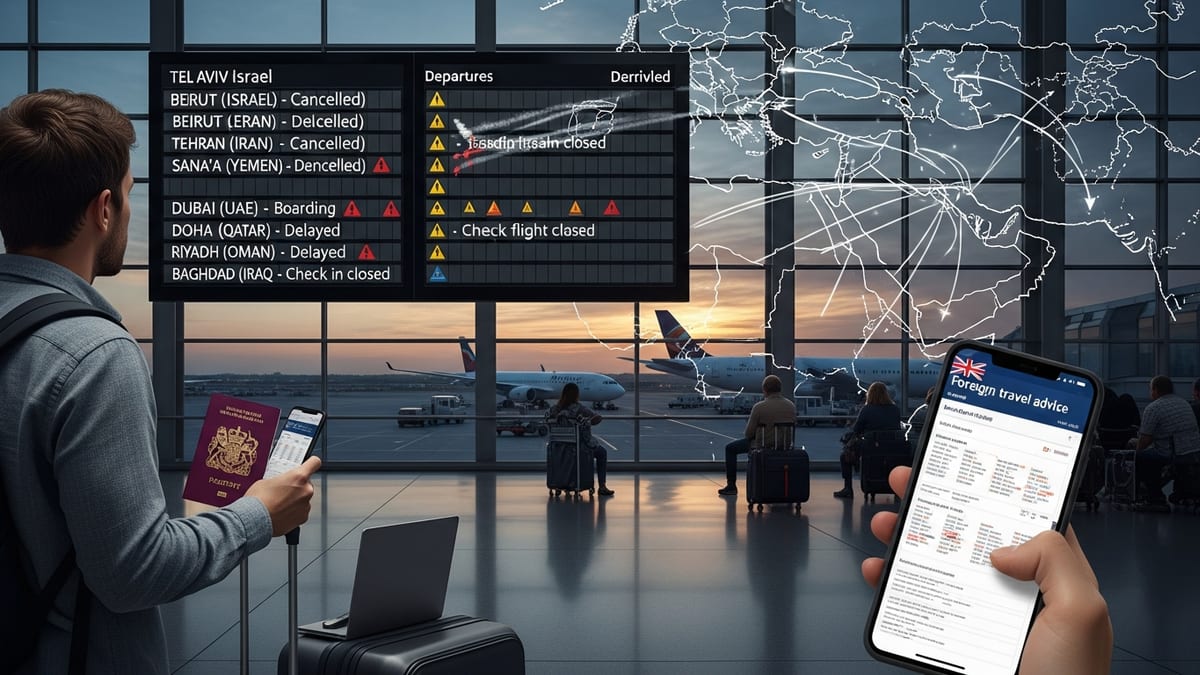
Foreign Office Raises Risk Levels Across the Region
Updated Foreign, Commonwealth and Development Office travel advisories indicate a more cautious stance on journeys to and through the Middle East, with stronger wording on security risks and disruption. The latest Israel guidance, revised on 28 October 2026, maintains advice against all travel to Gaza and highlights the possibility of rapid changes to border arrangements and air links across the wider region.
The same Israel notice stresses that British nationals travelling anywhere in the Middle East should be prepared for flight cancellations, airspace closures and short-notice changes to itineraries. It underlines that travel insurance may be invalidated if people enter areas against official advice, a key consideration for anyone weighing work trips, family visits or religious travel.
Separate FCDO pages covering neighbouring states, together with insurance industry briefings, show that advice for several Gulf and Levant destinations has been tightened since renewed conflict involving Iran and its regional allies. Publicly available summaries from travel insurers note that they now cross-check cover against the latest country-by-country warnings, particularly for Bahrain, Kuwait, Jordan, Oman, Qatar and the United Arab Emirates.
Travel organisations in the UK are steering customers towards the official foreign travel advice pages as the definitive reference for current restrictions. Industry guidance circulated in response to the crisis urges travellers to monitor advisories throughout their trip rather than relying only on the status at the time of booking.
Saudi Arabia Moves to ‘Essential Travel Only’ as Airports Targeted
Saudi Arabia has become a focal point of the UK’s tightened approach after missile and drone attacks this month on King Khalid International Airport in Riyadh prompted widespread flight cancellations and security concerns. Public reporting on the incident states that hundreds of services were halted after strikes on 6 and 7 October 2026 caused casualties and damage at the airport.
Following those attacks and subsequent warnings from armed groups about the use of Saudi airspace, updated UK travel advice now categorises the entire country as suitable for essential travel only, with a separate warning against any trips within 10 kilometres of the border with Yemen. Consumer travel bodies reporting on the change say this is a broadening of earlier, more geographically limited guidance.
Coverage by regional travel media on 28 October notes that the shift in UK advice has coincided with extended route suspensions by several international airlines serving Riyadh and other Saudi cities. While the airport has partially reopened, schedules remain heavily curtailed as carriers reassess overflight risk and ground handling capacity.
The combination of heightened security concern and “all but essential travel” wording has immediate effects for UK leisure visitors, religious pilgrims and business travellers. Accounts shared via travel forums and advisory services suggest that some employers are cancelling assignments to Saudi Arabia, citing duty-of-care obligations where official guidance advises against non-essential trips.
Flight Cancellations and Rerouting Ripple Through the Middle East
The sharper UK travel warnings come as airlines continue to adjust their networks across the Middle East. Recent statements from European carriers indicate ongoing cancellations and rerouting around affected airspace, even for destinations not directly involved in the latest incidents. Some operators have announced that flights to Tel Aviv, Dubai, Riyadh and Dammam will remain suspended well into 2026, reflecting a cautious approach to security and insurance requirements.
Industry digests on the conflict’s impact describe a patchwork of partial recoveries and renewed suspensions. While certain Gulf hubs have seen services gradually restored since earlier escalations, fresh disruption linked to the attacks in Saudi Arabia and concerns over Iranian-controlled airspace has slowed that recovery. Airlines are balancing strong passenger demand with higher operating costs tied to longer routings and fuel burn.
Travellers connecting between the UK and Asia, Africa or Australasia via Middle Eastern hubs are among those most affected. Guidance from the UK Civil Aviation Authority in recent months has urged passengers to confirm flight status with their airline before leaving for the airport and to stay alert to rebooking offers or schedule changes, especially on routes that typically cross Gulf or Iranian airspace.
Tourism and aviation analysts tracking capacity data suggest that, despite a gradual rebound from earlier pandemic and conflict shocks, overall traffic through key regional hubs is likely to remain below forecast for the remainder of 2026. The evolving UK advisories are one of several factors shaping how quickly airlines restore frequencies and how confident travellers feel about transiting the region.
Knock-on Effects for Insurance, Packages and Religious Travel
The tightening of UK travel warnings has direct consequences for insurance cover. Policy documents reviewed by travel news outlets emphasise that many standard leisure policies will not pay out for trips taken into areas where government advice is to avoid all or all but essential travel. Insurers are updating public FAQs on the Middle East conflict, pointing customers to the specific Foreign Office page for each destination before purchase.
Specialist providers cite current guidance for countries such as Bahrain, Kuwait, Jordan, Oman, Qatar and the United Arab Emirates when outlining what is and is not covered. For destinations where no warning against non-essential travel is in place, policies may still respond to disruption, though exclusions often apply to known events or pre-existing unrest. Where the UK advises against travel, insurers may refuse new cover altogether or limit benefits to emergency assistance only.
Package tour operators and travel agents in the UK are also revisiting their terms in light of the latest advisories. Trade organisations state that, when the government moves a destination into an “advise against travel” category, customers on package holidays generally gain stronger rights to rebook or cancel without penalty. However, travellers who assembled their own itineraries using separate flights and accommodation may find they have fewer statutory protections and must rely on individual supplier policies.
The stricter stance has particular resonance for religious travel, including pilgrimages to Saudi Arabia and visits to sites in Israel and the Palestinian territories. Reports from community travel agencies describe a surge in calls from clients concerned about whether long-planned trips can go ahead, and under what conditions refunds might be available. Many providers are encouraging travellers to wait for airline decisions or further Foreign Office updates before making final choices.
What UK Travellers Should Watch in the Coming Weeks
Publicly available government and industry briefings emphasise that the situation across the Middle East remains fluid, with the potential for further escalation or de-escalation shaping travel possibilities. The Foreign Office continues to adjust country pages as events evolve, sometimes making multiple changes within a short period, which can affect cover, employer risk assessments and airline operations.
Travel experts recommend that anyone with imminent plans involving the region monitor advisories for both their final destination and any transit points. This includes checking for new restrictions on land borders, ferry routes or key airports, as well as considering alternatives that avoid the most affected areas. For many itineraries, this could mean routing via non-Middle Eastern hubs, even if journey times and ticket prices increase.
British nationals already in countries where advice has tightened are being urged, in publicly available guidance, to stay in close contact with their travel provider, monitor local news and register contact details where possible. Consular-focused organisations, such as humanitarian agencies working with UK authorities, have published telephone numbers and online forms to assist people trying to reach friends and family in Israel, Gaza, the West Bank or Lebanon.
With no clear timeline for a comprehensive regional ceasefire, the UK’s upgraded Middle East travel warnings are expected to remain under close review. Travellers making plans for late 2026 and early 2027 are being advised to factor in the possibility of sudden changes and to build flexibility into bookings, while keeping a close eye on how official advisories evolve.