


More news on this day
The United Kingdom has tightened parts of its travel guidance for Saudi Arabia as airlines extend suspensions and reroute flights across the Gulf, compounding weeks of disruption for passengers trying to reach key hubs and pilgrimage sites amid continuing regional tensions.
Get the latest news straight to your inbox!
UK travel advice reflects shifting security picture
Recent updates to the UK Foreign, Commonwealth & Development Office guidance for Saudi Arabia highlight what public information describes as a fast-moving security environment across parts of the Gulf. The changes follow months of missile and drone activity around strategic locations in the region and intermittent airspace restrictions that have affected both direct and connecting services.
According to publicly available UK government material and independent trackers that log amendments to foreign travel pages, references to regional tensions and spillover risks from nearby conflicts have been strengthened over the course of 2026. The advice reiterates long-standing warnings about areas near the Yemen border, while drawing fresh attention to the potential for further attacks that could affect airports, seaports and overflight corridors used by commercial carriers.
The language encourages British nationals to stay alert to fast-changing flight conditions, monitor commercial airline communications and be prepared for significant last‑minute changes to itineraries. Travellers are also urged, through various official preparedness documents, to think ahead about contingency plans, including how they would cope with extended delays or diversions if routes through Gulf hubs became unavailable.
Analysts note that these updates align the UK position with a wider pattern of advisories from European and Asia‑Pacific governments, several of which now urge caution or explicitly discourage non‑essential travel to certain Gulf states or border regions while hostilities in and around Iran continue.
Airlines prolong suspensions and reroute around the Gulf
Airlines headquartered in Europe and Asia are progressively lengthening the period of their suspensions or restrictions on flights serving Gulf destinations, as operational uncertainty persists. Recent industry coverage indicates that carriers such as Air France, KLM and a number of Asian airlines have extended pauses on services to hubs including Riyadh, Dubai, Doha and Kuwait City, or are operating with sharply reduced frequencies.
Several network airlines continue to avoid the airspace of Iran, Iraq and Israel and are limiting routings over parts of the Gulf. This has resulted in longer flight times, aircraft needing additional fuel stops and more complex crew scheduling. Airline advisories show that services which do operate are often subject to short‑notice timing changes, while some routes are temporarily shifted to secondary airports judged to be less directly exposed to current security concerns.
Low‑cost and leisure carriers are also affected. Regional reporting from Southeast Asia has highlighted extended cancellations on routes linking Singapore with Jeddah, underscoring how disruption is impacting not only traditional Gulf transfer markets but also point‑to‑point traffic for religious and labour travel. Industry analysts describe a patchwork of suspensions and resumptions that can change within days, depending on assessments of airspace risk and the availability of war‑risk insurance cover.
Airline statements reviewed by travel media typically stress that safety considerations are guiding decisions and that schedules will be restored when conditions permit. For passengers, however, the staggered nature of these changes has created a sense of ongoing uncertainty, with some learning of new cancellations only shortly before departure.
Saudi corridor remains critical but constrained
Despite the wider turmoil, Saudi Arabian airspace has taken on renewed importance as one of the few east‑west corridors that has remained largely open for controlled overflight. Corporate travel and mobility bulletins describe this as an unprecedented strain on air traffic management, as long‑haul services that previously routed through Iran or the upper Gulf are funneled along narrower lanes skirting conflict zones.
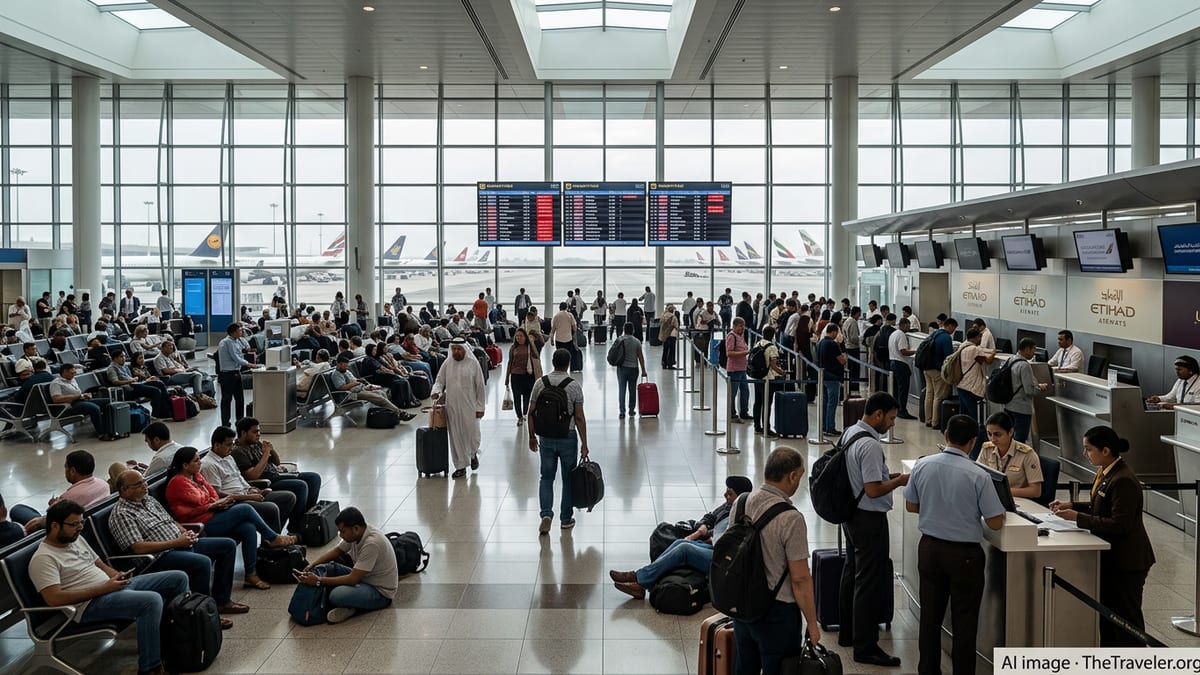
This role as a remaining corridor has not insulated Saudi Arabia and its neighbours from knock‑on disruption. Reports from aviation consultancies and immigration trackers point to heavy congestion at key Saudi airports and periodic flow restrictions as controllers balance safety margins with the surge in through‑traffic. Domestic operations and point‑to‑point international flights into Riyadh, Jeddah and Dammam have, at times, faced delays linked to the added complexity in surrounding airspace.
The UK’s updated guidance for travellers heading to or transiting Saudi Arabia reflects this dual reality: the country functions as a vital link in global aviation at a time when alternative routings are limited, yet it sits adjacent to areas where missile and drone incidents continue to be recorded. Travellers are encouraged by public information sources to remain flexible, keep documents and personal essentials with them in hand luggage, and prepare for potential overnight stays if onward connections are disrupted.
Travel management firms advise corporate clients to treat trips via Saudi hubs as higher risk from an operational standpoint, if not necessarily from a direct personal security perspective, and to maintain active monitoring of flight status up to and including the day of departure.
Pilgrims and expatriates face prolonged uncertainty
The timing of the disruptions has been particularly challenging for religious travellers and expatriate communities with strong ties to Saudi Arabia and neighbouring states. Earlier in the year, regional news coverage documented tens of thousands of foreign nationals left in limbo as airports across the Gulf curtailed normal operations during peak pilgrimage flows and school holiday travel.
Many of those affected were heading to or from holy sites in Mecca and Medina, often with tightly scheduled tour packages or limited visa validity. When flights were cancelled or rerouted, some groups found themselves scattered across alternative hubs with few clear options to rebook at short notice. Consumer advocates note that while airlines introduced flexible change policies and fee waivers, the sheer volume of disruption made it difficult to secure timely alternatives.
For the large expatriate populations based in Saudi Arabia, Qatar, the United Arab Emirates and Bahrain, extended flight suspensions have complicated routine travel for work rotations, family visits and medical appointments. Travel insurers and legal advisers have reported increased inquiries from policyholders seeking clarification on coverage where trips have been abandoned or substantially altered due to airspace closures and government advisories.
British nationals residing in the region, estimated by public sources to number in the hundreds of thousands, are being urged through general guidance documents to keep their contact details up to date with consular services and to have contingency plans in place in case commercial options narrow further.
What UK travellers should do now
For UK travellers contemplating journeys to Saudi Arabia or onward connections through Gulf hubs, industry and government guidance converge on several practical steps. Prospective passengers are encouraged to check the latest version of the UK foreign travel advice immediately before booking and again shortly before departure, as advisories have been updated multiple times in recent months in response to changing conditions.
Airline and airport notifications have become an essential reference point. Major carriers invite passengers to register mobile numbers and email addresses, enabling them to receive real‑time schedule updates and gate information. Travel agents and online booking platforms similarly recommend that customers monitor their reservations through dedicated apps, which often show aircraft routings and anticipated delays once flight plans are finalized.
Travel specialists indicate that flexible booking conditions and comprehensive insurance cover are more important than ever for trips involving the Gulf. Policies that allow for date changes, rerouting or cancellation in response to new government advice can help reduce financial exposure, although travellers are advised to study terms closely to understand the distinction between formal restrictions and general security warnings.
As the regional situation remains fluid, observers expect the UK’s Saudi travel advice and airline schedules across the Gulf to continue evolving through the coming weeks. For now, passengers planning to use Saudi Arabia as a destination or transit point are being urged to combine heightened situational awareness with generous time buffers and backup plans in case the aviation picture shifts once again.