


More news on this day
The United Kingdom’s drive to digitalise its railways with the European Train Control System (ETCS) is entering a pivotal phase in 2026, as ambitious signalling plans collide with the slower, more complex task of fitting thousands of trains and managing rising costs across the network.
Get the latest news straight to your inbox!
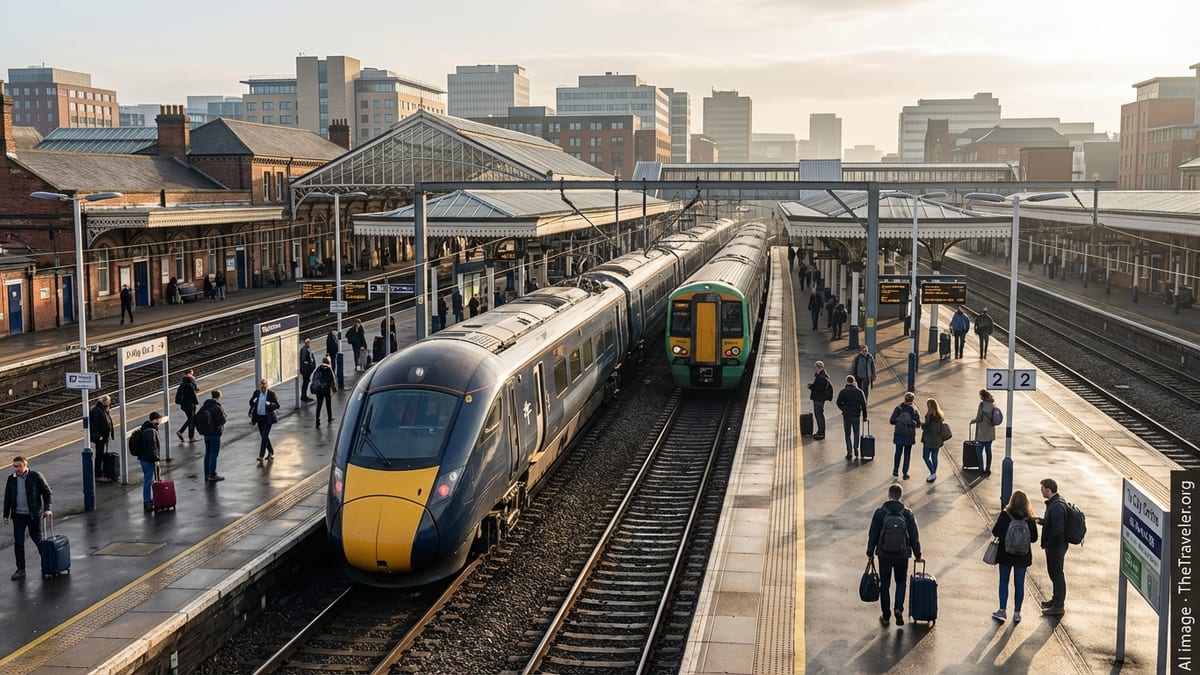
Digital rail vision meets 2026 delivery reality
ETCS lies at the heart of the UK’s Digital Railway strategy, intended to replace a patchwork of ageing lineside signals with in-cab displays that allow closer running of trains, more reliable timetables and lower lifetime maintenance costs. Network Rail’s long-term deployment plan sets out a progressive switch to digital signalling, prioritising busy main lines and key commuter corridors where capacity gains are greatest and conventional renewals are due.([networkrail.co.uk](https://www.networkrail.co.uk/our-work/digital-railway/digital-railway-strategy/digital-railway-long-term-deployment-plan/?utm_source=openai))
Publicly available information shows that the East Coast Digital Programme (ECDP) on the southern section of the East Coast Main Line remains the flagship scheme. It is designed to be the first deployment of ETCS on a busy mixed-use intercity main line, building on earlier UK experience on the Cambrian line and within the Thameslink core. First ETCS-operated passenger trains on parts of the East Coast Main Line are expected to run during 2026, marking a high-profile test of the country’s digital ambitions.([networkrail.co.uk](https://www.networkrail.co.uk/our-work/our-routes/east-coast/east-coast-digital-programme/?utm_source=openai))
Yet official planning documents and oversight reports emphasise that in this control period, stretching to 2029, progress will depend as much on equipping rolling stock as on upgrading trackside equipment. Network Rail identifies ETCS as its preferred signalling solution for future renewals, but stresses that infrastructure delivery must be synchronised with train fitment and operational change, otherwise new digital sections risk remaining underused.([networkrail.co.uk](https://www.networkrail.co.uk/wp-content/uploads/2024/11/2026-Network-Statement.pdf?utm_source=openai))
The government’s wider move toward Great British Railways, intended to bring infrastructure and operations under a single guiding mind, is emerging alongside this transition. Industry watchers note that digital signalling is seen as a key tool in delivering a more integrated, timetable-led railway, but in 2026 the policy aspiration still faces day-to-day engineering and funding constraints.([networkrail.co.uk](https://www.networkrail.co.uk/our-work/digital-railway/digital-railway-strategy/?utm_source=openai))
Train fitment becomes the critical bottleneck
Equipping the UK’s diverse fleet of passenger and freight trains with ETCS is proving more complicated than early projections suggested. Evidence submitted to Parliament in previous years highlighted that Britain would rely heavily on retrofitting existing rolling stock, a level of modification on this scale not seen elsewhere in Europe. Industry submissions warned that a robust, industry-agreed plan for cab fitment would be essential if the Digital Railway timetable was to be achieved.([committees.parliament.uk](https://committees.parliament.uk/writtenevidence/66222/html/?utm_source=openai))
Recent oversight data underline how those concerns have carried into the current decade. A 2024 to 2025 UK infrastructure assurance report flags vehicle fitment as a key risk to managing the overall cost of the East Coast Digital Programme, alongside the price of ETCS trackside works. Regulators also record adjustments to spending plans in Control Period 7, with Network Rail updating forecasts to reflect reduced and re-phased passenger fleet fitment costs as the industry learns how to deliver modifications more efficiently.([gov.uk](https://www.gov.uk/csv-preview/6895fbb63080e72710b2e2ef/nista_annual_report_data_2425.csv?utm_source=openai))
On the ground, fitment is now visible across a growing range of fleets. Interoperability authorisation data compiled by the Office of Rail and Road for 2026 show additional suburban and regional units cleared for onboard ETCS, including upgrades on commuter stock into London. Separate public updates from the East Coast Digital Programme highlight fitment under way on iconic High Speed Train sets, with all units on one operator’s route targeted for completion by mid-2026 to support forthcoming digital operations.([orr.gov.uk](https://www.orr.gov.uk/guidance-compliance/rail/health-safety/laws/interoperability/authorisations?utm_source=openai))
These trains join earlier adopters such as Thameslink’s Class 700 units and Crossrail’s ETCS-equipped trains, which have already demonstrated the technology in service on limited sections of the network. However, with thousands of vehicles still to be modified or replaced, the pace of cab fitment remains the defining factor in how quickly future digital corridors can move beyond pilot operation to routine, network-wide use.([en.wikipedia.org](https://en.wikipedia.org/wiki/European_Train_Control_System?utm_source=openai))
Cost pressures and programme phasing reshape ambitions
Funding pressures are reshaping how and where ETCS is introduced. Earlier assessments of the Digital Railway highlighted that cab fitment programmes had already suffered delays and cost increases, complicating attempts to keep the national roll-out aligned with signalling renewals. In evidence to Parliament, suppliers pointed to reduced funds for early cab fitment compared with initial plans, warning that greater uncertainty could deter long-term investment by the supply chain.([publications.parliament.uk](https://publications.parliament.uk/pa/cm201617/cmselect/cmtrans/67/6705.htm?utm_source=openai))
More recent regulatory advice on the 2024 to 2029 funding period confirms that the government and Network Rail have adjusted expectations further. The Office of Rail and Road reports that Network Rail’s updated plans include a reduction of around 200 million pounds in projected passenger fleet fitment costs for Control Period 7, driven by revised inflation assumptions and changes to deployment phasing. Regulators judge this rebalancing reasonable, but it highlights the degree to which ETCS delivery is being actively rescheduled to match available budgets.([orr.gov.uk](https://www.orr.gov.uk/sites/default/files/2023-08/30-pr23-further-supplementary-advice-central-costs-uk-government.pdf?utm_source=openai))
Spending plans now emphasise targeted development of new schemes on corridors such as the Midland Main Line, Brighton Main Line and sections of the Great Western network, alongside continued work on the East Coast and completion of earlier programmes in Wales. Network Rail’s published approach to digital signalling notes that some fleet-related activities have already taken longer than planned as requirements have been refined, and that further technical capability and industry-wide skills are still being developed to support complex retrofits.([networkrail.co.uk](https://www.networkrail.co.uk/wp-content/uploads/2025/07/Our-approach-to-Digital-Signalling-Year-2-update.pdf?utm_source=openai))
Elsewhere, timelines for digital upgrades feed into broader, multi-billion pound enhancement programmes. On the Transpennine Route Upgrade, which combines electrification, capacity works and signalling renewal between Manchester and York, official material points to ETCS deployment later in the 2030s, reflecting a longer horizon for full digital operation even as early elements of the infrastructure are delivered this decade.([reddit.com](https://www.reddit.com/r/GoodNewsUK/comments/1q6a6gj/transpennine_route_upgrade_look_back_on_2025_as/?utm_source=openai))
Operational change and passenger impact on future networks
Beyond technology and budgets, the shift to ETCS is triggering wide-ranging operational change. The East Coast Digital Programme is described in government documents as involving a major transformation in working practices, requiring new processes for drivers, signallers and maintenance teams alongside technical upgrades. Reports indicate that migration to signals-free operation on certain commuter routes into London will demand extensive training and updated rule books before conventional signals can be fully removed.([gov.uk](https://www.gov.uk/government/publications/department-for-transports-accounting-officer-assessment-summaries-for-the-government-major-projects-portfolio/east-coast-digital-programme-accounting-officer-assessment-july-2020?utm_source=openai))
Early digital deployments, particularly on Thameslink and the Northern City Line, have already shown how in-cab signalling can support higher frequencies through congested city cores. Network Rail’s strategy documents promote these schemes as proof that capacity and punctuality benefits are achievable when infrastructure, train fitment and operating practices are aligned. The aim is that, once fully implemented, ETCS will help unlock more trains per hour on key intercity and commuter corridors without major new track construction.([networkrail.co.uk](https://www.networkrail.co.uk/our-work/digital-railway/digital-railway-strategy/digital-railway-long-term-deployment-plan/?utm_source=openai))
For passengers, the most visible changes on future digital routes are likely to be more consistent timetables and fewer disruption-related delays, rather than the technology itself. However, the transition period can be complex, as sections of route operate with mixed signalling systems and operators manage rolling stock rotations between fitted and unfitted trains. Industry commentary suggests that a carefully managed migration strategy will be critical to retaining public confidence during this multi-year changeover.([gov.uk](https://www.gov.uk/csv-preview/6895fbb63080e72710b2e2ef/nista_annual_report_data_2425.csv?utm_source=openai))
As 2026 progresses, the UK’s ETCS projects are increasingly framed as long-term investments in network resilience and efficiency rather than short-term transformations. With flagship schemes approaching first digital operations, but large-scale train fitment and further corridors still to follow into the 2030s, the coming years will test whether the United Kingdom can maintain political support, funding and industrial capability for what remains one of Europe’s most ambitious railway modernisation programmes.([networkrail.co.uk](https://www.networkrail.co.uk/our-work/digital-railway/digital-railway-strategy/digital-railway-long-term-deployment-plan/?utm_source=openai))
Network Rail Digital Railway Strategy
Network Rail East Coast Digital Programme
UK Government assessment of the East Coast Digital Programme