


More news on this day
United Airlines is sharpening San Francisco International Airport’s role as a premium travel hub, rolling out new superpremium aircraft and expanded Polaris-branded service on routes linking the Bay Area to major global business centers.
Get the latest news straight to your inbox!
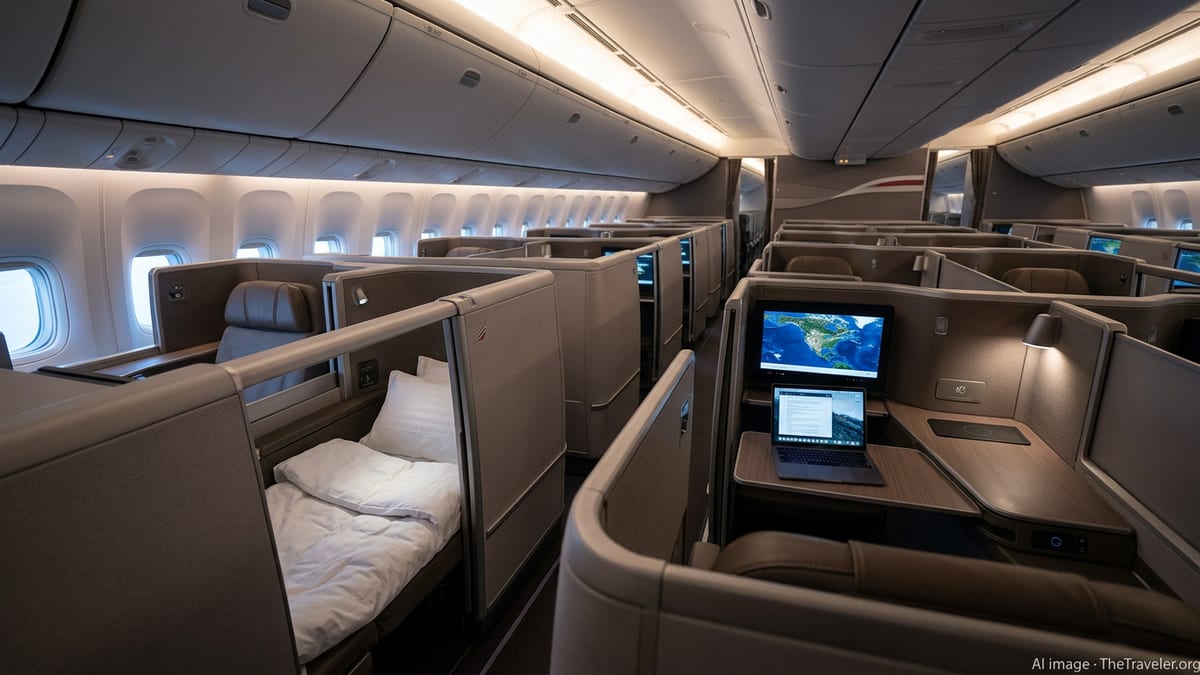
SFO positioned as launch pad for premium-heavy fleet
Public planning documents for San Francisco International Airport describe the United hub as the launch point for a new generation of “premium-heavy” aircraft, cementing SFO’s status as the airline’s leading Pacific and corporate travel gateway. Between the 2019 and 2026 fiscal years, United’s Asia-Pacific capacity from SFO rose sharply, and the airport’s share of the carrier’s international network increased as schedules were rebalanced toward higher-yield long-haul demand.
The same filings indicate that United has added more international seats at SFO than at any other airport in its system over recent years, and that SFO now accounts for a growing share of the airline’s global departing international capacity. The strategy reflects United’s view of the Bay Area as one of the strongest premium revenue markets in the United States, driven by technology, finance, and life-sciences demand on both transpacific and transatlantic sectors.
United has identified SFO as the home base for a subfleet of long-haul jets configured with the highest proportion of premium seats in its network. The airline intends to use these aircraft to target routes where corporate contracts and high-spending individual travelers can support a dense mix of business-class and premium economy cabins while keeping overall capacity in line with demand.
New 787-9 “Elevated” interior on Singapore and London routes
According to recent investor disclosures, United has begun operating its reconfigured Boeing 787-9 “Elevated” interior from San Francisco to Singapore and London Heathrow. The refreshed widebody design concentrates 99 seats in premium cabins, including an expanded United Polaris business cabin and a small number of Polaris Studio suites that offer additional privacy and space compared with the standard lie-flat product.
The new 787-9 layout increases the count of business and premium economy seats at the expense of standard economy, signaling a clear bet on higher-yield passengers on ultra-long-haul services. Publicly available information indicates that future 787 deliveries are scheduled to arrive with this premium-focused interior, with additional retrofits rolling out through 2027 to build a substantial fleet capable of operating from SFO and other long-haul hubs.
Positioning the first of these aircraft on SFO–Singapore and SFO–London routes gives United a more competitive product on two of its highest-profile corporate city pairs. Both markets connect Silicon Valley and the broader Bay Area with major financial and technology centers in Southeast Asia and Europe, and they have historically supported strong demand in the front cabin, particularly from contracted corporate accounts.
Polaris branding spreads across key transcontinental corridors
While the largest concentration of superpremium capacity remains on long-haul international flights, United is also extending its Polaris brand to select domestic transcontinental routes that feed its SFO hub. Recent schedule and fare data show that flights such as Newark to San Francisco, long operated with lie-flat seats marketed simply as business class, are now being sold under the United Polaris business label on certain frequencies.
This rebranding aligns domestic premium transcontinental services more closely with the international product, including access to Polaris lounges where eligibility rules are met. It also allows United to introduce its new tiered fare structure, which adds base, standard, and flexible options in the Polaris and Premium Plus cabins on long-haul international, select Hawaii, and premium domestic routes. The structure mirrors the airline’s economy fare families and is intended to give business and leisure travelers more price points within the front cabin.
For SFO, the expansion of Polaris-branded transcontinental flying strengthens links between the Bay Area and key East Coast financial centers. Passengers traveling between San Francisco and Newark or Washington Dulles can increasingly connect into or out of fully flat premium cabins on both legs of an international itinerary, a proposition that is important for corporate buyers who prioritize rest and productivity across multiple time zones.
Growing premium footprint across SFO’s international network
SFO’s evolution as United’s primary Asia-Pacific gateway is closely tied to the airline’s superpremium push. Airport financing documents note that United’s connecting traffic between the United States and Asia-Pacific routed through SFO has grown significantly since 2019, as the carrier consolidated flows from other hubs and focused on high-yield itineraries. The result is a network where a larger share of connecting passengers travel through a single West Coast hub, supporting more frequencies and larger premium cabins.
In addition to Singapore, SFO hosts United flights to major business markets such as Tokyo, Hong Kong, Taipei, Seoul, Sydney, and key European centers. Industry reports indicate that some of these routes are slated to receive the new premium-heavy widebodies as additional aircraft are delivered and retrofitted, though deployment will depend on seasonality, demand patterns, and operational constraints.
As premium capacity rises, SFO’s lounge infrastructure is also being scaled up. Recent coverage of airport developments points to ongoing work on an expanded United Club and the existing Polaris Lounge, with the goal of alleviating crowding that has periodically accompanied peak departure banks for long-haul services. Improved ground facilities, including upgraded check-in areas and security access for premium customers, are part of the broader effort to position SFO as a flagship experience within United’s network.
Competitive pressure in superpremium segment intensifies
United’s SFO-focused premium strategy unfolds in a highly contested market for high-yield travelers. Rival U.S. and international carriers also operate lie-flat cabins and enhanced ground services on many of the same routes, and several have invested in next-generation business-class suites with closing doors and direct-aisle access throughout. The move toward premium-heavy aircraft at SFO reflects both the revenue opportunity and the need to defend market share among corporate clients with global travel needs.
Industry analysts suggest that concentrating superpremium capacity in a handful of strategic hubs allows airlines to benefit from network effects, as more connecting options and higher frequencies make a given airport more attractive to business travelers. For United, SFO now functions as a central pillar in that strategy, anchoring long-haul growth while also supporting upgraded domestic links to key business centers on the East Coast.
How far United pushes the SFO premium envelope will depend on economic conditions, tech-sector travel budgets, and competitive responses from other carriers. For now, the introduction of premium-heavy widebodies, the spread of Polaris branding on transcontinental routes, and continued investment in lounges and ground services all point to a clearer focus on superpremium travelers moving through San Francisco.