


Finnish Lapland is home to two vast, wild national parks that capture the imagination of hikers, aurora chasers and anyone dreaming of true Arctic silence: Urho Kekkonen National Park and Lemmenjoki National Park. Both offer fell landscapes, reindeer, rivers and big skies, yet the on-the-ground experience can feel very different. Choosing between them shapes everything from how you travel to what you actually do once your boots hit the tundra. This guide compares the two in practical, real-world terms so you can decide which Lapland adventure fits you better.
Get the latest updates straight to your inbox!
First Impressions: Two Giants of the Lapland Wilderness
Urho Kekkonen National Park, or UKK, unfolds directly behind the popular village of Saariselkä in northern Lapland. It covers roughly 2,500 square kilometres, stretching all the way to the Russian border in the east. From the edge of town you can step almost immediately onto marked fell and forest trails, yet within a day or two of walking you can be in trackless tundra where you might see more reindeer than people.
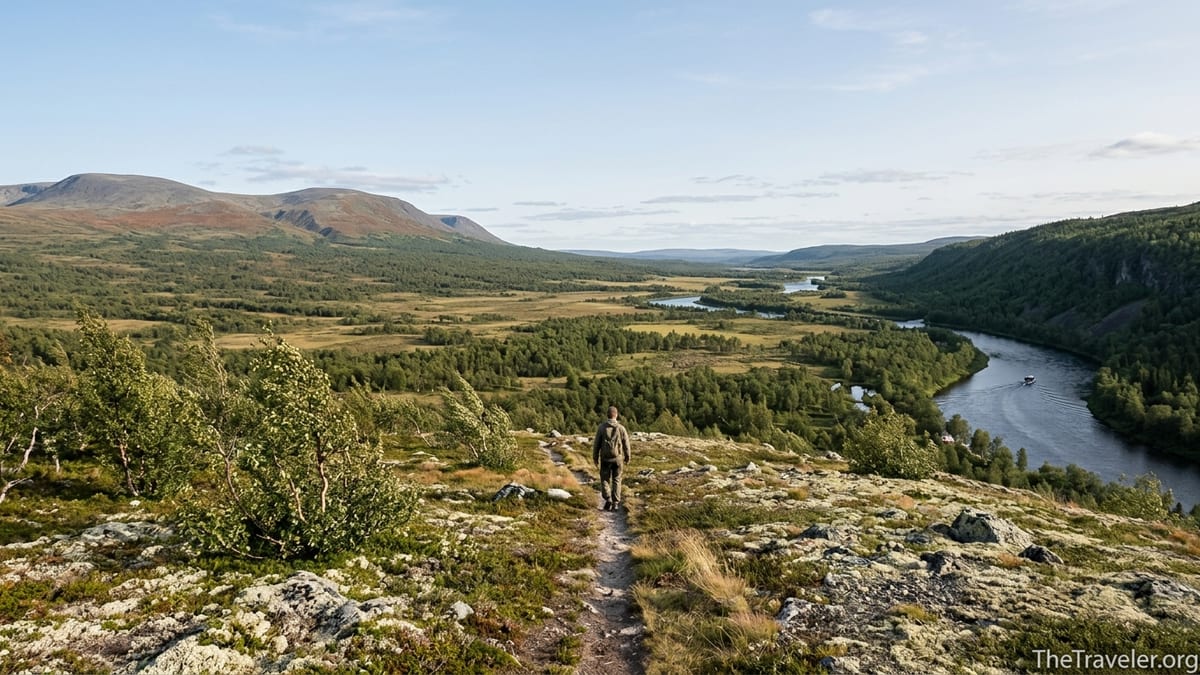
Lemmenjoki National Park lies further northwest, closer to the small Sámi communities of Inari and Kittilä. It is one of Europe’s largest roadless wilderness areas, focused around the wide Lemmenjoki River valley. Access tends to funnel through riverboat landings, remote cabins and a handful of starting points reached by gravel roads. It feels more like a deep backcountry reserve than a park you dip into between restaurant dinners.
In practice, that means UKK often works better for travellers who want a blend of wilderness and comfort: hotel beds in Saariselkä, ski or snowshoe tours by day, sauna and a restaurant meal at night. Lemmenjoki better suits those who like a slower, more old-school style of expedition, where a riverboat drops you at a basic wilderness hut and you continue on foot, by canoe or simply by following the riverbank trails.
Both parks are managed by Metsähallitus, the Finnish state forest agency, and both are free to enter. There are no driving fees or gate systems. Your main costs will be transport, accommodation, equipment and any guided activities you choose to add.
Getting There and Getting Around
Reaching Urho Kekkonen is straightforward for most visitors. The nearest airport is Ivalo, which has direct seasonal flights from Helsinki and occasional winter charters from major European hubs. From Ivalo Airport, scheduled buses run south to Saariselkä and to Kiilopää and Tankavaara, three main entry points to the park located along the E75 highway between Rovaniemi and Ivalo. Many winter visitors simply base themselves in Saariselkä village and walk or ski into the national park right from their accommodation.
Once in the Saariselkä area you can move around easily without a car. Local ski buses and shuttle services link Saariselkä, Kiilopää and nearby trailheads in winter, and many hotels offer transfers to the Kiilopää Fell Centre or other popular starting points. For example, a guest staying in a mid-range hotel in Saariselkä can often add a daily shuttle to Kiilopää to reach higher fell terrain for a modest per-person fee, booked through the reception desk or a local activity company.
Lemmenjoki requires a bit more effort. The usual airport gateways are Ivalo or Kittilä, after which most travellers either rent a car or arrange a private transfer to the small village of Lemmenjoki or to nearby Inari. Public buses exist but schedules are limited and often do not line up neatly with flight arrivals, so it pays to check timetables carefully and be flexible by a day if you want to rely on them. Many visitors combine Lemmenjoki with a broader Lapland road trip, stopping in Inari, Karigasniemi or the Pallas–Yllästunturi area along the way.
Inside Lemmenjoki National Park, the main artery is the Lemmenjoki River itself. In summer, small local riverboat companies carry hikers and day trippers upstream to popular drop-off points such as Ravadasköngäs, a well-known waterfall with a basic campfire shelter nearby. You pay the boat operator at the pier in Lemmenjoki village or pre-book through a local lodge. From the landing stages you can either return by boat or hike back along marked trails that follow the riverbanks through open birch woods and bogs.
Trails, Terrain and Difficulty
Urho Kekkonen offers perhaps the widest range of terrain and difficulty levels in Finnish Lapland. Near Saariselkä and Kiilopää there are short waymarked circuits suitable for families and beginners, including easy 2 to 8 kilometre loops that climb gently onto rounded fells with duckboarded sections over marsh. Trails like the Aurorapolku near Saariselkä are designed so you can walk out of a hotel after dinner, follow a lit path into the park, and be in good position to watch the northern lights if the sky is clear.
For more experienced hikers, UKK’s interior is a huge, mostly uninhabited wilderness of open tundra, lakes and low fells. Multi-day routes between wilderness huts such as Luirojärvi, Anterinmukka and Tuiskukuru are popular in late summer and early autumn. A classic week-long itinerary starts near Saariselkä or Kiilopää and loops eastward, crossing rivers and high plateau country, then returns via a different valley system. The ground is often boggy and uneven, and river crossings can require wading when water levels are high, so solid boots and good navigation skills are essential once you leave the main day hike areas.
Lemmenjoki’s terrain centres on the deep river valley, surrounding hills and several side valleys where small-scale gold panning has taken place for generations. Easier routes tend to follow the Lemmenjoki banks and connect wilderness huts, lean-to shelters and old prospector clearings. These paths are less numerous and sometimes less manicured than those around Saariselkä, so they feel more like backcountry travel than a maintained hiking resort. Elevation gain is usually moderate, but long, wet sections and roots can make the walking slow.
Because Lemmenjoki is more remote, you should be prepared for fewer signposts, fewer other hikers and a higher degree of self-reliance. On a mid-September weekday you might walk for several hours without seeing anyone once you leave the busy riverboat landings. That solitude is part of the park’s charm, but it also means carrying proper maps, knowing how to use a compass or GPS and being conservative about distances, especially in shoulder seasons when daylight is short.
Seasons, Weather and Best Times to Visit
Both parks lie well above the Arctic Circle, so seasons are pronounced. Winter typically stretches from late November into April, with heavy snow, short days in midwinter and long twilights at the edges of the season. In Urho Kekkonen, Saariselkä transforms into a full-service winter resort with groomed cross-country ski tracks, snowshoe routes and guided husky tours that dip in and out of the park boundary. Many visitors who come primarily to ski or chase the northern lights almost incidentally experience UKK as their backyard wilderness.
For long-distance winter travel in either park you need serious cold-weather experience, as temperatures can drop well below minus 20 degrees Celsius and storms can flatten visibility. However, for more casual skiers and snowshoers, early March often provides a good compromise of longer days, strong snow cover and more stable weather. Activity companies in Saariselkä typically price guided snowshoe walks or northern lights excursions per person, with the cost often including warm clothing rental, transport and hot drinks.
Summer and early autumn are prime seasons for hikers and canoeists. In UKK, July and August bring the warmest temperatures but also the most mosquitoes, especially in low-lying bogs. September, when the birch trees turn yellow and the groundcover burns red, is a favourite time for Finnish hikers. Nights are cooler, bugs much fewer, and the risk of early snowfall at higher elevations adds a sense of adventure. Many local outfitters time their guided hut-to-hut treks through Urho Kekkonen for this short “ruska” colour season.
Lemmenjoki is typically quieter even in high summer. Riverboat operators usually run from June into early September, adjusting exact start and end dates based on river ice and water levels. Early in the season, lingering snow patches on shaded slopes and high water in the river can make some routes more strenuous, while late August and September offer crisp air and beautiful colours with a greater chance of seeing the aurora reflected in the river at night.
Culture, Sámi Heritage and Gold Panning
Both parks lie in Sámi homeland, and the traditional reindeer herding culture shapes the landscape in subtle ways. In Urho Kekkonen, reindeer roam freely across the fells, and visitors often see herds grazing on lichen-covered slopes or crossing ski tracks at dusk. Signage and visitor centre exhibits in places like Tankavaara and Saariselkä frequently include information about Sámi history, language and livelihoods, though much of the daily tourist scene caters to an international resort crowd.
Lemmenjoki’s human story feels more intimate. The park’s river valley has long been a corridor for Sámi reindeer herders, fishers and families moving between seasonal camps. Today, small local companies based in Lemmenjoki village and nearby communities still run many of the riverboats, wilderness cabins and guided cultural experiences. A common day trip combines a boat ride upriver with a visit to a simple gold prospector camp, where you can watch demonstrations of manual gold panning techniques and try washing a pan yourself.
Mechanised gold mining in Lemmenjoki has been phased out under Finland’s updated mining laws, but small-scale, non-mechanised panning continues in designated plots along tributaries. This is tightly regulated and most casual visitors experience it only as a short, supervised activity during a guided tour. The appeal is more about touching a living tradition than about leaving with a vial of flakes in your pocket.
If you are interested in Sámi art, handicrafts and contemporary life, combining either park with time in the town of Inari works well. The Sámi Museum and cultural centre there offers exhibitions, films and workshops that help place what you see on the trail into a broader cultural context. Many travellers spend two or three nights in Inari, then continue to Lemmenjoki for a river-based adventure or to Saariselkä for fell hiking.
Comfort Levels, Huts and Who Each Park Suits Best
One of the biggest practical differences between the two parks is how easily you can combine wilderness days with comfortable nights. In Urho Kekkonen, the resort infrastructure of Saariselkä, Kiilopää and, to a lesser extent, Tankavaara provides a wide spectrum of beds and services. You can choose anything from a simple hostel dorm in Saariselkä to full-board spa hotels with aurora-viewing glass roofs. Many visitors alternate day tours into the park with evenings in a hotel sauna, and only a minority push deep into the interior for multi-day hut-to-hut or tent-based routes.
The park itself has a well-developed network of open wilderness huts, reservable huts and lean-to shelters. Typical open huts are free to use on a first-come basis and provide bunks, a wood stove and basic cooking surfaces, but no staff or services. Reservable huts can be booked in advance through Metsähallitus, securing your sleeping spot for a set fee per night. This system lets first-time Lapland hikers taste multi-day backcountry travel without carrying a tent, provided they plan carefully and respect hut etiquette.
Lemmenjoki feels more uncompromising. Accommodation options right at the park boundary are limited to a few small guesthouses and cabins in Lemmenjoki village and scattered lodges on the approach roads. Inside the park you will mainly rely on wilderness huts and your own tent. Services are sparse, and you should be prepared to carry more food and gear between checkpoints. For many visitors that is precisely the attraction: fewer people, fewer signs, and a strong sense that you are moving through a living landscape rather than a ski resort extension.
As a rule of thumb, Urho Kekkonen suits travellers who want flexible difficulty and the option to bail out easily. It works especially well for first-time Arctic visitors, families, or groups where some members prefer gentler day hikes while others crave longer journeys. Lemmenjoki suits patient, self-reliant hikers who are comfortable with less infrastructure and who value quiet, river-centred landscapes over dramatic fell panoramas and resort amenities.
Costs, Logistics and Real-World Trip Scenarios
Overall trip costs in Lapland can vary widely, but comparing rough patterns can help. In high winter, a mid-range hotel room in Saariselkä with breakfast often prices similarly to other Nordic ski resorts, and guided activities such as half-day snowshoe tours, husky safaris or aurora excursions are typically priced per person with extra charges for small-group or private options. Equipment rental shops in the village offer cross-country skis, snowshoes, winter clothing sets and sometimes pulks for overnight tours, which can be more cost-effective than flying heavy gear from abroad.
Urho Kekkonen makes it relatively easy to keep things simple: you might fly to Ivalo, catch the airport bus to Saariselkä, spend three or four nights in a cabin with a private sauna, and each day choose a different marked trail into the park. On one day you ski a loop from Kiilopää around a nearby fell, on another you snowshoe out along the Suomujoki River, and on the final evening you walk the short aurora trail just beyond the village lights. Your main planning concerns are daily weather, daylight hours and making sure you are back for dinner reservations.
A Lemmenjoki-based trip often looks different. Many travellers start in Helsinki, fly to Ivalo, overnight in Inari and stock up on food and stove fuel at the local supermarket before continuing to Lemmenjoki village. From there they might take an upriver boat to a remote hut, spend a couple of nights hiking side valleys or exploring old prospector clearings, then hike back downriver to meet the boat again. If water levels are suitable and they have the skills, some add a packraft or canoe component to travel one-way by boat and return by river under their own power.
If your travel time is short and you want to keep transfers straightforward, UKK usually wins. If you have a week or more and enjoy stitching together buses, rental cars and local boat services into one long, flowing journey, Lemmenjoki rewards that extra effort with a more secluded feel. In either case, you should budget extra time at the ends of your trip for weather disruptions, especially in late autumn and late winter when storms can delay buses and flights.
The Takeaway
At a distance, Urho Kekkonen and Lemmenjoki National Parks can look similar on the map: both are huge northern reserves dotted with lakes and fells under the same Arctic sky. On the ground, however, they serve slightly different kinds of travellers. Urho Kekkonen couples serious wilderness with the convenience of a resort gateway, making it a natural choice for first-time Lapland visitors, mixed-ability groups and anyone who likes the idea of skiing all day then warming up in a hotel sauna.
Lemmenjoki is quieter, more river-focused and more old-fashioned in its rhythms. The journey along the Lemmenjoki River, glimpses of traditional gold panning sites and the long, steady distances between huts give it the feel of a classic northern expedition, even if you are only out for a long weekend. It asks for more planning, more self-sufficiency and more tolerance for uncertainty, and in return it offers deeper solitude.
If you are still undecided, consider combining both parks on a single trip. Spend a few days based in Saariselkä to get used to the climate, gear and daylight, then move on to Lemmenjoki for a shorter but more immersive river valley adventure. Whichever you choose, remember that Lapland’s conditions can be harsh even in high season, so plan conservatively, respect local advice and give yourself space in the schedule to slow down and listen to the silence that makes this northern wilderness so special.
FAQ
Q1: Which park is better for a first-time visitor to Lapland, Urho Kekkonen or Lemmenjoki?
For most first-time visitors, Urho Kekkonen is the better starting point because it combines extensive wilderness with the resort services of Saariselkä, easy airport transfers and a wide range of marked day trails.
Q2: Can I visit Urho Kekkonen National Park without a car?
Yes. You can fly to Ivalo, take a regular bus to Saariselkä, Kiilopää or Tankavaara and access many of the park’s day trails directly from these villages or via local shuttles.
Q3: Is Lemmenjoki National Park suitable for beginners?
Lemmenjoki has some easier riverbank trails and popular day trips by riverboat, but overall it suits hikers with at least some experience, good navigation skills and a willingness to be more self-reliant.
Q4: When is the best time of year to hike in these parks?
July to early September is generally best for snow-free hiking, with September offering beautiful autumn colours and fewer insects. Early and late in the season you should be prepared for cold nights and the possibility of snow, especially on higher fells.
Q5: Can I see the northern lights in Urho Kekkonen or Lemmenjoki?
Yes. Both parks lie well within the auroral zone, and from late August to April you have a chance to see the northern lights on clear, dark nights, particularly away from village lights.
Q6: Do I need permits to hike or camp in these national parks?
You do not need general permits to hike or wild camp under Finland’s everyman’s rights, but you must follow park rules, use designated fire sites, and book reservable wilderness huts in advance if you want a guaranteed bed.
Q7: Are there guided tours available in both parks?
Guided tours are easy to find around Urho Kekkonen, especially from Saariselkä and Kiilopää, including snowshoe walks, cross-country ski tours and summer hikes. In Lemmenjoki, options are fewer but you can book riverboat excursions, gold panning visits and occasional guided treks through local operators.
Q8: Which park is better for families with children?
Urho Kekkonen is usually better for families because short, well-marked trails start near Saariselkä and Kiilopää, and you have quick access to shops, medical services and family-friendly accommodation if the weather turns bad.
Q9: How many days should I plan for each park?
For Urho Kekkonen, three to five days allow a good mix of day hikes and relaxation. For Lemmenjoki, plan at least four to six days to justify the extra travel and to include a riverboat trip and one or two nights at wilderness huts.
Q10: Is it realistic to visit both Urho Kekkonen and Lemmenjoki on one trip?
Yes, if you have about 8 to 12 days. Many travellers spend a few nights in Saariselkä to explore Urho Kekkonen, then continue by bus or rental car via Inari to Lemmenjoki for a shorter, more remote river valley experience.