


Not many places in Europe still feel genuinely wild. Roads, ski lifts, farmhouses and phone signal tend to creep into even the most remote valleys. Then you step into Urho Kekkonen National Park, in the far northeast of Finnish Lapland, and realize wilderness on this continent is not entirely gone. The scale, silence and sheer lack of human clutter here make the park feel wilder than almost anywhere else in Europe a place where you can still walk for days without crossing a road, where reindeer herds outnumber people, and where dark winter skies are broken only by the slow curtain of the aurora.
Get the latest updates straight to your inbox!
A Genuine Arctic Wilderness at Continental Scale
Urho Kekkonen National Park covers roughly 2,500 square kilometers in northeastern Finnish Lapland, right up against the Russian border. To put that in perspective, the park alone is larger than Luxembourg. Yet there are no villages inside its borders, no public roads crossing it, and almost no permanent residents apart from seasonal reindeer herders. You can walk for two or three days in its eastern half without seeing a single building beyond a scatter of simple wilderness huts.
Many famous European parks are hemmed in by development. In the Alps, even iconic areas such as Chamonix or Zermatt are ringed by ski lifts, hotels, railways and paved passes. In contrast, Urho Kekkonen is buffered by other protected areas and empty forest. To the northwest lies the Hammastunturi Wilderness Area, to the west and south vast tracts of state forest. Instead of a patchwork of conservation islands, you get one continuous subarctic landscape that functions as an ecological whole and feels like it goes on forever once you leave the trailheads at Kiilopää, Saariselkä or Raja-Jooseppi.
On a typical multi day trek beginning at Kiilopää, hikers might spend the first afternoon following a clear path over low fells, with views back toward the ski village of Saariselkä. By the second day, the last rooflines have vanished and the only sign of human management is the occasional waymark or a rough plank bridge over a boggy stream. By the third day, even the paths can fade to faint lines through dwarf birch and lichen, and you begin to understand why local hikers talk about the park in terms of “wilderness” rather than “trails.”
Landscape That Feels Empty, Elemental and Big
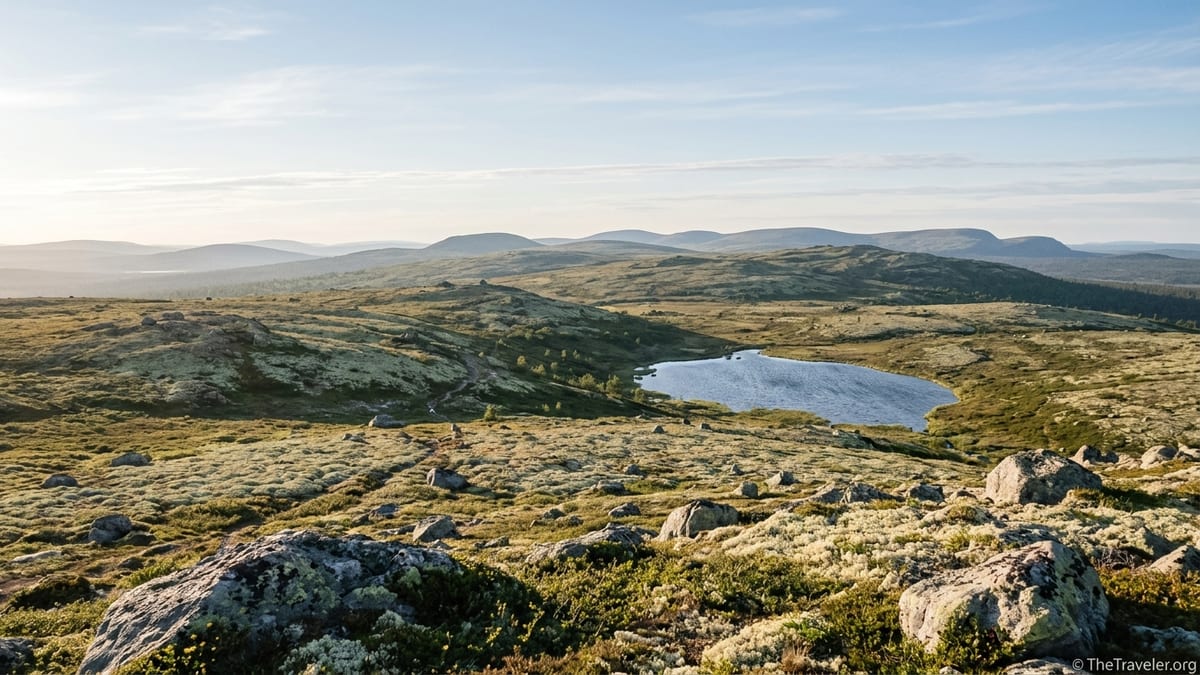
The wildness of Urho Kekkonen is as much about how it looks and feels as it is about its size. The park’s backbone is a chain of rounded fells tundra like hills that rise above the tree line to around 700 to 800 meters. From summits like Sokosti, the highest peak in the park, you gaze over a mosaic of dark spruce forest, pale lichen fields, and shining lakes with no villages to punctuate the horizon. The view is all land, sky and weather, with the occasional pencil line of a reindeer fence disappearing into the distance.
Between the fells cut deep, glacially carved valleys such as Paratiisikuru, a steep sided gorge where waterfalls tumble into pools framed by birch and willow. Lakes like Luirojärvi, sometimes called the “pearl” of the park, sit in wide, open basins. In autumn, the ground turns a patchwork of rust red, orange and gold as dwarf birch and blueberry shrubs change color, contrasting sharply with grey rock and dark conifer forest below. The overall effect is not dramatic in the jagged Alpine sense but quietly monumental a landscape stripped back to broad, simple lines and the small details of mosses, lichens and twisted birch.
For visitors used to the busier national parks of central Europe, even the approach to this scenery feels different. Instead of cable cars and busy mountain restaurants, you pass a small visitor center, maybe a single car park and a wooden trailhead sign. There is no queue for a summit photo, no hum of traffic from a valley floor. When the wind drops on a still evening at Harrijärvi or along the Suomujoki River, the silence is almost complete, broken only by the clicking call of a grouse or the splash of a fish taking an insect from the lake surface.
Light Footprints: Huts, Not Hotels
One of the most distinctive things about Urho Kekkonen is how lightly it has been equipped for visitors. There are marked routes and bridges in the western part of the park, but infrastructure is deliberately modest. Instead of lodges and mountain inns, you find a network of simple wilderness huts, lean to shelters and fire sites spaced a day’s walk apart. These huts are usually timber buildings with bunks, a wood stove, a basic table and benches, and an outdoor pit toilet. Water comes from the lake or stream nearby.
Many of these huts are “open” cabins that anyone may use for one or two nights at a time, as long as they follow Finnish hut etiquette. Others are reservable, with a small nightly fee paid in advance to the park authority. For example, a reservable hut at Tuiskukuru or Tahvontupa might cost in the region of 15 to 25 euros per person per night, significantly less than a commercial lodge but offering no services beyond shelter and a stove. You bring your own food, sleeping gear and often even your own saw and axe skills to manage the firewood pile responsibly.
The absence of commercial services inside the park fundamentally shapes the experience. If you want a meal, you cook it. If you want warmth, you split kindling and light the fire. In winter, backcountry skiers might spend an hour collecting snow to melt for drinking water or digging out an outhouse buried to the roofline after a storm. This level of self reliance stands in stark contrast to hut systems in places like the Dolomites or the French Alps, where hot meals, electricity and sometimes even Wi Fi are standard. In Urho Kekkonen, the huts are there to make wilderness travel possible and safe, not to civilize it.
Living Sámi Culture and Reindeer Herding
Another reason the park feels so different from much of Europe is that it is not a museum landscape. It is part of a living cultural region, where the indigenous Sámi people have herded reindeer across these fells for generations. Reindeer herding remains a central livelihood in and around the park, and the boundaries were drawn partly to safeguard the conditions needed for that traditional way of life to continue.
As you hike, you pass traces of this culture almost everywhere: reindeer fences striding up the hillsides, old herders’ huts on lake shores, snowmobile tracks used for winter roundups, and the herds themselves wandering the open slopes. In summer, small groups of reindeer often graze near wetlands and ridge tops, their bells audible in the distance long before you see them. In autumn and early winter, you might encounter herders working with modern tools such as ATVs or snowmobiles, but following patterns that go back centuries.
For visitors, this means the park feels less like a remote corner that the modern world forgot and more like an inhabited wilderness where traditional knowledge still shapes how the land is used. Park guidelines ask hikers not to disturb reindeer and to give herding work priority if they come across active roundups. Compared to many European parks where agriculture has largely retreated or been converted into tourism, this coexistence of conservation and an indigenous livelihood adds a distinctive sense of depth and continuity to the wildness you experience on the trail.
Silence, Solitude and the Sound of Weather
Because it sits far above the Arctic Circle and a long way from large cities, Urho Kekkonen sees a fraction of the visitor numbers of better known Alpine parks. The western edge near Saariselkä and Kiilopää can be busy on a sunny afternoon in July or during the northern lights season, but once you move a day or two’s travel into the interior the crowds thin to almost nothing, especially outside the short peak of school holidays.
On a four or five day trek looping between huts like Suomunruoktu, Tuiskukuru and Luirojärvi, it is common to share a cabin with just a handful of other hikers, or sometimes to have a hut entirely to yourself. Even at popular lakes, you can often camp on a low rise a few hundred meters away and feel as if you have the whole valley to yourself. There are no tour buses, no loudspeakers, no paragliders buzzing overhead, no villages broadcasting light pollution onto the sky.
This quiet accentuates the sense of exposure to weather. In September, cold fronts can sweep across the fells with little warning, bringing driving rain that makes the boardwalks slick and turns streams into knee deep crossings. In March or April, when the winter ski season in the Alps is winding down, this part of Lapland is still frozen, with temperatures well below freezing at night and biting winds on the open ridges. You hear the crunch of your skis on dry snow, the groan of lake ice shifting under its load, the dull roar of a blizzard against the hut walls. That direct, physical engagement with conditions is part of what many repeat visitors are seeking when they come back year after year.
Freedom to Roam and Choose Your Own Route
Finland’s everyman’s right, or jokamiehenoikeus, allows people to hike, ski and camp almost anywhere on uncultivated land, as long as they respect nature and private property. Inside Urho Kekkonen, this tradition combines with the park’s size to create a remarkable degree of route freedom. Marked summer hiking paths and winter ski routes exist, especially nearer to Saariselkä and Kiilopää, but there is no obligation to stay on them except in sensitive zones.
Experienced hikers and skiers regularly use topographic maps and GPS to link huts and valleys in creative ways. Some will follow the marked trail from Kiilopää to Suomunruoktu, then leave it to cross pathless fells to reach Luirojärvi. Others plan multi day traverses from the road end at Raja Jooseppi near the Russian border back toward Saariselkä, camping on open ridges and dropping into seldom visited side valleys. In winter, ski tourers might pull pulks loaded with a week’s food and explore unmarked drainages, relying almost entirely on their own navigation skills.
Compared with many central European parks, where strict zoning and private land issues often confine walkers to a dense network of official paths, this freedom feels liberating and wild. It also requires more judgment. A wrong decision about a river crossing in spring melt, or misreading a contour line in fog, can add hours to your day. That sense that you are making your own way rather than following a pre packaged route contributes strongly to the impression of genuine wilderness, even if you know that a hut or lean to usually lies within a day’s reach.
Harsh Seasons and the Drama of Arctic Light
Another element that sets Urho Kekkonen apart from most European destinations is its seasonal extremity. Winters are long, dark and cold. From roughly late November to early January, the sun does not rise above the horizon, and the park lives in a prolonged twilight of blue and pink light. Temperatures can drop far below freezing, and even simple tasks like melting snow for water or drying damp clothing become logistical challenges. For many visitors, this is not just scenery but a test of skills and equipment.
Yet winter is also when the park can feel most magical. Skiers glide along marked tracks or across open fells under a sky that suddenly erupts in curtains of green and purple aurora. Huts become islands of warmth and light in an otherwise monochrome world, their windows glowing against the snow. A typical guided multi day ski tour, booked through operators based in Saariselkä or Ivalo, might cost several hundred euros and include pulk rental, group safety gear and the services of an Arctic experienced guide, which underlines that traveling here in winter is closer to an expedition than a casual weekend getaway.
Summer brings nearly the opposite experience. In June and early July, the midnight sun circles the sky without setting, filling the valleys with soft light that never completely fades. You can start a hike after dinner and climb a fell at what would normally be midnight, only to find the sky as bright as early afternoon back home. This round the clock day length changes how people move through the landscape. Campers often walk longer stages because they are not racing sunset, and photographers can wait for the subtle shifts of light on distant ridges at any hour. Spring and autumn in between bring rapid transitions, from late lying snow to bog cotton and from the first frosts to full winter within a few short weeks.
The Takeaway
Urho Kekkonen National Park feels wilder than most places in Europe not because it is completely untouched, but because everything about it from the scale of its fell landscapes to the humbleness of its huts and the resilience demanded by its seasons encourages you to step away from the comforts of modern travel. You are never far from signs of human presence, whether in the form of reindeer fences or log cabins, yet you are acutely aware that you must rely on your own skills, judgment and respect for the elements.
For travelers willing to carry their own pack, navigate with a map, and light their own fire at the end of the day, the reward is profound. Days stretch into an almost meditative rhythm of walking, watching weather roll over the fells, and sharing simple meals with a small circle of companions or strangers in a hut. Nights whether luminous with the midnight sun or deep and cold under the northern lights remind you how far north you have come and how few signs of the wider world penetrate here.
If you are looking for another scenic photo stop between European cities, Urho Kekkonen may feel too austere, too demanding. But if your idea of a memorable trip involves solitude, self reliance and the chance to move for days through a landscape that still functions on nature’s terms, this Arctic park delivers a rare and precious kind of wildness that lingers long after you have brushed the last grains of Lapland sand and lichen from your boots.
FAQ
Q1. Where is Urho Kekkonen National Park and how do I get there?
Urho Kekkonen National Park is in northeastern Finnish Lapland, above the Arctic Circle. Most visitors fly to Ivalo, then take a bus or transfer about 30 to 45 minutes south to Saariselkä or Kiilopää, which serve as practical gateways with accommodation and visitor information.
Q2. Do I need special permits to hike or ski in the park?
No special permits are required for normal hiking, skiing or camping trips, as long as you follow park rules and respect reindeer herding activities. You only need advance reservations if you want to stay in specific reservable huts, which have limited bunks and a small nightly fee.
Q3. How difficult are the trails compared with other European parks?
The marked routes near Saariselkä and Kiilopää are comparable to moderate mountain hikes elsewhere in Europe, but distances between huts can be longer and weather more severe. In the eastern, less developed parts of the park, navigation is more demanding and conditions can feel closer to a lightweight expedition than a typical waymarked walk.
Q4. When is the best time to visit for first timers?
For most first time visitors, late June to early September is ideal, when trails are generally snow free, lakes are unfrozen and daylight is long or even continuous. More experienced winter travelers might prefer March and early April for reliable snow cover, longer days than midwinter and good chances of clear, cold conditions for ski touring.
Q5. What kind of wildlife might I see?
The most visible animals are semi domesticated reindeer, which roam widely across the fells and forests. You may also encounter grouse, various small mammals, and in the right season migratory birds using lakes and wetlands, while larger predators are present in the region but rarely seen by casual visitors.
Q6. How wild is it really if there are huts?
The huts are simple shelters rather than serviced lodges, and they do not remove the need for self reliance. Between huts you can travel for many hours without meeting anyone, and there are no restaurants, shops or roads inside the park, so the overall feel remains much wilder than in most European hut systems.
Q7. Can beginners safely visit Urho Kekkonen?
Yes, beginners can enjoy the western parts of the park using marked trails, day huts and short loops from Saariselkä or Kiilopää, especially in summer. Those new to Arctic conditions should avoid long winter tours without a guide, as cold, navigation challenges and changing weather require experience and appropriate equipment.
Q8. What should I budget for a multi day trip?
Your biggest costs are usually transport to Lapland, accommodation in Saariselkä or Ivalo before and after the trek, and gear if you need to rent or buy it. Actual park costs can be modest, with free use of open huts, small fees for reservable cabins, and grocery prices roughly in line with Finnish norms, although eating out and guided tours increase the total significantly.
Q9. How do I navigate without getting lost?
Carry a detailed topographic map, compass and ideally a GPS or mapping app, and know how to use them, especially if you leave marked routes. Weather can change quickly and fog or snowfall can obscure landmarks, so conservative route choices, clear turnaround times and a willingness to wait out poor visibility are important safety habits.
Q10. Is Urho Kekkonen suitable for seeing the northern lights?
Yes, the park lies well within the auroral zone and has very little light pollution, making it excellent for northern lights viewing in the dark season from roughly late August to early April. To maximize your chances, allow several nights in the region, stay flexible with late evening outings, and dress warmly enough to wait comfortably outside when the sky is clear.