


Urho Kekkonen National Park in Finnish Lapland is one of northern Europe’s great wilderness areas, a sweep of fells, mires and birch forests that feels genuinely remote yet is surprisingly accessible from the resort village of Saariselkä. Whether you are looking for a gentle half-day fell walk, a multi-day backpacking route between wilderness huts, or a winter adventure under the Northern Lights, the park offers a mix of guided tours and self-guided itineraries that can suit most experience levels. This guide focuses on concrete trips, routes and experiences you can actually book, with current examples drawn from operators working in and around the park in 2025–2026.
Get the latest updates straight to your inbox!
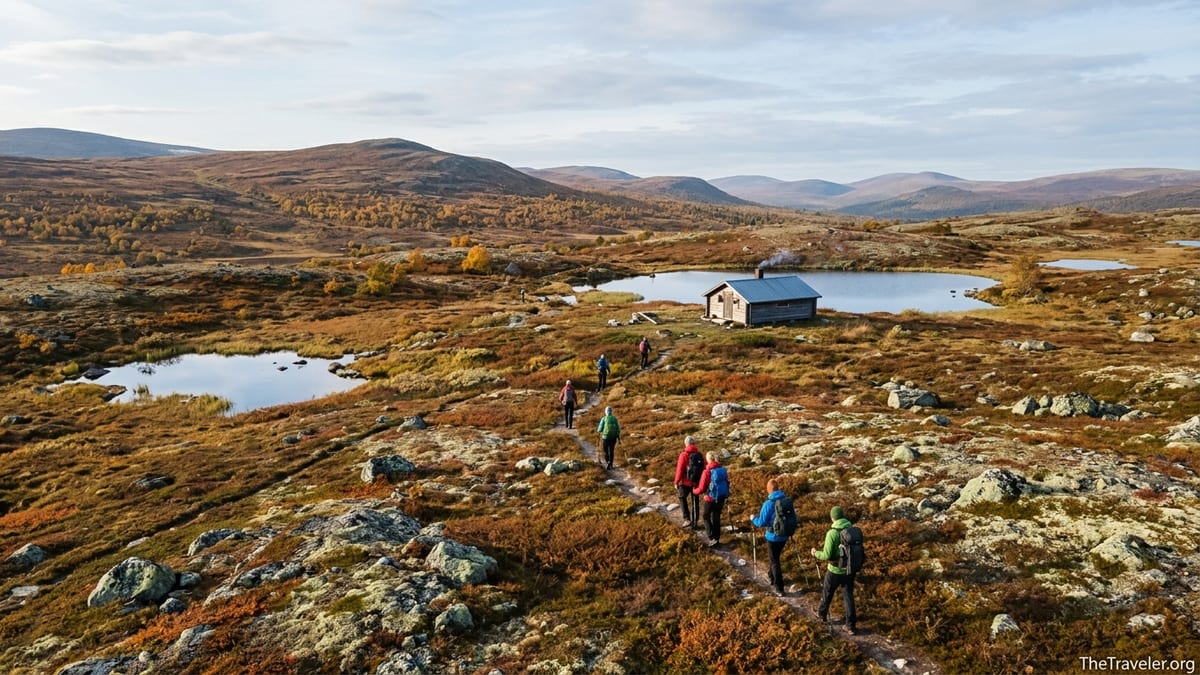
Why Urho Kekkonen Is Finland’s Ultimate Wilderness Playground
Covering almost a thousand square miles of northeastern Lapland, Urho Kekkonen National Park is Finland’s second largest national park and one of its least developed. There are no paved scenic drives, visitor trains or cable cars here. Instead, low treeless fells, clear rivers and wide mires create a landscape that feels empty in the best possible way. Trails often fade into reindeer paths, and weather can change quickly, which is part of the attraction for hikers who want to experience real subarctic wilderness without leaving Europe.
Most visitors base themselves in or near Saariselkä, a compact resort village on the edge of the park with hotels, cabins, supermarkets and gear shops, or at the Kiilopää fell center about 15 kilometers to the south. From these hubs you can step almost straight from your accommodation onto marked summer hiking routes or winter ski and snowshoe trails leading into the national park. Day hikers often stay in conventional hotels or cabins, while backpackers combine tent camping with simple wilderness huts that dot the interior of the park.
Unlike heavily regulated mountain parks elsewhere in Europe, much of Urho Kekkonen’s interior has no waymarked paths. The Finnish park authority publishes detailed topographic maps and maintains open and reservable huts, lean-to shelters and fire sites. In practice, first-time visitors and international travelers often choose a mix of guided activities around Saariselkä and Kiilopää and then, once they understand local conditions, venture deeper on self-guided overnights or book longer guided expeditions that handle navigation, safety and logistics.
The season you visit shapes the experience. From late June through September you get snow-free trails, long daylight and access to popular multi-day hikes like the route to remote Lake Luirojärvi. From December through April, the park turns into a winter playground with prepared ski tracks near the gateways, opportunities for snowshoeing and fatbiking, and high chances of seeing the Northern Lights away from resort lights on clear nights.
Best Guided Tours From Saariselkä and Kiilopää
For many travelers, the easiest way to get a first taste of Urho Kekkonen is to book a half-day or full-day guided tour from Saariselkä or Kiilopää. Local operators and outdoor centers offer a wide range of activities, especially in winter, and most departures are timed to connect with flights into Ivalo Airport, about a 30-minute transfer from Saariselkä. Typical group sizes range from 4 to 12 people, with hotel pickup included from major properties in Saariselkä village and nearby cabin areas.
One popular option in winter is a guided snowshoeing excursion that starts in Saariselkä and crosses the treeline into open fells within the national park. Commercial booking platforms currently list 3-hour afternoon snowshoe tours in Urho Kekkonen with prices often in the range of 80 to 110 euros per adult, including gear, warm drinks and guiding. These short outings suit anyone with moderate fitness and no previous snowshoe experience, and they are a straightforward way to experience the park’s silence without worrying about navigation in deep snow.
For guests based at the Kiilopää fell center, guided outings are almost on your doorstep. Kiilopää’s Finnish outdoor association base functions as both an accommodation hub and an activity center, with staff-led hikes, snowshoe walks and cross-country ski trips that head straight out into the fells behind the property. While many of these are advertised in Finnish, English is commonly spoken, and weekly programs often include 2- to 4-hour fell walks that cost roughly 40 to 70 euros per person, depending on duration and whether equipment hire is included. These tours are ideal if you have just arrived in Lapland and want an orientation walk before tackling longer routes alone.
Cyclists should look at guided fatbike tours that operate from Saariselkä and Kiilopää in both summer and winter. A local company such as Roll Outdoors currently runs small-group guided fatbike rides on nearby fell trails, with several routes skirting the edge of Urho Kekkonen National Park. Expect to pay roughly 75 to 120 euros for a 2- to 3-hour ride that includes a high-quality fatbike, helmet, guide and often a snack break. These trips appeal to active travelers who prefer a moving adventure rather than a static sightseeing tour, and they can be one of the most memorable ways to experience the park’s vast open spaces under midnight sun or aurora-filled winter skies.
Classic Day Hikes: Ahopää, Rumakuru and Rautulampi
While the heart of Urho Kekkonen is unmarked wilderness, the park’s northern fringe around Saariselkä and Kiilopää is laced with well-established day routes that local tourism boards market as ideal first hikes. Many of these appear on apps such as Komoot and AllTrails, and they are also signposted on the ground, at least near their trailheads. If you only have one or two days in the area and want high views without committing to an expedition, these circuits are strong choices.
One of the most popular routes is the Ahopää trail, a scenic fell hike that begins near the Kiilopää gateway. Walkers climb through sparse birch woods to open fells and ridgelines with wide views toward the park interior. Mapping platforms typically put the loop at around 14 kilometers with moderate elevation gain, and experienced hikers usually complete it in 4 to 5 hours. The ground is a mix of rocky fell terrain and damp sections with duckboards, and there are plenty of places for a picnic with far-reaching Lapland views.
Closer to Saariselkä village, the Rumakuru Gorge trail combines fell scenery with an atmospheric ravine. The route uses clear paths and ski tracks to climb above the tree line before dropping into the Rumakuru valley, where an old wilderness hut from the 1930s now serves as a day shelter. Depending on the variant you take, the loop is typically 6 to 14 kilometers and suits families and casual hikers, especially in late summer and early autumn when berries line the trail and the birch forests turn gold. Because it starts near the resort, this is one of the best options if you want a rewarding hike without long transfers.
Stronger hikers often aim for the Rautulampi area, a fell basin with a small lake and hut network reached via challenging but beautiful trails from both Saariselkä and Kiilopää. Current hiking apps list demanding loops of around 20 to 22 kilometers with significant elevation gain and rough sections that can be muddy or snowy even in early summer. In good weather, you are rewarded with big sky views, open fell crossing and the chance to visit one or two wilderness huts for a rest before heading back. This kind of long day hike works best in mid-summer when daylight is effectively unlimited and you are comfortable walking eight hours or more.
Multi-Day Wilderness Routes and Hut-to-Hut Trips
For many hikers, the true magic of Urho Kekkonen lies beyond the day-hiking belt, in a network of unmarked but well-trodden wilderness routes. These multi-day trips are not waymarked in the terrain, but they are clearly shown on official park maps and in Finnish-language route descriptions. You navigate using topographic maps, compass and GPS as backup rather than relying on color-coded trail poles. As a result, they are most suitable for experienced backpackers or for visitors who join a guided expedition.
A classic target is Lake Luirojärvi, often described by Finnish hikers as the pearl of the park. Reaching this lake in the park’s central fells typically takes 2 to 3 days of walking from the nearest road-accessible trailheads at Kiilopää or the Aittajärvi parking area, depending on the route you choose and your fitness. The surrounding fells, including Sokosti, the highest peak in the region, create a bowl of rounded hills around the lake. A large wilderness hut here can sleep more than a dozen hikers on simple bunks, and several tent sites allow you to camp if the hut is busy.
Hut-based traverses across the park are also possible. Finnish hiking forums often discuss week-long routes that start near Saariselkä or Kiilopää and finish near the remote northern boundary at Raja-Jooseppi, close to the Russian border. These trips typically cover around 120 to 150 kilometers over 6 to 8 days, visiting a sequence of open and reservable huts spaced roughly 15 to 25 kilometers apart. Some huts even have wood-fired saunas, turning each day’s walk into a journey from one simple refuge to the next. To plan such a traverse you will need the latest official hut list, a recent topographic map, and time to study river crossings and marshy sections.
If you prefer a bit more hand-holding, several Lapland-based outfitters and adventure travel companies offer guided multi-day expeditions in Urho Kekkonen, particularly in winter. These might be advertised as 5- to 7-day ski touring or snowshoe expeditions, with pulk sleds for gear and overnight stays in wilderness huts and tents. Prices for fully guided trips that include all meals, shared accommodation, guiding and group equipment typically start in the low four figures in euros per person, reflecting both the remote environment and the small-group, high-involvement nature of the experience. For strong hikers who want to experience midwinter silence and possibly -20 degree temperatures safely, these professionally organized expeditions are worth considering.
Winter Adventures and Northern Lights Experiences
Winter and early spring transform Urho Kekkonen into a deep-snow landscape of frozen rivers, wind-packed fells and crisp blue-sky days. From roughly December to April, locals and visitors alike switch from hiking boots to skis, snowshoes or fatbikes. The most accessible winter experiences stay close to Saariselkä and Kiilopää, where prepared ski tracks and waymarked winter trails reduce avalanche and navigation risk. Further into the park, experienced tourers follow snowmobile service tracks and unmarked routes between huts, but such trips require a solid understanding of Arctic winter conditions.
Many Saariselkä hotels and glass igloo resorts in the surrounding area sell Northern Lights excursions that enter or border the national park. Common options include small-group premium van tours that drive into darker areas followed by a short snowshoe section through forest, and fully snowshoe-based aurora walks that start at a trailhead and climb gently into open fells. Prices often sit around 120 to 180 euros per person for a 4- to 6-hour evening trip, which usually includes warm outer clothing, a campfire snack and basic photography tips. You pay partly for logistics and guide expertise, but also for the social aspect and the convenience of being driven into optimal viewing areas instead of figuring it out alone in the dark.
Cross-country skiing is the traditional way to explore Lapland in winter. The Saariselkä ski track network connects directly with Urho Kekkonen’s boundary, and dozens of kilometers of machine-groomed classic tracks run across frozen mires and low fells. Day-skiers commonly rent skis from village sports shops for 25 to 40 euros per day, then follow well-marked loops of 5 to 30 kilometers, stopping at open huts or cafes along the way. More adventurous skiers may use the maintained tracks as a springboard to venture deeper on backcountry skis, aiming for wilderness huts that are not reached by machines but may have snowmobile-maintained approaches.
Fatbiking is a relatively new but fast-growing way to experience the park in both winter and summer. In recent years, local guides have mapped bike-suitable winter trails around Kiilopää and Saariselkä, some of which extend into the park’s buffer areas. Guided winter fatbike tours usually last 2 to 3 hours and cover 10 to 20 kilometers at a relaxed pace, making them accessible even to travelers who have not ridden on snow before. In late spring, when snow turns to slush and then bare ground, the same wide-tire bikes transition smoothly onto gravel and singletrack routes across the fell slopes.
Wilderness Huts, Camping and How to Book
One detail that sets Urho Kekkonen apart from many other European parks is its dense network of simple wilderness huts and shelters. Within the park you will find open wilderness huts that are free to use for 1 to 2 nights on a first-come, first-served basis, reservable huts that can be booked in advance for a nightly fee, and lean-to shelters and day-use huts that provide rest stops and emergency refuge. Facilities are basic: typically wooden bunks or sleeping platforms, a wood stove, outdoor pit toilet and a nearby water source such as a stream or lake.
The Finnish park authority maintains current information on which huts are open, which require advance reservations and what rules apply to each. In practice, many foreign visitors mix hut nights with tent camping. Carrying a lightweight tent or tarp ensures you always have a backup if a popular hut such as Luirojärvi is full when you arrive. Local hiking culture emphasizes sharing space and leaving huts clean for the next party, so be prepared to make room, split firewood and haul water not only for yourself but also as a courtesy for those arriving after you.
Camping regulations differ between the more developed zones near Saariselkä, Kakslauttanen and the Nuortti river and the core wilderness. In the basic and recreational zones, camping is usually restricted to designated campfire sites, lean-tos and wilderness hut surroundings. Deeper in the park’s wilderness zone, you can typically pitch a tent almost anywhere sensible, as long as you respect Leave No Trace principles and avoid sensitive vegetation. Always check the latest park guidelines before your trip, as rules and hut availability can change from season to season due to maintenance or environmental reasons.
Booking systems for reservable huts and some tour packages are now largely online. Expect to pay a modest nightly fee in euros to secure a bunk in a reservable hut, with discounts sometimes available for children or members of certain Finnish outdoor associations. When organizing a multi-day route, it is wise to build some flexibility into your plan in case your preferred hut nights are already booked. In that scenario, you might adjust your daily distances or plan extra wild camping nights between huts. During peak Finns’ holiday times in July and early August, it is especially important to make reservations and route plans well ahead.
Practical Planning: When to Go, Budget and Safety
Although Urho Kekkonen feels remote, basic logistics are straightforward. Most international visitors fly to Helsinki and then connect to Ivalo, a small airport around 30 kilometers from Saariselkä. From there, shuttle buses and pre-booked transfers take you to Saariselkä, Kiilopää or Kakslauttanen in under an hour. Once in the region, you can get by using a combination of walking, occasional local buses and tour operator pickups, though having your own rental car gives more flexibility for starting and finishing points along secondary roads like the Aittajärvi access.
Costs vary widely depending on whether you are staying in resort hotels and booking daily guided activities, or backpacking and cooking your own food. As a rough guide, a mid-range hotel or cabin in Saariselkä in summer or shoulder seasons can run from 120 to 220 euros per night for two people, while hostel beds or simpler cabins may come in under 100 euros. Self-catering backpackers who sleep in a tent and use free huts can keep daily costs relatively low, especially if they buy most supplies in southern Finland before traveling north, as supermarket prices in Lapland can be slightly higher.
Weather and safety require serious attention, even on popular routes. In summer, temperatures can range from near freezing with sleet on the fells to over 20 degrees Celsius in the valleys, sometimes in the same week. Trails often cross mires and streams without bridges, so waterproof footwear and a willingness to get wet feet are useful. In winter, temperatures can drop well below -20 degrees Celsius, winds on open fells can be brutal, and daylight is scarce. Unless you have solid winter travel experience, it is safer to stick to prepared ski tracks and guided tours during your first cold-season visit.
Navigation skills are essential for any multi-day trip beyond the waymarked fell routes. While many hikers now rely on smartphone apps, batteries drain fast in cold weather and GPS signals can be unreliable in deep valleys, so you should always carry a paper topographic map and a compass, and know how to use them. Tell someone your route plan and expected return date, and be realistic about daily distances. Finnish hikers who know the terrain often consider 15 to 20 kilometers per day plenty when carrying a pack over uneven ground, especially when river crossings or marshes slow progress.
The Takeaway
Urho Kekkonen National Park rewards travelers who are willing to look beyond the polished surface of Lapland’s ski resorts and glass igloos. From accessible day hikes like Ahopää and Rumakuru to demanding multi-day traverses between wilderness huts, the park offers a gradient of adventure that can match both first-timers and seasoned backcountry walkers. In winter, guided snowshoe, ski and aurora tours from Saariselkä and Kiilopää provide safe ways to taste Arctic conditions without needing expedition-level skills.
To get the most from a visit, match your plans to your experience and the season. If you are new to the region, start with guided activities and marked day trails, then gradually push deeper into the wilderness as your confidence grows. Invest time in studying current maps, hut information and park rules, and treat the huts, trails and fragile tundra as the precious shared resources they are. Do that, and Urho Kekkonen will feel less like a remote name on a map and more like a living, breathing landscape you will want to return to again and again.
FAQ
Q1. Do I need a guide to hike in Urho Kekkonen National Park?
For marked day hikes near Saariselkä and Kiilopää, confident hikers can usually go self-guided with a good map or app. For unmarked multi-day routes into the park’s interior, a guide is strongly recommended unless you have solid navigation skills and experience in remote terrain.
Q2. What is the best time of year to visit for hiking?
The main hiking season runs from late June to late September, when most snow has melted from the fells and river levels are manageable. July and August are the warmest and busiest months, while September offers beautiful autumn colors and fewer insects but cooler temperatures and shorter days.
Q3. Can I see the Northern Lights in Urho Kekkonen National Park?
Yes, the park lies under the auroral oval and has very little light pollution, so on clear nights between roughly late August and early April there is a good chance of seeing the Northern Lights. Many visitors join guided evening tours from Saariselkä or Kiilopää that head into darker areas for better viewing.
Q4. How difficult are the most popular day hikes?
Routes like the Rumakuru Gorge variations can be moderate and suitable for families with active children, while the Ahopää loop is a longer, more demanding fell hike that suits reasonably fit adults. Rautulampi routes are longer and rougher again, best for experienced hikers comfortable with 20-kilometer days and changeable weather.
Q5. Are wilderness huts free and do I need to book?
Open wilderness huts are generally free to use for short stays and cannot be reserved, so space is shared on a first-come basis. Reservable huts require advance booking and payment of a nightly fee. It is common to combine both types of hut with tent camping as a backup during busy periods.
Q6. Is camping allowed anywhere in the park?
In the core wilderness zones you can usually camp almost anywhere that is environmentally sensible, following Leave No Trace principles. In more developed zones near Saariselkä, Kakslauttanen and certain river corridors, camping is restricted to designated sites and the surroundings of huts and shelters, so always check current rules before pitching a tent.
Q7. What gear should I bring for a summer multi-day hike?
For a summer multi-day route you should bring a sturdy backpack, waterproof boots, layered clothing for temperatures from near freezing to mild, rain gear, tent or tarp, sleeping bag and pad, stove and fuel, plenty of food, paper map, compass and a backup navigation device such as a GPS or smartphone with offline maps.
Q8. How do I get to Saariselkä and Kiilopää without a car?
Most visitors fly into Ivalo Airport via Helsinki and then take an airport shuttle or pre-booked transfer to Saariselkä, which takes about half an hour. From Saariselkä there are local buses and arranged transfers to Kiilopää and other nearby trailheads, and many guided tours include pickup from major accommodations.
Q9. Are there options for travelers with limited hiking experience?
Yes, beginners can enjoy short marked nature trails, gentle fell walks and guided excursions such as snowshoe trips, easy fatbike rides or introductory cross-country ski lessons. Many tour operators design outings that last only a few hours, with frequent breaks and no technical terrain.
Q10. How expensive is a typical guided activity in the park area?
Prices vary, but as a general idea, half-day group activities such as snowshoe tours or fatbike rides commonly cost around 75 to 120 euros per adult, while premium small-group Northern Lights outings or full-day expeditions can rise to 120 to 180 euros or more, depending on inclusions.