


More news on this day
Major US carriers are sharpening their focus on high-yield travelers as American Airlines prepares to expand access to its Flagship Dining experience from September 15, a shift that positions elevated on-the-ground gastronomy alongside next-generation business-class suites as core battlegrounds in the premium travel market.
Get the latest news straight to your inbox!
American’s Flagship Dining Opens to More Premium Flyers
Publicly available information from American Airlines shows that, starting September 15, customers booked in Flagship Business and Flagship Business Plus on qualifying long-haul international, transcontinental and Hawaii routes will gain access to the carrier’s Flagship Dining venues at Dallas Fort Worth and Miami. Previously, sit-down restaurant service in these spaces was largely reserved for Flagship First passengers, with entry tightly controlled around a small pool of first class tickets and select high-status travelers.
The change means a far larger group of premium passengers will be able to book itineraries that include a full-service, plated dining experience before boarding. According to American’s recent lounge updates, Flagship Dining menus are built around multi-course service and wine pairings, positioning the concept closer to destination restaurants than traditional self-serve airport buffets. On eligible routes, a business-class ticket will now function as a gateway to both an upgraded seat in the air and an enhanced culinary experience on the ground.
Reports indicate the airline is coupling this access shift with a refreshed food and beverage program across Flagship lounges, incorporating chef-driven dishes developed in partnership with the James Beard Foundation and other culinary collaborators. The goal is to present a more consistent, restaurant-style journey from check-in to boarding, reinforcing the idea that the most exclusive part of a trip may now begin well before pushback from the gate.
American’s roadmap also includes a Flagship Dining reopening in Los Angeles later in 2026, restoring its original three-hub footprint for the concept. That timing aligns with the carrier’s broader investment cycle in lounges and premium ground services, including new locations such as a Flagship lounge in Philadelphia and updated Admirals Club formats in other hubs.
Flagship Suites and the New Benchmark for US Business Class
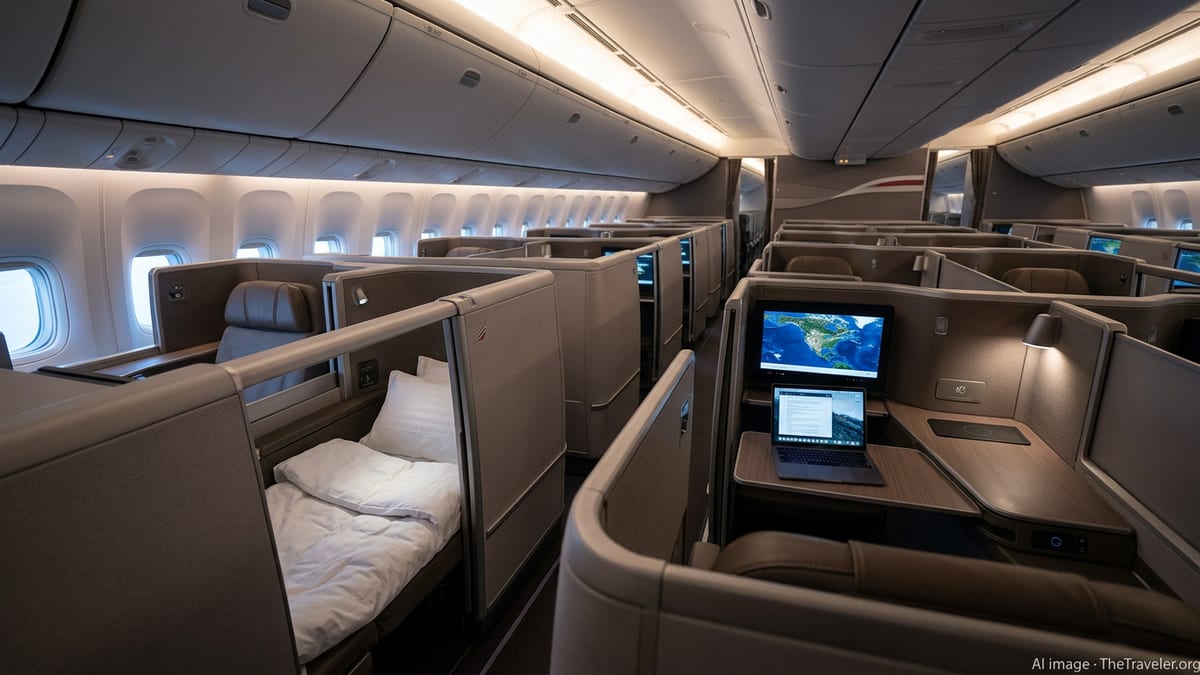
The expansion of Flagship Dining comes as American continues rolling out its Flagship Suite business-class product on upgraded Boeing 777 and 787 aircraft and on its new Airbus A321XLR fleet. Industry coverage describes the suites as fully enclosed or semi-enclosed pods with sliding doors, more personal storage and seating that converts to lie-flat beds, replacing older-generation configurations that lacked direct aisle access for every passenger.
On the A321XLR in particular, early route reports show a dense premium layout with a business cabin composed entirely of single-aisle suites, giving each traveler a private space in a 1-1 configuration. Travel reviews note that these jets are designed for transatlantic and premium transcontinental routes where business travelers value both privacy and the ability to work or rest on sectors of six hours or more.
Financial and investor materials from American highlight Flagship Suite as a key component of a wider strategy to increase premium seat capacity and generate higher unit revenue on long-haul routes. By standardizing toward suites with doors and pairing them with improved lounge and dining access, the carrier is seeking to narrow the perceived gap with international competitors from Asia and the Middle East that have long marketed business class as an almost first-class experience.
The pairing of Flagship Suites in the air with Flagship Dining on the ground is notable because it ties together two previously separate premium touchpoints. Instead of reserving restaurant-style lounges for the small number of passengers who buy first-class tickets, American is effectively anchoring its business-class proposition around both hard product and gastronomy, a combination designed to appeal to corporate buyers and frequent flyers who increasingly compare airlines on end-to-end experience rather than seat alone.
Delta and United Counter with Next-Generation Suites
American’s lounge and suite push arrives amid an escalating premium arms race among US network carriers. Delta Air Lines recently unveiled the next generation of its Delta One suite, which is scheduled to appear on forthcoming Airbus A350-1000 aircraft and to be retrofitted across the A330 fleet in the coming years. Public details describe longer lie-flat beds, upgraded padding and 24 inch 4K entertainment screens, all within door-equipped suites that emphasize privacy and sleep quality.
Delta already operates a large number of business-class suites with doors on long-haul routes, and company communications position the new design as a refinement rather than a wholesale replacement. The airline plans to extend a refreshed interior look across more than 800 aircraft over a five-year period, signaling that high-spec business cabins will spread beyond a narrow set of flagship routes and become more common on secondary international services and selected domestic flights.
United Airlines is executing its own premium push with an Elevated interior concept centered on enhanced Polaris business class. According to recent announcements, new Boeing 787-9 Dreamliners will feature updated Polaris suites with doors and 4K seatback screens, while a new Polaris Studio mini-cabin in the front rows will offer larger suites with companion seating, caviar service and expanded amenities. The airline also plans to introduce lie-flat Polaris suites on Airbus A321neo aircraft operating transcontinental services between Newark and West Coast hubs.
These moves are extending lie-flat, all-aisle access seating into aircraft types and route patterns that were historically served by recliner-style domestic first class. For business travelers, that means the traditional distinction between “international-grade” and “domestic” business products is starting to blur, especially on coast to coast and select Hawaii flights where United and Delta previously relied on mixed hard products.
Ground Experience Becomes a Key Differentiator
While much of the competition focuses on seats, carriers are also investing heavily in ground experiences. American’s decision to open Flagship Dining to a broader set of business-class passengers is part of that shift, positioning the lounge as a signature differentiator rather than a niche amenity for a small first-class subset.
American’s own lounge communications emphasize an expanded range of hot and cold dishes, improved presentation and a more complete meal concept in both Flagship and Admirals Club spaces. In practical terms, that means travelers on morning departures may now be able to enjoy a full restaurant-style breakfast in the lounge and skip the first meal service onboard, freeing more time for work or sleep. Evening departures, particularly on transatlantic flights, become opportunities for early dining on the ground followed by a shorter, more sleep-focused service after takeoff.
United and Delta, for their part, are scaling up premium lounges and dining as well, although with different branding. United’s Polaris lounges are pitched as an extension of its long-haul business-class product, while Delta has been expanding Delta One check in and dedicated premium security lanes at select hubs. The common thread is that time spent in the terminal is viewed as core to the product, not just an add-on for top-tier elites.
For corporate travel buyers and frequent flyers choosing between carriers, these changes turn the pre-flight experience into a decisive factor. Access rules for premium dining spaces, the consistency of lounge locations across key hubs and the ability to guarantee restaurant-style service before long overnight sectors are becoming as significant as seat pitch or screen size when evaluating value.
What the September 15 Shift Means for Travelers
From mid September, business travelers booked in American’s Flagship cabins on eligible itineraries through Dallas Fort Worth and Miami effectively gain a new benefit: reliable access to the airline’s highest tier of lounge dining. For those flying on overnight services to Europe or long westbound sectors from Hawaii, being able to eat a full meal before boarding could change how they structure work and rest onboard.
Travel forums and commentary suggest that some frequent flyers already make purchasing decisions based on whether an itinerary includes access to a premium dining facility, especially when schedules force late-night departures with limited sleep windows. With the new access rules, more of American’s business customers will be able to build that preference into their route planning without needing an elusive first-class ticket.
The policy shift also raises expectations across the market. As Flagship Dining becomes attainable for a wider pool of business-class passengers, pressure may grow on rivals to expand their own restaurant-style lounge offerings or to refine food and beverage service in existing premium spaces. In a landscape where seat technology is converging around suites with doors, the distinctiveness of a carrier’s ground hospitality may become an increasingly important way to stand out.
For now, the immediate impact will be most visible at American’s biggest hubs, where a surge of newly eligible Flagship Business passengers will put the expanded dining rules to the test from September 15 onward. How smoothly those venues handle higher demand and whether the elevated experience can be maintained at scale will likely shape the next stage of the US premium travel contest.
American Airlines expands access to Flagship Dining
Delta outlines next-generation Delta One suite rollout