


More news on this day
Autonomous robots are moving from trade-show demos to active test ramps at major US airports, with industry roadmaps indicating that by 2026, fleets of driverless tugs, dollies and inspection vehicles could become a routine part of ground operations.
Get the latest news straight to your inbox!
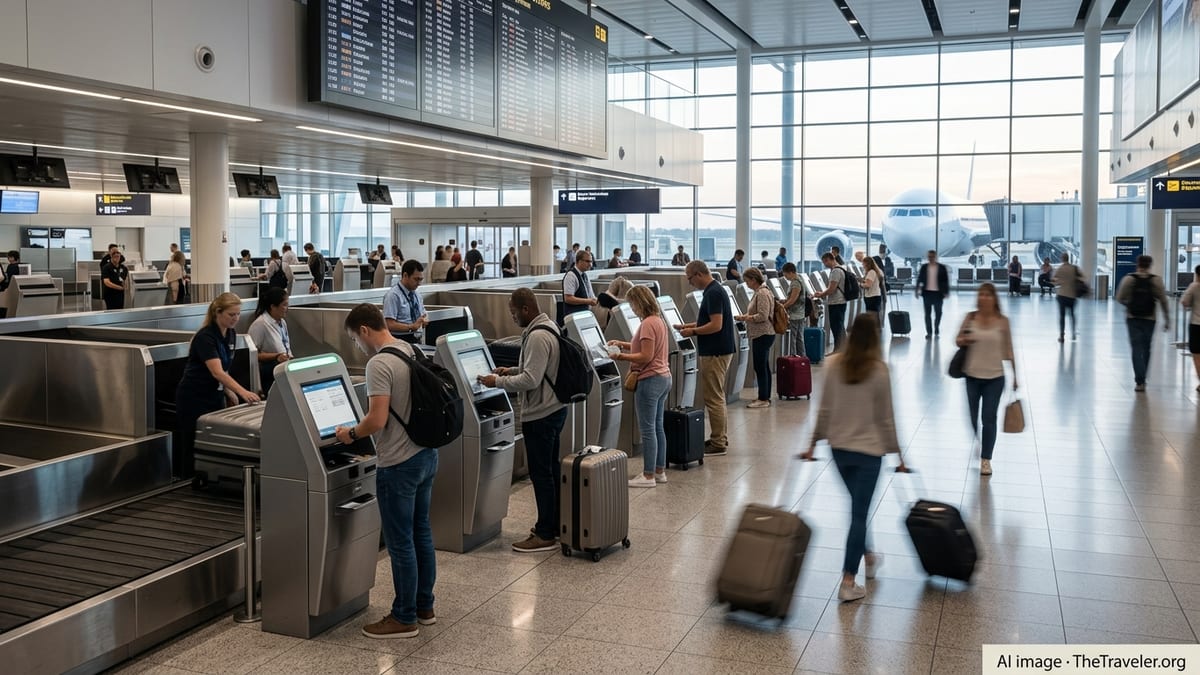
Airside Automation Moves From Trials to Timelines
Across the United States, ground support automation is shifting from isolated pilots to multi-year deployment plans, as airports and manufacturers respond to labor shortages, safety pressures and tighter on-time performance targets. Companies such as Aurrigo, TractEasy and Oshkosh AeroTech are scaling up autonomous baggage tractors, cargo dollies and gate equipment, while airport operators explore how to integrate them into daily ramp activities.
Recent trials at Cincinnati/Northern Kentucky International Airport have focused on Aurrigo’s Auto-DollyTug, a self-driving, electric vehicle that combines the functions of a traditional baggage tug and dolly into one unit. Publicly available company information indicates that the system can pick up and set down containers, navigate busy aprons and operate in convoys, all while communicating with a central control platform. Industry analysts view these demonstrations as early templates for similar deployments at other US hubs by 2026.
At the same time, TractEasy, a joint venture between TLD, Smart Airport Systems and EasyMile, has announced development of an autonomous cargo dolly capable of handling full-size unit load devices and pallets in complex airside environments. Its technology builds on an existing driverless tow tractor platform already in service at several global airports, using radar, lidar and camera arrays to operate with centimeter-level precision in mixed-traffic zones.
Manufacturers are signaling that the timing is right for scaled adoption. Oshkosh AeroTech, a major US ground support supplier, has flagged autonomous and electric ramp vehicles as a central feature of its technology roadmap through the 2025 and 2026 trade-show cycles, highlighting their potential to cut delays related to loading, fueling and aircraft turns.
What Will Change on the Ramp by 2026
By 2026, passengers looking out the terminal windows at large US airports are likely to see fewer human-driven baggage tractors and more compact, sensor-laden robots moving bags, cargo and equipment between aircraft and terminals. Early concepts point to integrated fleets in which autonomous dollies, tugs and belt loaders are orchestrated through digital “turnaround” plans that assign each vehicle its path, timing and task list.
In practical terms, that means driverless baggage vehicles could pull up to an arriving aircraft, align automatically with loading zones, and then depart in a pre-planned sequence toward baggage halls or cargo sort facilities. Several designs under test incorporate robotic loading features, allowing the same vehicle to carry out tasks that previously required both a tractor driver and ground crew positioned at separate dollies.
Beyond baggage, specialized robots are being developed for airfield inspection and safety checks. Technology profiles published in 2025 describe autonomous ground units equipped with high-resolution cameras and sensors designed to patrol runways, taxiways and aprons to detect foreign object debris and pavement damage. These systems are intended to operate primarily at night or during low-traffic periods, automatically recording, mapping and flagging hazards for rapid removal.
As these capabilities mature, the ramp environment is expected to become more choreographed and less reliant on ad hoc decisions by individual drivers. Airport planners foresee a future in which much of the surface movement of equipment is governed by digital twins of the airfield, with algorithms scheduling traffic flows to minimize conflict points and idle time.
Safety, Labor and Regulatory Questions
While automation promises fewer ramp incidents, it also raises questions about how autonomous vehicles will share space with workers, tow tractors, service trucks and pushback operations. US aviation regulators have begun to respond with guidance covering test operations, vehicle certification and risk-mitigation measures when robots operate on or near active movement areas.
Recent federal bulletins on emerging ground vehicle systems recommend strict test plans, geo-fencing and human oversight during early phases of deployment, particularly where autonomous vehicles cross taxiways or come within proximity of aircraft under their own power. These documents emphasize the need for robust fail-safe features, including automatic stop functions, obstacle detection and secure communications links with ramp control.
For airport employers, autonomous robots intersect directly with a tight labor market. Ground handling companies report persistent challenges in recruiting and retaining ramp agents for physically demanding work in extreme weather, with turnover adding significant training and overtime costs. Industry commentary suggests that automation is increasingly being framed not only as a cost-saving measure, but also as a way to shift human workers into higher-skilled roles supervising fleets, managing exceptions and handling complex or irregular operations.
Labor representatives and worker advocates are monitoring these developments closely, raising concerns about job displacement and the pace of change. Some airport programs are beginning to explore reskilling schemes that would transition experienced ramp staff into roles such as remote fleet operators, maintenance technicians for autonomous equipment and data analysts supporting airport digital twins.
Technology Under the Hood
Most of the autonomous ramp systems now moving toward US deployment draw on technologies proven in autonomous trucking, warehouse automation and industrial robotics. Vehicle platforms typically combine lidar, radar, stereo cameras and GPS to build a real-time, three-dimensional picture of the ramp environment, supported by onboard computing units that make navigation and collision-avoidance decisions in fractions of a second.
To operate reliably in rain, fog, snow and variable lighting, many designs use sensor fusion, blending multiple data feeds so that a single blocked or degraded sensor does not compromise safety. High-definition maps of airside roads and stand areas, often generated from earlier mapping runs or digital design files, help the vehicles localize their position and anticipate turns, gradients and clearances under aircraft wings.
Communication is another critical layer. Emerging systems rely on secure wireless links to connect vehicles with central fleet-management platforms that assign tasks, monitor performance and coordinate interactions with other airport systems, such as stand allocation and baggage sortation. Some manufacturers are experimenting with dedicated charging and maintenance hubs where autonomous vehicles can route themselves when batteries run low or system checks are required.
Cybersecurity is an evolving concern. Industry guidance emphasizes the importance of encryption, access controls and continuous monitoring to protect autonomous ramp systems from interference, given their proximity to aircraft and critical infrastructure. Manufacturers are also designing manual override capabilities that allow human supervisors to intervene quickly if anomalies are detected.
What Travelers Should Expect
For travelers, the shift to autonomous ground support is likely to be subtle at first, with most changes occurring behind the scenes in how baggage and cargo move around the airport. Over time, however, more predictable ramp operations could translate into fewer last-minute baggage delays, shorter aircraft turnaround times and improved on-time performance for departures and arrivals.
Some airports are planning public-facing demonstrations or viewing areas where passengers can see autonomous ground vehicles in action, reflecting an expectation that robotics will become part of the broader brand story around innovation and sustainability. Electric, self-driving ramp equipment is frequently positioned as a way to reduce local emissions, noise and fuel consumption while modernizing the travel experience.
Travelers may also notice secondary effects, such as changes to boarding times as airlines fine-tune their schedules around more consistent aircraft servicing, or new messaging about how airports are managing safety and security in increasingly automated environments. In many cases, human ramp workers will remain highly visible, particularly for tasks involving direct aircraft contact, specialized cargo and customer service.
By 2026, the most visible sign of change could be the mix of vehicles themselves. Rows of conventional diesel tugs may gradually give way to compact electric robots with distinctive sensor masts and light signatures, reflecting a broader shift in how US airports think about the ramp: not as a loose collection of vehicles and crews, but as a tightly coordinated, semi-autonomous system supporting every flight.