


More news on this day
Mounting confrontation between the United States and Iran, combined with renewed threats over the Strait of Hormuz, is driving a new wave of security warnings and travel uncertainty across the Gulf, with the United Arab Emirates, Qatar, Kuwait and Bahrain increasingly in focus for airlines and international travelers.
Get the latest news straight to your inbox!
Regional Tensions Deepen Around the Strait of Hormuz
Publicly available information shows that the latest round of US military strikes on Iranian targets and subsequent Iranian attacks on Gulf states have pushed the long running Strait of Hormuz crisis into a more volatile phase. Reports from regional media and international outlets describe missile and drone salvos directed at Bahrain, Kuwait and Qatar, alongside continued clashes around vital shipping lanes.
The Strait of Hormuz remains one of the world’s most critical chokepoints for oil and gas shipments, and it is central to Iran’s leverage in its standoff with Washington. Background coverage of the 2026 crisis indicates that traffic has already been sharply reduced for months as tankers divert around Oman or delay sailings while naval forces on both sides operate in close proximity.
Iranian military aligned statements carried by regional news agencies in recent weeks have warned that attempts to bypass its control of the waterway could face a forceful response. Commentaries in policy and energy publications note that some Iranian officials and commanders continue to argue that if Iran’s oil exports are curtailed, then, in their words, not a single drop of oil from the region should be allowed to pass.
At the same time, shipping advisories and maritime industry bulletins emphasize that there has been no universally recognized legal closure of the strait, but that the practical risk environment has escalated to the point where many commercial operators treat the route as effectively semi closed.
Airspace Warnings Extend Over UAE, Qatar, Kuwait and Bahrain
As military activity has intensified at sea and on land, aviation regulators and risk consultancies have turned growing attention to Gulf airspace. A recent advisory from the European Union Aviation Safety Agency, reported by Gulf focused outlets, urged European airlines to avoid the airspace of the UAE, Qatar, Kuwait and Bahrain, citing a high risk to civil aviation linked to US Iran hostilities and repeated attacks on commercial assets.
According to travel industry risk assessments and insurer digests issued in June and July, a wide arc of airspace across the northern Gulf, including routes frequently used by long haul services between Europe, Asia and Oceania, is now classified as high or extreme risk. These assessments recommend rerouting flights further south where possible, adding flight time and cost for carriers that continue to serve the region.
Regional news coverage from Dubai and Doha indicates that while major hubs such as Dubai International and Hamad International remain operational, airlines are adjusting schedules, altering routings and in some cases cancelling specific rotations during peak periods of tension. Some Gulf based carriers have reportedly consolidated frequencies on busier trunk routes while pausing services on secondary links that overfly or approach areas of active military activity.
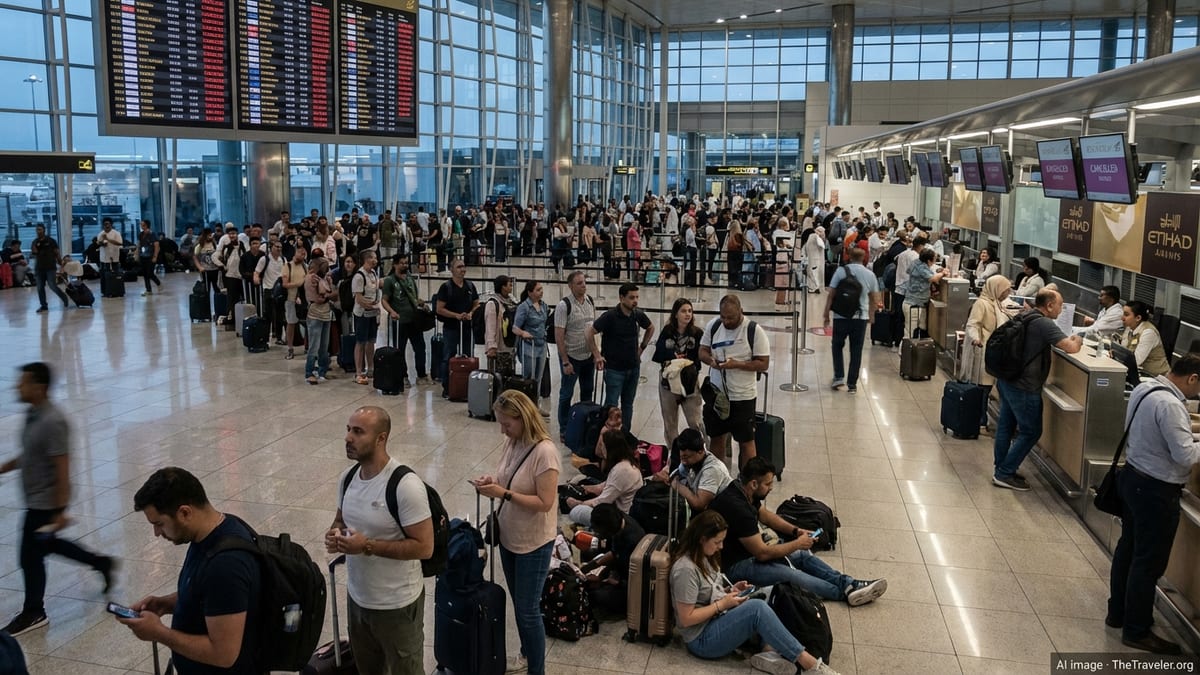
For travelers, the immediate effect is a more fluid schedule environment. Flight status can change at short notice as operators react to evolving security assessments, government level advisories and insurance constraints on overflying certain zones.
Potential Disruption for Emirates, Etihad and Qatar Airways
The rising risk profile in Gulf airspace has significant implications for Emirates, Etihad Airways and Qatar Airways, which have built their business models around high volume, long haul connectivity through hubs in Dubai, Abu Dhabi and Doha. Coverage in regional business media suggests that these airlines face increasing operational complexity as they balance safety, regulatory compliance and commercial needs.
Reports indicate that some services between the UAE and Kuwait have already been curtailed amid the latest exchange of strikes, while selected flights between Gulf capitals and nearby conflict affected states have been suspended or rerouted. Industry analysts note that any sustained perception of risk to major hubs could slow connecting traffic, particularly among corporate travelers and tour operators with strict internal security thresholds.
At the same time, aviation specialists quoted in sector analyses highlight the resilience and experience that Gulf carriers developed during previous regional crises, including earlier missile incidents and airspace closures. These airlines are accustomed to rapidly reconfiguring networks, using alternative routings and leveraging wide fleets to maintain as much connectivity as feasible under constraints.
For now, publicly available schedules still show a substantial volume of flights operating to and from the UAE, Qatar, Kuwait and Bahrain, but with a heightened emphasis on contingency planning and real time monitoring of geopolitical developments.
Travel Advisories and What Passengers Should Watch
Governments in Europe, North America and Asia have been gradually updating travel advisories for Gulf destinations as the US Iran confrontation has evolved. Recent guidance compiled by corporate security firms points to an emerging pattern in which many states advise citizens to exercise increased caution in the UAE, Qatar, Kuwait and Bahrain, and in some cases to avoid non essential travel to areas closer to known military targets.
These advisories typically focus on the possibility of missile or drone debris falling in populated areas, the risk of sudden airport or airspace restrictions, and the potential for protests or heightened security measures in urban centers. While they do not uniformly recommend leaving the region, they emphasize the importance of registering with consular services, monitoring local news and being prepared for itinerary changes.
Travel risk bulletins aimed at corporate travelers and expatriates also underline the need to check airline policies on flexible rebooking and refunds, particularly for itineraries transiting Gulf hubs on route to third countries. Some recommend building additional buffer time into trips and avoiding tight same day interline connections that could be disrupted by reroutings around restricted airspace.
Insurance providers, for their part, are updating fine print on war risk exclusions and security related cancellations. Travelers are being encouraged by brokers and travel managers to verify whether their policies cover delays or diversions linked to regional conflict, rather than only conventional weather or technical disruptions.
Oil Markets, Shipping and the Broader Travel Outlook
The military standoff around the Strait of Hormuz is feeding directly into global energy and travel economics. Financial news outlets report that Brent crude has moved back above 90 dollars a barrel as renewed fighting and threats to tanker movements raise the prospect of tighter supplies and higher refinery costs, especially for jet fuel.
Analyses of the 2026 Iran war’s economic impact suggest that earlier rounds of disruption in the strait helped drive up prices for kerosene based products, squeezing airline margins at the same time as carriers were dealing with reroutings and demand uncertainty. A prolonged period of elevated conflict risk could revive those pressures just as some airlines were counting on a steadier operating environment.
Maritime advisories and shipping trackers show that many oil and gas exporters have shifted at least part of their volumes to alternative routes where possible, including pipelines and ports outside the immediate conflict zone. Nonetheless, the Gulf’s geography means that a large share of regional exports would still normally flow through Hormuz, so any further intensification of threats to halt traffic entirely would likely ripple quickly through both freight and passenger markets.
For travelers considering trips to or through the UAE, Qatar, Kuwait and Bahrain, the overall picture is one of a functioning but stressed system. Flights continue to operate and major airports remain open, yet the backdrop of US Iran confrontation and recurring warnings about the Strait of Hormuz means conditions can change rapidly. Close attention to advisories, flexible planning and clear communication with airlines are becoming essential tools for navigating journeys across this strategically vital region.