


More news on this day
Passengers at London Gatwick faced severe disruption on Friday afternoon after all flights were temporarily grounded when a departing aircraft suffered a technical problem and became stuck on the airport’s single main runway.
Get the latest news straight to your inbox!
Runway closure halts operations at UK’s second-busiest airport
Published coverage indicates that Gatwick’s main runway was closed at around early afternoon on 4 September 2026, forcing a temporary halt to both arrivals and departures at the airport, which handles tens of millions of passengers each year.
Reports from multiple outlets describe how a departing widebody aircraft experienced a technical issue during its take-off roll, leaving it disabled on the runway. With Gatwick operating effectively as a single-runway airport, air traffic movements were unable to continue until the aircraft could be removed.
According to aviation tracking data cited in news reports, the closure lasted for roughly 50 minutes before the stranded aircraft was towed clear and the runway underwent a safety inspection. Operations then gradually restarted, but knock-on disruption quickly built up across the afternoon schedule.
Early accounts from flight-tracking platforms also show a sharp increase in holding patterns in the skies above southeast England during the interruption, as arriving services waited for confirmation that the runway had reopened or diverted to alternative airports.
Norse Dreamliner to New York at centre of incident
Details emerging from tracking services and regional media point to a Norse Atlantic Airways Boeing 787-9 Dreamliner operating flight Z0701 from Gatwick to New York JFK as the aircraft involved in the incident.
Coverage referencing data from Flightradar24 indicates that the jet rejected its take-off on runway 26L and came to a stop on the pavement, reportedly unable to vacate under its own power. Aviation outlets note that the aircraft became “stuck on the runway,” triggering an immediate pause in take-offs and landings while ground and emergency teams attended.
Subsequent reports describe the aircraft being towed from the active runway before the airport carried out a full inspection. Publicly available statements from Gatwick emphasise that the problem was contained to a “technical issue with a departing aircraft” and that safety protocols required the short-term runway shutdown while the situation was resolved.
There were no early reports of injuries linked to the rejected take-off, and the technical fault is now subject to further investigation, according to national and local media coverage.
Delays, diversions and missed connections for passengers
The 50-minute closure had an outsized impact on passengers, with the interruption unfolding during a busy afternoon period and at an airport heavily reliant on its single main runway. Flight tracking platforms showed severe delays building quickly once operations resumed.
Data referenced by travel news outlets suggested that more than 300 flights experienced disruption, with average delays of close to an hour for a period after the incident. Some inbound services diverted to other UK airports, including London Stansted and Birmingham, to avoid extended holding patterns while Gatwick’s runway remained unavailable.
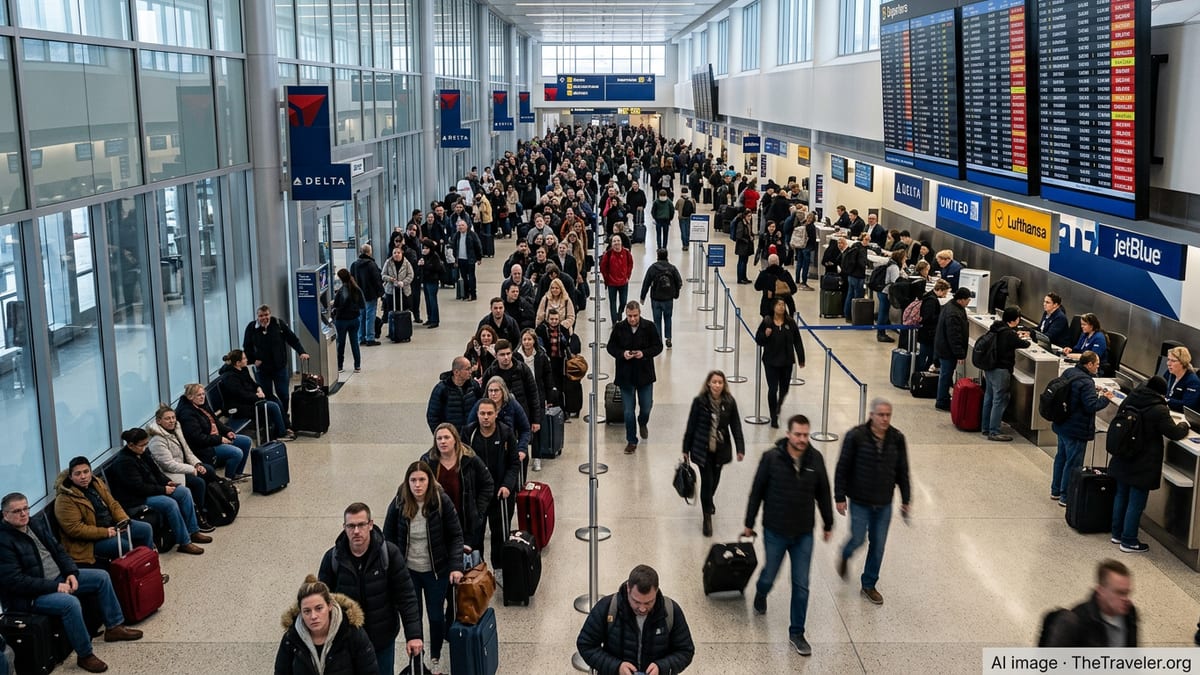
Travellers reported on social media that they were held on board aircraft at departure gates or on the tarmac waiting for clearance, while others described lengthy queues at check-in and security as departure times slipped. Many passengers faced missed connections at onward hubs in Europe and North America as a result of the cascading delays.
Public updates from airlines and Gatwick’s own travel information channels advised passengers to continue to arrive at the airport as scheduled but to monitor live flight status closely, with residual disruption expected to last into the evening as schedules were gradually realigned.
Why a single-runway closure hits Gatwick so hard
Gatwick is officially a two-runway airport, but its current configuration means only one runway is used for routine take-offs and landings. When an incident blocks that strip, there is limited short-term flexibility to keep traffic flowing, unlike at major hubs with fully independent parallel runways.
Previous operational reports from the airport’s airspace office show that “runway occupied” events are among the most common causes of go-arounds and short-lived disruption. When a departing or arriving aircraft cannot vacate the active runway quickly, the tightly timed landing and departure sequence is forced to pause until the blockage is cleared.
Friday’s event is one of a series of recent instances underlining how sensitive Gatwick’s operation is to even brief interruptions. Recent summers have seen weather, staffing constraints and isolated technical problems lead to congested terminals and knock-on delays, drawing renewed scrutiny of the airport’s resilience as traffic returns to pre-pandemic levels.
Gatwick has longer-term plans to bring its northern runway into more regular use, subject to regulatory approvals, which advocates argue could provide greater operational flexibility. For now, however, any significant incident that shuts the existing main runway can ripple rapidly through the flight schedule.
What travellers should do if flying via Gatwick today
Travel industry updates following Friday’s closure advise passengers due to fly into or out of Gatwick to treat schedules as fluid for the rest of the day. Even after the runway reopened, aircraft and crews were left out of position, creating the possibility of rolling delays.
Publicly available guidance from airlines and airport channels recommends that travellers check their flight status directly with their carrier before setting off, and again on arrival at the airport. Many airlines are offering options to rebook onto later services where delays are substantial or connections are no longer viable.
Rail links between central London and Gatwick are reported to be operating, but passengers are being encouraged in travel advisories to allow extra time in case of crowding or short-notice timetable changes. Those with flexible itineraries may find it prudent to adjust plans by several hours to accommodate ongoing disruption.
With investigations into the aircraft’s technical fault under way and schedules still recovering, today’s incident serves as a reminder of how dependent major hubs remain on single pieces of critical infrastructure and how quickly a blocked runway can bring one of Europe’s busiest airports to a halt.
ITV News Meridian: All flights grounded at Gatwick Airport due to technical issue
AOL Travel: Gatwick runway shuts as flight to New York left stranded after rejected take-off
Yahoo News: Gatwick Airport runway closed and flights grounded sparking travel chaos
V2 Radio: Flights grounded at Gatwick after aircraft technical issue closes runway