


More news on this day
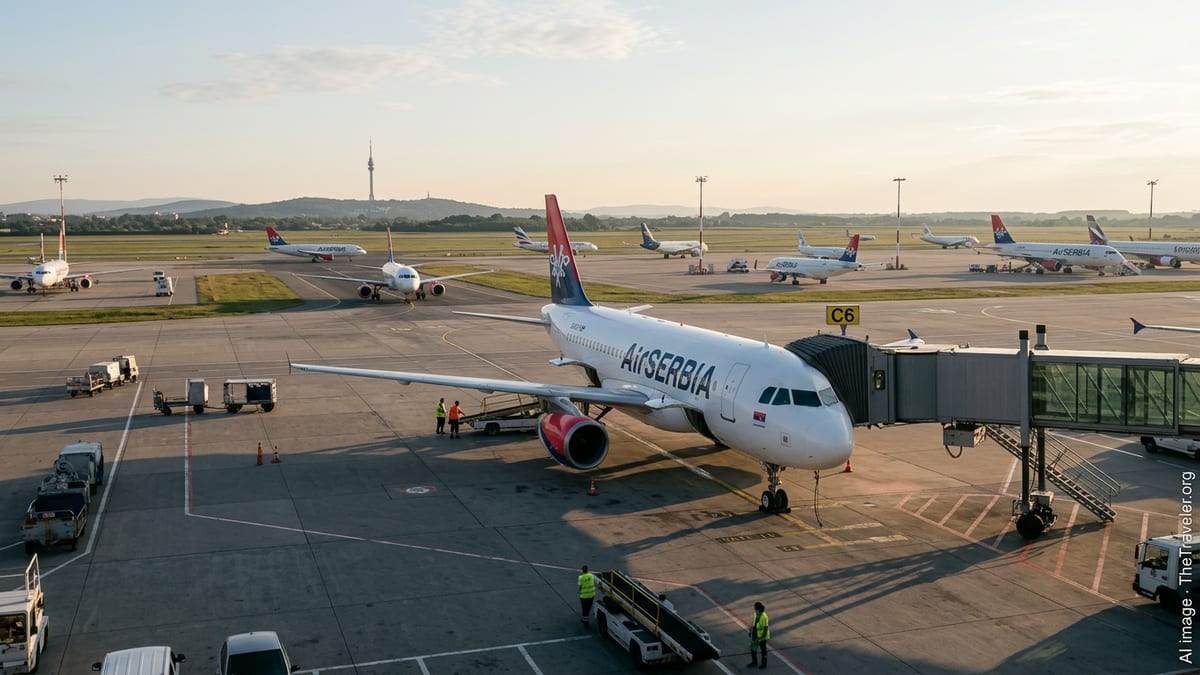
Publicly available data show that Air Serbia has recorded the busiest month in its history, carrying 616,479 passengers across scheduled and charter services in August 2026, a milestone that highlights the flag carrier’s accelerating growth and the expanding role of Belgrade as a regional aviation hub.
Get the latest news straight to your inbox!
Strongest Monthly Performance in Airline’s History
According to Air Serbia’s latest traffic update, the airline’s 616,479 passengers in August represent the highest monthly total since the carrier’s launch under its current brand. The result surpasses previous summer peaks and confirms August 2026 as a record-breaking month for the Serbian national airline.
Reports indicate that the airline operated 5,743 flights during the month, including both scheduled and charter services. Industry coverage notes that this translates into an average of nearly 186 flights per day, reflecting sustained demand throughout the peak European holiday period and solid utilization of the carrier’s growing fleet.
Publicly available information further shows that Air Serbia’s August performance built on several consecutive years of expansion, following a post‑pandemic recovery that has seen the airline push beyond historic traffic levels previously set by its predecessor JAT in the late 1980s. The latest monthly record comes on top of earlier announcements of record annual passenger volumes and improved financial results.
For travelers, the numbers point to a carrier operating at an unprecedented scale, with fuller aircraft and a denser schedule from its primary base at Belgrade Nikola Tesla Airport, as well as from Niš and Kraljevo on selected routes.
Network Expansion Across Europe, North America and Beyond
Air Serbia’s passenger growth is closely tied to the rapid expansion of its route network. Company materials and external aviation analyses show that the airline now serves more than 80 destinations across Europe, the Mediterranean, North America, Asia and parts of North Africa, supported by a mix of narrowbody and regional aircraft supplemented by wet‑leased capacity in peak season.
In recent years, the carrier has added long‑haul routes from Belgrade to cities such as New York, Chicago and Tianjin, while also growing its presence in key European markets including Italy, Germany, France and Turkey. Published coverage indicates that increases in flight frequencies on established routes, combined with new seasonal and charter services to leisure destinations in Greece, Spain and Egypt, have contributed significantly to the latest August result.
Industry reports also highlight Air Serbia’s growing role as a transfer carrier, positioning Belgrade as a convenient connecting point for travelers moving between Central and Southeast Europe and destinations in Western Europe, North America and Asia. The combination of relatively short minimum connecting times and competitive fares has helped attract passengers who might previously have routed via larger hubs such as Vienna, Istanbul or Frankfurt.
For the broader Serbian travel market, this network strategy increases the range of one‑stop options available to both inbound and outbound passengers, supporting tourism flows as well as business travel.
January–August Trends Point to Record Year
The record August figures are part of a wider upward trend across 2026. According to data cited in sector publications, Air Serbia handled 3,263,915 passengers between January and August 2026, covering both scheduled and charter operations. This represents the strongest January–August performance in the airline’s history and an increase of nearly 5 percent compared with the same period in 2025.
Average load factors for the first eight months of the year are reported at just over 77 percent, suggesting that the airline is filling a substantial majority of available seats while still maintaining room for further growth. Analysts note that this performance continues the trajectory established in recent years, during which Air Serbia reported record annual passenger totals and, for 2024, a net profit exceeding 50 million euros.
Observers point out that the airline’s current pace places it on track to surpass previous full‑year traffic records if demand remains robust through the autumn and winter seasons. The combination of additional capacity, new destinations and consistent load factors is viewed as a key driver behind expectations of another strong financial outcome.
For travelers planning itineraries through the Balkans and wider region, these trends suggest that Air Serbia is likely to maintain a broad schedule into the shoulder and winter months, with continued emphasis on both point‑to‑point and connecting traffic via Belgrade.
Fleet Strategy and Capacity Management
To sustain passenger growth and network expansion, Air Serbia has been actively adjusting its fleet and capacity strategy. Public information shows that the airline operates a mixed fleet centered on Airbus A320‑family jets and ATR turboprops, complemented by widebody aircraft for long‑haul routes and additional leased capacity during peak seasons when demand spikes.
Specialist aviation coverage indicates that the carrier is seeking more aircraft for 2027 to support further network growth and to increase frequencies on high‑demand routes. Temporary wet leases have been used to bridge capacity gaps during the busiest summer months, a common strategy among European carriers facing strong seasonal swings in demand.
From a traveler’s perspective, the fleet mix allows Air Serbia to serve a wide variety of markets, from short regional sectors to transatlantic flights, while optimizing aircraft size for each route. Turboprops connect smaller regional cities to Belgrade, feeding traffic into the wider network, while narrowbody jets and widebodies are deployed on higher‑volume services.
Industry analysts note that effective capacity management has been critical to achieving strong load factors without significant overcapacity, supporting the airline’s improved financial results and enabling reinvestment in product and network development.
Implications for Belgrade as a Regional Hub
Air Serbia’s record August is also significant for Belgrade Nikola Tesla Airport and for Serbia’s broader travel and tourism sector. Airport activity reports in recent years have already shown all‑time highs in passenger numbers, and the latest airline figures suggest continuing momentum as more travelers choose Belgrade as both an origin and a connecting point.
By building a dense network that links secondary cities in the Balkans and Central Europe with major European and intercontinental destinations, Air Serbia is reinforcing Belgrade’s status as a regional hub. This development supports increased hotel demand, conference and events activity, and inbound tourism to Serbia, while providing residents with more direct and one‑stop options for long‑haul travel.
Travel industry commentators observe that the carrier’s growth aligns with broader regional trends, as airports and airlines across Central and Southeast Europe compete to capture transfer traffic and tourism flows. In this context, Air Serbia’s historic August result strengthens its position among the fastest‑growing mid‑sized European airlines and underscores the strategic importance of continued investment in fleet, infrastructure and network connectivity.
For international travelers considering itineraries through Europe, the latest data reinforce Air Serbia’s emergence as a competitive option, particularly for journeys linking the Balkans with Western Europe, North America and parts of Asia via a compact, increasingly well‑connected hub at Belgrade.
Air Serbia media statement on August 2026 record
Travel Daily News coverage of Air Serbia’s August performance
EX‑YU Aviation analysis of Air Serbia’s busiest month on record