


More news on this day
The US Mission to the United Arab Emirates has issued a fresh security alert warning American citizens across the Middle East to exercise heightened vigilance and prepare for possible flight disruptions as regional tensions and Iran linked threats intensify.
Get the latest news straight to your inbox!
New Alert Highlights Complex Regional Threats
According to recent public advisories, the latest security message from the US Mission in the UAE builds on a series of warnings issued in 2026 for Americans in the wider Middle East. The alert, circulated in early November, states that the security environment remains complex and that conditions could deteriorate with little notice in multiple countries across the region.
Published coverage indicates that the mission’s message draws particular attention to the risk of armed attacks connected to Iranian supported groups, including Yemen based Houthis. Earlier notices this autumn referenced increased potential for missile or drone activity aimed at regional targets, raising concerns about airports, energy infrastructure and locations associated with Western interests.
The November warning follows security messages in September and October that urged Americans to seriously reconsider travel to or through the Middle East. Reports note that these earlier alerts referenced a substantial risk of sudden escalation, even in countries that are physically distant from front line combat zones but remain exposed to long range attacks or retaliatory strikes.
The cumulative effect is a stepped up posture by US diplomatic missions from the Gulf to the Levant, advising citizens that even routine movements could be affected by fast changing military or political developments. Coverage of the latest UAE alert emphasizes that there is no specific end date, underscoring the open ended nature of the current period of instability.
Travel Disruptions and Aviation Hubs Under Scrutiny
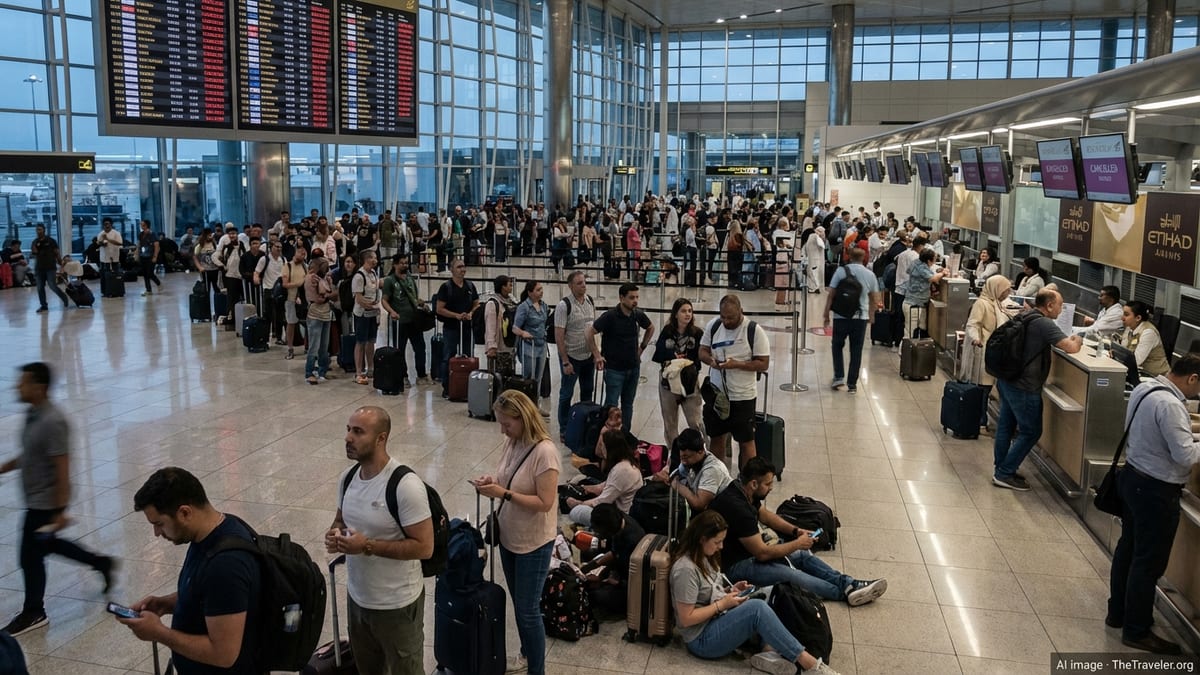
The US Mission’s messaging places notable emphasis on the potential for air travel disruption, a key concern for both residents and visitors who rely on Gulf hubs such as Dubai and Abu Dhabi for regional and intercontinental connections. The November notice, echoing language used in previous 2026 alerts, warns that Americans in the Middle East should be prepared for flight cancellations, periodic airspace closures and broader travel delays.
Publicly available information on recent advisories explains that these disruptions may not be confined to countries directly experiencing conflict. Because many major carriers route long haul flights through the Arabian Peninsula, temporary restrictions affecting one state’s airspace can quickly cascade into delays and diversions across a much wider network.
Travelers transiting through the UAE are being encouraged, through government guidance and airline communications, to monitor their flight status frequently on the day of departure, keep contact details updated with carriers and allow extra time for security checks. Reports on recent alert language also note that some itineraries involving multiple Middle Eastern stops could be more vulnerable to last minute schedule changes if tensions spike.
At the same time, the latest UAE specific travel advisory from the US Department of State continues to classify the country at a level that urges greater caution due to terrorism and armed conflict risks. The advisory highlights that tourist sites, transportation hubs and locations associated with certain communities or foreign interests could feature in potential targeting scenarios, even when daily life in cities such as Dubai appears to continue largely as normal.
Implications for Americans Living and Working in the UAE
The new alert has particular relevance for the sizable American expatriate community in the Emirates, many of whom work in aviation, energy, finance, education and hospitality. Official travel advisory text updated in late October notes that US government employees in the UAE require special authorization to visit military facilities and key energy installations, reflecting both host government rules and evolving security risk assessments.
Public information from the mission’s communications channels indicates that staffing and movement guidelines for US personnel can be tightened or relaxed as conditions shift. When restrictions are raised, it often signals that risk assessments for specific locations, such as symbolic sites or critical infrastructure, have worsened, even if there is no declared incident.
For private US citizens, the latest guidance focuses on personal security measures rather than mandatory movement restrictions. Americans are urged through consular communications and the worldwide caution notice to maintain a low profile, vary routes and routines, remain alert in crowded public places and stay away from demonstrations or large gatherings that could attract security force deployments.
Advisories also stress the importance of keeping travel documents, residency permits and local identification readily accessible. In a rapidly changing environment, this can be critical if authorities introduce temporary checkpoints, additional screening near sensitive facilities or new rules governing entry to ports and airports.
Guidance for Tourists and Transit Passengers
For short term visitors and transit passengers, the alert’s language suggests a need for more deliberate planning rather than automatic cancellation of trips. Publicly available State Department material continues to distinguish between complete prohibitions on travel to active conflict zones and strong recommendations to reconsider nonessential itineraries in surrounding states that might experience secondary effects.
Travel reporting from the region shows that many carriers serving Dubai and Abu Dhabi are still operating full schedules, but have adjusted routings and contingency plans based on evolving airspace restrictions. Tourists considering stopovers in the UAE are advised in open source travel advisories to check both their home government guidance and the latest US notices if they hold American citizenship, particularly when connecting onward to destinations elsewhere in the Middle East.
Experts cited in regional coverage recommend that travelers maintain flexible booking conditions, avoid tight layovers on multi leg journeys through Gulf hubs and secure comprehensive travel insurance that clearly covers cancellations or diversions linked to security developments. Given recent episodes of short notice airspace closures in the wider region earlier in 2026, a margin of flexibility can help reduce the risk of extended stranding.
The US Mission’s communication also reiterates long standing advice for Americans abroad to share itineraries and contact details with family members or trusted contacts and to have a basic contingency plan for accommodation should flights be delayed. For those who could face difficulties reentering their country of residence after a trip, advisory language suggests carefully weighing the necessity of non urgent travel before departure.
Steps Americans Are Urged to Take Now
Alongside the specific UAE alert, the broader State Department guidance on the Middle East crisis encourages US citizens to enroll in the Smart Traveler Enrollment Program. Public information notes that this free service delivers email or text updates from the nearest embassy or consulate and helps missions contact citizens in emergencies, including during sudden security incidents or major disruptions at airports.
Americans currently in the UAE or elsewhere in the region are also advised in open source consular materials to regularly review country specific travel advisories, which are updated as threat information changes. The October 23 advisory for the UAE, for example, reflects heightened concern over the potential for attacks by Iranian supported groups and indicates that risk levels are reviewed as new intelligence or incidents emerge.
Coverage of recent alerts stresses that citizens should keep mobile phones charged, store local emergency numbers, and identify at least one alternative route to and from their homes, workplaces and frequently visited locations. While everyday routines continue across much of the Gulf, the alerts emphasize that a baseline level of preparation can make a significant difference if conditions suddenly worsen.
For now, publicly available reporting suggests that the UAE continues to function as a major transit and business hub while authorities maintain enhanced security measures. However, the US Mission’s latest warning underlines that Americans moving through or residing in the wider Middle East in late 2026 face a more volatile landscape, one in which heightened awareness, careful planning and close attention to official advisories are increasingly essential parts of travel and daily life.