


More news on this day
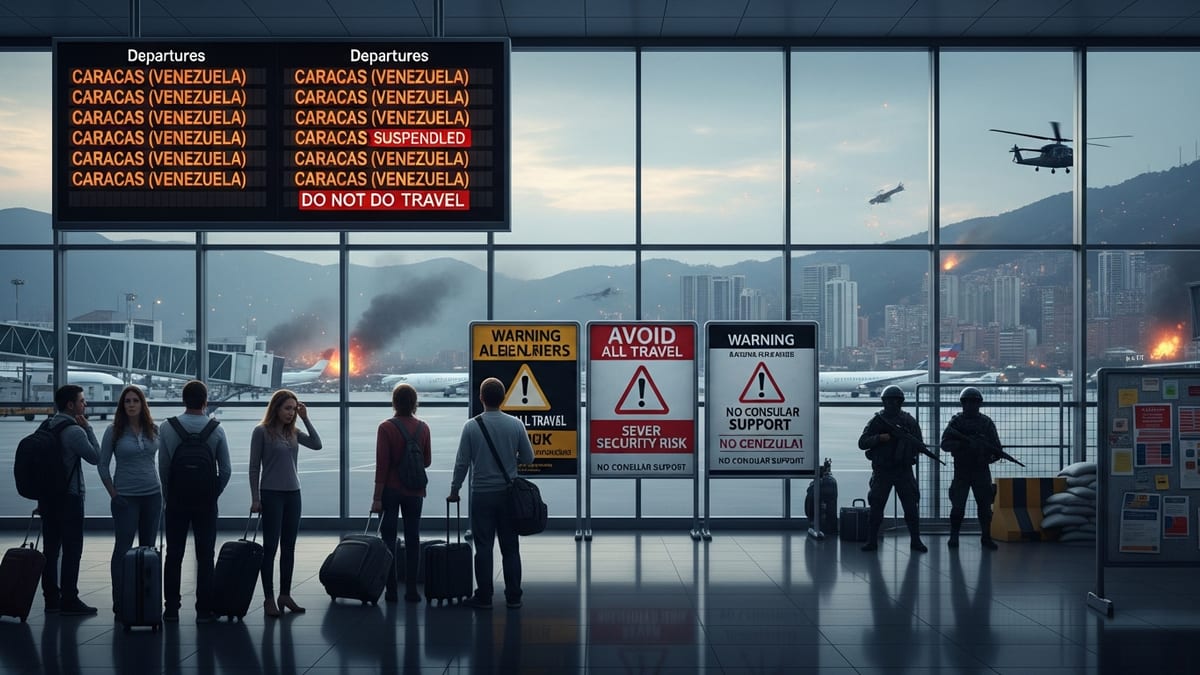
The United States has raised its travel advisory for Venezuela to Level 4, the highest warning on its four-tier scale, signaling that U.S. citizens should avoid all travel to the South American nation amid a shifting security and political landscape.
Get the latest news straight to your inbox!
Level 4 Status Marks Sharp Turn in Policy
The updated guidance returns Venezuela to the most severe U.S. travel warning, designated "Do Not Travel." Publicly available information indicates that the decision follows a reassessment of security conditions, political tensions, and the operating environment for foreigners throughout the country.
U.S. travel advisories are structured on a scale from Level 1, which encourages travelers to "exercise normal precautions," to Level 4, which advises against any travel. The renewed Level 4 status for Venezuela places it in the same risk category as a small group of destinations associated with widespread violence, institutional instability, or systemic breakdowns in public services.
Recent coverage notes that the heightened alert comes after a brief period in early 2026 when Washington experimented with easing its posture toward Caracas, including a reduction to Level 3 and the cautious restoration of commercial air links. The new advisory effectively reverses that opening, signaling increased concern over the reliability of local institutions and the potential exposure of foreign visitors to sudden disruptions.
According to reports on the advisory, travelers are now urged to reconsider any nonessential plans already in place and to evaluate contingency options if they are currently in the country. The language used in publicly available summaries stresses that conditions could deteriorate quickly, limiting the ability of outside partners to assist in an emergency.
Security Risks, Detention Concerns and Crime
Open-source summaries of the advisory highlight a broad spectrum of risks, including elevated levels of violent crime, the possibility of arbitrary detention, and the potential for foreign nationals to become entangled in local political or security disputes. These concerns are layered on top of long-standing issues such as armed groups in certain regions, kidnapping, and opportunistic crime in major cities.
Background coverage of prior warnings for Venezuela has consistently pointed to the risk that routine encounters with local authorities can escalate unexpectedly. Reports emphasize concerns surrounding opaque judicial processes, limited due process protections, and the danger that minor infractions or misunderstandings could lead to extended detention without timely consular access.
Analyses from policy institutes and risk consultancies also highlight that criminal activity in parts of the country often intersects with weak law enforcement capacity and shifting control of territory. Travelers may find that conditions vary sharply from one region to another, yet the new Level 4 designation reflects the overall national risk profile rather than any specific locality.
The advisory language, as relayed in media summaries, indicates that potential travelers should assume that personal security resources, secure transportation, and emergency medical evacuation could be limited or unreliable. This heightened uncertainty plays a central role in the decision to advise against tourism and most forms of discretionary travel.
Humanitarian, Economic and Aviation Context
The return to a "Do Not Travel" warning comes after tentative moves earlier in 2026 to normalize certain aspects of U.S.–Venezuela connectivity. Aviation industry reports documented the first resumption of direct commercial flights between the two countries since 2019, described at the time as a cautious step toward broader engagement.
Travel and security analysts now note that these gains are at risk as the security calculus shifts again. While the updated advisory does not by itself suspend commercial air service, it is likely to weigh heavily on airline route planning, insurance costs, and demand from both business and leisure travelers. Even a modest decline in international arrivals can affect local tourism operators, hotels, and small businesses that had begun preparing for a gradual rebound.
Humanitarian organizations monitoring the situation in Venezuela also view travel advisories as an indirect signal of conditions on the ground. Elevated risk levels typically reflect persistent challenges in health care provision, infrastructure reliability, and access to basic services. Although such advisories are framed primarily around the safety of foreign nationals, they often mirror concerns that affect local populations as well.
For travelers who must enter Venezuela for essential reasons, open-source guidance highlights the importance of robust contingency planning. This can include ensuring reliable local contacts, clear communication plans with family or employers, and a realistic assessment of how quickly exit routes could close if conditions worsen.
Impact on Travel Planning and Regional Mobility
The shift back to a Level 4 warning is expected to influence not only U.S. travelers but also regional mobility patterns more broadly. Tour operators in neighboring countries that had begun to market multi-country itineraries featuring Venezuela may reconsider those plans in light of the higher risk profile and potential liability.
Insurance providers commonly use government advisories as reference points in determining coverage for trip cancellations, emergency medical care, and evacuation services. With Venezuela now classified at the highest warning level, travelers may face exclusions or premium surcharges, and some policies may not provide coverage at all for discretionary trips into the country.
Travel industry observers point out that major booking platforms and corporate travel managers also rely on advisory data when programming destination approvals. A Level 4 notice often triggers automatic blocks on nonessential corporate travel, affecting sectors such as energy, logistics, and consulting that maintain a presence in resource-rich but volatile markets.
For independent travelers and diaspora communities, the renewed warning introduces a difficult trade-off between personal ties and safety considerations. Publicly available information suggests that travelers are being urged to weigh family visits and other compelling reasons against the possibility of sudden unrest, service breakdowns, or limited assistance in a crisis.
What Travelers Should Watch in the Coming Months
As the situation evolves, analysts recommend that potential visitors monitor updates to the advisory alongside regional news coverage, humanitarian assessments, and aviation notices. The trajectory of the warning level will likely depend on a combination of domestic political developments, security trends, and the capacity of institutions to provide reliable services across the country.
Observers note that previous adjustments to Venezuela’s travel status have sometimes come in response to discrete events, such as spikes in unrest, changes in leadership, or shifts in diplomatic relations. The current return to a Level 4 designation fits within that pattern, underscoring how quickly travel risk assessments can change in fluid environments.
Travelers with essential reasons to be in Venezuela are encouraged, according to widely circulated guidance, to maintain a low profile, avoid demonstrations, and develop detailed contingency plans in coordination with trusted contacts. Many risk advisories stress the importance of assuming that normal support mechanisms may be degraded or unavailable during periods of instability.
For the broader travel community, the renewed warning serves as a reminder of the value of checking official advisories close to departure dates, especially for destinations with recent histories of political tension or economic strain. As global mobility continues to recover, Venezuela’s return to the highest alert level illustrates the uneven and often fragile nature of that rebound.