


More news on this day
American travelers and expatriates across West Asia are facing renewed uncertainty after the United States issued a fresh regional security alert, urging its citizens to consider departing as tensions linked to Iran’s confrontation with the US and its partners continue to ripple across the Middle East.
Get the latest news straight to your inbox!
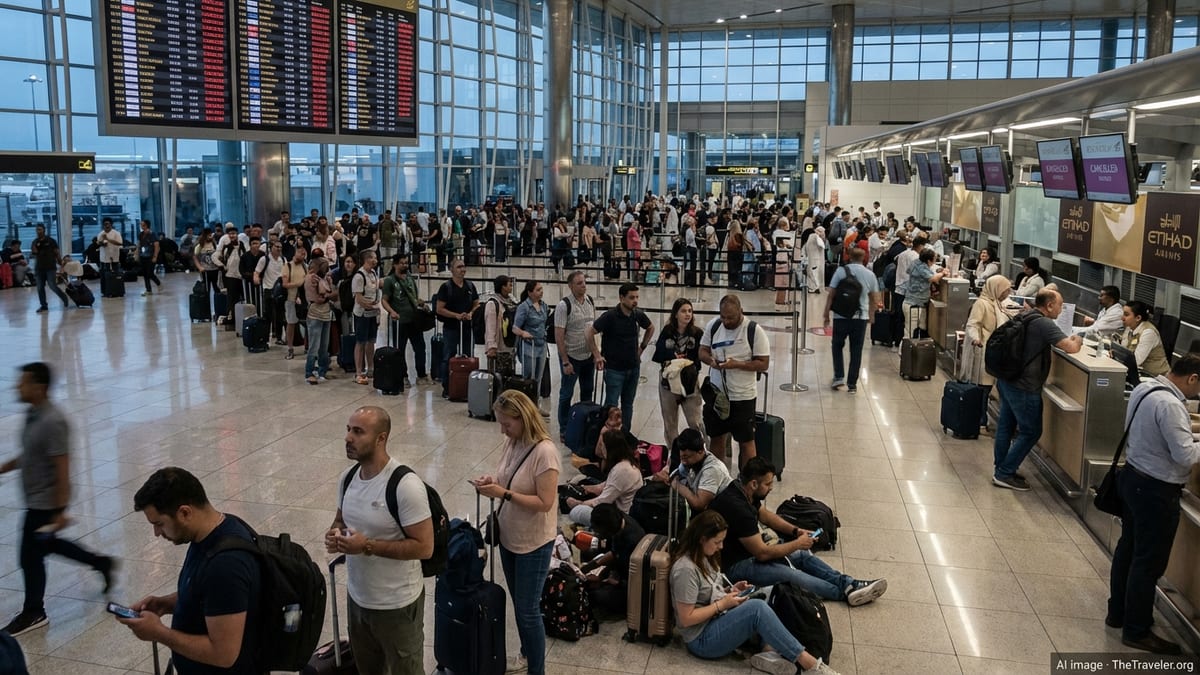
New regional alert urges Americans to be ready to depart
According to publicly available security messages shared by US diplomatic missions in the Gulf, the latest alert advises Americans in West Asia to consider leaving the region or to ensure they are prepared to depart at short notice in the event of further escalation. The wording reflects concern that any sudden deterioration in the security environment could rapidly disrupt commercial flights and overflight permissions, limiting exit options for foreign nationals.
Recent advisories highlight the potential for airspace closures, flight cancellations and congestion at major hubs that serve as key transit points between the Middle East, Europe and North America. The guidance stresses that Americans should not assume that governments will be able to organize emergency evacuations and instead are encouraged to plan for self-directed departure while commercial routes remain open.
Travel information shared in recent days reiterates that Iran, Iraq, Syria, Lebanon, Gaza and Yemen remain under the highest level of US travel warning, with formal advice not to travel due to risks from conflict, terrorism and arbitrary detention. Several US embassies around the region have republished the new alert, amplifying the message that Americans should carefully reconsider any nonessential trips into or through West Asia.
Iran tensions drive heightened caution across West Asia
The fresh alert comes against the backdrop of an extended crisis triggered by the 2026 Iran war and earlier US strikes on Iranian nuclear and military infrastructure. Publicly available timelines describe a cycle of attacks and retaliatory strikes involving Iran, the United States and regional allies, including missile and drone activity that has periodically targeted energy infrastructure, bases and shipping lanes.
Security assessments circulated in recent months describe a risk that groups aligned with or supportive of Iran could look to target US-linked interests across the wider region. This includes diplomatic facilities, commercial sites and public venues associated with the United States or its partners. Such concerns have underpinned repeated calls for Americans in affected countries to maintain a low profile, avoid demonstrations and be alert to changing conditions.
Regional evacuation case studies and crisis digests compiled by think tanks and consultancies note that earlier phases of the Iran conflict saw foreign embassies urge citizens to depart Iran itself and, in some instances, helped facilitate limited charter flights from nearby Gulf states. Those experiences appear to inform the current emphasis on leaving while standard commercial travel remains available, rather than waiting for a more severe deterioration that could limit both air and land exit corridors.
Travel disruption risks for air hubs and transit passengers
For travelers and expatriates who routinely use West Asia as a transit corridor, the latest US messaging underscores the fragility of the region’s air connectivity when tensions spike. Security summaries for airlines and corporate travel managers point to scenarios where regional airspace could be restricted with little notice, particularly over the Gulf and eastern Mediterranean, forcing rerouting or temporary suspension of flights.
Major hubs in the United Arab Emirates, Qatar and Saudi Arabia have previously been affected by shifting risk calculations during episodes of heightened tension, with carriers adjusting flight paths or temporarily suspending services on specific routes. While airports in these states often remain operational, the cumulative effect of multiple airspace advisories, insurer concerns and airline risk thresholds can sharply reduce options for travelers attempting to leave neighboring high-risk countries.
Travel risk bulletins circulated to companies with staff in West Asia stress the importance of monitoring airline schedules closely, holding flexible or refundable tickets where possible, and avoiding itineraries that rely on tight connections through a single regional hub. The new US alert, by explicitly raising the possibility of periodic airspace closures, is likely to reinforce those corporate risk-management practices and encourage earlier departure decisions.
Impact on expatriates, business travelers and tourism
The call for Americans to consider departing West Asia carries particular weight for long-term residents, contractors and students who have made their homes in Gulf states or in countries closer to the front lines of the Iran-related confrontation. Online discussions among expatriate communities reflect a mix of concern and fatigue, with some residents treating the alert as a serious signal to relocate and others viewing it as a continuation of an already elevated risk environment.
Business travel to the region had been recovering in the wake of earlier conflicts and pandemic-era disruptions, supported by strong demand in energy, construction and logistics sectors. However, industry digests tracking the 2026 Middle East crisis report that repeated security alerts and shifting insurance costs have added complexity to corporate trip approvals, particularly for projects in or near high-risk countries such as Iraq and Lebanon.
Leisure tourism into Gulf destinations has so far proven more resilient than travel to conflict-adjacent states, although analysts note that a prolonged period of elevated warnings from major Western governments could gradually dampen demand or redirect travelers toward alternative winter-sun and stopover hubs. For American travelers in particular, the latest US advisory may prompt some to swap itineraries involving Middle Eastern transits for routings through Europe or Asia instead.
What Americans in the region are being advised to do
Publicly available guidance linked to the new security alert urges Americans who choose to remain in West Asia to maintain updated travel documents, register with relevant consular services where available and keep family or employers informed of their movements. Travelers are encouraged to maintain ready access to essential supplies, secure accommodation and more than one potential route out of the country where they are staying.
Travel risk specialists recommend that Americans review the specific advisory level for each country in their itinerary, as conditions can vary sharply over relatively short distances. Iran, Iraq, Syria and Lebanon remain classified as locations where US guidance strongly discourages any travel, while several Gulf states are currently rated at a lower, though still elevated, level that calls for extra caution and detailed contingency planning.
For Americans still considering trips to or through West Asia in the coming weeks, the evolving situation around Iran means that flexibility and risk tolerance will be key factors. Many airlines continue to operate extensive networks across the region, but the latest US alert makes clear that travelers should be prepared for rapid changes, including the possibility that the safest option may be to depart earlier than originally planned.