


More news on this day
American travelers considering trips to Libya are confronting some of the starkest language in any current United States travel advisory, with guidance that urges those who ignore a sweeping “Do Not Travel” warning to prepare a will, establish proof-of-life protocols and even leave DNA samples behind with medical providers before entering the North African country.
Get the latest news straight to your inbox!
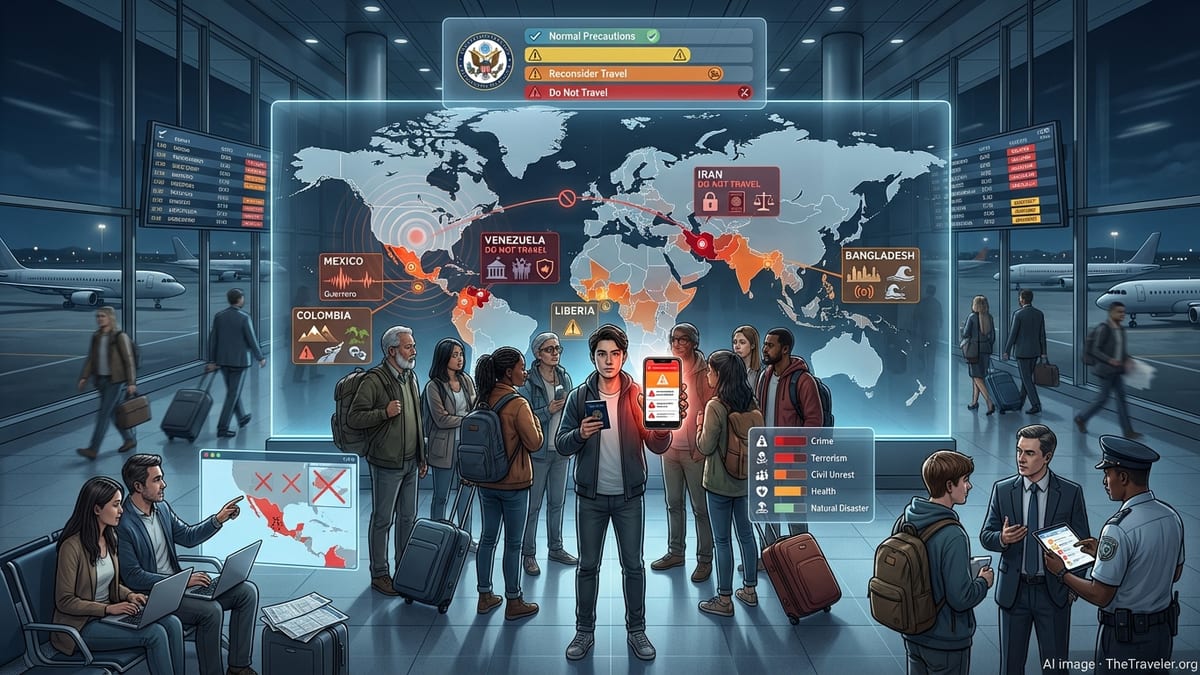
Level 4 warning highlights extreme risks in Libya
Libya has been under the US government’s highest travel warning for years, but a recent update to the advisory has sharpened attention on the risks facing foreign visitors. The country remains designated Level 4 “Do Not Travel,” reflecting what publicly available guidance describes as a combination of crime, terrorism, civil unrest, health risks, kidnapping and the presence of landmines and unexploded ordnance across parts of the territory.
The State Department’s Libya page notes that armed groups, militias and forces aligned with rival authorities retain significant control on the ground, creating a volatile security environment where clashes can erupt with little or no warning. Weapons are described as widely available, increasing the likelihood that local disputes, political tensions or criminal activity can quickly escalate into armed confrontations that catch civilians, including visitors, in the middle.
Other publicly accessible government materials on high-risk destinations underline that some locations categorized at Level 4 present such severe threats that US officials may have limited or no ability to assist if travelers get into trouble. This broader framework is used to explain why certain advisories include unusually blunt personal-preparedness recommendations intended for those who choose to visit despite the warnings.
For Libya, that framework now sits alongside language that has drawn intense public and media scrutiny, as commentators highlight the gap between typical vacation planning and the measures described for high-risk zones on the southern shores of the Mediterranean.
Advisory urges wills, DNA samples and proof-of-life plans
Within the Libya advisory and companion guidance on high-risk areas, American travelers are urged to take a series of steps that go far beyond conventional safety checklists. According to the government’s high-risk country guidance, those who insist on traveling to destinations facing heightened danger are encouraged to draft or update a will, designate insurance beneficiaries, consider a power of attorney and discuss with loved ones how children and property would be managed if they were unable to return home.
The same materials recommend leaving DNA samples with a trusted medical provider and ensuring that dental records are accessible to family members, a measure described as potentially necessary for identification of remains in the aftermath of a kidnapping, terrorist attack or other fatal incident. The guidance also promotes establishing a “proof of life” protocol in advance, under which a designated family member would know specific questions and answers that only the traveler could provide, to verify they are alive if taken hostage.
Publicly available information on high-risk travel further advises US citizens to share passwords, critical documents and contact lists with close contacts before departure; to erase sensitive or potentially provocative material from phones, laptops and social media accounts; and to leave behind items of high financial or sentimental value that could make travelers more attractive targets. These steps, while unsettling, are framed as practical planning measures in environments where the risk of kidnapping, wrongful detention or sudden violence is considerably higher than in more typical tourist destinations.
The language has appeared in various forms for some of the world’s most dangerous destinations, but Libya’s renewed prominence in recent days has focused attention on the intersection of tourism, personal security and the limits of consular assistance when conflicts and criminal networks overlap.
Kidnapping, militias and limited consular support
Recent coverage of the Libya advisory highlights kidnapping as one of the most serious concerns for Americans in the country, describing abductions as widespread and noting that victims have included US citizens in the past. Criminal groups, smugglers and armed factions are reported to be involved in activities ranging from human trafficking and fuel smuggling to politically motivated kidnappings and targeted assassinations, increasing the risk that foreigners may be perceived as high-value hostages.
Published reports also point out that the United States does not maintain an operating embassy in Libya, significantly restricting options for emergency help on the ground. The advisory states that US government employees are not present in country due to security concerns, complicating any potential response to crises involving American travelers. In practice, this means that those who enter Libya may need to rely heavily on private security arrangements, local contacts or neighboring embassies if conditions deteriorate.
Guidance on high-risk areas emphasizes that in such environments, evacuation options can become extremely limited with little notice. Airports may shut down, commercial flights may be suspended and overland routes can become impassable because of fighting, checkpoints or criminal activity. Travelers are therefore urged to develop their own contingency plans to leave quickly if the situation worsens, plans that do not depend on assisted evacuations by the US government.
Security advisories further caution that terrorist attacks and violent demonstrations can strike in or near locations that might otherwise attract visitors, such as hotels, government buildings, transportation hubs or public squares. The combination of political fragmentation, armed militias and opportunistic criminal networks contributes to what several commentaries have described as an “unprecedented” level of risk for casual tourism in Libya.
Impact on regional travel and tourism perceptions
Libya’s stringent travel warning comes as other North African destinations continue to attract international visitors, underlining the region’s complex security map. Neighboring countries such as Tunisia and Morocco, for example, have generally maintained lower advisory levels that call for increased caution rather than outright avoidance, reflecting more stable conditions in core tourist areas even as some border regions face challenges tied to smuggling routes and militant activity.
Analysts note that blanket impressions of North Africa as uniformly unsafe can obscure important distinctions between states and within individual countries. However, the severity of the Libya advisory, together with its striking personal-preparedness instructions, has the potential to shape broader perceptions of travel in the region, particularly among first-time visitors who may not differentiate between destinations along the Mediterranean coast.
The heightened language on wills and DNA samples also feeds into an ongoing debate about how governments communicate risk to their citizens. Some travel experts argue that strongly worded advisories help deter casual tourism in places where infrastructure and security conditions are ill-suited to visitors, while others warn that overreliance on stark language without detailed context can lead travelers to discount official guidance over time or to assume that all Level 4 countries present identical threats.
For tourism professionals, the Libya case underscores the importance of monitoring official advisories not only for their headline messages but for the specific details and requirements that can affect insurance coverage, tour operations and evacuation planning. Industry observers suggest that travelers, tour operators and insurers are likely to scrutinize updates closely as the situation on the ground evolves.
How Americans can track and interpret evolving advisories
US citizens planning any international travel are encouraged, in publicly available government resources, to consult destination-specific advisories, enroll in alert systems and regularly review high-risk area guidance even if they do not intend to visit the most dangerous locations. Advisory levels can change on short notice in response to security incidents, political shifts or natural disasters, and additional measures such as proof-of-life protocols or DNA recommendations may appear or be updated as threats evolve.
Travel information portals run by the US government serve as central hubs for these notices, consolidating country pages, high-risk area advice, crisis response descriptions and information on how consular services function in emergencies. Travelers can use these tools to understand not only whether a destination is categorized as Level 1, 2, 3 or 4, but also what specific behaviors, neighborhoods or border areas are flagged as particularly hazardous.
In the case of Libya, current guidance signals that leisure travel is strongly discouraged and that even essential trips should be planned with a level of preparation more commonly associated with conflict zones than with holiday destinations. For American tourists, the message embedded in calls to prepare wills, leave DNA samples and plan for hostage scenarios is that this is not a routine high-risk trip, but an environment where worst-case outcomes are sufficiently plausible to merit explicit, written contingency plans.
As global travel continues to rebound, the Libya advisory stands out as a reminder that safety conditions vary dramatically across destinations and that reading beyond the headline level of a warning can reveal just how far from ordinary some risks have become.
US Department of State Libya Travel Advisory
US Department of State High-Risk Areas Guidance
Yahoo Travel: Americans traveling abroad asked to leave DNA samples and wills
Fox News: Americans headed for high-risk nation urged to prepare wills, leave DNA samples
News File Daily: American tourists urged to prepare wills, leave DNA samples