


Arriving at Venice Marco Polo Airport is one of Europe’s most memorable travel moments. Instead of taxis and trains, you step out towards a lagoon of wooden piers, polished boats and shimmering water. The big question for many visitors is whether to splurge on a private or shared water taxi, or to stick with cheaper options like the Alilaguna water bus or the airport coach to Piazzale Roma. This guide walks you through real-world costs, how luggage and hotel docks work, and the situations when paying more for a water taxi genuinely makes sense.
Get the latest updates straight to your inbox!
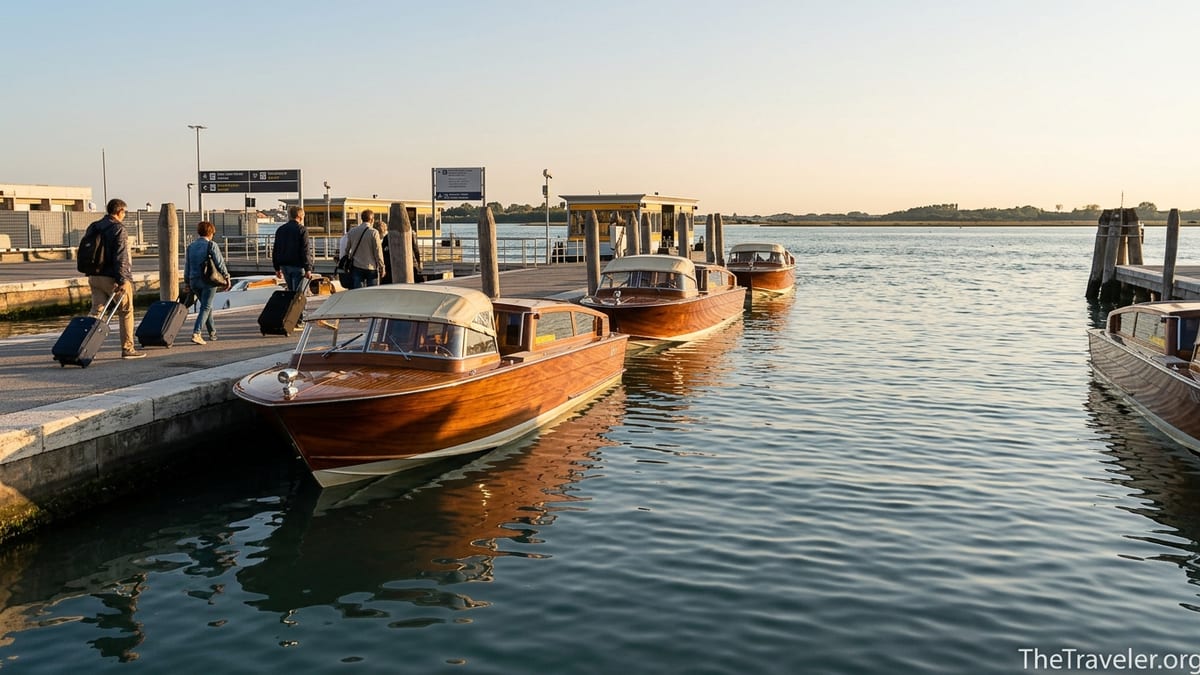
How Water Taxis Work from Venice Marco Polo Airport
Venice Marco Polo Airport sits on the edge of the lagoon, around 13 kilometers from the historic center. After landing, signs inside the terminal direct you to "Water Transport". You walk about 7 to 10 minutes along a covered walkway to reach the dock area, where private water taxis, shared water taxis and the Alilaguna water buses all depart. The dock is directly on the lagoon, so there is no road traffic between the airport and your boat.
Private water taxis are fast, enclosed wooden motorboats with a small cabin and outdoor seating at the back. They operate like door-to-door limousines on water. You either pre-book online or via your hotel, or you walk up to the official taxi desk at the dock and are assigned the next available boat. Shared water taxis are similar boats but you share them with other passengers headed in the same general direction, often booked through specialist transfer companies.
Travel time from Marco Polo Airport to central Venice by water taxi is usually around 25 to 35 minutes, depending on your exact hotel location and traffic on the canals. The boats take a route across the open lagoon before entering the city’s canals near the northern edge of Venice or by skirting towards the Grand Canal. Compared with the Alilaguna water bus, which can take 60 to 75 minutes with multiple stops, the time saving is substantial.
Water taxis run all day and night, but at certain hours they may be less frequent and more expensive. Late-night or very early-morning flights often mean surcharges for transfers leaving after about 22:00 or before 06:00. If your budget is tight and you land very late, it can be worth comparing the cost of a land taxi plus vaporetto to see if the price difference justifies the convenience.
Private Water Taxi Costs: What to Expect in 2026
Prices fluctuate by operator and season, but by mid‑2026 most standard private water taxi transfers from Venice Marco Polo Airport into the historic center fall in a typical range of about 130 to 170 euros for up to 4 passengers, booked in advance. These are guideline figures based on current fare structures and recent quotes; exact prices vary slightly between companies and routes. Some hotels, especially luxury properties, may quote higher flat rates that bundle meet-and-greet assistance in the terminal and porterage for luggage.
If you walk up to the official taxi desk at the airport without a reservation, you will usually pay a regulated base price for a standard taxi boat, but supplements quickly add up. Expect extra charges for night departures, additional passengers after the first four or five, and for particularly distant destinations in the lagoon. For example, a couple staying near Piazza San Marco might pay a base fare around 150 euros in the early evening, while a family of six in high season with heavy luggage and a late-night arrival could easily see a bill above 200 euros.
Some real-world examples help clarify what these prices feel like in context. A family of four landing in the late morning and going to a hotel with a private dock near the Rialto Bridge might pay around 150 euros, which breaks down to about 37 euros per person. The same family taking the Alilaguna water bus at roughly 15 euros per person from the airport to Rialto would spend about 60 euros in total, but accept a longer ride and a short walk or vaporetto hop at the end. On the other hand, a couple staying at a luxury property like a canal-front palazzo near San Marco might view a 150 to 180 euro private transfer as part of the overall experience, especially if the hotel arranges a seamless tickets-and-assistance package.
In almost all cases, it is better to have the price clearly confirmed in writing when you book. Reputable firms, including those recommended by central hotels, will provide a fixed price that already includes taxes and mandatory supplements, and will specify extra costs such as night surcharges and waiting time if your flight is significantly delayed. Paying by card is increasingly common, though some companies still prefer cash; ask in advance so you are not searching for an ATM on arrival.
Shared Water Taxis and Alilaguna: Cheaper Alternatives
For many travelers, shared water taxis provide a middle ground between the speed of a private boat and the economy of public transport. Shared services usually cost somewhere in the region of 30 to 45 euros per person from Venice Marco Polo Airport into central Venice, with exact prices depending on the operator, season and how many people you are sharing with. Boats often carry 8 to 10 passengers and drop them at a series of central stops such as near San Marco, Rialto or along the Grand Canal.
In practice, this means that a couple might pay around 80 euros total for a shared taxi instead of 150 or more for a private one. The trade-off is that you may wait 20 to 30 minutes for all passengers to assemble, and you might not get delivered directly to your hotel dock. Instead, you are dropped at an agreed landmark pier and cover the final 3 to 10 minutes on foot, which is perfectly manageable with light luggage but less appealing with multiple heavy bags or mobility issues.
The lowest-cost water option from the airport itself is the Alilaguna water bus, which operates several color-coded lines that connect Marco Polo Airport with major stops such as Fondamente Nove, Rialto, San Marco, Zattere and the Lido. As of 2026, a one-way ticket from the airport into Venice typically costs around 15 euros per adult, with slightly reduced fares for round trips. Journey times are longer, often around an hour or more depending on the route and intermediate stops, but you get a direct boat ride from the airport dock to key areas of the city.
Travelers on tight budgets or staying near Alilaguna stops can save significantly. For example, a solo backpacker staying near Zattere could pay about 15 euros for Alilaguna instead of taking a 130‑plus euro private taxi. A family of five aiming for San Marco might find that a shared water taxi, at around 40 euros per person, still comes out cheaper than a private transfer while offering faster travel and less walking than Alilaguna with multiple suitcases and children in tow.
Luggage Rules, Comfort and Mobility Considerations
Luggage is where the comfort difference between water taxis and cheaper options becomes very visible. Private taxis generally include a reasonable amount of luggage in the quoted fare, such as one standard suitcase and one small carry-on per person. If you are traveling with outsized items like golf bags, musical instruments or several large suitcases each, you should mention this when booking. Some companies may add a modest surcharge for excessive or bulky luggage, especially if it reduces the number of passengers that can be carried safely.
On the dock at Marco Polo Airport, staff or boat crew often help you load bags onto the boat, though this is not guaranteed and relies on the operator. Once on board, luggage is usually stowed behind the cabin or in a central space where it does not block aisles. Compared with Alilaguna, where you may have to manage your own bags on a crowded boat and step on and off with dozens of other passengers, a private or shared taxi generally offers a calmer, less hectic experience with more personal space and seating.
Mobility is another important factor. The boats are low to the water, and boarding often involves stepping down from the pier onto the deck, which can feel unsteady in choppy conditions. For travelers with knee problems, balance issues or those using walking aids, having crew assistance and not wrestling heavy bags on and off a public boat can justify the higher cost of a private taxi. Seniors who might otherwise struggle on a packed vaporetto or water bus sometimes choose a taxi simply to avoid stairs, crowding and long periods of standing.
That said, water taxis are not fully accessible for all disabilities, and there are no universal standards across operators. If you use a wheelchair or have very limited mobility, contact your hotel or a specialist transfer company well in advance. In some cases, a land taxi to Piazzale Roma, followed by a short, flat walk or a vaporetto ride, may be safer and more practical than any boat directly from the airport dock.
Hotel Docks, Drop-Off Points and Where Boats Can Really Go
One of the main selling points of a private water taxi is the promise of door-to-door service. In reality, whether the boat can pull up right at your hotel depends on the property’s location and whether it has a usable private dock. Many canal-front hotels in San Marco, San Polo and Dorsoduro, especially those in historic palazzi, do have small docks on a side canal or directly on the Grand Canal, allowing the taxi to nose straight up to the steps at your front door.
Examples include several well-known properties near Rialto and San Marco that highlight their private dock access in their descriptions. Guests arriving at a canal-front luxury hotel often step directly from the boat onto the hotel’s marble steps, with staff waiting to take bags. Mid-range hotels and smaller boutique properties along quieter canals may also have side entrances accessible by water, which water taxi companies know and use regularly. When in doubt, emailing your hotel with your booking and asking whether they have a private dock is the simplest way to confirm what to expect.
If your accommodation does not have a dock on a navigable canal, water taxis will normally drop you at the nearest public pier or landing stage. This might be a short walk away, such as from Rialto bridge to an apartment in San Polo, or from San Zaccaria to a guesthouse hidden in Castello’s alleys. For many visitors, this final walk is part of the charm, but it is important to understand that "direct to hotel" in marketing language often means "to the nearest sensible landing point" rather than literally to your doorstep.
In a few parts of the city with very narrow or shallow canals, or where bridges have low clearance, even slim water taxis cannot pass safely. In those situations, companies will specify an alternative drop-off point when you book. If you are staying in an apartment booked through a platform, it is crucial to ask the owner which boat stop or landmark pier you should give to the taxi company. Clear instructions, such as "get off at Ca’ Rezzonico stop and walk two minutes," can save you from confusion while balancing bags on cobblestones.
When a Water Taxi Is Worth the Money
Not every traveler needs a water taxi from Venice Marco Polo Airport, but for some it is easily worth the premium. A classic example is a short city break: imagine a couple flying in on Friday afternoon and out again on Sunday. With only 48 hours in Venice, they might decide that spending an extra 100 euros or so on a private taxi cuts an hour or more from each transfer, effectively giving them an extra half-day of sightseeing and a stress-free arrival straight to their hotel dock near San Marco.
Another situation where a taxi makes sense is for groups. A family of six with several suitcases may find that the cost difference between a private taxi and six separate Alilaguna tickets is not as dramatic as it looks at first. If a private taxi is quoted at, for example, 170 euros and Alilaguna tickets are around 15 euros per person one-way, the group would pay about 90 euros on Alilaguna. The extra 80 euros for the private taxi could be justified by avoiding a long crowded ride, managing multiple transfers and walking with tired children after a long-haul flight.
Special occasions are another obvious case. Honeymooners staying on the Grand Canal often choose a private taxi for the sense of arrival, especially if landing in the evening when the palazzi and churches are lit up. Couples celebrating an anniversary, or traveling with older parents who may only visit Venice once, may view the water taxi not just as transport but as a unique introduction to the city. A shared taxi can still offer a scenic ride at a lower price, though without the exclusivity and guaranteed private boat for photographs and quiet moments.
On the other hand, there are times when a water taxi is not worth it. Visitors planning a longer stay in budget accommodation, especially those comfortable using buses and vaporetti, might be better served by taking the airport express coach to Piazzale Roma and then using a vaporetto pass for the rest of their trip. Students and backpackers, or anyone arriving in broad daylight with plenty of energy, often find this combination entirely manageable. The key is to weigh your group size, luggage, time constraints and mobility against the price difference.
Booking Tips, Timing and Avoiding Common Pitfalls
Booking ahead is the safest approach if you know your flight details. Reputable water taxi firms and many hotels offer online reservation forms where you provide your flight number, arrival time, hotel name and contact information. In return, you receive a voucher or confirmation with clear instructions on where to go in the terminal and at the dock. This reduces uncertainty, especially after a long flight when you might not feel like haggling or seeking out desks among crowds of arriving passengers.
Timing matters. If your flight is scheduled to land in Venice at a peak hour, such as mid-morning or early afternoon during spring and autumn, walk-up queues at the airport water taxi desk can be long. Pre-booked passengers will usually have a boat allocated, while others must wait. Conversely, in the early morning or late at night, you may find that shared taxi departures are less frequent, which can mean longer waits for enough passengers to fill the boat.
To avoid surprises, always clarify what is included in the quoted fare. Ask about surcharges for night-time departures, extra luggage, additional passengers and waiting time in case of flight delays. Some companies monitor flight arrivals and adjust pick-up times automatically, while others start charging extra after a certain grace period. If your accommodation is on another island in the lagoon, such as Murano or the Lido, confirm that the quoted fare covers this and not just central Venice.
Finally, keep practicalities in mind. Make sure your phone works on arrival in Italy in case you need to contact the operator, and carry the company’s number and your hotel’s details in both English and Italian. Agree in advance on the exact drop-off point, particularly if you are staying in a rental apartment without a concierge. Clear instructions, combined with a fixed price and realistic expectations about walking distances from the dock, will turn your arrival by boat into one of the highlights of your trip.
The Takeaway
Water taxis from Venice Marco Polo Airport are a premium way to arrive in one of the world’s most enchanting cities. They are fast, scenic and, for many travelers, the most convenient option, especially when they can dock directly at your hotel or a nearby pier. The trade-off is cost: compared with the Alilaguna water bus or the airport coach plus vaporetto, you are paying significantly more for speed, comfort and a touch of glamour.
For short stays, special occasions, groups, and anyone traveling with heavy luggage or older relatives, the higher price can be justified by the time saved and the ease of a near door-to-door transfer. Shared water taxis offer a useful compromise for couples and small groups who want a quicker and more intimate journey than the public water bus, but do not need an exclusive boat. Solo travelers, students and budget-conscious visitors are usually better served by the cheaper options, particularly if they are comfortable with a longer ride and a bit of walking.
When planning your own arrival, think about your priorities. If stepping straight from the airport dock onto a sleek wooden boat and gliding across the lagoon to your hotel sounds like an unmissable part of the Venice experience, then a water taxi is likely worth the extra money. If you prefer to save that budget for meals, museum tickets or gondola rides, the city’s buses and water buses will still get you into the heart of Venice, just at a gentler pace. Either way, understanding the real costs, luggage rules and hotel access will help you choose the right option for your trip.
FAQ
Q1. How much does a private water taxi from Venice Marco Polo Airport to central Venice cost?
In 2026, most private water taxis from Marco Polo Airport to central Venice cost roughly 130 to 170 euros per boat for up to four passengers, with higher prices for late-night rides, larger groups or more distant destinations in the lagoon.
Q2. Is a shared water taxi from Venice airport worth it compared with Alilaguna?
A shared water taxi often costs around 30 to 45 euros per person, but is faster and usually less crowded than the Alilaguna water bus, which is cheaper at about 15 euros per person but takes longer and may involve more walking at the end.
Q3. Can a water taxi reach any hotel in Venice?
Water taxis can reach many hotels that have a private dock or are on a navigable canal, including numerous properties near the Grand Canal and San Marco, but if your hotel or apartment is tucked away from the canals the boat will drop you at the nearest public pier and you will walk the final few minutes.
Q4. Do I need to book a water taxi in advance at Venice Marco Polo Airport?
Advance booking is strongly recommended, especially in high season or at busy times of day, because it secures a fixed price and reduces waiting at the dock; however, you can also arrange a taxi on arrival at the official desk if you are prepared to wait longer and accept the on-the-spot fare.
Q5. How long does a water taxi from Venice airport to San Marco take?
Under normal conditions, a private water taxi from Marco Polo Airport to the San Marco area takes about 25 to 35 minutes, whereas the Alilaguna water bus on a similar route can take an hour or more due to intermediate stops.
Q6. Are there extra charges for luggage on Venice water taxis?
Most private taxi fares include a standard amount of luggage, such as one suitcase and one small carry-on per person, but bulky items or an unusually large number of bags can incur supplements, so it is wise to mention your luggage when requesting a quote.
Q7. Are Venice water taxis suitable for travelers with limited mobility?
Water taxis are more comfortable and less crowded than public water buses, which can help travelers with limited mobility, but boarding still involves stepping onto a moving boat and they are not fully accessible for all disabilities, so anyone with serious mobility challenges should coordinate in advance with their hotel or a specialist transfer provider.
Q8. What is the cheapest way to get from Venice Marco Polo Airport to the city?
The cheapest common options are the Alilaguna water bus at roughly 15 euros per person from the airport dock, or the airport express coach to Piazzale Roma for around 10 euros, followed by a vaporetto or a walk to your final destination.
Q9. Do Venice water taxis run late at night and early in the morning?
Yes, private water taxis operate around the clock, but late-night and very early-morning rides typically carry higher fares, and shared services may be less frequent, so it is important to pre-book if your flight arrives outside normal daytime hours.
Q10. Should I use a water taxi if I am staying on another island like Murano or the Lido?
Many travelers staying on Murano or the Lido choose a private or shared water taxi for a direct transfer from the airport, although it costs more than Alilaguna or a combination of bus and vaporetto; the extra expense is often justified if you have heavy luggage, limited time or prefer to avoid changing boats with bags.