


Victoria Glacier, draped across the back wall of Lake Louise in Banff National Park, is one of the most photographed ice fields in the Canadian Rockies. Whether you are a first time visitor stepping onto the lakeshore, a hiker chasing bigger viewpoints, or a photographer planning a sunrise mission, choosing the right vantage point can make the difference between a pleasant look and a truly unforgettable encounter with the glacier. This guide breaks down the best real world spots to see Victoria Glacier, what each one feels like on the ground, and how to match them to your time, fitness, and photography goals.
Get the latest updates straight to your inbox!
Understanding Victoria Glacier and the Lake Louise Setting
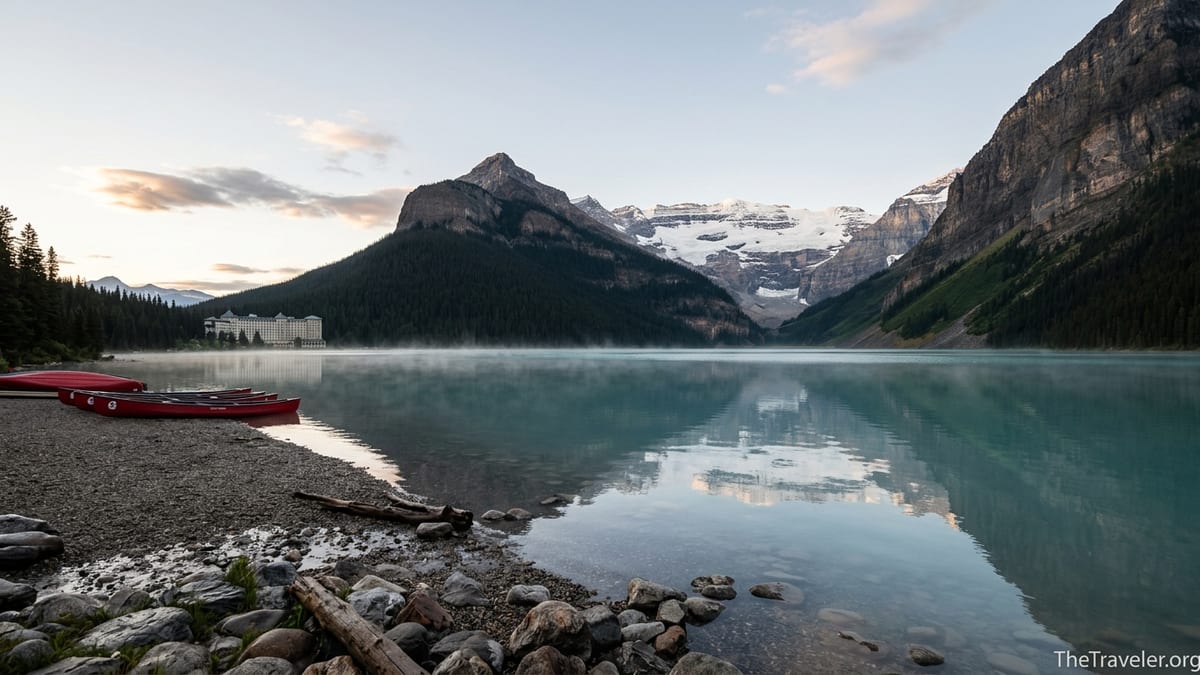
Victoria Glacier clings to the north face of Mount Victoria at the far end of Lake Louise, forming the snowy, fractured backdrop that appears in countless Canadian Rockies postcards. From the hotel terrace or the public lakeshore, you are looking almost directly up the glacial valley toward this mass of ice and the neighboring Lefroy and Aberdeen glaciers. Even without hiking, it is easy to appreciate how meltwater from this icefield feeds the lake and gives it that milky turquoise color visitors travel halfway around the world to see.
The glacier itself is not a single smooth sheet of white. When you look closely through binoculars or a zoom lens you will see broken seracs, deep crevasses, and streaks of rock debris that give the ice a striped, sometimes dusty appearance rather than a pristine snowfield. The view also changes dramatically with the seasons. In early summer, fresh snow softens the lines and the glacier looks whiter; by September, more rock and old ice is exposed and the surface tends to look grayer and more textured.
Because Lake Louise sits within Banff National Park, there is no road access to the base of the glacier itself. Every close view is earned on foot along established trails, which makes these perspectives especially rewarding for hikers and photographers. For first time visitors or travelers with limited mobility, the good news is that some of the best compositions of Victoria Glacier are available within a short, mostly flat walk from the parking area and lakeside hotels.
What follows focuses on specific, well known spots that regular visitors and local guides rely on: the lakeshore and canoe dock, the Plain of Six Glaciers trail and teahouse area, classic ridge viewpoints like Big Beehive and Fairview, and a few small variations that make a big difference to how the glacier appears in your frame.
Lakeshore & Canoe Views: Essential First Look at the Glacier
For many travelers, the first glimpse of Victoria Glacier comes just steps from the Lake Louise parking lot. A broad paved path leads past the Fairmont Chateau Lake Louise and out onto the public lakeshore. Within two or three minutes on level ground, you can stand at the water’s edge looking straight across the turquoise lake to the glacier at the far end. This is the classic “front of postcard” view: glacier centered, steep walls of Mount Victoria on the left and Mount Lefroy on the right, and often a line of bright red canoes sliding across the foreground.
Early morning is when this viewpoint is at its most photogenic. In June and July, sunrise can be just after 5 a.m., and photographers often arrive before the first tour buses so the lake is still glassy and the glacier is reflected cleanly on the water. By late morning on a warm day, the surface is usually ruffled by wind and filled with rental canoes, which creates a busier but still appealing scene. Tripods are allowed on the public shoreline, and you will see hobbyists with everything from phones to full frame cameras capturing long exposures as mist lifts off the water.
For a slightly different angle without much extra effort, follow the lakeshore trail along the right hand (north) side of Lake Louise. Within about 15 to 20 minutes you reach quieter spots with boulders at the shoreline and fewer people, where the glacier sits a little off center and the valley narrows in your frame. This trail is wide, mostly flat and suitable for families and first time visitors; sturdy walking shoes are enough in dry conditions, although in May and early June patches of snow and wet roots can make it slick.
If your budget allows, renting a canoe from the boathouse on the lake’s western shore gives another classic perspective. Seasonal rental prices in recent years have typically been in the three figure range for around an hour, which feels expensive but remains extremely popular in peak summer. Paddling slowly toward the back of the lake, you feel the glacier looming larger and the hotel shrinking behind you. Photographers often sit in the bow with a wide lens to include the canoe’s prow, turquoise water, and the growing wall of ice and rock ahead.
Plain of Six Glaciers: Up Close with Victoria Glacier
To move from admiring Victoria Glacier across the water to standing in its amphitheater, the Plain of Six Glaciers trail is the essential hike. The route starts from the far end of the Lake Louise shoreline and gradually climbs along the valley floor toward the glacier. Recent guides describe the walk to the historic teahouse as roughly 5.5 to 6 kilometers one way with about 360 to 380 meters of elevation gain, taking most visitors 4 to 6 hours round trip at a moderate pace. Beyond the teahouse, short extensions climb to higher ledges with even more dramatic, head on views of the glacier fields.
The experience on this trail feels very different from the busy lakeshore. After the first kilometer, crowds thin out and the path turns from smooth lakeside gravel to a more rugged mix of dirt, roots, and old moraine. You pass avalanche paths and look up at hanging icefalls on Mount Lefroy and Mount Victoria. As you approach the teahouse, the roar of distant serac falls and the crunch of your boots on glacial gravel create a sense of being deep in high mountain terrain, despite still being on a signed, well used path.
From the teahouse itself, perched around 2,100 meters on a rocky shelf, the Victoria Glacier is finally a near neighbor rather than a distant backdrop. Many hikers take a break here for a simple slice of cake and a pot of tea, paying a premium that reflects the fact that ingredients are brought in on foot and by helicopter at the start of the season. In practical terms, it is wise to carry your own snacks and enough water, then treat tea and baked goods as a bonus rather than your only food supply, especially on warm July and August days.
For the best photographic vantage point of the glacier, continue beyond the teahouse along the signed trail to the lateral moraine and upper viewpoints. In another 30 to 45 minutes you gain enough height to look almost directly across at the lower and upper Victoria Glacier, with crevasse patterns visible to the naked eye on clear days. A mid range zoom lens in the 70 to 200 millimeter range works well here for isolating seracs, while a wider lens will show how the ice sits among the cliffs of Mount Victoria and Mount Lefroy. Late afternoon often brings side lighting that reveals texture in the ice and rock; in overcast conditions, black and white images can emphasize the forms rather than the colors.
Big Beehive: Iconic Overlook with Glacier in the Distance
Where the Plain of Six Glaciers trail brings you into the glacier’s basin, the Big Beehive offers a balcony view of the entire valley, including Victoria Glacier at the far end. Reached via Lake Agnes, this hike is a favorite recommendation in recent park and hotel trail guides. The standard route begins at the Lake Louise lakeshore, climbs past Mirror Lake to Lake Agnes and its teahouse, then continues up switchbacks to the ridge of the Big Beehive. Total distance for the out and back is generally listed around 10 to 12 kilometers with over 500 meters of elevation gain, taking most fit visitors 4 to 5 hours.
At the Big Beehive lookout itself, you stand on a broad, fenced rock ledge directly above Lake Louise, looking down on the tiny patch of the hotel and the vivid turquoise water shaped like a comma below. In the distance, Victoria Glacier sits at the head of the lake, framed by the dark walls of surrounding peaks. This is one of the best spots for photographers who want a classic “lake and glacier from above” image rather than a close up of the ice. A wide lens between 16 and 24 millimeters on a full frame camera lets you include the entire lake, hotel, and the glacier basin in a single composition.
Light changes quickly at this viewpoint. In the early morning, the lake below is often in shade while the sky above the glacier brightens, creating a high contrast scene that can be challenging to expose. Around midday in summer, the turquoise color of the water is at its strongest but the overhead sun flattens shadows on the glacier. Late afternoon and early evening can be a sweet spot, with soft side light catching the ripples on the lake and tracing lines along the glacier and surrounding cliffs. It is sensible to carry a light jacket even on warm days, as the breeze on the ridge can be noticeably cooler than the temperature at the lakeshore.
This route does involve a longer climb compared with the lakeshore and even the Plain of Six Glaciers. First time visitors who are not used to hiking at altitude should budget plenty of time, carry at least 1.5 to 2 liters of water, and be prepared for patches of lingering snow well into June. Trekking poles help many hikers on the descent, especially on the steeper switchbacks above Lake Agnes, where loose gravel can be tiring on knees at the end of the day.
Fairview Lookout and Fairview Mountain: South Side Perspectives
Most of the well known viewpoints for Victoria Glacier sit on the north side of the valley, but the south shore offers two useful alternatives: Fairview Lookout for casual visitors and Fairview Mountain for experienced hikers comfortable with steeper trails. Both provide valuable perspective, literally and figuratively, on how the glacier hangs above Lake Louise.
Fairview Lookout is a short, steady climb through forest from near the lakeshore. The distance is roughly 1.5 to 2 kilometers round trip with a few hundred meters of elevation gain, and many visitors complete the outing in less than an hour. At the lookout, you step out of the trees onto a wooden platform with a frontal view of the Fairmont Chateau below and Lake Louise spread out beyond. Victoria Glacier is visible behind the lake, framed a little differently from the usual hotel terrace perspective and often with less crowding. This is a convenient choice for first time visitors who want a bit of exercise and a fresh angle without committing half a day to a bigger hike.
For those seeking a more demanding outing, the trail up Fairview Mountain itself climbs the south side of the valley to a broad summit that overlooks Lake Louise and the entire glacier basin. The hike is typically described as a strenuous half day objective with steep, sustained ascent on a mix of forest path and alpine scree. From the top, the glacier looks smaller in your frame than from the Plain of Six Glaciers but sits in a grander setting, flanked by the peaks of the Lake Louise group and distant ranges down the Bow Valley. Photographers who enjoy capturing broader landscapes rather than close details often prefer this vantage point.
Both of these south side routes can hold snow later in the season than the lakeshore and lower valley trails. Even in late June it is common to encounter packed snow patches near treeline on Fairview, so waterproof boots and poles are strongly recommended. As always in Banff National Park, hikers should check up to date trail condition reports from Parks Canada before setting out, particularly in shoulder seasons when avalanche hazard or lingering ice can affect higher slopes.
Planning for Weather, Crowds, and Trail Conditions
Seasonal timing makes a major difference to how you experience Victoria Glacier, regardless of which viewpoint you choose. The core hiking season around Lake Louise typically runs from late June through September, with July and August bringing the most stable weather and the largest crowds. During these peak weeks, the main Lake Louise parking lot often fills very early in the morning, and many visitors rely on prebooked shuttles or tour buses to reach the lakeshore. If you are planning a sunrise photography session on the shoreline or an early start for the Plain of Six Glaciers, setting out from your accommodation well before 6 a.m. is common in high summer.
Weather in the Canadian Rockies can shift quickly, even on seemingly settled days. At the lakeshore, it might be mild and calm, while wind funnels down from the glacier and clouds cling to the higher ridges. For close glacier views on the Plain of Six Glaciers trail, low cloud or afternoon thunderstorms can obscure the ice entirely. Many photographers watch the sky closely from the hotel area before committing to a longer hike, starting earlier on days that look unstable so they reach the glacier viewpoints before storms build.
Trail conditions also change significantly through the season. In May and early June, snow and ice can still cover shaded sections of the Lake Agnes and Big Beehive routes, and the upper parts of Fairview and the Plain of Six Glaciers may require microspikes or cautious footwork. By late summer, most snow has melted but afternoon thunderstorms and heavy use can leave sections muddy and slippery. Simple, practical choices such as wearing broken in hiking shoes instead of street sneakers, carrying a light waterproof shell, and packing a pair of thin gloves can make the difference between an enjoyable outing and a miserable one at altitude.
Finally, remember that all of these viewpoints are within a protected national park. Drones are not permitted for recreational visitors, and off trail scrambling onto loose moraine slopes near the glacier is discouraged for both safety and environmental reasons. Staying on signed paths, carrying out all of your trash, and giving wildlife plenty of space keep the area enjoyable for future hikers and photographers.
Matching Viewpoints to Your Experience Level
With so many options clustered around a single lake, it helps to think about Victoria Glacier viewpoints in terms of time, effort, and photographic priorities. For first time visitors on a tight schedule, the public lakeshore path and the short extension along the north shore provide easy, crowd friendly ways to see and photograph the glacier. You can arrive on a shuttle, spend an hour or two strolling, take standard images of the lake and glacier, and still have time to explore other spots in Banff National Park later that day.
If you have a half day and moderate fitness, the Plain of Six Glaciers hike is the most direct way to feel close to the ice. The trail’s steady but manageable grade, combined with the reward of a rustic teahouse and head on glacier views, makes it a favorite recommendation for visitors who hike a few times a year. It also works well for mixed groups: strong hikers can push on to the upper viewpoints while others relax at the teahouse or turn back earlier.
For photographers or hikers who prioritize big, sweeping vistas, Big Beehive and Fairview Mountain stand out. They require more effort and comfort with altitude, but the payoff is a balcony like view over the lake with Victoria Glacier as part of a larger composition. These routes are less about studying the crevasses and more about seeing how the glacier anchors the entire Lake Louise landscape. On clear evenings in late summer and early autumn, the light from these vantage points can be spectacular, with long shadows stretching across the lake and golden tones on the upper ice.
No matter which option you choose, the key is to be realistic about your pace, the time of day, and the conditions. Checking recent trip reports, packing a small but thoughtful day kit, and starting a little earlier than you think you need to will help you enjoy whichever viewpoint best matches your goals.
The Takeaway
Victoria Glacier shapes the character of Lake Louise, turning a beautiful alpine lake into one of the Canadian Rockies’ most recognizable scenes. From the easy lakeshore stroll to the longer Plain of Six Glaciers hike, from the balcony of Big Beehive to the slopes of Fairview Mountain, each viewpoint offers a different relationship to the ice and the valley it carved. None requires technical mountaineering skills, but all reward a bit of planning and respect for mountain conditions.
For first time visitors, starting with the shoreline and perhaps adding the Plain of Six Glaciers provides an intimate introduction to the glacier’s scale and sound. Photographers willing to climb higher will find that mixing one close view with one high vantage point gives a fuller portfolio and a better sense of place. However you approach it, taking time to linger at your chosen overlook, watching light move across the ice and listening to the subtle sounds of the valley, is what turns a simple sightseeing stop into a lasting memory of Victoria Glacier.
FAQ
Q1. What is the easiest place to see Victoria Glacier if I am a first time visitor?
The easiest spot is the public lakeshore at Lake Louise, just a few minutes’ walk from the parking area and hotel, where you get a direct view of the glacier across the lake.
Q2. Which hike gives the closest views of Victoria Glacier?
The Plain of Six Glaciers trail brings you into the glacier’s basin, with the upper viewpoints beyond the teahouse offering the most direct, up close look at the ice.
Q3. Is the Plain of Six Glaciers hike suitable for beginners?
It is a moderate hike rather than an easy stroll. Many active beginners manage it with plenty of time, sturdy footwear, and regular breaks, but those unused to hills or altitude should start early and be prepared to turn around if needed.
Q4. For photography, should I choose Big Beehive or Plain of Six Glaciers?
Choose Big Beehive if you want a sweeping overhead view of Lake Louise with the glacier in the distance, and Plain of Six Glaciers if you prefer more intimate, detailed images of the glacier itself.
Q5. What is the best time of day to photograph Victoria Glacier from the lakeshore?
Early morning shortly after sunrise usually offers calmer water, fewer crowds, and softer light on the glacier, which helps with reflections and dynamic range.
Q6. Do I need special equipment to photograph the glacier?
No special gear is required, but a zoom lens helps isolate glacier details, and a light tripod is useful for sunrise or low light shots. Good hiking shoes and layers are more important than camera accessories.
Q7. Are there guided hikes to Victoria Glacier viewpoints?
Several local outfitters and the major lakeside hotel typically offer guided day hikes to routes like Plain of Six Glaciers and Big Beehive in summer, which can be helpful for first time mountain hikers or solo travelers.
Q8. Can I use a drone to photograph Victoria Glacier at Lake Louise?
No. Recreational drones are not permitted in Banff National Park, so all images must be taken from the ground using established viewpoints and trails.
Q9. When is the main hiking season for Victoria Glacier viewpoints?
Most visitors aim for late June through September, when trails are largely snow free and services are running. Shoulder seasons can still have snow and ice on higher routes.
Q10. How should I prepare for wildlife when hiking near Lake Louise?
Travel in small groups when possible, make noise on the trail, carry bear spray where permitted, keep food securely stored, and always give wildlife plenty of space, following current Parks Canada guidance.