


There are ski resorts that photograph well, and then there is Lake Louise. The Canadian Rockies icon looks almost unreal in images: ice-blue lakes, jagged summits, powdery bowls under piercing blue skies. Yet every traveler who finally clicks into skis here tends to say the same thing. The pictures did not prepare them for how vast, steep, and wild the place feels in real life. Lake Louise Ski Resort is where scale and setting collide, and that difference between screen and snow is exactly what makes a trip here so memorable.
Get the latest updates straight to your inbox!
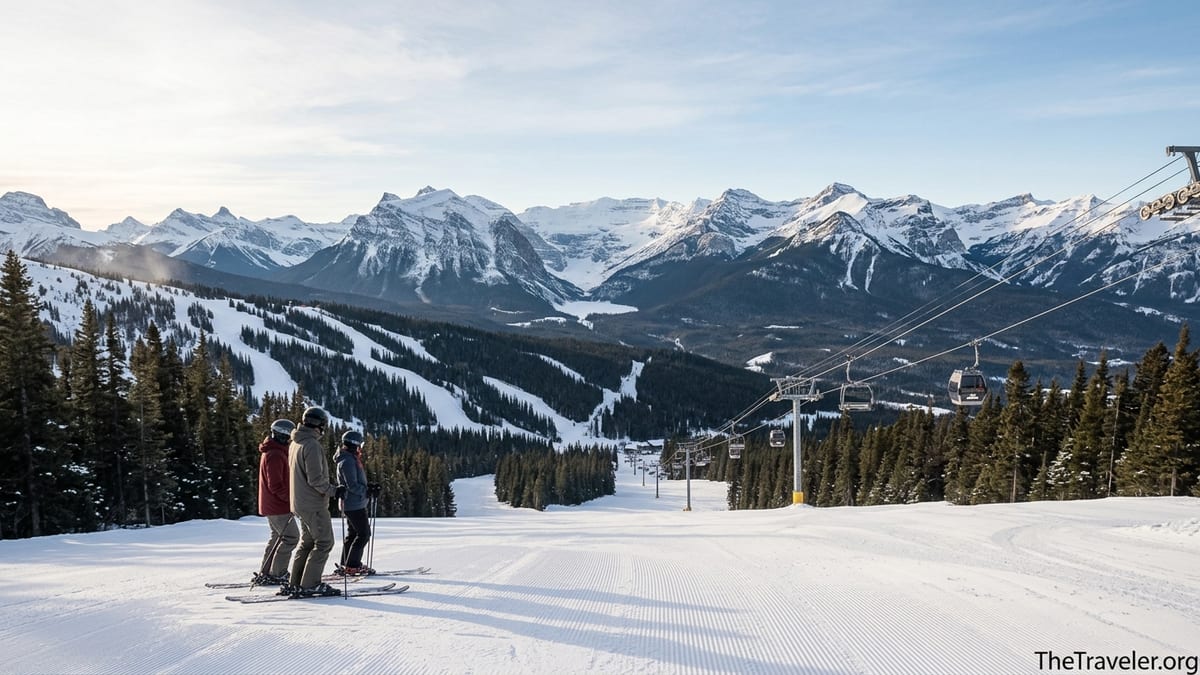
The First Time the Scale Really Hits You
Even before you buckle your ski boots, Lake Louise has a way of making you feel very small. The access road leaves the Trans Canada Highway and winds gently up toward Whitehorn Mountain, and suddenly the base area appears, ringed by steep, forested slopes. In photos, it can look like a tidy mid-sized hill. In person, the peaks tower more than a vertical kilometer above the valley, and the broad amphitheater of terrain is hard to take in with a single glance.
The numbers back up that first impression. Lake Louise offers roughly 4,200 skiable acres, with about 990 meters of vertical drop from top to bottom, spread over multiple aspects and four distinct mountain faces. From the Summit platter or the top of the resort’s sightseeing gondola, you can pivot in a slow circle and see terrain rolling away in every direction: groomed boulevards on the front side, wide open bowls plunging off the backside, and the distant ridge of the Larch area tucked around the corner. On a clear day, your eye is drawn far beyond the piste markers to the skyline of 3,000‑meter peaks that frame Banff National Park.
That sensation of space is difficult to convey in a single frame. Stand at the top of a front side run like Wiwaxy or Bald Eagle and look down to the day lodge, and the people below are reduced to pinpricks. Pan your gaze across to runs under Glacier Express, over to the backside bowls, then to Larch and its quieter glades, and you start to understand why a single photo, taken from one angle, can never really do the place justice.
For many visitors, the moment the scale truly lands is when they ride the gondola or Glacier Express and realize how long it takes just to reach mid-mountain. You pass successive waves of terrain: beginner learning slopes at the base, flowing blue cruisers in the mid alpine, and finally the steeper pitches and corniced ridges up high. The ride is a moving lesson in vertical relief, and by the time you unload, your sense of proportion has quietly recalibrated.
Terrain That Stretches Far Beyond the Frame
In marketing images, Lake Louise is usually represented by one of two views: a skier carving a perfect turn above a sea of peaks, or the turquoise lake and chateau down in the valley. Both are real, both are spectacular, but they also underplay just how varied the ski terrain is. The front side alone can fill a multi-day trip, with a mix of long blue cruisers, groomed blacks, and steeper fall‑line pitches falling straight toward the base area.
Head over the ridge into the backside and the mood changes immediately. Wide bowls such as Men’s Downhill and Boomerang plunge into pockets of trees and gullies, with lines that fan out so widely that even on busy days you can often find untracked pockets hours after a storm. Here, the distances between lift towers, treelines, and ridgelines are so great that your internal scale, tuned to smaller resorts, can feel off. A bowl that looks like a quick shot from above can turn into a leg‑burning descent that leaves you gasping at the bottom and double‑checking the trail map.
Then there is Larch, tucked away on the lower western slopes of Lipalian Mountain. On the map, it is a side pod. On snow, it feels like a mini‑resort of its own, with intermediate‑friendly glades and groomers that catch afternoon sun. The journey just to reach it, linking lifts and traverses from the front side, helps you grasp how far the resort stretches from end to end. Many skiers plan a “Grand Tour” day: warming up on front side blues, sampling backside laps, ducking over to Larch for a few tree runs, and then finally cruising all the way back to the base. You end that circuit with tired legs and a mental map of a mountain much larger than you imagined from Instagram.
Importantly, the terrain scale is matched by variety across abilities: roughly a quarter of marked runs are classified as beginner, nearly half as intermediate, and about a third as advanced or expert. That distribution is meaningful in practice. A mixed‑ability group can ride the same lift, choose entirely different lines that suit their comfort level, and still regroup at the bottom without anyone feeling pushed too far. It is a kind of generosity of space that photos rarely communicate.
Modern Lifts in a Big Mountain Environment
Large vertical and sprawling terrain are exciting, but they only feel enjoyable if the lift network can move people around efficiently. That is another area where real‑world experience at Lake Louise feels different from the static image of a gondola gliding across a winter panorama. As of the mid‑2020s, the resort operates around a dozen lifts including a gondola, multiple high‑speed quads, and a new heated six‑person bubble chair designed to ease congestion and improve access to key intermediate terrain.
For example, Pipestone Express, one of the resort’s newer high‑speed lifts, provides fast access to a swath of mid‑mountain runs that used to require more connecting rides. Glossy photos show its orange bubbles floating gracefully above the trees, but the meaningful difference is how it changes your day. You can now link warm‑up laps, carving runs, and short off‑piste forays in quick succession, instead of spending extra time in slower, older chairs. Similarly, upgrades to existing workhorses such as the Glacier Express have focused on modernizing their electronics and communications systems to keep the resort’s lift infrastructure reliable through long winters.
New expansions promise to stretch the sense of scale even further. A planned chair on Richardson’s Ridge, for instance, is expected to open additional intermediate terrain off the front side, reducing the amount of traversing and providing a different angle on the mountain’s impressive vertical relief. For skiers, that means more options on storm days, fresh lines that stay softer longer, and yet another pocket of terrain that photos have barely begun to reveal.
All of this sits in the context of the broader SkiBig3 region, where Lake Louise is complemented by Banff Sunshine and Mt. Norquay. Many visitors base themselves in the town of Banff and use a multi‑resort lift pass to sample different mountains. On paper, it is a handful of numbers: drive times of roughly 40 to 60 minutes, vertical drops, and trail counts. On the ground, the contrast in feel between Norquay’s compact, quick‑hit laps and Lake Louise’s long, committing descents into distant bowls underscores again how unusually expansive Lake Louise really is.
From Price Tag to Experience: What a Day on Snow Really Looks Like
Trip planning often starts not with dream shots, but with the practicalities of budget. For the 2025‑26 winter season, a full‑day adult lift ticket bought dynamically online at Lake Louise typically ranges roughly between 155 and 175 Canadian dollars plus tax, depending on the date and how far in advance you purchase. Youth and senior tickets usually fall in the 120 to 135 Canadian dollar range, while children between six and twelve pay around 60 Canadian dollars. Kids five and under generally ski free with a paying adult. These numbers fluctuate slightly year to year, but they provide a realistic starting point for a visiting skier from the United States or overseas.
At first glance, that might seem comparable to major destination resorts like Whistler Blackcomb or big U.S. mountains. The difference comes when you translate the ticket price into real skiing hours and terrain covered. On a typical day, with first chair at 9 am and last at 4 pm, an intermediate skier who plans ahead and uses high‑speed lifts strategically can easily notch 20,000 to 25,000 vertical feet without rushing. That might mean five or six long top‑to‑bottom laps mixed with shorter bowls or tree runs, plus a leisurely lunch in one of the mid‑mountain lodges. Essentially, your ticket buys you not just a lift ride, but access to descents that take many minutes, not seconds.
There are also ways to soften the budget impact. Multi‑day passes and SkiBig3 lift products can lower the per‑day cost, particularly if you plan to ski at least three days across Lake Louise, Banff Sunshine, and Mt. Norquay. Early‑season and late‑season dates sometimes price lower than peak holiday weeks, and group packages arranged through hotels in Lake Louise village or Banff can bundle tickets with lodging and transfers. Many travelers bring their own lunch for some days and splurge at on‑mountain venues other days, balancing costs while still enjoying the full resort scale.
When you put the expense into the context of what you actually ski, the value proposition becomes clearer. A single long run from the summit down the front side, flowing from steep pitches into mellow rollers, offers more sustained skiing than multiple laps at a smaller regional hill. By the time you ride back up and repeat, you have likely skied more vertical than you would in a whole afternoon elsewhere. That is the sort of difference that rarely shows in a single image, but that you feel in your legs, your lungs, and your memory of the trip.
Weather, Seasons, and How Conditions Change the Feel of the Mountain
In travel photography, Lake Louise is often portrayed under postcard conditions: bluebird skies, perfect groomers, and light sparkling on frosted trees. Reality, of course, is more varied and interesting. The resort typically opens in early November and often runs into early May, with mid‑winter highs frequently well below freezing and a cold, dry snowpack that can preserve good conditions for long periods. That means that a January visit can feel very different from an April trip, even if you ski many of the same runs.
On a mid‑winter powder day, the scale feels amplified by weather. Temperatures can dip below minus 15 Celsius at the summit, and wind can sculpt snow into soft drifts on leeward slopes while scouring others. Visibility in the upper bowls might drop to a few dozen meters, and suddenly the wide open expanses you admired in photos are replaced by more intimate wayfinding from tree island to tree island. It is here that Lake Louise’s mix of alpine and gladed terrain becomes practical. Tree‑lined options off lifts like Ptarmigan or Larch can offer better contrast and a greater sense of shelter, while still delivering long descents.
By contrast, spring at Lake Louise can feel almost like a different resort. Sunny days soften south‑facing aspects by late morning, making front side groomers ideal for cruising, while north‑facing backside slopes can hold drier snow longer. Lodge patios at mid‑mountain fill with skiers peeling off layers, and the atmosphere becomes more social and relaxed. The grand scale of the peaks is still present, but the mood lightens; what looked austere and remote in a winter storm becomes welcoming and almost playful under April sunshine.
For planners, the key is to match expectations to season. Families with newer skiers often prefer March and early April, when daylight is longer and temperatures more forgiving, yet there is still ample coverage. Expert skiers chasing steeps and colder powder might target January or February, accepting the chance of low‑visibility days in exchange for deeper snow. Either way, packing layers, face protection, and good goggles, and checking each morning’s snow and wind report, will go further than chasing a specific “photo look.”
Beyond the Lens: Wildlife, National Park Setting, and Off‑Slope Moments
Many ski photos at Lake Louise are cropped tight: a skier against a white slope, a single peak on the horizon. What they often omit is the broader context of Banff National Park, one of the world’s most famous protected mountain landscapes. The resort is ringed by designated wilderness, and even while riding a lift you are always aware of the broader ecosystem: dark spruce forests, frozen rivers, and occasionally the distant tracks of wildlife.
In summer, the same gondola that carries skiers in winter operates for sightseeing, and wildlife viewing is a major draw. Bears are commonly spotted below the lift in warmer months, and interpretive programs focus on how the resort coexists with sensitive alpine habitats. That conservation focus carries into winter operations, from avalanche control and terrain closures in complex zones to signage reminding guests not to ski beyond boundaries into protected areas. For visitors, this can make the experience feel more immersive and consequential. You are not just sliding on snow; you are moving through a living, regulated national park environment.
Off the slopes, the small hamlet of Lake Louise and the larger town of Banff provide the kind of après‑ski experiences that photos rarely capture. Evenings might include a soak in the Banff Upper Hot Springs, craft beers and live music in a local pub, or a quiet walk under starlight with the temperature dropping and the Milky Way clearly visible. In peak winter, ice sculptures, night tubing, and guided evening snowshoe outings add texture to the trip, and shuttle buses connect resorts to hotels so guests can leave cars parked.
These seemingly small details deepen your sense of the place. A snapshot can show you a single ridge at sunset. Spending a few days here connects that image to the way the air smells at minus 20, the crunch of snow under boots in the parking lot before dawn, and the low murmur of conversation in a day lodge as skiers study the map and plan which bowl or face to tackle next.
The Takeaway
Lake Louise Ski Resort is one of those destinations where the camera, no matter how good, is always playing catch‑up. The scale of the terrain, nearly a thousand meters of vertical, and thousands of acres spread across multiple faces of Whitehorn and surrounding peaks simply do not compress neatly into a single frame. Nor does the dynamic experience of skiing here: the way the conditions shift with aspect and season, the evolving network of modern lifts that redraw how you move around the mountain, and the profound sense of being a guest in a national park landscape.
For travelers deciding whether to make the journey, it helps to think beyond the postcard shot. Budget for the real costs of a lift ticket, lodging, and transport, but weigh them against days filled with genuinely long runs, surprising pockets of quiet even on busy weekends, and an alpine environment that still feels wild despite its world‑class infrastructure. Consider timing your trip for the kind of snow and weather you enjoy most, and leave room in your itinerary for non‑ski experiences, from hot springs to wildlife viewing and simple time spent in mountain towns.
Most importantly, arrive prepared to let the place recalibrate your internal scale. Bring your camera, certainly, but also bring a willingness to explore beyond the obvious viewpoints, to ride one more lift to a ridge you have only seen on the trail map, and to follow a local’s tip into a bowl or glade that you have never heard mentioned in a brochure. The best memories at Lake Louise rarely come from replicating a famous photograph. They come from the moment you stop, look around, and realize just how much larger and more alive the mountain is than you ever expected.
FAQ
Q1. Where exactly is Lake Louise Ski Resort located?
Lake Louise Ski Resort sits in Banff National Park in Alberta, Canada, about a 40 to 60 minute drive west of the town of Banff along the Trans Canada Highway.
Q2. How big is Lake Louise compared with other Canadian ski resorts?
Lake Louise offers roughly 4,200 acres of skiable terrain and close to 1,000 meters of vertical, placing it among the largest ski resorts in Canada by both area and vertical drop.
Q3. What skill levels is Lake Louise best for?
The resort suits all levels, with a notable emphasis on intermediates. About a quarter of runs are beginner‑friendly, nearly half are intermediate, and roughly a third are advanced or expert.
Q4. When is the best time of year to visit Lake Louise for skiing?
Conditions are typically cold and snowy from December through February, ideal for powder seekers. March and early April usually offer softer snow, more daylight, and milder temperatures that many families prefer.
Q5. How much does a lift ticket cost at Lake Louise?
For the 2025‑26 season, full‑day adult tickets generally range around 155 to 175 Canadian dollars before tax when bought online in advance, with lower prices for youth, seniors, and children.
Q6. Do I need a car to ski at Lake Louise?
A car is convenient but not essential. Many visitors stay in Banff or Lake Louise village and use ski shuttles included with certain lift passes or lodging packages to reach the resort each day.
Q7. What makes the terrain feel so much bigger in person than in photos?
The combination of nearly a vertical kilometer of relief, multiple faces, and long top‑to‑bottom runs means distances and descents are far longer than they appear on screen or on a paper trail map.
Q8. Is Lake Louise a good choice for first‑time skiers or families?
Yes. The resort has dedicated learning areas, progressive green and blue runs from higher lifts, and plenty of on‑mountain facilities, making it a strong option for lessons and mixed‑ability family trips.
Q9. What should I pack for a winter trip to Lake Louise?
Plan for very cold temperatures: layered clothing, a quality insulated jacket, waterproof pants, warm gloves or mitts, face protection, goggles with low‑light lenses, and sturdy winter boots for walking around the base.
Q10. Can I enjoy Lake Louise if I do not ski or snowboard?
Absolutely. Non‑skiers can ride the sightseeing gondola in certain periods, explore snowshoe and walking trails, visit the nearby lake and townsites, enjoy spa facilities, and take in the dramatic mountain scenery from lodges and viewpoints.