


Few places in Slovenia have gone from local favorite to global bucket-list name as quickly as Vintgar Gorge. The 1.6-kilometer canyon carved by the Radovna River, just north of Lake Bled, has become one of the country’s most talked about natural wonders, shared endlessly on social media and folded into almost every itinerary through the Julian Alps. Yet what draws travelers here is not just its photogenic boardwalks and turquoise water, but the way Vintgar distills Slovenia’s wider story of wild landscapes, careful stewardship and booming tourism into a single, walkable experience.
Get the latest updates straight to your inbox!
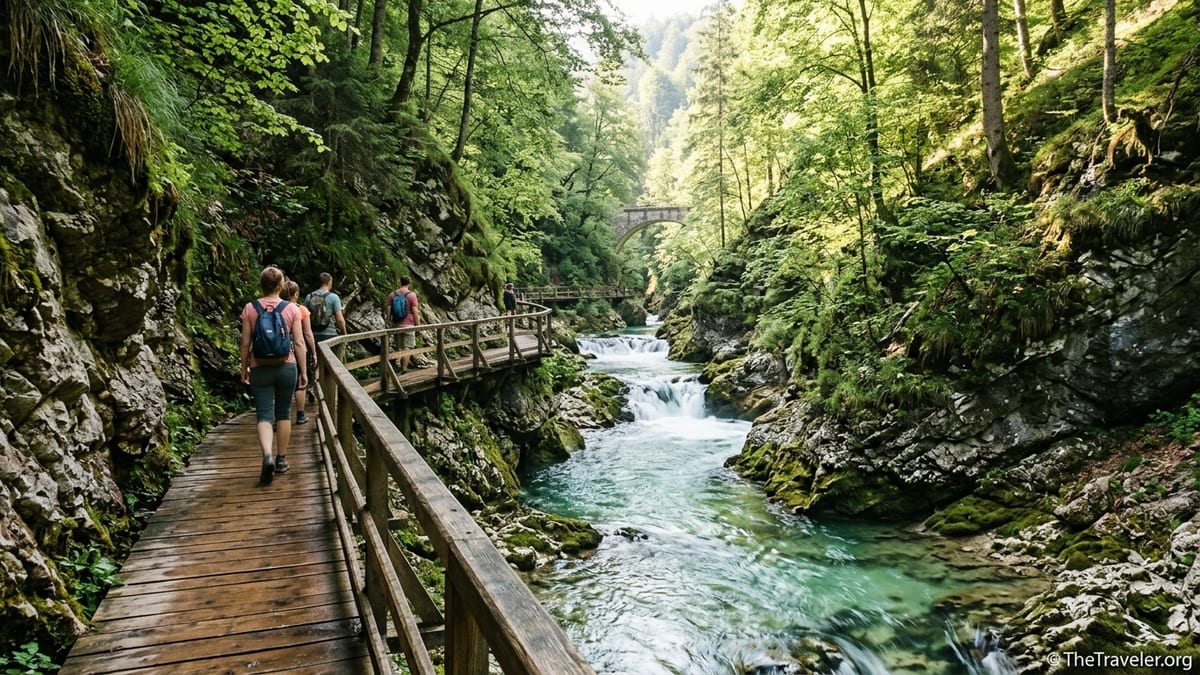
A Short Gorge With Outsized Visual Drama
Vintgar Gorge is not a multi-day trek or a remote alpine expedition. The official trail is roughly 1.6 kilometers long, following the Radovna River through a narrow canyon up to about 250 meters deep. In practical terms, most visitors spend 1.5 to 2.5 hours walking the wooden boardwalks and pausing for photos, then looping back to the start via marked return paths rather than through the gorge itself. What makes it remarkable is how much visual impact is packed into such a compact distance.
The river is the star. Fed by cold alpine sources in Triglav National Park, the Radovna runs through the gorge in shades that range from pale jade to deep turquoise, with light bouncing off pale limestone and mossy rock. On a bright summer morning, travelers stepping onto the first section of boardwalk are often hit with the same reaction: the color looks unreal, yet every swirl and pool is natural. In many trip reports, visitors rank the hue of the water alongside Lake Bled’s island church and Lake Bohinj’s mirrored peaks as one of the most memorable sights of their Slovenia itinerary.
Along the route, the canyon constantly shifts shape. In some stretches the walls crowd in, forcing the boardwalk to cling to the rock a few meters above churning rapids. In others, the gorge widens into calmer pools where fallen logs and boulders sit beneath glassy water. At the eastern end, hikers emerge near the 13-meter-high Šum waterfall, one of Slovenia’s notable river waterfalls, where the Radovna plunges in a white curtain before continuing through a forested valley. For travelers who may only have a single day in the Bled region, the gorge offers a concentrated, highly accessible taste of the country’s alpine river scenery.
There is also a striking touch of engineering history: the stone Bohinj railway bridge, completed in 1905, arches more than 30 meters above the canyon near the trail. When a train rumbles across, visitors on the boardwalk below get an almost cinematic moment that ties the wildness of the gorge to the region’s early efforts to connect alpine communities with the rest of the Austro-Hungarian world.
From Local Curiosity to International Headliner
Vintgar Gorge opened to visitors in the 1890s, when local leaders and mountaineering enthusiasts from nearby Bled and Gorje installed the first wooden galleries and walkways along the Radovna. For decades, it remained largely a regional attraction, occasionally visited by spa guests from Bled’s lakeside hotels and early twentieth-century railway travelers. Its status shifted dramatically once independent Slovenia began marketing its landscapes more aggressively in the 1990s and 2000s.
As Lake Bled grew into a global icon, with images of its church-topped island shared in guidebooks and glossy magazines, Vintgar quickly became the natural day-trip extension. Tour operators in Ljubljana and Bled began packaging “Bled & Vintgar” excursions, shuttling groups to the gorge in the late morning after a circuit of the lake. By the mid-2010s, major travel publishers and broadcasters were featuring the canyon in roundups of Europe’s best easy hikes, often highlighting it as a quieter alternative to more crowded destinations like Croatia’s Plitvice Lakes.
Social media then turbocharged Vintgar’s rise. Photos of narrow boardwalks hanging over milky-blue rapids, often taken with wide-angle lenses and shared on Instagram, TikTok and YouTube, gave the impression of a hidden fantasy corridor. In reality, those same planks can be shoulder-to-shoulder with travelers in July and August, but the combination of visual drama and relative ease of access made the gorge a perfect fit for modern travel storytelling. Backpackers writing about two-week Slovenia routes now routinely slot Vintgar into their top three highlights, alongside Triglav National Park and the Soča Valley.
The numbers tell the story. Local tourism materials now describe Vintgar as one of the most visited natural attractions in Slovenia, with hundreds of thousands of people walking the boardwalk each season. Trip reports from recent years often mention that entry has sold out for certain time slots, a clear sign that the gorge has transitioned from side excursion to headline destination that shapes how visitors plan their days around Lake Bled.
Ease of Access: How Vintgar Fits Modern Travel Habits
One of the main reasons Vintgar has become so talked about is how easily it slots into a short Slovenian itinerary. The gorge lies about 4 kilometers north of Lake Bled, on the edge of Triglav National Park, and is reachable in roughly 10 minutes by shuttle bus or taxi from Bled’s town center. For visitors relying on public transport, a free Vintgar Shuttle typically runs from the Bled main bus station and a central parking area to the Vintgar Visitor Centre during the main season, allowing car-free travelers to visit without navigating rural roads.
The logistics are straightforward, which matters in an era when many trips are pieced together from online bookings and last-minute decisions. Timed-entry tickets are now standard, with an adult pass in 2026 costing around 15 euros and a child ticket about 5 euros. That price typically includes the gorge entry itself, the use of the managed return trail network and shuttle access from designated parking. For a family of four basing themselves in a midrange guesthouse in Bled, the total cost of a morning at Vintgar is often well under what they would pay for a boat rental and castle admission on the lake, yet the experience feels just as memorable.
Accommodation providers in Bled have adapted to this pattern. Many hotels and guesthouses now list Vintgar alongside Bled Castle and Lake Bohinj on their welcome boards, and some offer bundled shuttle and ticket arrangements. Budget travelers staying in hostels or simple pensions commonly report catching an early-morning shuttle around 8 or 9 a.m., walking the gorge before the heaviest crowds, then returning for lunch by the lake. Guided tours, often booked through international platforms, offer door-to-door transport from Ljubljana or Bled and combine the gorge with activities like stand-up paddling or wine tastings, making it an easy sell for visitors who want a “see a lot in one day” experience.
Even small details contribute to its appeal. Helmets are distributed at the Visitor Centre and are mandatory on the boardwalks, which reassures many travelers who might otherwise be nervous about narrow paths above fast water. Facilities at the entrance and exit, such as basic cafés, toilets and drinking water, make the outing straightforward for families with children, while clear signage in multiple languages reduces the friction that can come with visiting wilder, less managed gorges elsewhere in the Alps.
Managing Crowds in a Fragile Alpine Canyon
Vintgar’s rapid rise in popularity has also created pressure. The gorge lies within the wider Triglav National Park area, where authorities and local communities face the same question as many mountain destinations: how to share an iconic landscape with the world without degrading the very qualities that make it special. The introduction of time-slot tickets, relocated parking and a managed shuttle system is a direct response to this tension.
Instead of allowing visitors to drive up to the entrance and queue freely, cars are now directed to central lots such as the VINTGAR LIP parking area outside the immediate gorge environment. From there, free electric shuttles ferry visitors to the Visitor Centre near the entrance. This system reduces the traffic burden on small villages, cuts noise and emissions in the narrow valley and keeps the immediate surroundings of the gorge quieter and safer for pedestrians. Travelers who used the shuttle in recent seasons often remark that it felt efficient and significantly less stressful than trying to find a space on steep local roads.
Inside the gorge, the path operates one way only, from the entrance near Podhom toward the Šum waterfall. Returning through the canyon is prohibited and can be fined, which helps avoid gridlock on sections of boardwalk only a meter or so wide. Visitor numbers per time slot are capped, which means those who book early morning or late afternoon entries often comment that the experience feels calmer and more enjoyable, with enough space to pause for photos without constant jostling.
Other rules underscore the fragility of the site. Drones are banned due to both safety and wildlife disturbance concerns. Dogs are allowed but must be kept on a leash, and muzzles are required on the shuttle. There are no rubbish bins inside the gorge, a deliberate choice that encourages a “carry in, carry out” ethic and reduces the need for frequent staff access along delicate riverbanks. Swimming is prohibited, not only for safety around fast currents and slippery rocks but also to protect the clarity of the water and reduce erosion. For travelers accustomed to more freewheeling river destinations, these restrictions can feel strict, yet many visitors leave with a sense that the structure helps preserve the gorge’s magic even in peak season.
Storybook Scenery Tailored to the Camera Age
Vintgar Gorge’s appearance in traveller conversations owes a lot to how well it photographs and films. The composition of narrow wooden walkways, milky-blue rapids and vertical limestone walls almost seems engineered for the wide-angle lenses and high-dynamic-range settings of modern smartphones. Visitors stepping onto the first bridge will often stop within minutes to take sweeping shots looking back along the winding boardwalk, with leading lines and converging perspectives that require little skill to make dramatic images.
As travelers progress deeper into the canyon, the light changes constantly. Dappled sunlight filters through beech and spruce forests high above, creating alternating patches of highlight and shadow on the water. After rain, the Radovna runs higher and more forceful, throwing up spray that catches the light in short-lived rainbows. In overcast conditions, the colors become moodier and more saturated, ideal for photographers who prefer soft, even light. This variability means that almost every visitor ends up with images that feel slightly different, even though they are walking the same short path.
The Bohinj railway bridge provides one of the gorge’s signature photographic moments. Many travelers position themselves on a mid-gorge platform to frame the stone arch against the sky, and patient photographers sometimes wait for a train to cross for a fleeting juxtaposition of industrial history and wild canyon. Near the Šum waterfall, long-exposure shots taken with small tripods or handheld stabilization turn the falling water into a smooth white veil, while moss-covered rocks and fallen branches add texture in the foreground.
For content creators and casual social media users alike, this density of ready-made viewpoints is invaluable. A single morning visit can yield dozens of usable photos and short video clips. It is no coincidence that Vintgar features heavily in reels and vlog itineraries titled along the lines of “24 hours around Lake Bled” or “Top 5 nature stops in Slovenia.” The gorge does not require advanced hiking skills or specialized equipment, yet the media it produces looks dramatic enough to rival far more demanding alpine routes.
Gateway to Slovenia’s Wider Alpine Story
Beyond its own beauty, Vintgar has become a talking point because it introduces travelers to the broader themes of Slovenian nature and tourism. The gorge sits at the edge of Triglav National Park, and for many visitors it is their first direct encounter with the country’s protected alpine environments. Information panels along the approach and at the Visitor Centre explain how the Radovna carved the canyon after the last Ice Age, how plant communities cling to the damp limestone walls and how local communities historically used the river for power and transport.
After walking Vintgar in the morning, many travelers continue the story elsewhere in the region during the same day or trip. Some follow the Radovna valley on foot or by bike, visiting smaller gorges and meadows that see only a fraction of Vintgar’s traffic. Others head for the Pokljuka Plateau, with its high meadows and spruce forests, or out to Lake Bohinj, which offers a more spacious, less developed feel than Bled. Travel writers and bloggers increasingly use Vintgar as a stepping stone in their narratives, encouraging readers who love the canyon to seek out lesser-known trails such as the Mostnica Gorge near Stara Fužina.
The gorge also sits at the intersection of Slovenia’s push for sustainable tourism and the realities of rising visitor numbers. National and regional strategies published in recent years highlight the need to spread tourism more evenly across the country and across the calendar, easing pressure on hotspots like Bled in midsummer. Vintgar’s timed-entry and shuttle system is often cited domestically as an example of how to manage a concentrated flow of people through a delicate site without closing it off entirely. For travelers, this means that a visit to the gorge can feel like participating in a broader experiment in how Europe’s smaller nations adapt to global interest in their wild landscapes.
On a personal level, the experience often shapes how visitors talk about Slovenia when they return home. Many recount that Vintgar helped them appreciate the country’s focus on clean water, trails that feel carefully maintained yet not overbuilt, and a tourism culture that encourages respect for nature. When friends ask whether Slovenia is worth visiting beyond its photogenic lakes, the memory of walking a narrow boardwalk above roaring turquoise water in a cool, shaded canyon tends to feature prominently in the answer.
The Takeaway
Vintgar Gorge became one of Slovenia’s most talked about natural wonders not because it is the country’s longest hike or most remote valley, but because it distills the appeal of Slovenian nature into an experience that is beautiful, manageable and memorable. In a single short walk, travelers encounter glacial geology, alpine river ecosystems, early twentieth-century engineering and modern visitor management, all wrapped in a landscape that photographs effortlessly yet feels immersive in person.
Its rise from local curiosity to international headliner mirrors Slovenia’s own journey onto the global travel stage. Shuttles, time-slot tickets and helmet rules may seem far removed from romantic notions of untouched wilderness, but they also signal a conscious effort to keep the gorge’s narrow wooden paths safe and its waters clear in the face of growing popularity. For visitors planning a few days around Lake Bled, Vintgar offers more than just a pretty detour. It provides a vivid introduction to how a small alpine country is learning to share its most fragile places with the world.
FAQ
Q1. Where exactly is Vintgar Gorge and how far is it from Lake Bled?
Vintgar Gorge is in northwestern Slovenia, between the municipalities of Bled and Gorje, about 4 kilometers north of Lake Bled. By shuttle or taxi, the ride from Bled’s town center to the Vintgar Visitor Centre typically takes around 10 minutes.
Q2. How much time should travelers budget for a visit to Vintgar Gorge?
Most visitors spend between 1.5 and 2.5 hours at the gorge. That includes walking the 1.6-kilometer boardwalk one way, taking photos, visiting the Šum waterfall and then returning to the starting point via the marked return paths and shuttle, if used.
Q3. How much do tickets cost and do I need to book in advance?
In 2026, an adult ticket is typically around 15 euros and a child ticket about 5 euros, with an additional small fee for dogs. Tickets are sold for specific time slots and advance booking is strongly recommended in high season, as popular morning and midday slots can sell out.
Q4. What is included in the ticket price for Vintgar Gorge?
The standard ticket usually includes entry to the gorge, access to the signed return trail network and use of the designated shuttle from official parking areas. Some passes may bundle an audio guide or specific themed routes; details can change season by season, so travelers should check current inclusions when booking.
Q5. How do I get to Vintgar Gorge if I do not have a car?
Car-free travelers commonly use the free Vintgar Shuttle that runs from Bled’s main bus station and central parking areas during the main visiting season. Many hotels and guesthouses in Bled can also arrange local taxis or include the gorge as part of a half-day tour. From Ljubljana, organized day trips often combine transport, Lake Bled and Vintgar in one package.
Q6. Is the walk through the gorge difficult or suitable for children?
The trail is short and not technically demanding, but it does involve narrow boardwalks, steps and sections above fast-moving water. It is generally suitable for reasonably mobile children and adults with normal fitness. It is not recommended for toddlers in strollers, and the route is not accessible for wheelchairs or people who are very uncomfortable with heights.
Q7. When is the best time of year and day to visit Vintgar Gorge?
The gorge usually opens from spring to late autumn, with the main season running from about April to October, depending on conditions. Early morning and late afternoon time slots tend to be quieter, with softer light and fewer crowds, while late morning and early afternoon in July and August are typically the busiest periods.
Q8. What should I wear and bring for a visit?
Travelers should wear comfortable walking shoes with good grip, as the boardwalks and steps can be damp and slippery. A light waterproof jacket is useful in changeable mountain weather, and layers help in the cool shade of the canyon. Bringing water and a small snack is sensible, as there are no shops inside the gorge itself, only at the entrance and exit.
Q9. Are there any important rules visitors should be aware of?
Key rules include following the one-way system, not returning through the gorge, keeping to marked paths, not swimming, and carrying out all rubbish. Dogs must be leashed, and a muzzle is required on the shuttle. Drones are not allowed. Helmets are provided at the Visitor Centre and are compulsory on the boardwalk for safety.
Q10. How does Vintgar Gorge compare with other natural sights in Slovenia?
Vintgar is one of Slovenia’s most accessible and concentrated nature experiences, ideal for a half-day visit near Bled. It offers dramatic river and canyon scenery in a short, managed walk, while larger areas like Lake Bohinj, the Soča Valley or the higher trails of Triglav National Park provide broader landscapes and longer hikes. Many travelers see Vintgar as a perfect introduction before exploring those wider regions.