


Oslo’s reputation as a Nordic art capital usually starts with the monumental National Museum and the waterfront MUNCH museum. Yet for many art lovers, the place that lingers longest in memory sits a little further along the fjord at Tjuvholmen. The Astrup Fearnley Museum of Modern Art may be smaller and privately run, but its distinctive architecture, daring collection and intimate scale mean it punches far above its weight in Oslo’s increasingly crowded art scene.
Get the latest updates straight to your inbox!
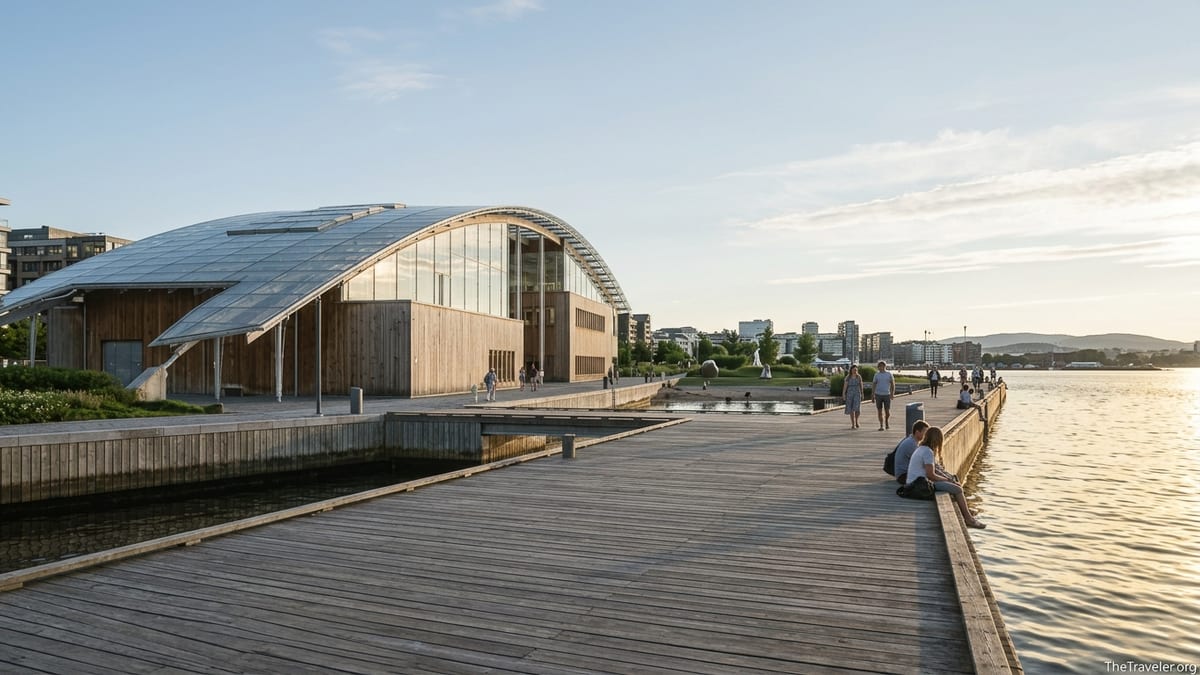
An Architectural Icon at the Edge of the Fjord
One of the most striking reasons Astrup Fearnley stands out is the building itself. Designed by Renzo Piano Building Workshop and completed in 2012, the museum anchors the Tjuvholmen waterfront, with its three low timber-clad volumes gathered under a dramatic, sail-like glass roof. The complex is split by a narrow canal, so visitors literally cross small bridges between galleries and the surrounding promenade, constantly aware of Oslofjord light, reflections and sea air drifting into the visit.
Unlike many grand national museums that read as monumental blocks, Astrup Fearnley feels almost nautical and light. The curved glass canopy filters daylight into the double-height exhibition halls, which means you can stand in front of a large sculpture and see clouds moving faintly above you. In winter, snow often gathers on the sloped glass, muting the light inside, while in summer the roof acts as a sunshade, creating a soft, even glow that flatters contemporary painting, photography and installation works.
The setting makes the museum experience feel inseparable from Oslo’s wider harbour transformation. Step out of the entrance and you are on a wooden pier looking toward Aker Brygge and the Rådhus, with the fjord stretching out behind. Locals use the area as much as a park as a cultural destination: you will often see office workers and students with takeaway coffee sitting on the steps outside, or couples taking sunset photos with the museum roof framing the background. For travellers, this means a visit to Astrup Fearnley is also a walk through one of the city’s most photogenic urban landscapes.
The building is also part of a broader architectural conversation in Oslo. Together with the angled glass tower of MUNCH in Bjørvika and the expansive stone volume of the National Museum near Aker Brygge, Astrup Fearnley represents a third way: intimate, low-rise and closely tied to the shoreline. Many visitors comment that while the other two institutions impress with sheer scale, it is Astrup Fearnley’s human proportions and tactile materials that make them want to linger.
Inside a Bold Private Collection
If the exterior turns heads, the collection inside is what truly secures Astrup Fearnley’s reputation. Built from the holdings of the Astrup Fearnley Collection, one of Scandinavia’s most influential private collections, the museum focuses on post-war and contemporary art with a distinctly international outlook. Rather than offering a chronological survey of Norwegian art history, it presents sharp, sometimes provocative selections from global contemporary scenes.
Visitors familiar with contemporary art will recognize headline names. Works by Jeff Koons, including major sculptures from the 1980s, have long been among the collection’s calling cards, as have pieces by Damien Hirst that confront themes of mortality and spectacle. Exhibitions in recent years have juxtaposed these with younger voices from Europe, the Americas and Asia, so you might walk from a room dominated by a monumental Koons piece into a space devoted to a mid-career European painter or a video installation by an emerging artist.
For travellers, this means Astrup Fearnley offers a very different experience from MUNCH or the National Museum. At those institutions, visitors often gravitate to specific icons such as The Scream or The Dance of Life. At Astrup Fearnley, there is no single masterpiece to “tick off.” Instead, the curatorial approach encourages slower looking and open-ended discovery. You may encounter an American conceptual work that questions consumer culture, an immersive sound installation by a Scandinavian artist, or a politically charged photographic series exploring identity and migration.
Because the museum is nimble in its programming, the atmosphere changes markedly between visits. One season the spaces may be filled with large-scale sculptures that use the full height of the galleries, another season may feature more introspective textile works or drawings. This responsiveness, rare in larger national institutions that plan shows years in advance, helps keep Astrup Fearnley central to conversations about where contemporary art is headed, rather than just where it has been.
How Astrup Fearnley Complements Oslo’s Big Museums
Oslo’s art scene has expanded rapidly in the past decade, with the opening of the vast National Museum at Vestbanen and the new MUNCH building in Bjørvika. These institutions command attention with extensive permanent collections and busy event calendars. Yet precisely because they carry the responsibility of telling Norway’s national story, they inevitably devote significant space to canonical works and art-historical narratives.
Astrup Fearnley, free from that mandate, functions as a kind of counterpoint. Instead of presenting visitors with a grand overview of Norwegian art from Romanticism onward, it zooms in on specific questions raised by contemporary practice: how artists respond to global capitalism, how identity and gender are negotiated visually, how new media reshape what counts as a sculpture or a painting. Travellers who have just spent a morning at the National Museum looking at nineteenth-century landscapes will often remark on the jolt of walking into Astrup Fearnley’s galleries full of neon works, digital pieces and installation art.
For a short city break, this contrast can be valuable. A typical art-focused itinerary might involve a first day divided between the National Museum and a walking tour of public sculpture around the city centre, then a second day split between MUNCH in Bjørvika and Astrup Fearnley at Tjuvholmen. The combination offers both a deep dive into Norway’s most famous artist, Edvard Munch, and a look at how contemporary artists from around the world address today’s concerns. Astrup Fearnley holds its own in this company because it does not attempt to imitate the larger institutions. Instead, it offers a clear, sharply defined role: a place where the international contemporary scene meets a distinctive Norwegian setting.
The museum’s smaller scale also influences visitor experience. While the big museums can feel overwhelming, with multiple floors and hundreds of works, Astrup Fearnley’s compact layout makes it possible to see the current exhibition thoroughly in two to three hours, with time for a coffee break overlooking the water. Travellers with limited time in Oslo often appreciate knowing they can combine the museum with a relaxed stroll around Tjuvholmen’s galleries, cafes and small design shops without feeling rushed.
An Art Museum That Doubles as a Waterfront Park
Another factor that sets Astrup Fearnley apart is how seamlessly it integrates art and everyday leisure. The museum anchors a landscaped sculpture park that wraps around the tip of Tjuvholmen, complete with grassy slopes, wooden decks and a small city beach. In summer, locals arrive with towels and swimwear to sunbathe on the rocks and swim in the fjord just a few steps from the museum entrance, then drift inside for an hour of art when the sun gets too intense.
For families and mixed-interest groups, this blend of culture and recreation can be a practical advantage. While one person explores the galleries, another might relax on the lawn with a book, watch sailboats pass, or take photos of the skyline back toward Akershus Fortress. Children often respond enthusiastically to the outdoor sculptures, which invite walking around and viewing from different vantage points along the water. The result is a visit that feels less like a formal museum outing and more like spending an afternoon in a lively public space that happens to contain world-class art.
The surrounding district has been shaped with this lifestyle in mind. Tjuvholmen’s narrow streets are lined with cafes, bakeries and restaurants that spill onto outdoor terraces in warm weather. It is common to see visitors combine a late-morning visit to Astrup Fearnley with lunch at a nearby seafood restaurant and an afternoon coffee at a waterfront kiosk. Because the area is compact and pedestrian friendly, it is easy to wander from the museum to small commercial galleries and design boutiques, broadening your sense of Oslo’s creative scene beyond institutional walls.
Even in winter, when the beach is empty and the wind from the fjord can be sharp, the museum’s park remains atmospheric. Snow softens the lines of the sculpture garden and the glass roof glows against the short Nordic daylight. Travellers willing to wrap up in a warm coat and hat will find that the walk from Aker Brygge to Tjuvholmen, with Astrup Fearnley rising at the tip of the peninsula, captures a quieter, more introspective side of Oslo that many summer visitors miss.
Visitor Experience: Practicalities, Atmosphere and Costs
In practical terms, Astrup Fearnley is straightforward to visit. The museum sits at Strandpromenaden in Tjuvholmen, roughly a 10 to 15 minute walk from the National Museum and the City Hall, mostly along flat waterfront promenades. Travellers staying near the central station can reach it by tram to Aker Brygge followed by a short stroll. For those arriving on a fjord cruise or island-hopping boat, it is often the natural last stop before heading back into the city.
Ticket prices are in line with other major Oslo museums, and visitors should expect to pay a standard adult admission roughly comparable to what the National Museum or MUNCH charges. Students, seniors and children typically benefit from reduced rates, and families can often take advantage of bundled or family tickets. Because prices can change, it is wise to check current details shortly before your visit or ask at your hotel’s reception desk, which will usually have updated information.
Inside, the layout is clean and intuitive. Visitors enter into a light-filled foyer with a ticket desk, small shop and access to a café area overlooking the water. From there, broad ramps and staircases lead into the main exhibition halls. The museum is fully accessible, with elevators to all public levels. Audio guides are not always essential, since wall texts are generally concise and bilingual, but when available they can deepen understanding of more conceptual works without overwhelming you with theory.
The overall atmosphere is relaxed and unhurried. Compared to the crowds that gather around The Scream at MUNCH or the most famous rooms in the National Museum, Astrup Fearnley usually feels spacious, even at weekends. On a typical Saturday afternoon you may find a steady flow of visitors but still have time to stand in front of a piece, read the label and take in the view back toward the harbour through the large windows without feeling jostled. Many people comment that this slower rhythm helps them connect more fully with challenging or unfamiliar contemporary works.
Why Astrup Fearnley Matters to Oslo’s Cultural Identity
Beyond its visitor appeal, Astrup Fearnley plays a symbolic role in Oslo’s identity as a modern European capital. The museum’s presence on Tjuvholmen signalled a shift from a largely industrial waterfront to a “Fjord City” vision focused on culture, public space and residential life. Its privately financed collection and high-profile architecture demonstrated that contemporary art in Oslo was not only a public-sector responsibility but also a field in which private patrons and developers were ready to invest.
This has had ripple effects across the city’s creative ecosystem. Galleries, design studios and smaller project spaces have flourished in nearby neighbourhoods, from the more commercial Aker Brygge to the edgier districts east of the centre. For local artists, the museum offers both inspiration and a benchmark: it brings global trends into direct dialogue with Norwegian practices. For international curators and critics visiting Oslo, a stop at Astrup Fearnley alongside the larger museums provides a fuller picture of how the city positions itself within the broader art world.
For travellers, understanding this context can enrich a visit. Rather than seeing Astrup Fearnley as just another museum on a checklist, you can approach it as a lens through which to read Oslo’s broader transformation. Standing on the museum’s deck and looking back at the skyline, it is easier to grasp how quickly the city has changed in the past fifteen to twenty years, and how cultural institutions, architecture and everyday waterfront life have grown together.
The museum’s willingness to show challenging and sometimes controversial works also signals a confidence that befits a capital city. While family friendly and accessible, Astrup Fearnley does not shy away from themes like consumerism, environmental anxiety or bodily vulnerability. For visitors who may associate Norway primarily with fjords and hiking, discovering such conversations in a fjord-side museum can be a surprising and memorable part of any Oslo itinerary.
The Takeaway
In a city now rich with major cultural institutions, Astrup Fearnley Museum of Modern Art stands out as a place where architecture, landscape and contemporary art converge. Renzo Piano’s fjordside building turns a museum visit into a walk through light, water and timber, while the privately assembled collection brings global contemporary debates into a distinctly Norwegian setting. The surrounding park and beach make it easy to combine art with simple pleasures like a swim, a coffee in the sun or a winter stroll along the pier.
For travellers deciding how to allocate limited time in Oslo, the museum’s compact scale and strong sense of identity are key arguments in its favour. It complements rather than competes with the National Museum and MUNCH, offering a focused, internationally minded perspective that deepens your understanding of the city’s cultural landscape. Whether you are a seasoned museum-goer or simply curious about how contemporary art looks and feels on the edge of a Nordic fjord, Astrup Fearnley rewards the journey to the tip of Tjuvholmen.
Plan to give yourself at least half a day: enough time to explore the galleries, enjoy a drink or light meal by the water, and wander through the sculpture park as the light shifts over the fjord. Long after the details of individual works fade, many visitors find they remember the sensation of standing under that sweeping glass roof, with art in front of them and the sea at their back. That blend of setting, collection and atmosphere is precisely why Astrup Fearnley has earned its place as a standout in Oslo’s art scene.
FAQ
Q1. Where is the Astrup Fearnley Museum located in Oslo?
The museum is on the Tjuvholmen peninsula, a short walk west of Aker Brygge and the City Hall, right on the edge of the Oslofjord.
Q2. How much time should I plan for a visit?
Most visitors spend between two and three hours exploring the exhibitions, with additional time for the sculpture park, café and waterfront walk.
Q3. Is the museum suitable for visitors who are new to contemporary art?
Yes. The museum’s manageable size, clear wall texts and relaxed atmosphere make it a welcoming place for first-time visitors to contemporary art.
Q4. How does Astrup Fearnley differ from the National Museum and MUNCH?
While the National Museum and MUNCH focus strongly on Norwegian art history and Edvard Munch, Astrup Fearnley concentrates on an international private collection of post-war and contemporary works.
Q5. Are there good places to eat near the museum?
Yes. Tjuvholmen and neighbouring Aker Brygge have many cafes and restaurants, from casual coffee bars and bakeries to seafood and fine-dining options.
Q6. Is the museum family friendly?
It generally is. Children often enjoy the outdoor sculpture park and beach, and inside the galleries parents can decide which works are appropriate based on age and interest.
Q7. Can I swim near the museum?
In summer, locals and visitors use the small public beach and bathing areas right next to the museum, where you can swim in the Oslofjord before or after your visit.
Q8. Do I need to book tickets in advance?
Advance booking is usually not essential, but during peak summer season or for particularly popular exhibitions it can be helpful to check current ticket arrangements.
Q9. Is the museum accessible for visitors with reduced mobility?
Yes. The building has step-free access, elevators to exhibition levels and wide circulation spaces designed to accommodate wheelchairs and strollers.
Q10. Can I combine Astrup Fearnley with other sights in the same day?
Yes. Many travellers visit the National Museum or City Hall in the morning, then walk along the waterfront to Astrup Fearnley and finish the day with dinner in Tjuvholmen or Aker Brygge.