


I arrived in Baku expecting a familiar post-Soviet script: stern facades, a few grand monuments, and a capital city that travelers pass through rather than fall in love with. What I found instead was a place that kept wrong-footing me in the best possible ways. From late-night tea on the Caspian promenade to frank conversations about politics and identity, visiting Baku changed far more than my mental map of the Caucasus. It altered how I think about Azerbaijan itself.
Get the latest updates straight to your inbox!
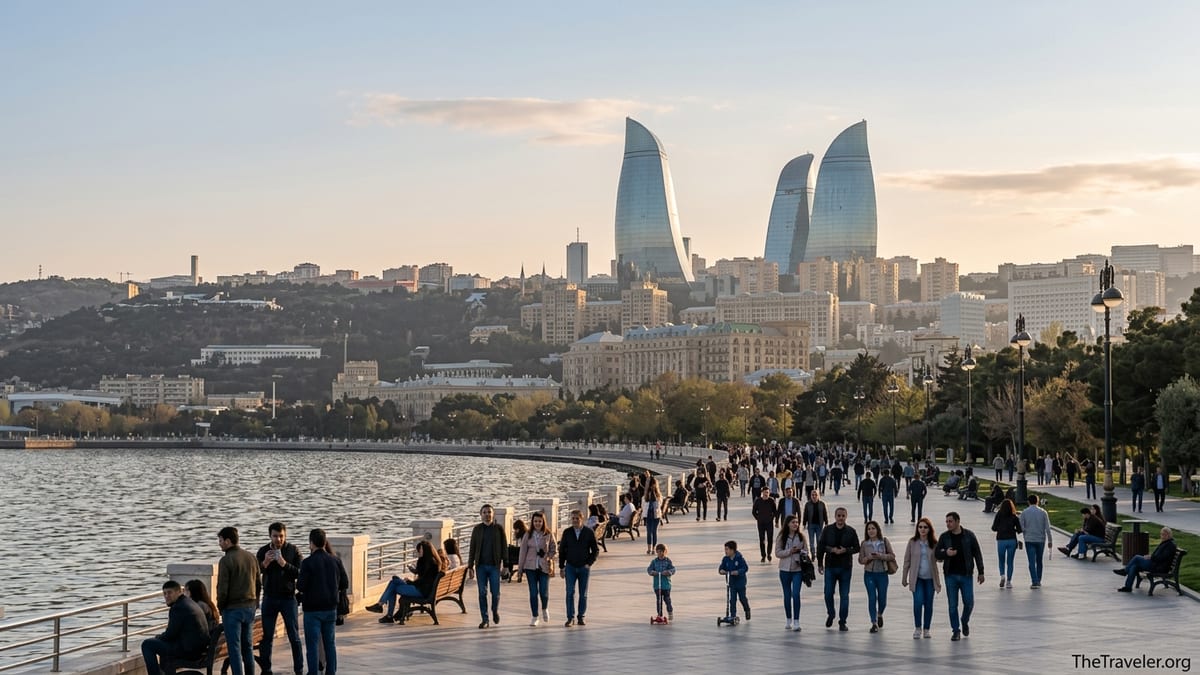
First Impressions on the Caspian Shore
Baku announces itself before you have even left the airport. Driving into the city at night, the road is lined with illuminated modernist facades, LED-lit overpasses, and glimpses of the Caspian Sea off to the side. It feels like you are arriving in a Gulf city more than in the South Caucasus. Yet the taxi driver is quick to point out oil derricks on the horizon and Soviet-era apartment blocks that still house much of the city. That coexistence between shiny new and stubbornly old sets the tone for everything that follows.
My first real sense of Baku came on the Bulvar, the city’s long seaside promenade. Families strolled past late into the evening, kids rode electric scooters, and couples leaned against the rail looking out at the low waves of the Caspian. A small paper cup of local coffee from a kiosk was about 2 to 3 manat, and a ride on the small ferris wheel near Deniz Mall was only a little more. Nothing was designed to impress in a grand way; instead, it felt like a city using its waterfront exactly as locals wanted it, not as a stage for tourists.
Walking back toward the center, I was surprised by how polished downtown Baku has become. LED-lit towers reflect in glass office blocks, and global brands sit next to local bakeries selling hot tandir bread for the equivalent of less than a dollar. My mental image of a grey post-Soviet capital dissolved quickly. Here, Azerbaijan felt not like a place trapped in its past, but like a city moving, for better and worse, at high speed into a new era.
What changed for me in these first hours was scale. I had imagined a small, quiet city. Instead I met a capital that felt confident and outward-looking, yet anchored in its own rhythms, especially in the way locals occupy public space late into the night without any sense of hurry.
Icherisheher: A Living Old City, Not a Museum
If the waterfront shows Baku’s modern ambitions, the Old City, known as Icherisheher, reveals its layered history. Stepping through the stone gates from the wide boulevards outside feels like crossing a border. Cobbled lanes twist between honey-colored walls, laundry hangs from balconies, and small shops sell pomegranates, persimmons, and flatbreads alongside magnets and postcards. It is easy to expect a preserved museum quarter, polished to perfection for tour groups. Instead, you find something messier and more alive.
On my first morning there, I climbed up to the Maiden Tower, the iconic cylindrical stone structure with sweeping views of the city from its rooftop. The ticket price for foreigners was modest, and the short climb inside passes by displays that interpret the tower’s mysterious past. From the top, the contrast is startling: terracotta rooftops of Icherisheher in the foreground, the glass-and-steel Flame Towers rising behind, and the curve of the Caspian coast stretching away to the east. Seeing those layers literally stacked on top of each other shifted how I thought about Azerbaijan’s narrative. It is not a simple story of old versus new, but of constant adaptation.
Wandering back down, I watched a woman in a ground-floor kitchen hand-rolling dough while her teenage son took orders in English from a pair of German backpackers. They left with plates of dolma and qutab, the thin stuffed pancakes you see everywhere in Baku. My qutab plate, with a pot of black tea, came to under 10 manat. It felt like eating in someone’s home rather than a tourist restaurant. That moment, more than any museum label, reminded me that Old City is first and foremost a neighborhood.
Before visiting, I had read that Icherisheher can feel commercial. There is truth in that, particularly along the main arteries where carpet shops and souvenir stands crowd the pavements. But when you step just one or two lanes away, Baku looks and sounds different. Neighbors chat from windows, kids kick a ball against a centuries-old wall, and a stray cat slinks past a doorway carved long before anyone imagined oil derricks in the Caspian. The Old City made Azerbaijan feel less like a peripheral state and more like a crossroads that has been negotiating new arrivals for centuries.
Modern Icons and a New National Story
For many visitors, the first image that comes to mind when they think of Baku is not the Old City but the Flame Towers and the flowing white form of the Heydar Aliyev Center. Seeing them up close, it is obvious that these buildings are intended to tell a story about modern Azerbaijan. What surprised me was how that story felt more complicated once I walked their corridors and talked to people working there.
The Heydar Aliyev Center, designed by Zaha Hadid, rises from a wide plaza that locals use as an enormous public park. On a sunny afternoon, families rolled down the grassy slopes in front of the building while teenagers took photos on the center’s reflective surfaces. Inside, the main exhibition ticket for adults cost around 15 manat, with discounts for students and children. That ticket granted access to galleries filled with everything from traditional musical instruments and costumes to small-scale models of historical buildings from across the country.
Spending an afternoon there, I saw how the center attempts to curate a cohesive national identity: one that honors carpets, mugham music, and village architecture while also celebrating space travel, car design, and global cultural events. In one room, a gleaming display of classic Soviet-era cars from the 1970s sat directly opposite mannequins in embroidered village clothes. The message is subtle but clear. Azerbaijan is both European-facing and deeply local, proud of its oil-fueled modernization yet keen to root that progress in pre-Soviet culture.
Visiting places like the Azerbaijan Carpet Museum on the waterfront deepened that impression. The building itself, shaped like a rolled carpet, houses collections that explain how different regions produce distinct patterns and techniques. A guide pointed out motifs that reference pomegranates, the Caspian, and ancient fire temples. Before Baku, carpets for me were mostly decorative. After an hour there, they felt more like maps of identity and belonging. It was a reminder that in Azerbaijan the new skyline rests on older foundations than I had appreciated from afar.
Everyday Baku: Cafes, Prices, and Unscripted Encounters
What ultimately changed my sense of Azerbaijan the most were not its landmarks but its small, everyday details. Sitting in a tea house off Nizami Street, where tulip-shaped glasses of strong black tea arrive with sugar cubes and sometimes a slice of lemon or a small plate of jam, I realized how central hospitality is to the city’s rhythm. A pot of tea for two might cost 3 to 5 manat, and it buys you not just a drink but permission to linger for as long as you like, watching the flow of life outside.
In the evenings, I often wandered between backstreet bakeries and small cafes. A plate of plov, the saffron-scented rice dish often cooked with lamb and dried fruits, usually cost between 8 and 15 manat depending on the setting. In one modest place near the 28 May metro, the server gently corrected my pronunciation and then sat for ten minutes to talk about why so many young Azerbaijanis are studying English. His own brother, he explained, drives a taxi using apps that charge about 3 to 7 manat for rides within most of central Baku, as long as you book away from obvious tourist hot spots.
Those taxi rides were revealing too. One driver complained frankly about corruption, another about high apartment rents, and a third spent half an hour recommending rural regions like Quba and Sheki, pulling up photos on his phone of green valleys and stone caravanserais. These conversations did not match the sleek marketing videos I had seen before the trip. They painted Azerbaijan as a place where people are intensely pragmatic, aware of geopolitical tensions, and deeply proud of their landscapes and food.
There were rough edges as well. Around some busy nightlife streets, a few bars clearly targeted visitors with inflated prices, and drivers parked near major hotels sometimes quoted cash-only fares two or three times higher than the same trip ordered by app. Online forums had warned of such practices, and locals advised using ride-hailing apps or agreeing on a price in advance. Being prepared for this does not erase the frustration, but it grounded my view of Azerbaijan in reality rather than romanticism. Like any fast-developing city, Baku contains both genuine warmth and opportunistic hustle, often on the same block.
Safety, Politics, and the Conversations You Do Not Expect
Before traveling, friends asked if it was safe to visit a country that frequently appears in news reports about tensions with its neighbors. Walking around Baku late at night, the question felt remote. The city center is heavily policed, with visible patrols on main squares and around metro stations, and violent crime against tourists is rare according to recent travel advisories. I walked along the Bulvar past midnight several times and saw families with strollers, joggers, and older couples on benches. The atmosphere felt comparable to many European capitals, if not calmer.
Yet beneath that surface calm lie serious political and regional complexities. More than once, conversations in taxis or cafes drifted toward the conflict over Nagorno-Karabakh, relations with Armenia, and a wider sense of geopolitical insecurity. People voiced strong opinions, shaped by personal histories and national narratives. Some were careful, lowering their voices when discussing domestic politics. Others were blunt, criticizing official decisions or expressing frustration about media freedom.
As a visitor, it is not my role to judge or to pretend expertise on these issues. But hearing these perspectives firsthand punctured the simplified image I had carried of Azerbaijan as a monolithic, tightly controlled state. The reality, at least in Baku, is more nuanced. People navigate constraints in ways that are often subtle: sarcastic jokes, careful pauses, or a quick shift of subject. The experience reminded me that travelers cannot understand a place like Azerbaijan solely through its monuments or marketing slogans. You also learn from what people feel comfortable saying, and what they choose not to say, over a glass of tea.
Ultimately, I left with an awareness that safety in Baku is not just about street crime statistics. It is also about understanding where you are, recognizing that you are a guest in a country shaped by recent conflict and rapid change, and approaching sensitive topics with humility and openness rather than assumptions.
Beyond Baku: Seeing Azerbaijan as a Whole
Baku is an overpowering introduction to Azerbaijan, and it would be easy to leave thinking the country is all glass towers and seafront promenades. Talking with guides and fellow travelers, though, shifted my sense of scale again. Many insisted that only by leaving the capital and heading into regions like Lahij, Sheki, or Qabala do you begin to grasp Azerbaijan’s diversity.
On a day trip to Gobustan and the Absheron Peninsula, I saw how quickly the city gives way to semi-desert, mud volcanoes, and rock engravings thousands of years old. The excursion cost roughly the equivalent of a casual day tour in many European destinations and included stops at a fire temple where natural gas still seeps from the earth. Standing there, watching flames flicker against stones that once guided ancient Zoroastrian worship, I realized how incomplete my pre-trip mental map had been. Azerbaijan is not just a post-Soviet oil state. It is also home to some of the oldest continuously inhabited landscapes in the region.
For travelers with more time, multi-day trips into the Caucasus mountains offer an even more dramatic shift in perspective. Rural guesthouses that charge modest nightly rates provide simple rooms, home-style meals, and views of terraced hillsides or river valleys. The bread tastes different, the dialects change, and tea is poured in even greater quantities. Many Baku residents I met described these regions with a kind of nostalgic affection, as if venturing there allowed them to reconnect with a slower, more grounded Azerbaijan that is easy to forget among the city’s high-rises.
Hearing their stories and catching even brief glimpses of villages and mountain roads reframed how I think about the country. Baku, for all its scale and spectacle, is only one facet of Azerbaijan. Visit the capital and you encounter an outward-facing, ambitious, and sometimes contradictory city. Venture beyond and another Azerbaijan appears, one defined less by glass and steel than by stone houses, orchards, and the constant presence of mountains or steppe. The two belong to each other, and understanding that relationship is key to seeing the country more clearly.
The Takeaway
Before visiting, Azerbaijan for me was mostly a name on a map, associated with energy pipelines, contested borders, and a Eurovision stage from years past. After several days in Baku and its surroundings, that abstraction gave way to a mosaic of lived details: the faint smell of oil near old derricks, the hush of the Carpet Museum, the sharp sweetness of pomegranate juice sold from a street stall, the quiet nod of a stranger on the metro platform.
Baku in particular challenged easy categories. It is neither a polished Gulf-style showcase nor a frozen Soviet relic. It is an evolving city where global brands share space with tea houses, where architect-designed cultural centers sit a short walk from crumbling courtyards, and where conversations about the future often unfold in the shadow of a very present past. For travelers willing to look beyond surface impressions, the city becomes a lesson in how national identity is built and contested in real time.
Most of all, visiting Baku changed how I think about the so-called edges of Europe and Asia. Azerbaijan does not fit neatly into either, and Baku wears that in-between status with a kind of stubborn pride. It is in the food that blends influences from Iran, Turkey, and the wider Caucasus; in the architecture that leaps from medieval to modern in a single skyline; and in the people who carry family stories that span empires and upheavals. To see Azerbaijan only through its headlines or its most iconic buildings is to miss that complexity.
Leaving the city on an early-morning flight, the Flame Towers receding into the haze, I knew I would not speak about Azerbaijan again as an abstract place. Instead, I would remember a woman in the Old City pressing extra herbs into my qutab, a guide tracing motifs on a carpet, a taxi driver explaining why he wants his daughter to study abroad and then come back. Those encounters are what ultimately changed how I see this country, and they are what make Baku worth more than a quick stopover on any traveler’s map.
FAQ
Q1. Do I need a visa to visit Azerbaijan as a tourist?
Most travelers, including visitors from the United States and much of Europe, need a visa to enter Azerbaijan. Many nationalities can apply online for an electronic visa, which is usually processed within a few business days. Requirements and fees can change, so you should always check the latest official guidance before you book flights.
Q2. Is Baku safe for solo travelers, including at night?
Central Baku is generally considered safe, with a visible police presence on main streets, the waterfront, and around metro stations. Many people walk on the Bulvar and in busy districts late into the night. As in any big city, you should keep an eye on valuables, use licensed taxis or ride-hailing apps, and avoid isolated areas after dark, but most solo travelers report feeling comfortable.
Q3. How expensive is Baku compared to Western Europe?
Baku can feel noticeably cheaper than many Western European capitals for everyday items like local meals, public transport, and basic accommodation. A ride on the metro or by bus often costs the equivalent of a small fraction of a euro, and simple meals in local eateries can be quite affordable. Upscale restaurants, imported alcohol, and international hotel chains are priced closer to what you might expect in major European cities.
Q4. Can I get by with English in Baku?
English is increasingly common among younger people, staff in hotels, cafes in central areas, and those working in tourism. Outside those circles, Russian and Azerbaijani are more widely spoken, and older residents may not speak English. Learning a few basic phrases in Azerbaijani and keeping key addresses written down can make interactions smoother, especially if you travel beyond Baku.
Q5. What is the best time of year to visit Baku?
Spring and autumn are usually the most comfortable times to visit Baku, with milder temperatures and lower humidity. Summers can be very hot, especially in July and August, while winters are often chilly and windy along the Caspian, though not usually extremely cold. Your ideal season will depend on whether you plan to combine Baku with mountain regions or the coast.
Q6. How should I dress in Baku, especially as a woman?
Baku is relatively relaxed in terms of dress, especially in the city center where you will see a range of styles from conservative to very modern. Women travelers can comfortably wear trousers, skirts, and short-sleeved tops, though very revealing outfits may draw extra attention in some areas. If you plan to visit mosques or more conservative neighborhoods, it is respectful to wear clothing that covers shoulders and knees and to carry a light scarf.
Q7. What local foods should I try in Baku?
Popular dishes to look for include plov, a saffron rice dish often served with lamb; qutab, thin stuffed pancakes cooked on a griddle; dolma, vegetables or vine leaves stuffed with meat and rice; and fresh kebabs grilled over charcoal. Baku is also known for its tea culture, so do not miss sitting down with a tulip-shaped glass of black tea, sometimes served with jams, dried fruits, or sweets.
Q8. How do I get around Baku without overpaying for transport?
Baku has a compact metro system and a network of buses that are inexpensive and cover most areas a visitor is likely to need. Many locals and visitors also use ride-hailing apps, which usually show an estimated fare before you confirm the trip and can be cheaper and more transparent than hailing taxis on the street. If you do take a street taxi, it is wise to agree on a price in advance.
Q9. Are there day trips from Baku worth doing?
Yes, several popular day trips are easily arranged from Baku. Many visitors head to Gobustan to see ancient rock carvings and nearby mud volcanoes, often combined with a visit to the Absheron Peninsula’s fire temple or burning hillside. Other excursions reach coastal villages, semi-desert landscapes, or the foothills of the Caucasus, giving a very different perspective on Azerbaijan beyond the capital.
Q10. How many days should I spend in Baku?
A stay of three to four days allows enough time to explore the Old City, the seafront promenade, a few museums, and one or two modern landmarks, while still leaving space for unplanned wandering. With five to seven days, you can add one or two day trips outside the capital or simply slow down, spending more time in local cafes and neighborhoods to get a deeper feel for daily life in Baku.