


The road out of Baku toward Shamakhi does something no museum in the capital could quite manage for me. With each kilometer, the glass and steel of the Caspian coast fall away, replaced by vineyard slopes, stone villages and the kind of quiet that lets old stories rise to the surface. By the time I walked into Shamakhi’s Juma Mosque and later wandered through nearby mountain villages, Azerbaijan’s history stopped being a timeline on a page and became something I could stand inside, touch and even taste in a glass of local wine.
Get the latest updates straight to your inbox!
Leaving Baku: The Road Where History Starts To Thicken
Most visitors treat Shamakhi as a half-day stop between Baku and the northwest, but the drive itself is where Azerbaijan begins to reveal its layers. Leaving the capital, the new highway follows part of an old Silk Road artery that once carried caravans toward the Caucasus passes and on to Georgia and Iran. Today you pass compressed versions of the same story: tanker trucks from the oil fields, roadside produce stalls, shepherds moving flocks across brown hills that turn green after spring rains. It is barely a two hour drive, yet the mood shifts from cosmopolitan to rural and deeply local in the space of one roadside tea break.
Practicalities here are refreshingly straightforward. Shared taxis leave from Baku’s intercity terminals, with drivers often quoting a per-seat price that works out to roughly the cost of a modest lunch in the city. Private drivers arranged through hotels and guesthouses are more expensive but allow you to stop at viewpoints or villages along the way, including the photogenic Diri Baba Mausoleum near Maraza perched inside a limestone cliff. However you travel, the road slowly climbs, and the air grows both cooler and quieter, as if preparing you for a place where history has been repeatedly shaken and rebuilt.
What struck me most on this stretch was how recently all of this became reachable for casual travelers. Just over a decade ago the road was slower and the tourist infrastructure around Shamakhi minimal. Today it is realistic to leave a hotel in central Baku after breakfast, stand inside a mosque dating back to the early Islamic period before lunch, and be wandering among mountain vineyards by afternoon. That physical ease makes the contrast in time periods feel even sharper.
Stepping Into the Juma Mosque: Thirteen Centuries in One Courtyard
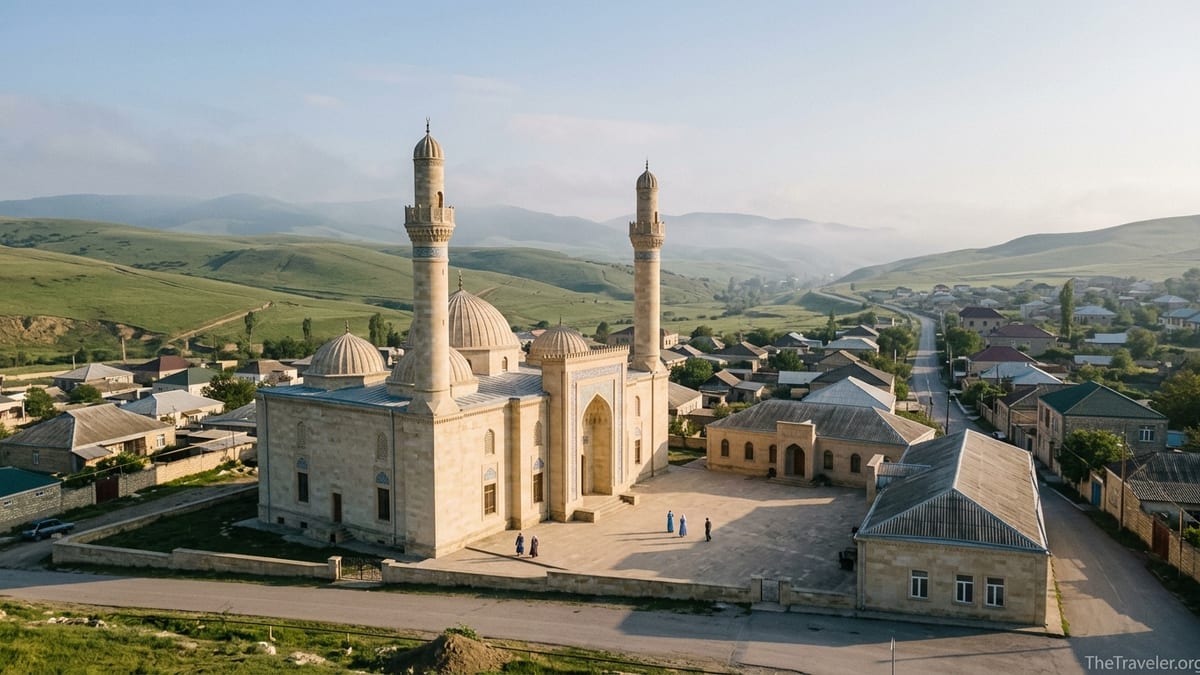
If Shamakhi has a single building that collapses Azerbaijan’s history into one address, it is the Juma Mosque. Local museum material and historical research place its origins in the mid eighth century, making it one of the oldest mosques in the Caucasus. You do not need dates to feel that age. You sense it as soon as you cross the courtyard, your footsteps echoing off stone that has survived earthquakes, invasions and multiple reconstructions. The current structure is the result of extensive restoration in the 2010s, but the layout respects the original multi hall design, with three domed prayer spaces lined up side by side.
Inside, the atmosphere is modern yet rooted. New plaster and careful lighting highlight calligraphy and geometric patterns, while the thick outer walls, squat proportions and relatively small windows still feel like a defensive structure built for an unstable frontier. I visited just after midday prayers, when the main hall was nearly empty. A caretaker quietly motioned for me to look up, and only then did I notice the subtle transition from plain white walls to the more intricate ornamentation near the domes, as if the decoration was concentrated where human attention was meant to rise.
There is a tendency when traveling in the Islamic world to treat mosques as a category: blue tiles here, carved stone there. Shamakhi’s Juma Mosque breaks that pattern by forcing you to think about earthquakes as much as empires. Panels in the small on site exhibition explain how major quakes in the nineteenth and early twentieth centuries destroyed large parts of the town and repeatedly damaged the mosque. Each rebuilding brought a different architectural influence, from local Shirvan styles to early twentieth century design ideas. Standing in the courtyard, you can trace where old stone gives way to newer blocks, like growth rings in a tree. The building becomes a physical graph of survival rather than an untouched relic.
That feeling of continuity is strengthened by the way local people still use the mosque. During my visit, a family arrived with boxes of sweets, distributing them in the courtyard to mark the anniversary of a relative’s death. A group of teenagers slipped in after school, leaving their backpacks at the door before joining a small knot of worshippers. For them, this is not a monument or a photo stop. It is the neighborhood mosque, a place woven into life events. Watching them, Azerbaijan’s deep Islamic history felt less like a chapter in a textbook and more like an ongoing conversation you are briefly allowed to overhear.
Earthquakes, Empires and Poetry: Shamakhi’s Uneasy Past
Walk a few blocks from the mosque and Shamakhi’s quiet streets start to tell a different side of its story. Low houses with corrugated roofs line lanes that curve around the hills, and you occasionally glimpse the remains of walls or foundations that seem far older than the buildings perched on top. This was once the capital of the Shirvanshah dynasty and later an important regional center within the Russian Empire, yet repeated earthquakes and invasions meant Shamakhi never accumulated layers of architecture the way Baku did. Much of the city’s grandeur survives only in archives and local memory.
One way to reconnect with that lost city is through its poets. Shamakhi is the birthplace of Nizami Ganjavi’s contemporary Seyid Azim Shirvani and later satirists and mystic writers who drew on the region’s mix of Persian, Turkic and Caucasian influences. Inside the modest Shamakhi History and Local Lore Museum, exhibition labels outline how these poets navigated imperial politics, shifting borders and natural disasters, using humor and metaphor to critique the rulers of their day. Reading a translated couplet scratched on yellowing paper while trucks rumble past outside ties the abstract idea of “literary heritage” to a very specific place and set of survival challenges.
Another thread is the town’s seismic record. Local guides casually rattle off the years of major quakes that reshaped the city’s layout and even pushed political power to other centers. You can stand on a hillside where a fortress once dominated the valley and see almost nothing left, the stone long since recycled into village houses. Yet the view itself remains. From those slopes, the patchwork of fields, forest and new vineyards stretches toward the horizon, hinting at why people rebuilt here again and again in spite of the risks: the land is fertile, the water reliable, the position on trade routes strategic.
For a traveler, that combination of fragility and persistence makes ordinary details unexpectedly moving. A grape arbor over a courtyard, a roadside spring capped with a small stone dome, old men playing backgammon under a plane tree: all feel like temporary arrangements in a landscape that has proven it can shrug off entire city plans. Shamakhi’s history becomes less about a list of rulers and more about the stubborn decision of thousands of unnamed residents to stay put and start over after each shock.
Wine Routes and Family Vineyards: Tasting Centuries in a Glass
One of the most tangible ways to feel the continuity of life around Shamakhi is through its vineyards. The district’s mild climate and well drained soils have supported grape cultivation for centuries, supplying both local households and trade caravans. In recent years, several wineries have opened their doors to visitors, offering tastings and tours that conveniently break up a day of mosque visits and museum stops. A short drive from town brings you to manicured rows of vines laid out against rolling hills, with stone tasting rooms designed to echo traditional architecture.
Sitting on a terrace overlooking those vineyards, a glass of dry white in hand, you begin to understand how agriculture knits together different historical periods. The grape varieties may have changed, and the barrels might now be imported from Europe, but the basic rhythm remains. Workers move along the rows in early autumn much as their great grandparents did, harvesting before the first serious cold and relying on the same contour of the land to guide irrigation channels. A host might explain how Soviet era collective farms once dominated these slopes, and how, after independence, families reclaimed or re leased parcels to start private wineries. That temporal arc runs through every sip.
Prices at these wineries are usually comparable to mid range cafes in Baku, which makes them accessible without feeling mass market. Tasting flights often include both international styles and wines made from indigenous grape varieties, helping visitors connect what they are drinking to specific corners of the region. Many estates also produce grape juice and jams, a nod to the fact that for local families, vineyards long served multiple purposes beyond alcohol. Even if you do not drink, coming here puts you in the middle of a landscape that has anchored Shamakhi during political upheavals and earthquakes alike.
Perhaps the most powerful moment for me came not in a formal tasting room but in the backyard of a small guesthouse on Shamakhi’s edge. The owner’s father invited us to sit under a tangle of vines while he poured homemade wine from a plastic container into mismatched glasses. He spoke about how his parents survived one of the city’s more recent earthquakes, sleeping outside for months while aftershocks rattled the valley. Through all of it, he said, the vines had kept growing. That improvised toast, somewhere between hospitality and quiet defiance, did more to make Azerbaijan’s resilience feel real than any printed brochure.
Lahij and the Mountain Villages: Where Craft and Daily Life Overlap
From Shamakhi, the road continues toward the mountains, tightening into curves before branching off toward Lahij, one of Azerbaijan’s most atmospheric villages. Perched on a terrace above a river gorge, Lahij is famous for its cobblestone streets and copper workshops. Arriving here after the muted stone of Shamakhi’s neighborhoods feels like walking into a living open air museum. The main lane climbs gently past stone houses, each with wooden balconies and sometimes a carved doorframe that hints at the age within.
What distinguishes Lahij from reconstructed heritage villages elsewhere is that the craft tradition has not been separated from daily life. Copper workshops line the street, their doors propped open, the steady tapping of hammers ringing out as artisans shape pots, trays and decorative plates. It is tempting to see these craftsmen primarily as performers for tourists, but if you linger you notice local customers coming in to repair an old kettle or order a new cauldron. Some masters are happy to demonstrate engraving techniques or explain the symbolism behind certain patterns, especially if you buy a small item. Prices cover a wide range, from affordable souvenirs to expensive hand hammered sets that reflect days of work.
UNESCO recognition of Lahij’s coppersmithing as intangible cultural heritage has brought more visitors, but the village still feels far from polished. Chickens scratch in side alleys, children race up and down the main street, and old men gather near the mosque to exchange news. Modest guesthouses have sprung up in recent years, many in converted stone houses with low ceilings and woven carpets underfoot. Staying overnight rather than day tripping from Baku or Gabala lets you see the village after the day tours leave, when the sound of metalwork fades and the air cools enough for families to sit outside their doors.
In that evening quiet, Lahij’s connection to the broader history of Azerbaijan becomes clearer. This was once an important stop on the Silk Road, producing metal goods for markets across the region. Today, a young artisan might check orders on his smartphone while using a hammer his grandfather passed down. The coexistence of those tools in a single workshop encapsulates what makes the Shamakhi region special for history minded travelers: the past is not preserved under glass, but threaded through routines that still make economic sense.
Practical Ways to Touch History, Not Just Read About It
One of the risks in writing about history heavy destinations is making them sound like homework. Shamakhi turned out to be the opposite. So many experiences here are hands on by default. At the Juma Mosque, a caretaker may casually invite you to help roll up a carpet after prayer, giving you a tactile sense of the building’s scale. In the local museum, you might be shown fragments of pottery or tools excavated from nearby sites, their weight and roughness reminding you that ancient Shirvan was populated by real households with clutter and chores.
Similarly, the wine estates often allow visitors to walk among the vines, brush leaves aside to see the grapes and, at certain times of year, watch as workers load crates onto trucks. Children in particular respond well to this, suddenly grasping that the bottle on the table was not created in a factory but grew from sunlight and soil in a valley they can see.
In Lahij and other mountain villages, the most memorable interactions tend to be the unscripted ones. A coppersmith pauses to let you try a light tap on a plate he is working on. A woman weaving a carpet on a simple wooden loom explains, through gestures and a few shared words, which patterns she learned from her mother. These moments do not appear on brochures or interpretive panels, yet they do more to make Azerbaijan’s history feel real than any official narrative. They also underline a simple truth: in this part of the country, heritage and livelihood are still the same thing.
Language is less of a barrier than you might expect. While Russian, Azerbaijani and sometimes Turkish dominate conversations between locals, enough people in the tourism facing businesses speak basic English to navigate practicalities. A small phrasebook or translation app helps, but patience and a willingness to slow down matter more. Histories surface here in stories told on benches, in courtyards and beside roadside springs, and those stories rarely conform to neat time slots.
The Takeaway
Travelers often talk about destinations where “history comes alive,” but in practice that phrase usually means costumed guides or multimedia installations. Shamakhi and its surroundings offer something subtler and, ultimately, more affecting. Here, history feels real not because someone stages it for you, but because the same landscapes, buildings and skills that shaped Azerbaijan’s past are still in daily use.
Standing in the courtyard of a mosque that has risen after multiple earthquakes, tasting wine produced on slopes farmed for generations, hearing the metallic rhythm of Lahij’s workshops echo through a stone village at dusk: these are not isolated experiences. They are pieces of a wider story about endurance, adaptation and the quiet ways people root themselves in unstable ground. For anyone curious about Azerbaijan beyond Baku’s skyline, a journey to Shamakhi is less a side trip and more a key that unlocks how this country became what it is today.
FAQ
Q1. How long does it take to travel from Baku to Shamakhi?
Travel time by car or private transfer is typically around two hours each way, depending on traffic and weather. Shared taxis and minibuses can be slightly slower.
Q2. Do I need a visa to visit Azerbaijan and the Shamakhi region?
Most nationalities require an e visa, which can be applied for online and is usually processed within a few working days. Fees vary by nationality and service speed, so check current requirements before booking flights.
Q3. Is Shamakhi suitable as a day trip from Baku?
Yes, many visitors come on a day trip to see the Juma Mosque and nearby viewpoints. However, staying one night allows time for a winery visit and a detour to villages such as Lahij.
Q4. What should I wear when visiting the Juma Mosque in Shamakhi?
Dress modestly, with shoulders and knees covered. Women are typically asked to cover their hair; headscarves are often available at the entrance, but bringing your own is more comfortable.
Q5. Are there guided tours available in English in Shamakhi?
Guides can be arranged through Baku based agencies, local guesthouses or some wineries. English is not universal, but it is increasingly common among younger guides and tourism workers.
Q6. When is the best time of year to visit Shamakhi and Lahij?
Late spring and early autumn offer mild temperatures, clearer skies and good road conditions. Summer can be hot in lower areas, while winter may bring snow to mountain roads.
Q7. Is it easy to combine Shamakhi with other destinations in Azerbaijan?
Yes, Shamakhi sits on the route toward Gabala, Sheki and other northwestern towns. Many travelers follow a loop from Baku through these destinations and back to the capital.
Q8. What kind of accommodation can I expect in Shamakhi?
You will find a small selection of hotels, roadside motels and family run guesthouses. Facilities are simpler than in Baku but generally comfortable, with home cooked meals a common highlight.
Q9. Can vegetarians and vegans find suitable food in the Shamakhi region?
Traditional cuisine is meat heavy, but vegetable based dishes, salads, bread, dairy and seasonal fruits are widely available. Vegans should communicate needs clearly and may want to carry some snacks.
Q10. Is it safe to travel independently in and around Shamakhi?
The region is generally considered safe for visitors. Standard travel precautions apply: use registered taxis or reputable drivers, keep valuables secure and check current advice before venturing onto remote mountain roads.