


Long overshadowed by Baku’s glittering skyscrapers and the spa towns of Gabala and Sheki, Shamakhi sits quietly in the foothills of the Greater Caucasus, just far enough from the capital to feel like another world. Yet for travelers trying to understand Azerbaijan beyond the Caspian shoreline, this former Silk Road capital is still one of the most revealing places you can visit today.
Get the latest updates straight to your inbox!
From Forgotten Capital to Essential Stop
For centuries Shamakhi was the capital of Shirvan, a powerful Caucasian state that controlled trade routes between Persia, the Caspian and the Caucasus mountains. Earthquakes in 1191 and 1859 devastated the city, and the provincial capital was eventually transferred to Baku, which grew into the modern metropolis travelers know today. Shamakhi, by contrast, became a quiet market town, bypassed by the country’s rapid oil-fueled development.
That shift is precisely why Shamakhi matters now. Just 120 to 130 kilometers west of Baku along the improved M4 highway, the city is close enough for a day trip yet distant enough that you feel the tempo of everyday rural Azerbaijan. Travel time has gradually fallen to about two hours by car under normal conditions, so it is increasingly realistic to add Shamakhi as a first stop on a wider loop to Lahij, Ismayilli, Gabala or Sheki.
For visitors, this historical “downgrading” from capital to provincial town has an upside: monuments that once served rulers and merchants now sit in a relaxed, small-city setting. You can stand in a mosque that once anchored a regional power, then, ten minutes later, buy fruit from a roadside stall where truck drivers and shepherds haggle over apricots and cheese. The combination of deep history and unpolished daily life is rare in a country modernizing as fast as Azerbaijan.
Many travelers still drive straight past Shamakhi on their way to the famous mountain resorts further west. Those who stop typically find that a half-day visit turns into an overnight stay, especially once they add a vineyard visit or an excursion towards the Pirgulu mountains. Shamakhi is no longer the political center of Shirvan, but for visitors, it is a practical and atmospheric center of an entire region.
Walking Through Centuries at Juma Mosque and Yeddi Gumbaz
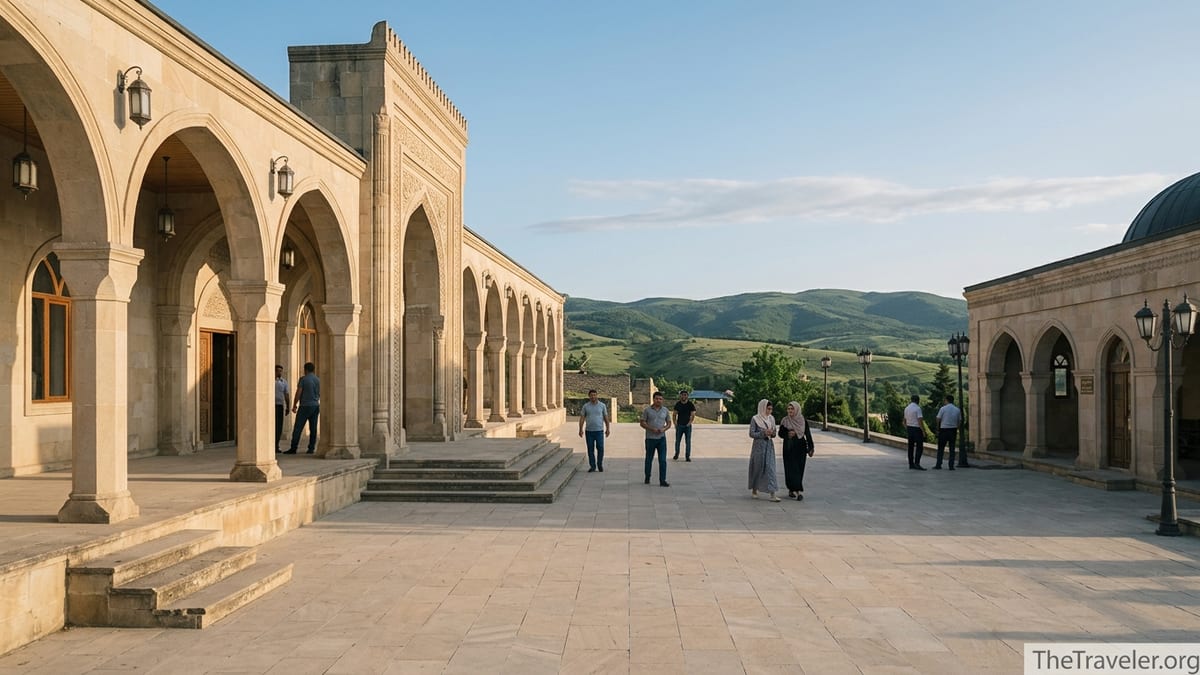
The single site that most clearly explains why Shamakhi still belongs on any Azerbaijan itinerary is the Juma Mosque, also known as Shamakhi Juma. Often described as the oldest Friday mosque in the Caucasus, its origins date back to the 8th century, when Arab rulers chose Shamakhi as their residence. The structure you see today has been rebuilt after earthquakes and wars, but the plan, stonework and courtyard convey the weight of more than a millennium of worship.
Arriving mid-morning, you are likely to find local families quietly moving in and out between prayers. The restored interior combines clean white walls with restrained ornament and carved stone. Instead of velvet ropes and ticket desks, there is usually just a simple donation box and a caretaker who may invite you to walk around as long as you dress modestly and remove your shoes. Many visitors pair their stop here with a guided explanation from Baku-based agencies that run Shamakhi day tours, but independent travelers can just as easily visit by renting a car or hiring a driver for the day.
A short drive south of town, on a low ridge above the road, the Yeddi Gumbaz mausoleums provide a striking counterpoint. These “Seven Domes,” burial places of Shamakhi’s 18th and 19th century rulers, look out over the town and surrounding valleys. Some domes have collapsed and the complex is partly ruined, but that is part of its atmosphere. Travelers often arrive to find only a shepherd and a few grazing sheep, making it easy to imagine caravan routes and riders coming over the hills below.
Seen together, Juma Mosque and Yeddi Gumbaz frame Shamakhi’s story: the mosque speaks of an early Islamic city on the Silk Road; the hilltop tombs recall later khans whose power was eventually eclipsed by Baku. For photographers, the combination is particularly rich. Wide shots of the mosque courtyard work well in soft afternoon light, while the domes of Yeddi Gumbaz are best shot late in the day, when the stone turns warm and the town below begins to glow with house lights.
A Base for Mountain Escapes and Starry Skies
Shamakhi’s setting is as compelling as its monuments. The town lies where rolling steppe gives way to the forested slopes of the Pirgulu range, making it a practical gateway to some of the most accessible highland scenery in central Azerbaijan. For travelers who do not have time to push on to the highest Caucasus villages, a night near Shamakhi can still deliver a real sense of mountain life.
About an hour’s drive south of the city, the Pirgulu State Reserve climbs into spruce forests and meadows. Several small hotels and guesthouses on the slopes cater to domestic weekenders from Baku, offering simple rooms, wood-fired saunas and outdoor terraces with views across the Shirvan plain. Prices vary, but travelers often find mid-range double rooms for a fraction of what similar mountain lodges might cost in Western Europe. In winter, snow transforms the area into a quiet retreat, while in late spring and early summer the hills are bright with wildflowers.
Shamakhi also has a surprising connection to the stars. The Shamakhy Astrophysical Observatory, set at higher elevation in the mountains, has long been one of the main astronomical facilities in the South Caucasus. While this is primarily a working observatory rather than a theme park, visits can sometimes be arranged through local tour operators or by contacting staff in advance. Even if the interior is not open, the drive up gives panoramic views and, on clear nights, some of the darkest skies within a few hours of Baku.
For travelers designing a compact itinerary, this combination of history, nature and science is a major reason Shamakhi still matters. In a single day and night you can visit an 8th-century mosque, walk among ruined mausoleums, watch the sun set from a mountain ridge and, if skies cooperate, see the Milky Way arch over the same valleys that once carried caravans towards the Caspian.
Wine Country and Slow Food in the Shirvan Hills
One of the most unexpected developments around Shamakhi in recent years has been the growth of wine tourism. The hills west of the city have long grown grapes, but new investment has brought modern wineries and visitor centers that are starting to appear on international travelers’ radar. The Meysari winery, operated under the Shirvan Wines brand, is the best-known example and sits about a short drive from Shamakhi on the road towards Ismayilli and Gabala.
Meysari markets itself as one of Azerbaijan’s pioneering organic wine estates, with certification from European bodies and a focus on local grape varieties alongside familiar international ones. Travelers who book a visit typically walk through neatly laid out vineyards, see the production facilities, and finish with a tasting flight in a modern stone-and-glass building looking onto the hills. Tastings and tours are usually priced at a level that remains accessible for many foreign visitors: expect something closer to prices in Eastern European wine regions than to Western European or North American estates.
On-site restaurants in and around these wineries lean heavily into local produce. Menus often feature clay-pot lamb stews, dolma wrapped in grape leaves picked from nearby vines, fresh herbs and salads, and sweets made with walnuts and mulberries. For many travelers, this is their first encounter with the full breadth of Azerbaijani regional cuisine beyond the kebabs and plov found in Baku’s city-center restaurants. Drivers commonly combine a morning visit to Juma Mosque with a leisurely lunch at a winery before continuing to mountain towns further west.
Crucially, the wine scene has helped tie Shamakhi into broader regional routes. It now makes sense to plan a two-day circuit that begins with mosque and mausoleums, follows with an afternoon among the vines, and finishes with an overnight in the mountain villages around Ismayilli or the cobbled streets of Lahij. That kind of slow, food-and-wine focused travel is exactly what many visitors seek as an alternative to capital-city sightseeing, and Shamakhi is where those experiences increasingly begin.
Everyday Shamakhi: Markets, Marshrutkas and Modest Hotels
Unlike purpose-built resorts, Shamakhi is a working town where tourism is just one of several livelihoods. This gives today’s traveler an opportunity to see how ordinary Azerbaijanis live outside Baku. The town center has small supermarkets, corner bakeries, auto-repair yards and clothing shops rather than glossy malls. A morning wander reveals grocers stacking crates of tomatoes, mechanics tuning Ladas and Volgas, and schoolchildren trailing home with armfuls of notebooks.
The main bazaar area is where visitors will feel this everyday rhythm most strongly. Stalls sell seasonal produce, homemade cheeses, pickles and honey from nearby villages. Prices are generally low by Western standards: a bag of cherries or apricots often costs the equivalent of a few US dollars, while simple lunches in local cafes may run to only a bit more. English is not widely spoken, but pointing, basic phrases and a friendly attitude are usually enough to complete transactions.
Accommodation in Shamakhi is modest but improving. You will not find international five-star chains here, but small hotels and family-run guesthouses offer clean rooms, hot water and Wi-Fi. Many are used to hosting domestic travelers arriving by car from Baku for weekends, so secure parking and late check-in are often available. Travelers who prefer more atmospheric stays may opt for guesthouses just outside town, trading central location for views of orchards and hills.
For budget-conscious visitors, minibus services known locally as marshrutkas still connect Shamakhi with Baku and neighboring districts. They usually depart from Baku’s western bus terminals and take around two to three hours depending on stops and traffic. Fares are typically far cheaper than hiring a private taxi or organized tour, though seats can be cramped during peak hours. Some travelers instead negotiate with taxi drivers in Baku for a fixed price day trip, which offers flexibility to combine Shamakhi with stops at Diri Baba Mausoleum near Gobustan or the mountain village of Lahij.
Practical Reasons to Include Shamakhi in Your Route
Beyond romance and history, there are practical reasons why Shamakhi fits neatly into a modern Azerbaijan itinerary. First is its position on the M4 highway, which forms part of the main east-west route linking Baku to western Azerbaijan and onward towards Georgia. Road upgrades over the past decade have shortened travel times and smoothed out what used to be a tiring journey. For travelers renting a car in Baku, Shamakhi is now an easy first-leg destination before branching north or west.
Second is flexibility. Because Shamakhi is relatively close to the capital, you can keep your plans loose. If weather is poor in the mountains, you can still visit the mosque and mausoleums as a day trip from Baku. If skies are clear and forecasts favorable, you might instead decide to stay overnight and continue onward to Ismayilli or Gabala the following day. This adaptability is especially useful for travelers visiting in late autumn or early spring, when conditions in higher villages can change quickly.
Third, Shamakhi’s scale and infrastructure make for a gentle introduction to rural travel in the region. Roads in and around town are generally paved, fuel is easily available, and there are enough cafes and small restaurants to avoid worrying about where to stop for meals. At the same time, traffic is lighter and the pace slower than in Baku, which can be reassuring for drivers unfamiliar with local habits. For those using public transport, the fact that Shamakhi sits on a main route means that finding a bus or marshrutka is usually straightforward from major hubs.
Finally, Shamakhi offers a realistic way to experience Azerbaijani hospitality without heavy commercial packaging. Whether it is a guesthouse owner inviting you to join their family for tea or a market vendor insisting you taste a slice of melon before buying, encounters here tend to feel spontaneous. In an era when many historic towns are carefully curated for visitors, the fact that Shamakhi’s attention is still focused largely on its own life is a strong reason to go now, before it inevitably becomes better known.
The Takeaway
Shamakhi will likely never reclaim its title as capital of Shirvan, but that is exactly what makes it compelling today. It is a place where history, religion, wine and highland landscapes merge in a town still shaped by its own routines rather than visitor expectations. For travelers, it offers a chance to understand how Azerbaijan’s past and present meet away from Baku’s oil towers and seaside boulevards.
Include Shamakhi in your route and the country’s map changes. The Juma Mosque becomes the anchor of a journey that passes vineyards and apricot orchards, mountain passes and village markets. An overnight stay opens up starry skies in Pirgulu and quiet mornings in streets that have seen caravans, earthquakes and empires rise and fall. In a country rushing towards the future, Shamakhi remains one of the most grounded places you can go.
Whether you have only one free day from Baku or a week to explore the interior, treating Shamakhi as more than a quick photo stop rewards you with context. It links the capital’s museums to the rural landscapes that fed them, and the modern motorway to the Silk Road tracks that once ran parallel. That is why, for travelers exploring Azerbaijan today, Shamakhi still matters.
FAQ
Q1. How long does it take to reach Shamakhi from Baku?
Under normal conditions it takes around two hours by car from central Baku to Shamakhi, slightly longer if you travel by bus or marshrutka with intermediate stops.
Q2. Is Shamakhi realistic as a day trip, or should I stay overnight?
A rushed visit is possible as a day trip, but many travelers prefer to stay at least one night to combine Juma Mosque and Yeddi Gumbaz with a winery visit or a short excursion into the Pirgulu mountains.
Q3. What are the must-see sights in and around Shamakhi?
Key highlights include the historic Juma Mosque in town, the Yeddi Gumbaz mausoleums on a nearby hill, the Shamakhy Astrophysical Observatory and Pirgulu area in the mountains, and the vineyards and wineries west of the city.
Q4. Do I need to join a tour, or can I visit Shamakhi independently?
You can visit independently by renting a car, hiring a driver or taking a bus or marshrutka from Baku. Organized day tours from the capital are convenient if you prefer fixed schedules, but independent travel is straightforward for most visitors.
Q5. What should I wear when visiting Juma Mosque and other religious sites?
Dress modestly with shoulders and knees covered. Women are usually asked to cover their hair with a scarf inside the prayer hall. Shoes must be removed before entering the mosque interior.
Q6. When is the best time of year to visit Shamakhi?
Late spring and early autumn are ideal, with mild temperatures and clear views of the surrounding hills. Summer can be warm but is still pleasant compared to lowland areas, while winter is quieter and colder, especially in the mountains.
Q7. Are there good places to eat in Shamakhi and nearby?
Yes. In town you will find simple cafes serving kebabs, soups and pilaf, while wineries and countryside guesthouses often offer more elaborate meals featuring local lamb dishes, fresh herbs and seasonal produce.
Q8. Is Shamakhi suitable for families with children?
Shamakhi works well for families who enjoy relaxed cultural and nature-focused trips. Children often appreciate the open courtyards of the mosque, the space around Yeddi Gumbaz and the chance to run in the meadows near Pirgulu or at vineyard estates.
Q9. How does Shamakhi compare to more famous destinations like Gabala or Sheki?
Gabala and Sheki are larger and more developed for tourism, with more hotels and activities. Shamakhi is quieter and closer to Baku, better suited for those seeking history, early wine tourism and a glimpse of everyday provincial life.
Q10. Is it safe to travel to Shamakhi as an independent traveler?
Shamakhi is generally considered safe for visitors who take normal precautions. As elsewhere, keep valuables secure, agree taxi fares in advance when possible and check current conditions before driving into the mountains, especially in winter.