


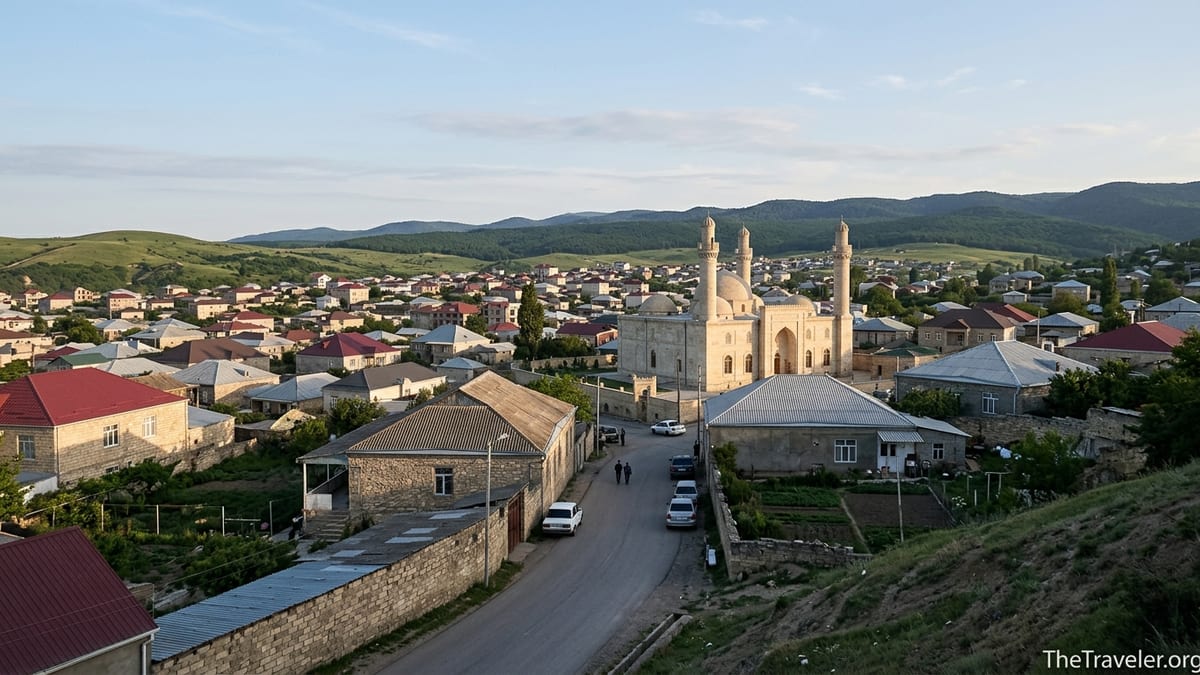
Set among the rolling foothills of the Greater Caucasus, about two hours west of Baku, the ancient city of Shamakhi looks modest at first glance: tidy streets, low stone houses, the silhouette of a rebuilt mosque rising above red roofs. Yet behind this quiet surface lies one of the deepest historical and cultural stories in Azerbaijan. For more than a millennium, Shamakhi was a political capital, a crossroads of trade and ideas, a center of poetry, winemaking and Islamic scholarship. Today, travelers who make the journey find not only picturesque landscapes and monuments, but a living cultural legacy that still shapes Azerbaijani identity.
Get the latest updates straight to your inbox!
From Shirvan’s Capital to a Quiet Hill Town
For much of the last thousand years, Shamakhi was not a provincial town, but the beating heart of a regional state. As the capital of Shirvan, a historic region in what is now central Azerbaijan, it stood on caravan routes that linked the Caspian coast with the Caucasus mountains and the Iranian plateau. Merchants brought silk, ceramics and spices through its gates. Local rulers, known as the Shirvanshahs, fortified the surrounding hills and issued coins that circulated far beyond their borders. Walking today along Shamakhi’s main streets, it is hard to imagine that this quiet town once handled the politics and trade of an entire region.
The city’s fortunes rose and fell with the shifting powers of the wider Caucasus. Under Arab rule in the 8th century, Shamakhi became an administrative center for the caliphate’s Caucasian territories, which helped plant early Islamic institutions here. Centuries later, it passed under the influence of Persian dynasties and then the Russian Empire. Each wave left traces in architecture, language and customs. A modern visitor glimpses this layered past in small details: Arabic calligraphy above a doorway, Persian-style decorative motifs on stone, Russian-era civic buildings along the central square.
Disaster reshaped Shamakhi’s role in the 19th century. A devastating earthquake in 1859 destroyed large parts of the city and prompted Russian authorities to move the regional capital east to Baku, which was already emerging as an oil hub. Administrative offices, merchants and skilled workers followed. Baku became the country’s political and economic center, while Shamakhi slipped into relative obscurity. This shift changed the city’s trajectory, but it also froze certain aspects of its character, allowing older ways of life and architecture to survive where they might otherwise have been swept away by industrialization.
Today, Shamakhi feels more like a compact hill town than a former capital, with around forty to fifty thousand residents spread between the city and surrounding villages. For travelers, this scale is an advantage. It allows visitors to move easily between sites, speak directly with local families and see how centuries of history now coexist with everyday routines. Coffee trucks and small supermarkets share space with stone caravanserai courtyards and ancient graveyards. The contrast is part of the city’s understated charm.
Juma Mosque: A Thousand Years of Faith and Survival
No single building tells Shamakhi’s story more clearly than the Juma Mosque, a monumental Friday mosque whose origins go back to the 8th century. Often described as one of the oldest mosques in the Caucasus, it was established around 743 during the early Islamic period, when Arab governors chose Shamakhi as their residence. Over time, earthquakes, fires and invasions repeatedly damaged the complex. Each reconstruction layered new architectural ideas over the old. The result is a structure where early Islamic, medieval Shirvan and modern restoration work stand side by side.
Travelers approaching the mosque along Nariman Narimanov Street first see its wide courtyard, restored facades and a cluster of domes and minarets set against the hills. Step inside and the atmosphere changes: cool stone floors, carefully restored arches, carved plaster and muted carpets create a space that is both historic and very much in use. During Friday prayers, the main hall fills with worshippers from Shamakhi and nearby villages. At other times of day, visitors might find only a handful of locals reading or resting, the quiet broken intermittently by the call to prayer from the minaret.
The mosque’s three-hall layout is one of its most distinctive features. Rather than a single vast chamber, the interior is divided into three parallel naves, separated by stone arcades. This design reflects an early regional interpretation of Islamic architecture and offers a subtle lesson in how faith was adapted to local building traditions. Travelers who take a guided tour often hear how archaeological excavations around the mosque uncovered remains of madrasas and cells, evidence that this was not only a place of worship but also a center for religious learning and perhaps scientific study.
Modern restoration has played a central role in preserving Juma Mosque for visitors. In the early 21st century, a comprehensive project backed by national foundations and the state consolidated the structure, repaired earthquake damage and renewed interior decoration while trying to keep the historical silhouette intact. For travelers, this means that the mosque is now structurally sound and accessible, with maintained gardens, lighting and basic visitor amenities. Modest dress is expected; scarves are often provided for women at the entrance, and there is no fixed ticket price, though small donations are customary and appreciated.
Poets, Storytellers and the Voice of Shirvan
Shamakhi’s cultural legacy is not confined to stone. For centuries, the city was a center of poetry and storytelling that helped define Azerbaijani literary identity. One of its most celebrated sons is Khaqani Shirvani, a 12th century poet known in both Persian and Azerbaijani traditions. His verses praised Shamakhi as a city whose glory rivaled that of famed cultural centers like Bukhara. Through his metaphors and moral reflections, Khaqani linked local landscapes and rulers to a broader Islamic and Persianate world of ideas.
Although manuscripts and scholarly editions of Khaqani’s work are usually found in major libraries rather than on local streets, visitors still encounter his presence in Shamakhi. A central park bears his name, and schoolchildren learn excerpts of his poetry. Guides often quote a line or two to illustrate how strongly intellectuals once identified with the city. For a traveler, hearing Khaqani mentioned in the same conversation as European poets like Dante or Chaucer helps situate Shirvan’s literary heritage in a global context.
Shamakhi also nurtured ashug traditions, the art of traveling bards who sang epic tales accompanied by a stringed instrument such as the saz. In nearby villages, older residents still recall evenings when families would gather to listen to stories of lovers, heroes and moral dilemmas delivered in verse. While formal ashug performances are less common today, versions of this oral culture survive in wedding songs, improvised toasts and narrative jokes told at family gatherings.
For travelers interested in living culture rather than only monuments, the best opportunities to experience these traditions are informal. A guesthouse owner might bring out a saz after dinner and sing a local song, or a tea house may host musicians on weekends. In some seasons, municipal cultural centers in Shamakhi organize poetry recitations or mugham concerts, where complex modal music is performed on the tar and kamancha. These events are usually advertised locally rather than online, so asking a hotel receptionist or taxi driver if anything is happening that evening can lead to unexpectedly rich encounters with the city’s musical and poetic heritage.
Wine, Gardens and the Agricultural Soul of Shamakhi
Long before Azerbaijan became associated with oil, Shamakhi was known for wine. Historical accounts describe the surrounding hills as covered with vineyards, and wine from Shirvan was exported along caravan routes to neighboring regions. While exact production figures from pre-modern times are uncertain, what is clear is that grape cultivation shaped both the economy and the landscape. Terraced fields, stone pressing basins and family-run cellars were once common features of rural life here.
Modern Shamakhi is again emerging as one of Azerbaijan’s key wine regions. Several wineries have established estates in the rolling countryside outside town, taking advantage of sunny slopes and relatively cool nights. Visitors driving from Baku often pass neat rows of vines and signs for wine tastings. A typical visit might include a walk through the vineyards, a tour of stainless-steel fermentation tanks and barrel rooms, and a guided tasting of local varieties in a glass-walled pavilion overlooking the hills.
Prices are generally accessible by international standards. A guided tasting of several wines at a local estate commonly costs roughly the equivalent of ten to twenty US dollars per person, while a bottle of mid-range Shamakhi wine in a cellar shop often falls in the six to fifteen dollar range depending on vintage and style. Many visitors choose to pair tastings with a simple lunch of local cheese, fresh herbs, bread and grilled lamb or chicken, turning the experience into an easy half-day outing from the city.
Beyond commercial wineries, small-scale agriculture remains central to everyday life in Shamakhi’s villages. In summer and early autumn, roadside stalls along the highway into town sell crates of grapes, apples, plums and walnuts. Travelers who stop for a few minutes can watch informal negotiations between drivers and farmers, often conducted with a mixture of Azerbaijani, Russian and expressive hand gestures. Buying fruit directly from growers is not only a way to taste the region’s produce at its source, but also a concrete reminder that Shamakhi’s cultural landscape is still rooted in the rhythm of planting, harvest and family labor.
Earthquakes, Resilience and Architectural Memory
Shamakhi’s cultural story cannot be separated from the earthquakes that have repeatedly struck the region. Chronicles and scientific studies record numerous significant tremors across the centuries, with especially destructive events in the 17th and 19th centuries. The 1859 earthquake proved particularly consequential, prompting the shift of regional administrative functions to Baku and altering the city’s long-term trajectory. For locals, these disasters are not just dates on a timeline but family stories of loss, rebuilding and migration.
Architecturally, repeated earthquakes forced Shamakhi’s inhabitants to adapt. Builders favored lower, thicker walls and flexible materials in residential houses. Mosques and public buildings had to be reinforced, sometimes by adding buttresses or simplifying decorative elements that might fall during tremors. When modern engineers and architects planned the latest restoration of Juma Mosque, seismic stability was a central concern. Reinforced concrete frames were discreetly integrated behind historical stone facades, and foundations were strengthened to better distribute future shocks.
For travelers, the result is a city where history is visibly scarred but still standing. In the older quarters, one can see where newer bricks patch earlier stone courses, or where doorframes have been subtly realigned after ground movement. The Yeddi Gumbaz mausoleum complex, set on a ridge above town, includes cracked domes and leaning tombstones that speak quietly of past earthquakes and weathering. Yet people continue to bury their dead nearby and to visit the site for contemplation, turning a landscape of damage into a space of continuity.
Understanding this seismic background adds depth to a visit. When a guide mentions that Shamakhi has been destroyed and rebuilt many times, the statement is not a poetic flourish but an observation grounded in geological reality. The city’s cultural legacy is therefore not simply about artistic achievements or political history, but also about the capacity of its residents to reconstruct their world repeatedly, preserving what they can and reinterpreting what they must.
Everyday Culture: Hospitality, Food and Modern Life
Shamakhi’s cultural legacy lives most vividly in daily habits rather than in museums. Hospitality is one of the most striking features for visitors. Guests are often greeted with strong black tea served in pear-shaped glasses, accompanied by sugar cubes, homemade jam or dried fruits. In family settings, it is common for hosts to insist that visitors taste multiple dishes, from dolma wrapped in grape leaves to plov scented with saffron. Refusing too quickly can be perceived as indifference, so travelers learn to accept at least a small portion and to compliment the cook.
Several small restaurants and roadside eateries in and around Shamakhi specialize in kebabs grilled over charcoal, stewed lamb dishes and seasonal salads of tomatoes, cucumbers and herbs. Prices remain relatively moderate compared to Baku. A filling meal for two people, including kebabs, salad, bread and tea, often totals the equivalent of fifteen to twenty-five US dollars depending on the setting. In village homes, families might slaughter a lamb for a major celebration and prepare traditional dishes collectively, turning cooking itself into a social ritual.
Modern influences are visible as well. Younger residents often commute to larger cities for work or study, returning on weekends with new music, fashion and ideas. Smartphones and social media have connected Shamakhi to global trends, but they coexist with older practices. It is not unusual to see a teenager checking messages beside a grandmother spinning wool or preparing lavash bread in a tandoor oven. For travelers, this juxtaposition offers a candid view of how a historic town negotiates contemporary life without fully abandoning its roots.
Accommodation options reflect this blend of old and new. In and around Shamakhi, visitors find a mix of simple Soviet-era hotels, family-run guesthouses and newer hillside resorts built to serve domestic tourism. A basic room in town typically costs the equivalent of twenty-five to forty US dollars per night, while larger spa-style properties in the nearby countryside may range from eighty to one hundred fifty dollars depending on season and amenities. Many travelers choose to stay in the hills, enjoying forest views and fresh air, then make short trips into the city to explore its historical sites.
The Story in the Landscape: Observatories, Villages and Roads
Shamakhi’s cultural legacy extends beyond its urban core into the surrounding landscape. One notable modern institution in the region is an astronomical observatory located in the mountains northwest of the city. Built in the Soviet period and still used for research and education, it symbolizes a different facet of Shamakhi’s identity: a link between the clear Caucasian skies and scientific inquiry. School groups and curious travelers sometimes visit to view telescopes, learn about basic astronomy and enjoy panoramic views over forests and meadows.
The villages encircling Shamakhi preserve architectural and craft traditions that complement the city’s story. Stone houses with wooden balconies, narrow lanes, small orchards and roadside chapels or shrines reveal how religious and cultural practices diffuse into the countryside. In some settlements, older women still weave carpets using regional patterns on home looms, creating textiles that echo motifs found in historical Shirvan carpets displayed in museums. Buying directly from weavers, when possible, helps support these crafts and keeps small-scale production viable.
The road network that ties Shamakhi to Baku and other cities is itself part of the narrative. The main highway from the capital climbs gradually through semi-desert landscapes before reaching greener, more wooded terrain near Shamakhi. Along the way, travelers notice changes in architecture, crops and roadside businesses. Modern fuel stations and cafes alternate with small tea houses and fruit stands, mirroring the broader transition from metropolitan Baku to the older cultural environment of Shirvan. The trip, which typically takes around two hours by car or bus depending on traffic and weather, is an accessible and rewarding detour for those exploring Azerbaijan beyond the capital.
For many visitors, combining Shamakhi with nearby destinations creates a fuller picture of regional culture. Day trips often pair the city’s mosque and mausoleums with the mountain village of Lahij, known for cobbled streets and coppersmith workshops, or with forested resorts and lakes further west. In this way, Shamakhi becomes both a destination in its own right and a gateway to the cultural and natural diversity of the central Caucasus foothills.
The Takeaway
Shamakhi’s story is one of prominence, loss and quiet persistence. Once the capital of Shirvan and an early center of Islamic culture in the Caucasus, it endured earthquakes, political shifts and economic decline. Yet its core elements survived: the Juma Mosque with its layered architecture, the memory of poets like Khaqani, the vineyards that still produce wine, the hospitality of families who welcome strangers with tea and stories. Each of these elements adds another thread to a tapestry that continues to evolve.
For travelers, Shamakhi offers more than a checklist of monuments. It invites patient observation: the way afternoon light falls across mosque courtyards, the taste of grapes bought from a roadside stall, the sound of mugham drifting from a cultural center, the conversation with a winemaker explaining why a particular hillside matters. These experiences illuminate how history is not only preserved in stones and texts, but also lived daily by the people who call this place home.
Visiting Shamakhi means stepping briefly into the long narrative of Shirvan, where caravan roads once met and where faith, art and agriculture shaped a distinctive regional identity. By walking its streets, listening to its stories and supporting its local businesses, travelers become part of the city’s ongoing cultural journey. Shamakhi may no longer be a political capital, but in many ways it remains a capital of memory and meaning in Azerbaijan.
FAQ
Q1. Where is Shamakhi located and how far is it from Baku?
Shamakhi lies in central Azerbaijan in the Shirvan region, about 120 kilometers west of Baku. By car or intercity bus, the journey typically takes around two hours each way, depending on traffic and weather conditions.
Q2. Why is Shamakhi historically important?
For many centuries Shamakhi served as the capital of Shirvan, a significant regional state. It was a hub of trade, poetry, Islamic learning and winemaking, and later an administrative center under the Russian Empire before the capital shifted to Baku after a major earthquake in the 19th century.
Q3. What makes the Juma Mosque in Shamakhi special?
The Juma Mosque is one of the oldest mosques in the Caucasus, with origins in the 8th century. It has been destroyed and rebuilt several times due to earthquakes and invasions, giving it a layered architectural character. Recent restorations have stabilized the structure and made it accessible for both worshippers and visitors.
Q4. How should visitors dress and behave at Juma Mosque?
Modest clothing is recommended, with shoulders and knees covered for all visitors and headscarves for women. Shoes are removed before entering the prayer hall. Photography is usually allowed but it is courteous to ask permission, avoid flash during prayers and keep voices low inside.
Q5. Can travelers taste local wine in Shamakhi?
Yes, several wineries operate in the countryside around Shamakhi and welcome visitors for vineyard tours and tastings. A typical guided tasting costs roughly the equivalent of ten to twenty US dollars, and many estates sell bottles on site, often priced lower than in city shops.
Q6. What other historical sites should visitors see besides the mosque?
Many travelers visit the Yeddi Gumbaz mausoleum complex on a hill above the city, which contains domed tombs of local rulers and offers wide views of the landscape. Ruins of older fortifications and cemeteries in and around Shamakhi also provide insight into the city’s long and sometimes turbulent history.
Q7. Is Shamakhi safe to visit, given its history of earthquakes?
While the region has experienced destructive earthquakes in the past, modern building standards and monitoring have improved safety. Seismic activity is a natural feature of the wider Caucasus. Visitors generally experience Shamakhi as a calm and safe destination, though it is always wise to follow local guidance in the rare event of tremors.
Q8. What is the best time of year to visit Shamakhi?
Spring and autumn are particularly pleasant, with mild temperatures and green hills in April and May, and colorful foliage and grape harvests in September and October. Summers can be warm but usually remain cooler than Baku, while winters bring occasional snow and a quieter atmosphere.
Q9. Are there good places to stay and eat in Shamakhi?
Shamakhi offers a mix of basic city hotels, family-run guesthouses and modern countryside resorts. In town, simple hotels often cost around twenty-five to forty US dollars per night, while larger hilltop properties with pools and spas may cost more. Local eateries serve kebabs, stews, plov and fresh salads at moderate prices.
Q10. How can visitors experience local culture beyond sightseeing?
Spending time in tea houses, visiting village markets, joining a wine tasting or attending a music or poetry evening at a cultural center are all good options. Conversations with taxi drivers, shop owners and guesthouse hosts often reveal personal stories that bring Shamakhi’s history and traditions to life in a memorable way.