


Ask an Azerbaijani where the country’s story begins, and many will point not to glamorous Baku on the Caspian, but inland to Shamakhi. Tucked into the rolling foothills of the Greater Caucasus, this modest modern town was once a glittering Silk Road capital, a center of poetry and trade, and one of the earliest strongholds of Islam in the Caucasus. Today its ruined fortresses, ancient mosques and quiet vineyards explain why Shamakhi occupies a central place in Azerbaijan’s history and imagination.
Get the latest updates straight to your inbox!
Where and What Is Shamakhi Today?
Shamakhi is a small city in central Azerbaijan, about 120 kilometers west of Baku along the main highway that cuts through the country’s wine country and into the Caucasus foothills. The drive from the capital usually takes around two hours by car or organized tour, passing oil fields that gradually give way to green slopes, grazing flocks and roadside pomegranate stalls. For many visitors it is an easy day trip from Baku, often combined with the mountain village of Lahij or the resort town of Ismayilli.
Modern Shamakhi feels like a provincial market town: low apartment blocks, new roadside cafes serving kebabs and plov, and a scattering of small hotels that mainly cater to local travelers and weekenders from Baku. It is not a museum city frozen in time. Trucks still rumble through the center, schoolchildren spill out of courtyards in the afternoon and farmers sell cheese and herbs from the back of Lada cars. Yet walk a few minutes from the main road and you begin to see why historians keep returning here.
On the hills around town stand the broken walls of ancient citadels and the domes of royal mausoleums. In the center rises the restored Juma Mosque, whose foundations date back over 1,200 years. Outside town, vineyards line the valley floors, a reminder that Shamakhi has been associated with wine and agriculture for centuries. For travelers, this mix of lived-in reality and deep history is part of its appeal: Shamakhi is a place where Azerbaijan’s past is not only displayed, but still quietly lived.
Shamakhi as the Capital of Shirvan
For much of the last millennium Shamakhi was the political heart of Shirvan, a historic region that covered much of modern-day Azerbaijan between the Caspian Sea and the Caucasus. From about the 9th century, local rulers known as the Shirvanshahs made the city their capital. They controlled important caravan routes that connected Iran and Central Asia with the Caucasus and the Black Sea, and the taxes and tolls from that trade poured into Shamakhi.
In its heyday the city was celebrated by travelers and poets for its wealth and refinement. Caravans carried silk, spices and ceramics through its markets, while artisans produced carpets, metalwork and fine textiles that circulated across the region. The court attracted scholars and poets who wrote in Persian and Azerbaijani, helping to turn Shamakhi into a cultural center long before Baku’s rise. When you stand today on the windy hill near the ruined Gulistan fortress above town, it takes little imagination to picture processions of courtiers and traders moving in and out of the city gates.
Shamakhi’s role as a regional capital was so entrenched that even after repeated invasions by Seljuks, Mongols and later Safavid and Ottoman armies, power would return here once the dust settled. Local rulers repaired walls, rebuilt palaces and reopened caravanserais. This pattern of destruction and renewal is written into the landscape. A modern visitor may first see only low earthworks and scattered stones on the citadel hill, but with a guide or some advance reading it becomes clear that these are the archeological shadows of a city that once decided the fate of Shirvan.
An Early Stronghold of Islam in the Caucasus
One of the reasons Shamakhi is so important in Azerbaijani history is its role in the early spread of Islam in the region. Arab armies reached the South Caucasus in the 7th and 8th centuries, and by the early 700s Shamakhi had been chosen as a residence for Arab governors. It was in that period, according to local chronicles and modern research, that the Juma Mosque of Shamakhi was founded, with many sources giving a date in the 740s.
This makes the Juma Mosque one of the oldest mosques in the entire Caucasus, second only to the Friday Mosque of Derbent in present-day Dagestan. Its original form has been altered by earthquakes and reconstructions, but its continuous use as a place of worship for more than a thousand years gives the site particular weight. For Azerbaijanis, it stands as visible proof that Islam took root in this land very early, long before modern borders existed.
When you walk into the mosque complex today, entered through a landscaped courtyard and low stone gate, you move through layers of history. The current structure combines 19th and 21st century rebuilding with older foundations. Inside, rows of columns and a high central dome create a calm, cool space, with carpeted floors and white walls broken by geometric ornament. On Fridays, local residents and visitors pray side by side. For travelers who may know Baku mainly for its futuristic flame-shaped towers, the Juma Mosque is a reminder that Azerbaijan’s identity is equally shaped by ancient religious architecture in places like Shamakhi.
Earthquakes, Decline and the Rise of Baku
If Shamakhi was so wealthy and well placed, why did it lose its status as a capital? The answer lies partly beneath travelers’ feet. The city sits in one of the most seismically active zones of the South Caucasus. Chroniclers recorded severe earthquakes in the Middle Ages, and modern seismologists confirm that the region’s geology makes strong tremors likely. Several documented quakes, including major ones in the 12th and 19th centuries, devastated the city and killed large numbers of inhabitants.
The most consequential of these occurred in June 1859, when an intense earthquake struck what was then the administrative capital of the Shamakhi Governorate of the Russian Empire. The destruction was so great that imperial authorities decided not to rebuild the provincial center here. Instead they transferred the capital, and with it much political and economic investment, to the growing port of Baku on the Caspian coast. That decision, made in the wake of a natural disaster, set the stage for Baku’s rapid expansion into an oil boomtown and eventually the dominant city of modern Azerbaijan.
For Shamakhi the consequences were stark. Many administrative buildings were abandoned or relocated, trade routes shifted, and some families followed jobs to Baku. Later earthquakes in the early 20th century compounded the damage. Walking around today, you may notice how few pre-1800 buildings survive compared with the city’s long history. The mosque, sections of fortress walls, mausoleums and scattered tombstones are the main survivors. Yet this vulnerability has also become part of Shamakhi’s story. Azerbaijanis often speak of the city with a certain tenderness, as a place that has endured repeated blows yet preserved its role as a cultural and spiritual center.
Poets, Wine and the Silk Road
Shamakhi’s importance is not only political and religious. For centuries it has stood at the intersection of trade, viticulture and literature, leaving traces that visitors can still experience. Historically, the city lay on routes that linked Iran and Central Asia with the Caucasus and the Black Sea. Caravans brought Persian silk and Indian spices north, while local products such as wool, dried fruits and wine moved in the other direction. Wells, caravanserais and bridge foundations in the broader Shirvan region testify to that traffic.
The area around Shamakhi, with its sunny slopes and cooling breezes, has long been associated with wine production. Medieval Persian poetry and later travel accounts mention the quality of Shirvan wines. That tradition is being revived today by wineries in the district that produce both still and sparkling wines from local and European grape varieties. Travelers based in Baku increasingly book day tours that combine a visit to the Juma Mosque with a tasting at one of these vineyards, where they might sample a dry white made from indigenous varieties before returning to the city in the evening.
Literature also underlines Shamakhi’s place in Azerbaijani cultural history. The city was either home or inspiration to several notable poets writing in Persian and Azerbaijani Turkic. Perhaps the most widely known is Sabir, an early 20th century satirist whose work criticized social inequality and conservatism. His legacy is honored at the Mirza Alakbar Sabir Museum in Shamakhi and in statues and street names across Azerbaijan. For travelers, even a short stop at the museum helps connect the quiet streets outside to the intellectual debates that once animated the city’s cafes and salons.
Key Historic Sites Travelers See in Shamakhi
Most visitors experience Shamakhi through a small number of key sites that condense its long history into a single day. The most prominent is the Juma Mosque in the center of town. Recent restorations, completed in the early 2010s, have reinforced its structure while adding modern facilities such as a visitor entrance, ablution areas and discrete exterior lighting for evenings. Travelers usually spend 30 to 60 minutes here, walking through the main prayer hall, exploring side galleries and quietly observing worshippers if their visit coincides with prayer time.
A short drive or walk from the center brings you to the Shamakhi History and Local Lore Museum. Housed in a modest building, it contains archeological finds, coins, traditional costumes and photographs that trace the city’s story from ancient settlements through the Soviet period. Exhibits are simple but evocative. For example, fragments of pottery and weapons from the surrounding hills illustrate the area’s strategic importance, while black-and-white images capture the aftermath of 20th century earthquakes and the gradual reconstruction that followed.
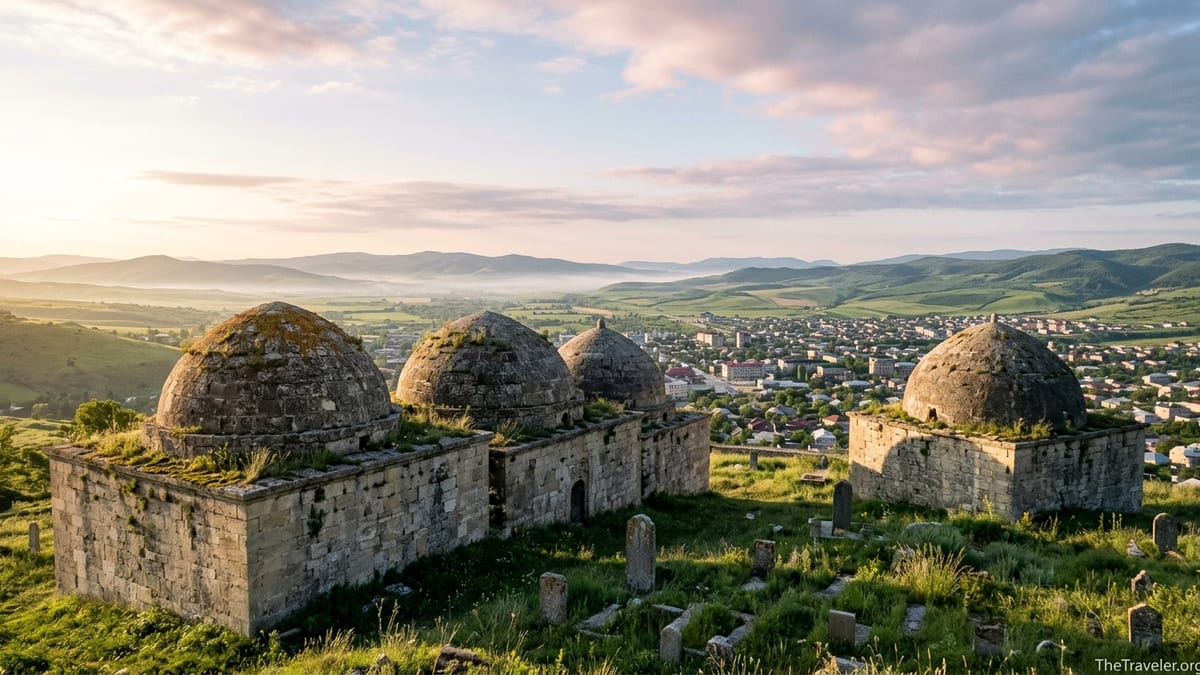
Just outside town, on a hill with sweeping views over fields and villages, stands the Yeddi Gumbaz, or Seven Domes, mausoleum complex. Only three of the original domed tombs now stand largely intact, with the others reduced to low walls and stone fragments. Built in the early 19th century as the burial place of the Shamakhi khans, the domes are a powerful reminder of the region’s last semi-independent rulers before full incorporation into the Russian Empire. Dry grass often grows between the tombs and flocks graze on nearby slopes, giving the site a quiet, slightly melancholic atmosphere that many travelers find moving.
Some tours also include a stop at the remains of Gulistan fortress, an earlier stronghold of the Shirvanshahs located on a high ridge not far from the city. Little stands above ground beyond stretches of wall and earthworks, but the location explains much about Shamakhi’s historic power. From here, rulers could watch routes threading through the valleys below. For photographers, sunset over these ruins, with the sky turning from gold to soft purple above the hills, offers one of the most atmospheric views in the region.
Shamakhi in Independent Azerbaijan
Since Azerbaijan regained independence in 1991, Shamakhi has enjoyed renewed attention as a symbol of national continuity. Government-funded restoration projects, particularly at the Juma Mosque, have aimed to present the city’s monuments as part of a broader narrative of Azerbaijan as an ancient yet modern state. Presidential visits to inaugurate restorations, covered widely in local media, highlight the idea that caring for Shamakhi’s heritage is a matter of national pride.
At the same time, everyday life here remains strongly tied to agriculture and small-scale trade. Many families rely on orchards, livestock and seasonal work. This means the city’s renaissance is modest rather than spectacular. New cafes and small hotels have opened to serve weekend tourists from Baku, and private tour companies market Shamakhi as a convenient escape into nature and history. Typical full-day tours from the capital currently cost roughly what a mid-range hotel night in Baku might cost, making them accessible to many foreign visitors considering a short break.
For Azerbaijanis, Shamakhi functions as both ancestral memory and present-day retreat. School groups come to visit the mosque and museum, couples pose for wedding photos among the domes of Yeddi Gumbaz, and families drive up for picnics in nearby forests and meadows. The city’s role as a living place, not only an open-air museum, helps ensure that its story continues into the 21st century.
The Takeaway
Shamakhi matters in Azerbaijan’s history because so many of the country’s defining themes converge here. As the long-time capital of Shirvan, it once held political power over much of what is now Azerbaijan. As the site of one of the Caucasus’s earliest mosques, it anchors the country’s Islamic heritage. As a node on Silk Road trade routes and a center of wine production and poetry, it contributed to a cosmopolitan culture that connected the Caspian to wider worlds.
At the same time, Shamakhi’s story is one of vulnerability and resilience. Repeatedly shaken by earthquakes and eclipsed by the meteoric rise of Baku, it could easily have faded into obscurity. Instead it has remained a reference point in Azerbaijani memory, restored and revisited by generations who see in its mosque domes and fortress walls a mirror of their own endurance.
For travelers, visiting Shamakhi is an opportunity to step behind the polished facade of modern Baku and walk through a landscape that explains how Azerbaijan became what it is today. Standing in the cool interior of the Juma Mosque, or looking out from the windswept hill of Yeddi Gumbaz over the valleys below, you are not only seeing monuments. You are standing in the place where, for centuries, the political, spiritual and cultural currents of this part of the Caucasus came together.
FAQ
Q1. Where exactly is Shamakhi and how do I get there from Baku?
Shamakhi lies about 120 kilometers west of Baku in central Azerbaijan. Most visitors reach it by car along the main Baku Shamakhi highway, either by private taxi arranged through their hotel or by joining a small-group day tour that includes stops at the Juma Mosque and nearby villages.
Q2. Why is Shamakhi considered so important in Azerbaijan’s history?
Shamakhi served for centuries as the capital of Shirvan, a historic region that covered much of present-day Azerbaijan. It was a political center for local rulers, an early stronghold of Islam in the Caucasus, a hub on Silk Road trade routes and a place where poets, merchants and craftsmen shaped Azerbaijani culture.
Q3. What is special about the Juma Mosque of Shamakhi?
The Juma Mosque is one of the oldest mosques in the Caucasus, with origins traced back to the 8th century. Despite repeated damage from earthquakes and invasions, it has remained a central place of worship and a powerful symbol of Azerbaijan’s Islamic heritage.
Q4. What are the Yeddi Gumbaz or Seven Domes near Shamakhi?
Yeddi Gumbaz is a hilltop mausoleum complex just outside Shamakhi, built in the early 19th century as the burial site of the local khans. Today three main domed tombs and several ruined structures remain, offering wide views over the surrounding valleys.
Q5. How badly have earthquakes affected Shamakhi over time?
Shamakhi sits in a highly seismic zone and has suffered several devastating earthquakes over the centuries. A particularly destructive quake in the 19th century led the Russian imperial authorities to move the regional capital from Shamakhi to Baku, contributing to the latter’s rapid rise.
Q6. Can I visit Shamakhi as a day trip or should I stay overnight?
Many travelers visit Shamakhi on a day trip from Baku, often combined with nearby destinations such as Lahij or Ismayilli. However, staying overnight in a local guesthouse or nearby countryside resort allows more time to explore the ruins, enjoy the quieter evenings and visit surrounding vineyards and forests.
Q7. Is there anything to see in Shamakhi beyond the mosque and mausoleums?
In addition to the Juma Mosque and Yeddi Gumbaz, visitors can explore the local history museum, remnants of fortress walls on nearby hills, small wineries in the district and traditional villages in the surrounding countryside that reflect everyday life in central Azerbaijan.
Q8. What role did Shamakhi play in the Silk Road trade?
Shamakhi lay on routes linking Iran and Central Asia with the Caucasus and the Black Sea. Caravans carrying silk, spices and textiles passed through or near the city, while local producers supplied goods such as wine, wool and dried fruits, helping to weave Shamakhi into wider commercial networks.
Q9. How does Shamakhi compare to Baku for travelers interested in history?
Baku offers grand boulevards, museums and a well preserved old town that reflect its oil boom and imperial past. Shamakhi, smaller and more rural, provides a deeper sense of early Azerbaijani statehood, religious history and the impact of natural forces on human settlements. Visiting both gives a more complete picture of the country.
Q10. Is Shamakhi still significant in modern Azerbaijan?
Yes. While it is no longer a political capital, Shamakhi remains symbolically important as a cradle of Azerbaijani statehood and culture. Ongoing restoration projects, school excursions and domestic tourism all show that the city’s historical and spiritual legacy continues to matter in contemporary Azerbaijan.