


I arrived in Monaco expecting a postcard of obvious extravagance: superyachts stacked in Port Hercule, diamond-bright boutiques in Monte Carlo, and the shrill echo of Formula One engines bouncing between apartment towers. Luxury, I assumed, meant being driven, hosted, and shielded from ordinary effort. But a day spent simply walking the principality, riding its public elevators instead of private cars and lingering in its quieter corners, rewrote that definition. Monaco, it turned out, was built for feet as much as Ferraris, and seeing it at walking speed changed how I understood luxury travel itself.
Get the latest updates straight to your inbox!
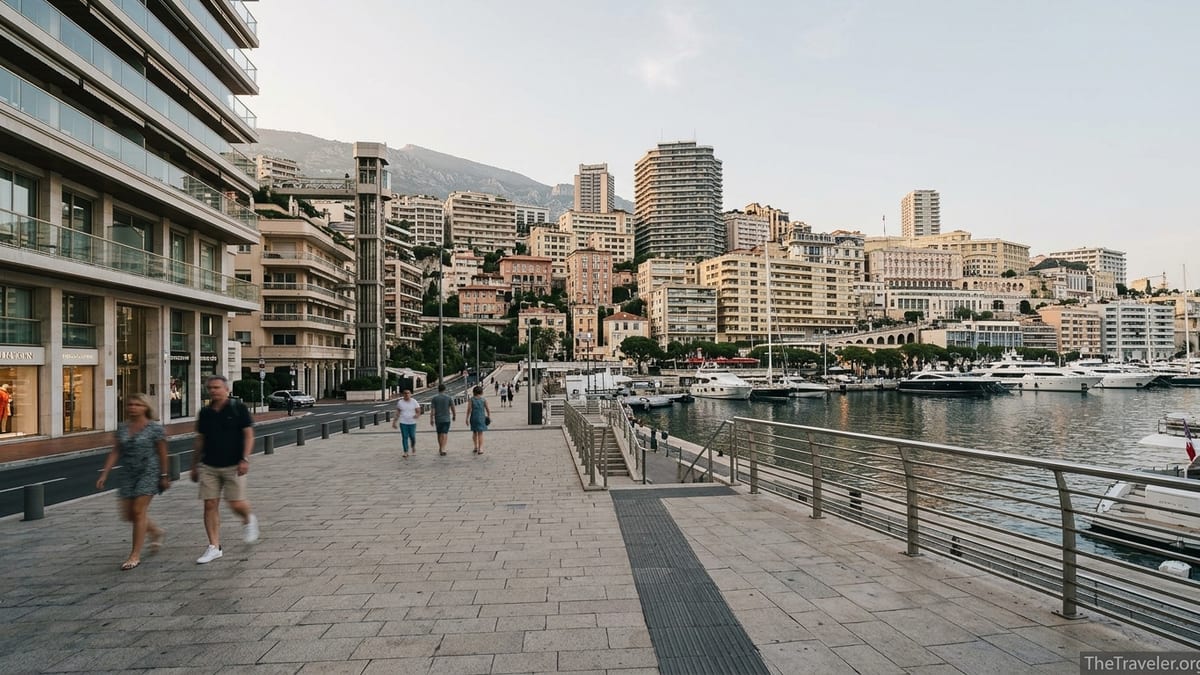
Discovering a Vertical City on Foot
From a map, Monaco looks straightforward: just over 2 square kilometers pressed between mountains and sea. Local walking guides note that you can cross the country in roughly 40 to 45 minutes if you keep a steady pace. In reality, the streets stack on top of each other like shelves, connected by staircases, tunnels, and an almost improbable web of public elevators and escalators. Official tourism information describes dozens of these free lifts, with government communication in the 2020s speaking of close to a hundred mechanical links when you count elevators, escalators, and travelators combined. It is a vertical city calibrated for pedestrians, not only chauffeurs.
My first surprise came as I exited Monaco-Monte-Carlo station. Instead of a taxi stand defining the arrival experience, signboards quietly pointed toward ascenseurs publics that whisk you up into the light. Within minutes I moved from a cool tunnel to a panoramic balcony above Port Hercule without spending a cent or sitting in traffic. The design felt closer to a ski resort’s lift network than a traditional wealthy enclave, yet it serves office workers, school children, and visitors equally.
Later, following a walking map, I traced one of the classic routes from the modern towers of La Condamine up to the old town of Monaco-Ville on “the Rock.” Elevators handled much of the climb that would have once meant stiff legs and sweat-damp shirts. The contrast was striking: where I had expected luxury to mean being driven door to door, here the luxury lay in effort made optional but still available if you wanted it. You could glide smoothly up the cliff in a glass box, then choose to wander the sloping lanes under your own power.
This invisible infrastructure changes how a traveler experiences the place. You may still catch sight of a parade of supercars outside the casino, but if you pay attention you also notice locals in office attire flowing through elevator lobbies, stepping into machines that transport them between sea level and hilltop districts. For a visitor on foot, these vertical shortcuts feel like a quiet, democratic form of comfort and one of the most valuable luxuries Monaco offers.
From Superyachts to Side Streets: Reframing Luxury
Before I arrived, most of my mental postcards of Monaco were broadcast images: the Monaco Grand Prix threading through tight corners, drone shots of private pools, and interviews on superyacht decks. It is an easy place to imagine as a closed loop of chauffeur-driven cars between the Hôtel de Paris Monte-Carlo, the Casino, and the harbor. Yet my first real impression of the principality was not a Lamborghini on Casino Square but a bakery window in La Condamine, its baguettes still warm, with office workers queuing for espresso before work.
Walking from the station toward Port Hercule early in the day, I passed construction workers grabbing coffee at a simple corner bar, older residents negotiating steep alleys with the help of handrails, and teenagers in sports kits crossing the street below the stands of the Formula One grandstands, long packed away until race season. The harbor glittered, and a yacht with a helipad drew glances, but the more I let my pace slow, the more that boat became background rather than centerpiece.
Luxury travel in Monaco certainly can mean booking a suite at the Hotel de Paris, where rates for high-season sea-view rooms frequently climb into four-figure sums per night and private transfer services line up outside. It can mean dining in three-Michelin-starred rooms or reserving a private terrace above the Grand Prix circuit. Yet experiencing Monaco as a pedestrian suggested a different hierarchy of indulgence. Drinking an ordinary cappuccino on a quiet back street felt, in its own way, as precious as a flute of vintage champagne when the view included laundry lines and ivy-draped walls as much as designer storefronts.
As I skirted the edge of Monte Carlo’s One Monte-Carlo complex, where boutiques like Prada, Dior, and Hermès sit within arm’s length of each other, I had the sense that this is the version of Monaco most travelers expect: immaculate paving stones, glossy window displays, and valets who treat a Bentley and a compact rental car with equal brisk efficiency. But I began to realize that the true luxury was the ability to step out of that polished corridor and, within ten minutes of downhill walking, find myself among the fishing boats at the far end of the harbor, where the sea smelled stronger and prices in little snack bars dropped noticeably.
Tracing the Grand Prix Circuit at Human Speed
Nowhere did walking feel more transformative than on the route of the Monaco Grand Prix itself. On television, the Circuit de Monaco is a blur of color and speed, its corners labeled like mythic sites: Sainte Dévote, Casino, Mirabeau, the Fairmont hairpin, the tunnel, Rascasse. At street level on a normal day, many of these names are just signs at intersections where parents push strollers and residents walk home with groceries.
Starting at the Sainte Dévote corner near the harbor, I followed the white racing lines as they tucked uphill in a curve so tight that even on foot you sense the squeeze. Climbing toward the famous casino, I paused at a pedestrian crossing where days earlier, according to a local walking tour guide, crowds had leaned across safety fences to watch race preparations. The striped curbs and scuffed barriers remained, but the engines were replaced by scooters and the soft rumble of buses.
On race weekend, hospitality suites overlooking the track can cost thousands of euros per person, complete with open bars and curated menus. Specialized travel agencies sell packages that bundle hotel rooms, balcony access, and after-party invitations, turning a few lap times into a multi-day festival of abundance. Yet as I walked the same asphalt at my own speed, reading the small plaques embedded into the tarmac, I found myself more fascinated by the everyday logistics. Near the Fairmont hairpin, which doubles as a driveway to the hotel and a route to a public elevator down to the sea, a delivery truck edged around a tight corner where, in race footage, cars slip almost nose to tail.
Understanding the circuit on foot shifts the story. Instead of a pure symbol of exclusivity, it becomes a reminder that even the most televised luxury spectacle rests on ordinary streets, public sidewalks, and municipal engineering that has to function every day of the year. Knowing that a city bus shares tarmac with one of the world’s most expensive sporting events might not diminish the glamour, but it certainly reframes it.
Sidewalk Prices vs. Palace Prices
Monaco’s reputation for high prices is well-earned, and it is reasonable for a traveler to arrive with sticker shock preloaded. A fine-dining tasting menu in the Casino Square neighborhood can easily run well into three figures per person before wine, and afternoon tea in the salons of grand hotels has become an experience in its own right, with prices that reflect the prestige of a celebrated pastry chef or a historic dining room. Some visitors rave about these moments, while others quietly admit that the cost felt disproportionate to the pleasure.
Walking, however, makes it much easier to calibrate your own version of indulgence. A few minutes downhill from the casinos, brasseries and bars along Port Hercule serve coffee, croissants, and simple plats du jour at prices much closer to what you might pay in nearby Nice. One traveler I met at a waterfront counter told me she had paid less than 5 euros for a morning espresso and pastry while watching crews wash the decks of superyachts just meters away. Another couple described splitting a shared pizza on a shaded terrace for under 20 euros, then taking the 2-euro harbor water taxi across to the opposite quay, effectively buying both dinner and sightseeing for what might be a single drink on Casino Square.
The same pattern repeats itself in accommodation. A suite with a terrace overlooking the Grand Prix circuit or the harbor can cost more per night than many travelers would spend in a week elsewhere on the Riviera. Yet a short train ride away, in Nice or Menton, rooms in comfortable mid-range hotels often cost a fraction of Monaco’s top-tier rates, sometimes under 200 euros even in lively seasons. Because Monaco is so compact, staying outside and commuting in by train or bus takes less than an hour, and once you arrive, that very network of elevators and escalators puts most sights within walking distance.
What walking reveals is choice. You can sit at the Belle Époque terrace of Café de Paris Monte-Carlo on Place du Casino, where the price of a simple glass of wine partly covers front-row views of the parade of cars and people. Or you can walk ten minutes and pay local-bar prices for the same drink with a different view: perhaps laundry lines strung between balconies instead of diamonds at the blackjack tables. Both experiences belong to the same tiny country. Luxury, in that sense, is not one expense level but the freedom to select the angle that feels right for you.
Luxury as Access, Not Exclusion
As I moved around Monaco on foot, the detail that struck me most was how much of its comfort-oriented infrastructure is free and shared. The elevators, escalators, air-conditioned tunnels, and carefully graded ramps are not hidden behind room keys or private membership cards; they are part of the public realm. In recent years the principality has even expanded this network, opening new pedestrian bridges and lift connections between districts such as Fontvieille and the rest of the city to make walking more attractive than driving.
This approach complicates the caricature of Monaco as a place reserved only for the ultra-rich. Yes, luxury boutiques concentrate in the Carré d’Or, and yes, there are private clubs, marinas, and clubs where the minimum spend is larger than many people’s weekly budgets. But between these pockets of exclusivity run sidewalks open to everyone, often lined with small playgrounds, pocket parks, and benches angled for maximum sea view. During my visit, I watched a group of teenagers in football shirts use one of the seaside promenades near Fontvieille as an impromptu practice pitch while, a few meters away, a visitor in a tailored suit took calls on a bench overlooking the same harbor.
For travelers, this means that some of Monaco’s most satisfying luxuries cost nothing at all beyond the price of getting there. Climbing up to the viewing terrace near the Prince’s Palace in Monaco-Ville and watching the arc of coast from Italy to Cap Ferrat costs only the energy of a short walk or an elevator ride. Wandering through the alleyways around the cathedral at sunset, when the stone walls hold the day’s warmth, is available whether you arrived by private yacht or regional train. Access, not exclusion, becomes the real currency.
That realization altered how I thought about luxury travel more broadly. Instead of equating it solely with private space and shielded experiences, I began to see it as the ability to move comfortably through a place, to have the tools that make exploration easy and safe, and to choose between grand spectacles and everyday scenes at will. Monaco’s elevators and promenades, designed for everyone, quietly deliver this form of luxury every day.
Walking as an Antidote to Performance Travel
There is a particular kind of pressure that comes with visiting a famously glamorous destination. It can feel as though you have a checklist to complete: pose in front of the casino, sip a drink on a famous terrace, post a harbor photo that suggests effortless access to a life of superyachts and private jets. Watching other visitors in Monaco, I sensed how easy it would be to spend a short stay performing a version of luxury rather than actually enjoying the place.
Walking provided an antidote. Without a car door to step out of or a concierge orchestrating each movement, it became harder to stage-manage the day and easier to simply notice what was in front of me. On a narrow staircase linking different levels near the Japanese Garden, I fell into step behind a local resident carrying groceries and ahead of a small group of cruise passengers checking a map. No one was dressed for a red carpet, and everyone was slightly winded. It felt human, unguarded, and reassuring.
This slower pace also uncovered moments that would have gone unnoticed from a limousine window. In the morning, I walked past the market at La Condamine, where vendors sold fragrant peaches and bundles of herbs at prices that, while not cheap, felt normal rather than inflated for a luxury enclave. Around lunchtime, office workers filled the terrace tables of simple cafes, ordering daily specials chalked at reasonable sums compared with the more theatrical dining rooms uphill. Late in the afternoon, a breeze picked up along the seawall near Larvotto Beach, and joggers threaded between families pushing strollers, using the same waterfront path that a luxury-minded visitor might cross in a tailored suit later that evening.
By the time I climbed one last set of steps back toward the station, I realized that walking Monaco had not made it feel less extraordinary. If anything, it had revealed more layers of story and contrast. But it had stripped away the need to constantly match the city’s image of perfection. In its place was a quieter appreciation: of infrastructure that worked, of public spaces that invited lingering, and of a version of luxury that looked a lot like comfort, curiosity, and time.
The Takeaway
Walking through Monaco changed my understanding of luxury travel because it shifted the focus from possession to experience, from spectacle to access. The principality is still a showcase of wealth: anyone crossing Casino Square or glancing across Port Hercule at sunset can see that instantly. Yet the elements that made my visit feel truly luxurious were not the polished displays, but the humble, shared systems that made it easy to explore the city at my own rhythm.
Monaco’s dense web of public elevators, escalators, and pedestrian bridges turns a steep hillside into a walkable playground. Its harborfronts, old town lanes, and seaside promenades are open to anyone with the willingness to wander. Prices in its most famous rooms and restaurants may be out of reach for many travelers, but coffee at a neighborhood counter, a harbor crossing on a modest boat, or a sunset from a public terrace remain accessible pleasures.
In that sense, Monaco becomes a case study for a broader shift in how we might define luxury travel in the twenty-first century. Instead of equating it solely with high price tags, we can look for destinations that invest in public comfort, that make their greatest views easy to reach without a chauffeur, and that allow visitors to step between front-row glamour and backstreet daily life in a matter of minutes. Luxury, I learned step by step on those hilly sidewalks, can be as simple as having the freedom to choose your own route and the time to walk it.
FAQ
Q1. Is Monaco actually walkable, or do you need a car to get around?
Monaco is very walkable. The entire country is only a little over 2 square kilometers, and a dense network of public elevators, escalators, and pedestrian paths helps you navigate its steep hills without needing a car.
Q2. How expensive is it to eat and drink in Monaco if you avoid the top luxury spots?
Prices vary, but if you choose casual brasseries and cafes, especially around La Condamine and parts of Port Hercule, a coffee and pastry or simple lunch can cost only slightly more than in neighboring French towns, while high-end venues on Casino Square and in grand hotels are significantly more expensive.
Q3. Can you experience the Monaco Grand Prix atmosphere without buying an expensive hospitality package?
Yes. Outside race days you can walk the circuit for free and see the famous corners at your own pace. During race week, general-admission and more modest grandstand tickets, while still not cheap, cost far less than private terraces or hospitality suites, and simply being in the city adds to the atmosphere.
Q4. Are Monaco’s public elevators and escalators free to use for visitors?
All of Monaco’s public lifts, escalators, and travelators are free to use for everyone, including visitors. They operate for long hours each day and make it much easier to move between sea level and the higher districts on foot.
Q5. Is it possible to stay outside Monaco and visit as a day trip?
Yes. Many travelers base themselves in nearby cities like Nice or Menton, where hotel prices are generally lower, and then take the regional train or bus into Monaco for the day. Once there, you can explore almost everything on foot.
Q6. Does walking in Monaco feel safe, especially at night?
Monaco has a reputation for being one of the safer urban environments in Europe, with a strong visible security presence. Main pedestrian routes and waterfront promenades are generally well lit, and many visitors report feeling comfortable walking in the evening, though standard big-city awareness is still advisable.
Q7. Can you enjoy Monaco on a moderate budget, or is it only for very wealthy travelers?
While some aspects of Monaco are undeniably geared toward high spenders, it is possible to visit on a moderate budget by staying outside the principality, using public transport, choosing casual dining options, and focusing on free experiences like walking tours, harbor views, and public terraces.
Q8. What footwear is best for exploring Monaco on foot?
Comfortable walking shoes with good grip are ideal. Streets can be steep and include stairs, ramps, and polished stone surfaces, so lightweight trainers or sturdy sandals generally work better than dress shoes or high heels for daytime exploration.
Q9. Are there specific walking routes you should not miss in Monaco?
Popular routes include walking the Monaco Grand Prix circuit, strolling from Port Hercule up to the old town of Monaco-Ville and the Prince’s Palace, exploring around Casino Square and the Carré d’Or, and following the waterfront path between Larvotto Beach and Fontvieille.
Q10. How much time do you really need to get a feel for Monaco by walking?
You can gain a good first impression in half a day by focusing on one or two districts, but a full day allows time to walk the harbor, climb to Monaco-Ville, explore Casino Square, and linger on seaside promenades without rushing.