


At barely two square kilometers, Monaco is one of the smallest countries on earth, yet it draws travelers with the magnetism of a global capital. High above the Mediterranean, glass towers and Belle Époque palaces share the skyline with rocky cliffs, terraced gardens, and a harbor filled with superyachts. Visitors do not come here for a checklist of sights alone. They return, again and again, for a particular kind of Riviera glamour: sea views framed by grand hotels, Formula 1 cars screaming past apartment balconies, and evenings that drift from Michelin-starred terraces to the warm lights of the Casino de Monte-Carlo. Monaco is a place where the scenery, the experiences, and the sense of spectacle are all turned up a notch, and that is exactly what keeps travelers coming back.
Get the latest updates straight to your inbox!
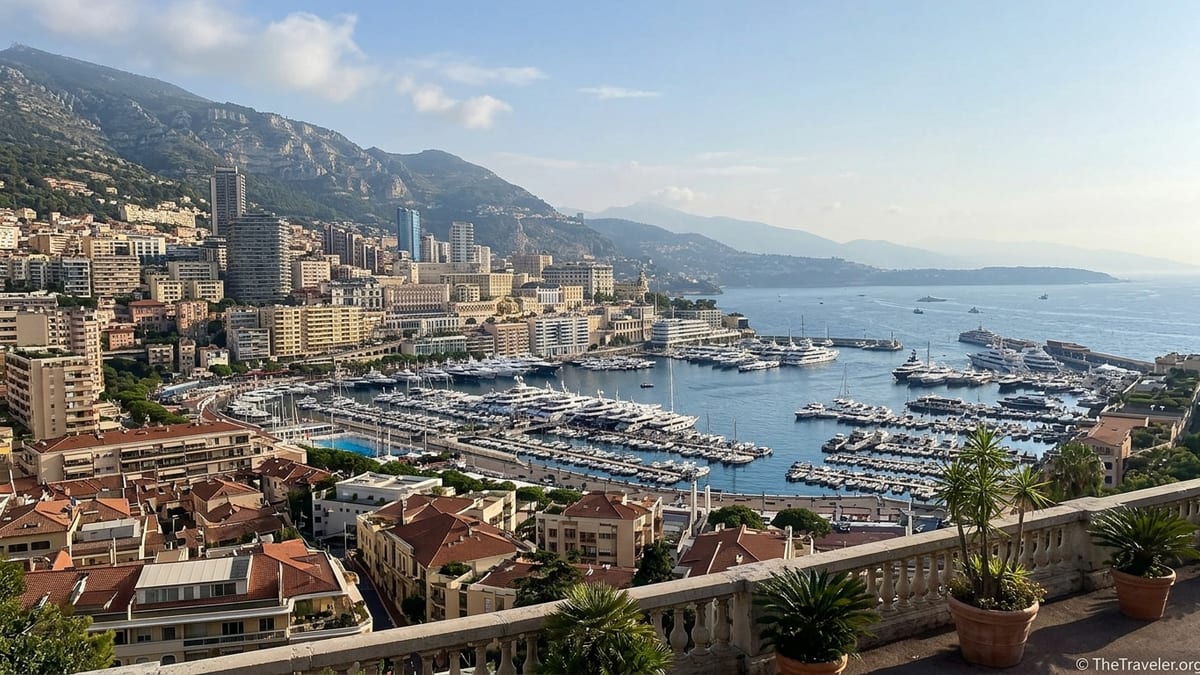
Monaco’s Luxury Skyline and Mediterranean Views
For many travelers, the first reason to return to Monaco is visual: the principality offers some of the most dramatic coastal views on the Riviera. From the moment your train curves out of the tunnel between Nice and Monaco, the scene opens to a vertical city rising straight from the water. On one side, apartment towers like Tour Odeon climb the hillside; on the other, the Port Hercules basin bristles with masts and superyachts. Even budget-conscious visitors can enjoy million-euro panoramas simply by walking the elevated streets that ring the port or climbing the public staircases linking the different levels of the city.
Specific vantage points have earned a kind of cult status among repeat visitors. The viewpoint from the Rampe Major, the pedestrian route leading up to the Prince’s Palace, looks back across the entire harbor and the sharp curve of the Formula 1 circuit. Many visitors time their climb for late afternoon, when the limestone facades in Monte-Carlo glow gold and the sea below turns inky blue. On the opposite side of the port, the slope toward La Condamine offers more intimate angles: narrow streets drop towards the quays, and between the buildings you catch glimpses of yacht decks, pool terraces, and the cranes of Mareterra, Monaco’s new eco-district reclaimed from the sea and unveiled in late 2024.
Luxury travelers often book hotel rooms based on the view alone. Iconic properties such as the Hotel de Paris Monte-Carlo and the Hôtel Hermitage look directly over Place du Casino and out to the sea, while Monte-Carlo Bay Hotel & Resort and Monte-Carlo Beach sit right on the water in the Larvotto district, with balconies facing the bay. In high season, sea-view rooms in top five-star hotels often run well into four figures per night, yet they continue to sell because the experience cannot easily be replicated elsewhere: breakfast on a private terrace while the sun comes up over the Mediterranean, or a late-night drink watching the lights of Italy flicker on the horizon.
Even day-trippers can tap into this visual drama for the price of a bus ticket. The coastal road that links Monaco’s neighborhoods, particularly the stretch along Avenue Princesse Grace, doubles as a moving balcony over the water. Local buses run this route in both directions, and many visitors simply stay on for a full loop to take in the layers of architecture, rock, and sea that define Monaco’s unique sense of place.
Larvotto Beachfront: Riviera Leisure with a Polished Edge
Another powerful draw for repeat visitors is Larvotto, Monaco’s main public beachfront, freshly transformed by a multi-year regeneration project. Completed in 2021, the bay now stretches along roughly 400 meters of sheltered shoreline, with a wide, two-level promenade above the sand. Travelers find a level of finish that stands out even on the Riviera: smooth pale paving, shaded seating areas, discreet security, and direct access to cafés and restaurants facing the water.
For sunseekers, the beach combines free public access with private comfort. Visitors can simply throw down a towel on the sand at no charge, or they can rent a sunbed and umbrella at one of the beach clubs, with prices typically starting around 30 to 50 euros per day in summer depending on the front-row proximity to the sea. Showers, restrooms, and lifeguards are standard, so families with children often base themselves here for several days. The bay’s calm, enclosed waters are gentle enough for stand-up paddling and casual swimmers, and in high season there are usually pedalos and other light water toys for rent directly from the shore.
Behind the loungers, the new Larvotto promenade has effectively become an outdoor living room for Monaco residents and visitors alike. Around 10,000 square meters of space is dedicated to food, drinks, and shopping, from casual gelato counters to sit-down seafood restaurants where diners linger over grilled dorade and chilled rosé with the beach just a few steps away. A 298-square-meter children’s play area and an outdoor fitness zone attract both local families and frequent travelers who want to combine a beach morning with a workout beneath the pine trees. In the evening, the scene shifts: the same restaurants dim the lights, DJs set up at some venues, and cocktails replace coffee as the bay reflects the lights of the Monte-Carlo Bay Hotel & Resort.
Larvotto’s location also contributes to its repeat appeal. It is roughly a 20-minute walk from Casino Square along the seafront, yet it feels more laid-back and residential. Many visitors now choose to stay in hotels and apartment rentals in the Larvotto district specifically because they can move between beach and city on foot without ever needing a car. For those who have done the classic “one-night in Monte-Carlo” stay, Larvotto offers a reason to return and settle in for a longer, slower visit.
The Allure of Casino de Monte-Carlo and Belle Époque Glamour
No discussion of Monaco’s enduring pull can skip the Casino de Monte-Carlo. Even travelers who never place a bet are drawn to its lavish Belle Époque facade and its role in cinema and popular culture. Set on Place du Casino, the building anchors a square lined with luxury hotels, designer boutiques, and manicured flowerbeds that change with each season. For many visitors, simply arriving here in the evening, when the casino’s lamps are lit and high-end cars idle in front, feels like stepping into a film set.
Inside, the experience runs from classic to contemporary. The Grand Atrium and historic gaming rooms showcase ornate ceilings, frescoes, and chandeliers, while newer lounges and terraces open onto the sea. Entry fees vary depending on the time and areas someone wants to access, but casual visitors can generally enter certain halls for a modest charge, provided they follow the dress code. Repeat guests often talk about the pleasure of returning at different times of year: in early spring, when the terrace is a calm spot for an afternoon coffee, or during major events like the Monaco Grand Prix and the Monte-Carlo Masters, when the square is busy with sponsors’ displays and hospitality tents.
Surrounding the casino, a cluster of legendary establishments reinforces Monaco’s reputation for old-world glamour. Hotel de Paris Monte-Carlo, open since the 19th century, is still considered the principality’s flagship property. Many high-spending travelers time their stays to coincide with seasonal gastronomic events or wine cellar tours. Across the square, the Hôtel Hermitage offers a slightly quieter elegance, with a glass-domed winter garden perfect for afternoon tea. Monaco’s tourism statistics in recent years show strong growth in the “accommodation and food services” sector, a sign that visitors are not just passing through but actively booking stays and dining experiences that revolve around this historic core.
Place du Casino itself has been carefully refreshed over the past decade to enhance the visitor experience. The square is now largely pedestrian, with underground parking nearby and a broad, open surface that lends itself to events and photo opportunities. Seating areas allow people to linger and people-watch, which is part of the attraction: visitors sitting with a coffee outside Café de Paris can watch a steady parade of supercars, fashion-forward outfits, and wedding parties using the casino steps as a backdrop for their photos. The scene changes by the hour, which is one reason travelers find themselves returning to the square on multiple days during a single trip.
Iconic Events: Monaco Grand Prix and a Year-Round Calendar
For many repeat visitors, Monaco is not just a place but a date on the calendar. The most famous example is the Formula 1 Monaco Grand Prix, held each May on a temporary street circuit that snakes around the harbor and up into Monte-Carlo. Hotels and rentals fill months in advance, and prices rise accordingly, but the experience is unlike any other race in the world. Spectators can watch from grandstands built over the water, from apartment balconies offered as hospitality suites, or even from yachts moored in Port Hercules. Balcony packages with catering can start around several hundred euros per day and rise sharply for the most coveted turns and views.
The level of extravagance reaches its peak on the superyachts lining the track. Reports and firsthand accounts suggest that a full Monaco Grand Prix weekend on a trackside yacht can cost tens of thousands of euros per person when factoring in charter fees, mooring, and hospitality. Yet these berths still sell out, underlining the event’s status as a once-in-a-lifetime social and networking opportunity. Even travelers who opt for more modest grandstand tickets, which are often available in the low hundreds of euros per day depending on the stand and day, come away with memories of the sound of engines reverberating between apartment blocks and the sight of cars brushing the barriers only meters away.
Crucially, Monaco’s appeal extends beyond that one race weekend. The principality has actively developed a year-round program of events designed to fill hotel rooms and keep visitors coming back in different seasons. In spring, the Monte-Carlo Masters tennis tournament brings top players and fans to the clay courts just over Monaco’s eastern border, with many attendees staying in the principality’s hotels and visiting its restaurants. Summer sees a packed schedule of cultural events, from the Monte-Carlo Television Festival to open-air concerts and ballet performances staged against sea views.
In recent years, Monaco has also seen a steady flow of cruise passengers, with authorities deliberately limiting the season to the milder months between April and mid-November. According to local economic reports, U.S. and Middle Eastern visitors have become especially prominent in hotel statistics, reflecting a global audience that treats Monaco as both a primary destination and a high-end stop on broader European itineraries. Many of these travelers first encounter Monaco during a marquee event, then return later in the year for a slower-paced stay.
Compact Size, High-End Shopping, and Effortless Access
One of Monaco’s most underrated luxuries is its scale. At just over two square kilometers, the entire country can be crossed on foot in less than an hour, yet within that compact space visitors find flagship designer boutiques, fine-dining addresses, and iconic viewpoints all layered vertically. For repeat travelers, this means that they can arrive by train from nearby Nice, drop their bags at a hotel, and be sitting at a waterfront café within minutes, without worrying about rental cars or long transfers.
Shopping is a major reason many visitors return, particularly to the Monte-Carlo and Carré d’Or districts around Place du Casino. Galleries of boutiques cluster in arcades and luxury malls, offering everything from haute couture to niche watchmakers and jewelers. While headline purchases may be out of reach for some visitors, browsing itself becomes part of the experience. Travelers can wander from store to store, then step out into the sunlight and find themselves face-to-face with the sea or with one of Monaco’s many public artworks, creating a rhythm that mixes urban exploration with resort relaxing.
Accessibility also plays a key role in Monaco’s repeat business. The principality sits roughly 30 minutes by train or car from Nice Côte d’Azur Airport, a major international hub with direct flights to cities across Europe, the Middle East, and North America. Regular regional trains and buses run late into the evening, so even travelers based in nearby French towns like Beaulieu-sur-Mer or Menton can easily make multiple day trips. This simple logistics encourages experimentation: a traveler might first visit Monaco for an afternoon to stroll the harbor, then return for a full day to explore the old town, and eventually book a two- or three-night stay to enjoy the nightlife and beach clubs.
Within Monaco itself, a network of public elevators, escalators, and buses helps overcome the steep terrain. Repeat visitors quickly learn shortcuts: an elevator behind a shopping center that pops them out near the Jardin Exotique, or a tunnel that links the train station to the harbor level. This infrastructure makes it realistic for travelers of different ages and fitness levels to enjoy the views without strenuous climbs, another subtle but important factor in why the destination appeals across generations.
Old Town Charm, Exotic Gardens, and Cultural Heritage
While much of Monaco’s image is tied to yachts and high-rise apartments, its historic core on the Rock of Monaco offers a contrasting charm that many repeat visitors grow to appreciate more deeply over time. The old town, known as Monaco-Ville, preserves a warren of narrow streets lined with pastel houses, small souvenir shops, and local restaurants that feel a world away from the sleek boutiques below. The Prince’s Palace, home to the Grimaldi family, crowns the rock and opens some state rooms to visitors when official duties allow.
Twice a day in high season, many travelers gather on the square in front of the palace to watch the changing of the guard. The ceremony is deliberately traditional rather than spectacular, but it reinforces the sense that Monaco is not simply a resort but a functioning sovereign state with its own institutions and rhythms. Around the corner, the Monaco Cathedral, where Prince Rainier III and Princess Grace are buried, gives visitors a quiet, reflective stop amid the bustle of the city below.
On the western side of the principality, the Jardin Exotique clings to the cliff face high above the port. The garden is famous for its collection of succulents and cacti, some grown here for decades, as well as for the sweeping views over the city and out to sea. Visitors wander along pathways lined with agaves and aloes, pausing at viewing terraces that make clear just how compact Monaco is. On clear days, it is possible to see all the way to the Italian border in one direction and deep into the French Riviera in the other. For many travelers, a return visit to Jardin Exotique at a different time of day or year reveals new light and colors, from winter sunsets to spring blooms.
Below, the Oceanographic Museum sits dramatically on the cliff edge, its ornate facade directly above the water. Families and marine-life enthusiasts often build entire days around the museum, which combines classic aquarium displays with educational exhibits about marine exploration and conservation. The combination of culture, science, and architecture here is a reminder that Monaco’s appeal is not limited to nightlife or motorsport: the principality invests substantially in institutions that can engage visitors of all ages and interests.
The Takeaway
Travelers keep returning to Monaco because, despite its tiny footprint, the principality layers multiple types of experiences into one compact, visually striking destination. It offers the thrill of major events like the Monaco Grand Prix, the quiet charm of an old town perched on a rock, the polished ease of Larvotto’s new beachfront, and the enduring glamour of Place du Casino. Luxury here is not just about high prices or famous names. It is about the ease with which a visitor can move from a cliffside garden to a yacht-filled harbor, from a casual beach café to a world-renowned dining room, all against a backdrop of sea and stone.
For first-time visitors, Monaco often feels almost unreal, a postcard that has come to life. For those who return, the appeal deepens: they learn the shortcuts, discover lesser-known viewpoints, and find favorite cafés where the staff start to recognize them. Whether you arrive by train, tender, or chauffeured car, the country’s blend of scenery, spectacle, and sophisticated infrastructure makes it a place that rewards repeat visits. In an era when many destinations struggle to distinguish themselves, Monaco continues to offer something singular: luxury views and iconic attractions compressed into a walkable, ever-evolving stage facing the Mediterranean.
FAQ
Q1. Is Monaco worth visiting if I am not interested in gambling?
Yes. Many visitors never enter the casino and still find plenty to enjoy, from Larvotto Beach and the Oceanographic Museum to the old town, gardens, shopping streets, and harbor promenades.
Q2. How expensive is it to stay in Monaco?
Monaco is generally expensive, especially in peak season, but prices vary. Five-star hotels often start in the high hundreds of euros per night, while more modest three- and four-star options and nearby French towns can reduce costs significantly.
Q3. Can I visit Monaco as a day trip from Nice or other Riviera towns?
Yes. Regular trains and buses connect Monaco with Nice, Menton, and other Riviera towns, and many travelers visit as a day trip, arriving in the morning and returning after dinner.
Q4. When is the best time of year to visit Monaco?
Late spring and early autumn offer a good balance of pleasant weather and slightly lower prices. Summer is lively but busy, while winter is quieter, with some seasonal venues closed.
Q5. Do I need a car to get around Monaco?
No. Monaco is very compact and well served by public elevators, escalators, and buses. Most visitors get around on foot, sometimes using taxis or ride-hailing services for late-night trips.
Q6. Is Larvotto Beach free to access?
Yes. The main stretch of Larvotto Beach is free to enter and use. Visitors can pay extra to rent sunbeds, umbrellas, or water-sport equipment from private operators along the shore.
Q7. How far in advance should I book for the Monaco Grand Prix?
For hotels and premium viewing spots, it is wise to book many months, and often close to a year, in advance. Standard grandstand tickets also sell quickly, especially for race day.
Q8. Are there family-friendly activities in Monaco?
Yes. Families often enjoy the Oceanographic Museum, the old town, Larvotto’s playground and calm swimming areas, boat trips from the harbor, and easy train access to nearby Riviera towns.
Q9. Is Monaco safe for tourists?
Monaco is widely regarded as very safe, with visible security and low street crime. As always, visitors should take normal precautions with valuables, especially in busy areas and during major events.
Q10. What is the dress code like in Monaco’s upscale areas?
In most public spaces smart casual is sufficient, but upscale restaurants, bars, and the Casino de Monte-Carlo often expect elegant attire. It is sensible to pack at least one polished evening outfit.