


Long after the last plume of ash from Mount Vesuvius settled in the year 79, travelers keep streaming into Pompeii. In 2023 alone, nearly four million people walked its stone streets, making it one of Italy’s most visited archaeological sites. Yet the draw is not just the drama of disaster. Visitors come to Pompeii because it offers something no museum case or textbook can match: an almost intact Roman city, frozen mid‑stride, where you can still read political graffiti, wander into bakeries and bars, and feel how the Roman world actually worked.
Get the latest updates straight to your inbox!
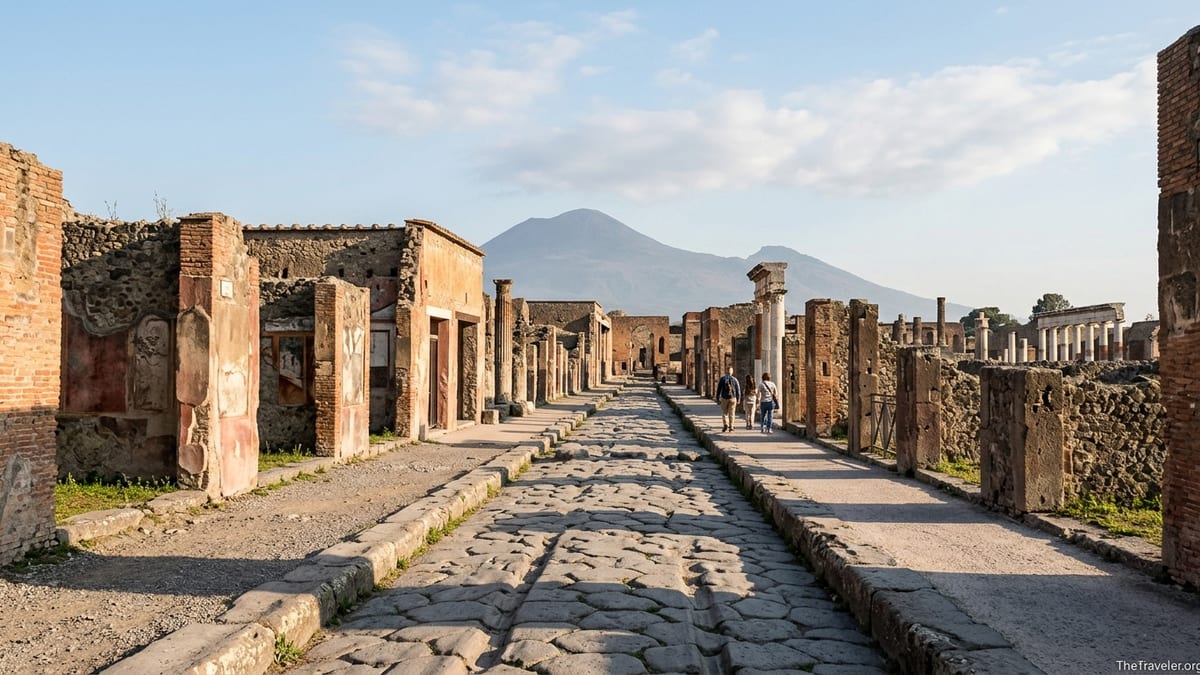
A Roman City Frozen in Mid‑Stride
The first shock in Pompeii is scale. This was not a villa or a temple complex but a living Roman city of around 10,000 to 15,000 people, with gridlike streets, traffic ruts carved by cart wheels and entire neighborhoods still mapped out. When you enter through Porta Marina and step onto Via Marina, the basalt paving stones under your feet are the same surfaces worn by carts heading toward the forum two millennia ago. Many travelers say this is where ancient Rome stops being an abstract idea and turns into a navigable place you can walk without a guidebook in hand.
The forum, framed by columns with Vesuvius looming behind, anchors that experience. Standing where market stalls once sold oil, wine and fish sauce, you can see the outlines of the basilica where legal disputes were heard, and the Temple of Jupiter that dominated the civic skyline. Modern visitors often compare it to standing in a medieval piazza in Siena or a main square in Naples: the proportions and urban logic are surprisingly familiar. For many, this makes later visits to the Roman Forum in the capital feel more legible; they have already rehearsed city‑planning basics in Pompeii.
What sets Pompeii apart from other Roman sites is how much of the urban fabric is still there at human height. In places like Ostia Antica near Rome, you might see walls and foundations. In Pompeii, a two‑storey insula apartment block still shows where shop shutters once slid into grooves, while internal staircases reveal cramped upper‑floor rentals. Travelers walking down Via dell’Abbondanza can peer into doorways and instantly read a mixed‑use street where businesses occupied the ground floor and families lived above, a pattern that still shapes much of Mediterranean urban life today.
The city’s sudden burial under several meters of ash sealed this mid‑stride moment. Archaeologists have uncovered snack bars with coins left on the counter, bread still in bakery ovens and household shrines with offerings in place. Visitors joining a standard two‑hour guided tour often stop at one such bakery, where millstones and a reconstructed oven make it easy to picture the morning rush for fresh loaves. It is this sense of interrupted normality, more than the catastrophe itself, that keeps travelers returning to deepen their understanding of Roman daily life.
Everyday Roman Life, From Takeaway Counters to Back‑Alley Baths
Most travelers arrive expecting marble temples and patrician villas. What surprises them is how ordinary most of Pompeii feels. Along the side streets, you encounter thermopolia, the Roman equivalent of takeaway food counters. One especially well preserved example, excavated in recent years, still shows a painted scene of a server on its counter and jars sunk into the stone surface where hot dishes were once kept. Guides like to point out that Romans were urban dwellers who often ate on the go, and that these snack bars played a social role not unlike today’s coffee bars in Naples or Rome.
Public baths are another revelation. At the Stabian Baths, one of Pompeii’s oldest bathing complexes, visitors can walk through a complete ritual sequence: changing room, frigidarium cold room, tepidarium warm room and caldarium hot room. The suspended floors and hollow wall bricks that once circulated hot air are still visible. For a traveler who has just soaked in a modern spa in Ischia or the thermal pools near Viterbo, seeing this ancient underfloor heating system in situ makes Roman engineering astonishingly concrete.
Shops and workshops bring the economic life of the city into focus. In the fullonica, or laundry, you can still see basins where clothes were trodden in a mixture of water and ammonia from fermented urine. The detail may make modern visitors wrinkle their noses, but it explains why laundries often sat downwind in Roman cities. Recent excavations have even uncovered waste dumps and glass‑recycling areas behind the Sarno Baths, giving archaeologists new evidence that Pompeians reused broken vessels rather than throwing them away, a reminder that “sustainability” is far older than the term itself.
The street life that unfolds between these places feels surprisingly familiar. On walls near the theaters and amphitheater, visitors can still read electoral slogans and graffiti scratched by anonymous hands. Some praise local candidates; others joke about love affairs or mock gladiators. When travelers stop at one such wall with a guide reading out a translation, they often laugh at how petty or affectionate the comments sound. It becomes clear that Roman citizens were not just marble busts in a gallery but people who grumbled about neighbors and bragged about relationships much like social media users today.
Art, Frescoes and the Color of Roman Imagination
Pompeii’s interiors are where many visitors finally let go of the idea that ancient Rome was a world of white marble. Painted walls explode in deep reds, rich blacks and complex architectural illusions. In houses like the Villa of the Mysteries just beyond the city walls, entire rooms are wrapped in life‑size mythological scenes. Travelers used to seeing these images as small framed reproductions in books are often startled when a guide switches on the lights and a 360‑degree Dionysian procession suddenly surrounds them at human height.
Fresh discoveries keep this artistic story evolving. In 2024, archaeologists working in Regio IX uncovered a large banqueting hall with remarkably vivid frescoes of mythological figures and elaborate trompe‑l’oeil columns. Visitors joining special themed tours now detour through this area to see newly cleaned panels before they appear in textbooks. Earlier finds, such as a sensuous fresco of Leda and the Swan or realistic still lifes of figs, bread and silver dishes, are displayed in the Antiquarium museum near the main entrance, allowing travelers to appreciate fine painting in climate‑controlled galleries after seeing more fragile pieces in situ.
The sheer quantity and variety of wall painting in Pompeii gives travelers a visual encyclopedia of Roman taste. Simple taverns might have a painted menu of food and drink, complete with wine jugs and loaves, while more luxurious homes display framed scenes of heroes, gods and theatrical episodes. Travelers who have just toured Baroque palaces in Rome or Florence can trace a direct line from these Roman interiors to later European traditions of mural painting and fresco cycles. Standing shoulder to shoulder with other visitors in a narrow corridor in the House of the Tragic Poet or the House of the Vettii, many realize that their mental image of Rome will never again be monochrome.
The site also challenges assumptions about who art was for. While the finest frescoes decorated elite homes, public buildings and even some fast‑food counters carried painted decoration accessible to anyone passing by. A traveler pausing at a thermopolium counter to photograph a painted dog or rooster is, in a sense, participating in the same visual economy of eye‑catching signage that Roman customers experienced while choosing where to buy a snack after leaving the baths or the amphitheater.
Human Stories Written in Ash and Stone
Perhaps the most powerful reason travelers return to Pompeii is the human dimension. In the Antiquarium and in roped‑off corners of the site, plaster casts show men, women, children and even dogs caught at the moment of suffocating in volcanic ash. The technique, developed in the 19th century, involved pouring plaster into cavities left in the hardened ash where bodies once lay. The result is unnervingly intimate: a man shielding his face, a child curled beside an adult, a dog twisted in its collar. Many visitors report that after seeing these figures, every anonymous doorway suddenly feels inhabited.
Recent research has added nuance to these individual tragedies. Scholars are increasingly uncovering evidence that a significant number of Pompeians escaped and rebuilt their lives elsewhere. Inscriptions and legal documents hint at former residents resurfacing in towns to the north and in Roman colonies further afield. This emerging picture complicates the old narrative of total annihilation and suggests a community marked more by displacement than simple extinction. For modern travelers, especially those familiar with stories of contemporary refugees, this blend of loss and resilience feels strikingly current.
On the ground, guides often highlight specific stories that make the Roman world feel personal. In one bakery, a carbonized loaf of bread was found scored into eight wedges, each marked so that enslaved workers and family members knew which piece was theirs. In another house, a small shrine in the kitchen preserves traces of offerings to household gods, underscoring how religion was woven into daily routines rather than confined to grand temples. Travelers walking through these spaces find themselves comparing Roman domestic habits to their own, from how kitchens are organized to how families mark sacred or special corners of the home.
Even the graffiti deepens this sense of shared humanity. In one house, a child appears to have drawn gladiators in charcoal on a wall, capturing a fight witnessed in the amphitheater with surprisingly energetic lines. Nearby, a scratched message records a boast about drinking prowess; elsewhere, there is a complaint about unpaid debts. When a guide translates these snippets aloud, the crowd’s reaction is often a murmur of recognition rather than solemn silence. The Romans of Pompeii step out of the role of distant ancestors and into the role of neighbors with familiar jokes, quarrels and aspirations.
Living Archaeology and Constant New Discoveries
Unlike many ancient sites that feel static, Pompeii is an active archaeological park where new finds regularly make headlines. In the last decade, an almost intact street‑corner thermopolium complete with painted animals and food residues, a vivid gladiator fresco and a series of richly decorated dining rooms and gardens have emerged from layers of volcanic material. In early 2026, archaeologists announced fresh discoveries of frescoed rooms in some of the city’s oldest quarters, again reminding the world that perhaps a third of Pompeii still lies unexcavated.
For travelers, this means that a return visit often looks different from a trip taken just a few years earlier. A traveler who first visited on a backpacking trip in 2015 and returns in 2026 might find entire new blocks open, with protective walkways leading through previously inaccessible houses. The park has been rolling out improved signage, digital guides and suggested routes designed to reduce congestion, so many visitors now navigate via a free app that shows real‑time crowding and themed itineraries, from “daily life” to “sacred spaces.”
The excavations themselves sometimes feel like open‑air laboratories. It is not uncommon to turn a corner in Regio V or IX and see archaeologists in hats and dust masks carefully brushing layers of pumice, trowels and sieves at hand. Respectful visitors are kept behind barriers, but even at a distance they can glimpse fragments of fresco coming to light or amphorae emerging from earth that has not seen the sun since antiquity. This sense of watching history being re‑written makes Pompeii particularly compelling for travelers who follow archaeology news or grew up fascinated by ancient history documentaries.
Ongoing research also pushes beyond art and architecture to topics like diet, trade and recycling. Studies of food remains from the thermopolium counters, for example, show mixtures of meat, fish and snails that challenge simplistic ideas about Roman cuisine. Analysis of waste layers and industrial zones near the Sarno Baths has revealed organized glass and metal recycling, changing how historians think about resource use in Roman cities. When guides mention that some of the most important academic papers on these topics were published only in the last few years, many visitors realize they are not just walking through a static ruin but through a case study driving global debates about urban life in antiquity.
A Gateway to the Wider Roman World
Pompeii also attracts travelers because it serves as a gateway to understanding the Roman world far beyond the Bay of Naples. The city’s layout, with its forum, amphitheater, baths and city walls, became so influential that visitors can use it as a mental template when they later explore other sites. Someone who has walked the length of Via dell’Abbondanza finds it easier to imagine how a main street might have felt in a frontier town along the Rhine or in a provincial capital in North Africa. The rhythms of markets, elections and festivals glimpsed in Pompeii echo across the empire.
The location under Vesuvius adds another layer of context. Many travelers combine a day in the ruins with a hike up the volcano’s crater or a visit to nearby Herculaneum. Standing on the rim of Vesuvius and looking down toward the patchwork of modern Naples, the highway and the archaeological park, visitors see how closely ancient and contemporary settlements hug the slopes. That view makes the decision of Pompeians to live with volcanic risk feel less exotic when compared to today’s coastal cities built along earthquake faults or hurricane‑prone shorelines.
Pompeii also sits conveniently within a broader network of Roman and Greek sites that help travelers connect cultural dots. A short train ride away, Herculaneum offers a different, more vertical version of a buried Roman town, with upper stories preserved. Further south, Paestum’s Greek temples predate Roman expansion and provide a contrast in religious architecture and city planning. Travelers who base themselves in Naples or Sorrento often use Pompeii as their anchor and then plan a sequence of day trips that gradually widen their understanding of ancient Mediterranean civilizations.
Modern infrastructure makes these explorations surprisingly accessible. From Naples, the Circumvesuviana commuter railway carries passengers to the Pompei Scavi‑Villa dei Misteri station in roughly 35 minutes, with a single ticket costing just a few euros. Travelers willing to pay extra can opt for the Campania Express, a tourist‑oriented service with guaranteed seats and air conditioning. Those staying in Sorrento often take the same line in the opposite direction, coupling a morning at Pompeii with an afternoon swim back on the Amalfi Coast. These practicalities mean that travelers can immerse themselves in ancient history without giving up the comforts of a contemporary seaside base.
The Takeaway
What keeps travelers returning to Pompeii is not a simple fascination with ruins, but the way the site bridges past and present. Here, the raw outlines of a Roman city remain walkable, from the forum to the amphitheater and down every side street. Everyday spaces like snack bars, laundries and small gardens pull focus away from emperors and generals and toward the people who actually made the Roman world function. Vivid frescoes and ongoing discoveries keep rewriting the story, ensuring that even repeat visitors encounter new rooms, new colors and new insights.
The human stories embedded in the ash, from the haunting plaster casts to the playful graffiti, make the site emotionally resonant as well as intellectually rich. Pompeii becomes a mirror in which modern visitors see reflections of their own urban lives, concerns and joys. Add in the city’s role as a gateway to other Roman and Greek sites around the Bay of Naples, plus its straightforward connections from Naples and Sorrento, and it is easy to understand why this ancient city remains on so many travelers’ shortlists.
For anyone seeking to understand ancient Rome not as a chapter in a history book but as a lived reality, Pompeii is less a single attraction and more an open‑air archive of everyday life. Whether you are planning a once‑in‑a‑lifetime itinerary or considering a return visit to see the latest excavations, walking these streets offers a rare chance to grasp how a Roman city worked, felt and sounded on an ordinary day before history intervened.
FAQ
Q1. Why is Pompeii considered the best place to understand ancient Rome?
Pompeii preserves an entire Roman city with streets, homes, shops and public buildings still standing at human height, so travelers can see how urban life functioned in practice rather than in theory.
Q2. How much time should I plan for a visit to Pompeii?
Most travelers spend at least four to five hours on site, which allows time to see key highlights like the forum, amphitheater and a few houses, plus a visit to the Antiquarium museum.
Q3. Is it better to visit Pompeii from Naples or from Sorrento?
Both work well. Naples offers more city culture and direct rail connections from elsewhere in Italy, while Sorrento provides a calmer seaside base and easy onward access to the Amalfi Coast.
Q4. Do I need a guide to understand what I am seeing in Pompeii?
You can explore independently, but many travelers find a licensed guide or small‑group tour helpful to interpret houses, frescoes and inscriptions that otherwise look like anonymous ruins.
Q5. What are the most important areas to see for everyday Roman life?
For daily life, focus on Via dell’Abbondanza, the thermopolium snack bars, at least one set of baths such as the Stabian Baths and a couple of homes like the House of the Vettii or the Villa of the Mysteries.
Q6. How do I reach Pompeii by public transport?
From Naples or Sorrento, most visitors use the Circumvesuviana train to Pompei Scavi‑Villa dei Misteri station, a short walk from the main entrance, or pay extra for the faster Campania Express service.
Q7. Are the plaster casts of victims still on display?
Yes, several plaster casts are on view either within the archaeological park or in the Antiquarium museum, though their exact locations can change as the park rotates and conserves exhibits.
Q8. What recent discoveries should I look out for?
Newly excavated areas in Regio V and Regio IX include richly decorated dining rooms, thermopolia with painted counters and fresh sets of mythological frescoes that highlight the color and complexity of Roman interiors.
Q9. Can I combine Pompeii with a visit to Mount Vesuvius in one day?
Many travelers do, often visiting Pompeii in the morning and then taking a shuttle or tour up to the Vesuvius crater in the afternoon, but it makes for a long, full day.
Q10. Is Pompeii suitable for children and non‑specialists?
Yes. Children often enjoy the streets, amphitheater and visible details like carts’ wheel ruts and snack bars, while non‑specialists appreciate how clearly the site explains Roman daily life through real spaces and objects.