


By the time I stepped off the stone causeway and onto the volcanic rock of Castello Aragonese, Southern Italy’s past no longer felt like something confined to museum labels and dusty textbooks. It was underfoot in the smooth, sun‑warmed paving stones, in the salt‑bleached walls above the Tyrrhenian Sea, and in the quiet chapels that still hold the memory of sieges, earthquakes, and monastic lives. Walking through this fortress on the eastern tip of Ischia is not just a sightseeing stop. It is a way to feel how history has unfolded in the Bay of Naples, almost room by room.
Get the latest updates straight to your inbox!
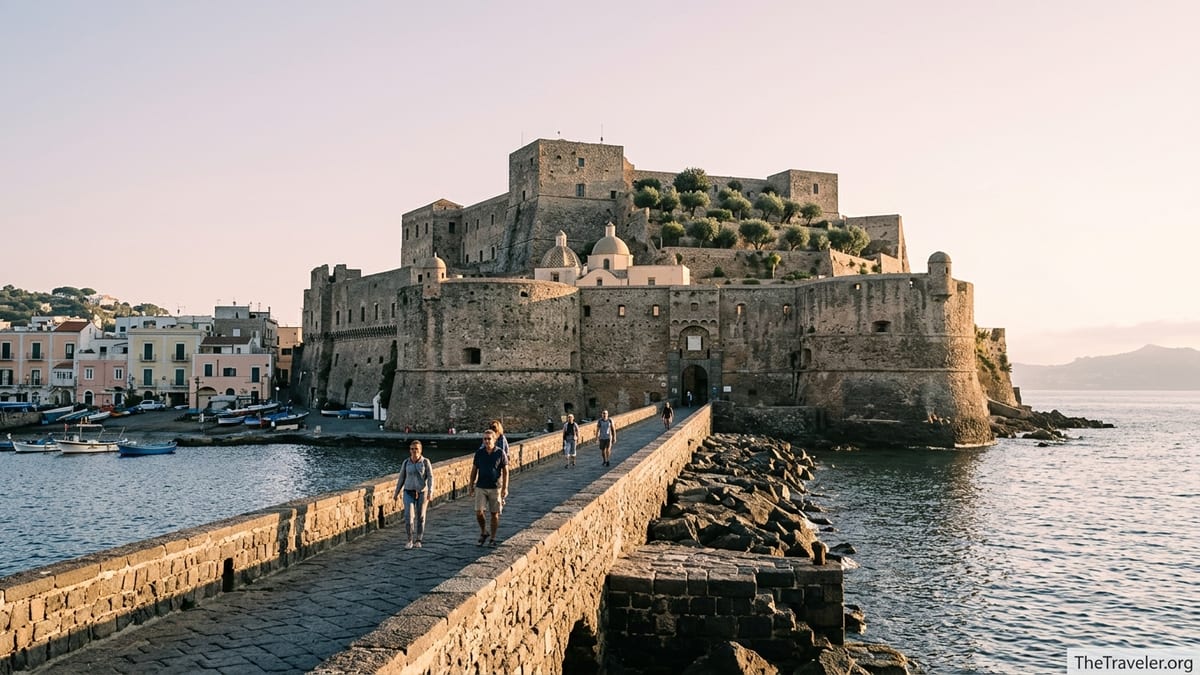
First Glimpse: Crossing From Ischia Ponte to the Castle
The experience of Castello Aragonese begins well before its gates. Most visitors approach from Ischia Porto, the island’s main ferry harbor, either by bus, taxi, or on foot. A local bus, often the number 7, typically takes around 15 minutes from the port to Ischia Ponte, the old fishing quarter. From here, the castle fills your field of vision, perched on its trachytic rock dome 113 meters above the sea, linked to the island by a 220‑meter stone bridge. The closer you walk along the waterfront, the more the modern island drops away and the medieval profile of the fortress dominates.
On a typical late afternoon, the causeway is a procession of small details: a fisherman coiling nets on the rocks below, wedding photographers lining up couples against the castle walls, Vespa engines fading in the distance behind you. Looking back, you see the pastel houses of Ischia Ponte layered against the green flanks of Mount Epomeo; looking forward, the gatehouse looms, with its teeth‑like battlements. It is an approach that quietly prepares you to shift from the everyday life of the island into a self‑contained world of stone, chapels, and hanging gardens.
For many travelers, this bridge walk is the first moment when Southern Italy’s history feels less like a story and more like a set of lived choices. When you realize that for centuries this narrow strip of stone was the lifeline between the sea village and the fortified rock, every passing wave seems to underline how precarious safety once was here.
Stepping Inside: Tunnels, Lifts, and the Ascent Through Time
At the base of the rock, the ticket office and entrance mark the transition from waterfront bustle to fortress interior. As of 2026, the castle is generally open daily from 9:00 in the morning until around sunset, with the last tickets issued roughly an hour and a half before closing. Entry is typically priced in the mid‑teens in euros for adults, with reduced tickets for children and certain categories of visitors. Times and tariffs can change, so it is sensible to confirm shortly before your visit, but the structure of the experience remains constant: from the gate, you must climb.
That climb can take two very different forms. One is the modern elevator, added in the late 1970s, which shoots you up the rock in seconds. The other is a gently sloping path that begins in a long tunnel carved through the volcanic stone in the fifteenth century under Alfonso I of Aragon. Choosing the tunnel means choosing to move at medieval speed. The air cools, voices echo, and the faint sound of waves is replaced by your own footsteps. Niches in the wall and worn stones remind you that this was once a mule track and a military artery, not a scenic stroll.
Emerging from the tunnel into daylight feels like surfacing into another era. Ahead, the path switchbacks upward between terraces and low defensive walls. Small signs point toward chapels, gardens, and former convents, but it is the changing view that really marks your progress. With every turn you see more of the Bay of Naples, the outline of Procida, and on very clear days the faint silhouette of Capri on the horizon. The higher you walk, the easier it is to understand why generations of rulers poured money and manpower into controlling this rock. Power here was not abstract. It meant literally being able to see danger coming from all directions.
Walking With the Aragons, Pirates, and Local Families
Castello Aragonese takes its name from the Aragonese dynasty that ruled much of Southern Italy in the fifteenth century, but the story of the rock itself stretches back to at least the fifth century BC, when Greeks from Syracuse first fortified it. Over the centuries, Romans, Byzantine officials, Angevin and Aragonese kings, and local noble families all left their marks. When you follow the paved paths today, you are tracing lines drawn to resist real threats, not imaginary ones.
Informational plaques scattered around the site highlight episodes that would not be out of place in a historical novel. In 1441, Alfonso V of Aragon ordered the construction of the stone bridge that replaced a more vulnerable wooden structure, tightening the bond between the rock and Ischia. In the sixteenth century, as Ottoman and Barbary corsair raids intensified, as many as two thousand islanders are thought to have taken refuge up here, transforming the fortress into a walled town with houses, churches, and cisterns. Looking at the now quiet courtyards, it becomes easier to imagine stairwells cluttered with amphorae, bundles of grain, and children jostling for space under the looming bell towers.
Later, as pirate threats receded and warfare evolved, the castle’s role shifted. By the nineteenth and early twentieth centuries, parts of the complex decayed, while other sections became private residences or humble lodgings. This layering of uses is still obvious today. You might pass a restored chapel that hosts art installations, then round a corner to find a cluster of potted lemon trees outside a doorway that belongs to someone who still lives on the rock. The result is a lived‑in atmosphere that keeps the site from feeling like a fossilized monument.
Chapels, Cloisters, and the Chilling Cemetery of the Nuns
Many of the most affecting spaces in Castello Aragonese are religious. The path from the main terrace leads first to the ruins of the cathedral, damaged heavily in the late eighteenth century during fighting that involved the British fleet under Horatio Nelson. Portions of the apse and some side walls survive, framing sky and sea where once there were vaulted roofs. Standing amid these broken lines, with seabirds calling overhead, the idea of history as something neat and contained disappears. You see directly how cannon fire and political rivalry translated into shattered masonry and exposed altars.
A short walk away, the former Monastery of the Poor Clares and its cloister offer a more introspective kind of time travel. The small garden, with geometric beds of herbs and flowers, is surrounded by arcades that catch soft light even in the heat of the afternoon. Yet beneath this tranquil surface lies one of the most unsettling corners of the entire island: the cemetery of the nuns. Here, interpretation panels and the preserved environment explain how deceased sisters were once placed in stone seats with drainage channels, their slow decomposition exposed as a memento mori to those still living. It is a visceral reminder that religious devotion in early modern Southern Italy was tangled with stark ideas about death and humility.
Encountering this space in person can be confronting. Travelers accustomed to polished museum displays may find the cemetery’s starkness jarring, especially when contrasted with the light‑filled church of the Immaculate nearby, whose white facade and simple interior now serve as venues for temporary art exhibitions and concerts. It is exactly this oscillation between beauty and unease that makes the walk through Castello Aragonese so powerful. You are not simply reading about beliefs and practices; you are moving through the very rooms where they unfolded.
Terraces, Olive Groves, and Views Across the Bay of Naples
Beyond its heavy history, the castle is also a remarkably gentle place to wander, especially on its upper terraces and gardens. One of the most evocative stops is the Olive Tree Terrace, where silvery branches sway above long stone parapets. Looking down, you can see the straight line of the bridge and the jumble of Ischia Ponte’s rooftops; looking outward, the sea is an ever‑changing field of color, from deep cobalt to glassy silver on hazy days. This terrace is where many visitors finally slow to a full stop, leaning against the wall just as lookouts once did, scanning the horizon not for sails but for passing ferries and fishing boats.
Small signs and occasional benches suggest that you linger rather than rush. Couples share cones from gelaterie back in Ischia Ponte, families point out ferries heading toward Naples, and solo travelers often sit sketching the profile of the distant Sorrento Peninsula. You might notice that the masonry here is not uniform. Some stones are rough‑cut and ancient, others smoother and clearly the result of more recent work. The castle has been repeatedly restored and adapted, including ongoing maintenance closures in the winter months, and that patchwork texture becomes a physical record of how each generation decided to keep this place standing.
On clear days, the heights of the castle give you a literal map of the Bay of Naples. To the west lie the thermal resorts and beaches of Ischia itself; to the north, the smaller island of Procida and the mainland coast unfurl; to the south, the outline of Capri appears beyond the open water. For travelers trying to understand how all these famous names connect, there is no better lesson than standing on this rock and tracing sea routes with your eyes.
Practical Ways to Turn a Visit Into a Historical Journey
Because Castello Aragonese is such a compact space, it is tempting to treat it as a quick photo stop. In practice, allowing at least two to three hours transforms the experience from a checklist item into an immersive walk through time. Starting early in the morning or later in the afternoon can make the steep paths more comfortable, especially in high summer when temperatures on the exposed terraces climb quickly. Comfortable shoes, a hat, and a refillable water bottle are essentials, as shade is intermittent once you are above the tunnel and elevator level.
Several small cafés and refreshment points operate inside the complex, typically offering espresso, cold drinks, and light snacks, sometimes with outdoor seating facing the sea. Prices are often a bit higher than similar offerings in Ischia Ponte, but the views more than compensate. Planning a pause here, rather than powering straight through the circuit, can help you absorb what you have seen in the chapels and cloisters. Many visitors find that reading a short historical overview before arrival, then revisiting key dates on information boards as they walk, helps anchor the experience.
From a logistics standpoint, most travelers reach the island of Ischia by ferry or hydrofoil from Naples or Pozzuoli, with crossing times ranging roughly from 50 minutes to about an hour and a half depending on the service. Once in Ischia Porto, you can ride local EAV buses or hire a taxi to Ischia Ponte. Public buses are economical but can be crowded in peak season; taxis are faster and more flexible, particularly if you are managing luggage or traveling with children. If your hotel is in Ischia Porto, it is entirely possible to walk to the castle along the waterfront in about half an hour, passing beaches, shops, and cafés along the way.
Staying Nearby: Letting the Castle Shape Your Sense of Ischia
For many visitors, the most memorable encounters with Castello Aragonese happen not just during the daytime visit but from a distance, at dawn or after dark. Choosing accommodation in or near Ischia Ponte allows the castle to become an anchor in your mental map of the island. Budget guesthouses, mid‑range hotels, and a few higher‑end properties cluster along the waterfront and in the narrow lanes just behind it, so you can step out in the evening for a short stroll to watch the fortress silhouette against the fading light.
At night, the castle is often illuminated, the outlines of its towers and walls glowing softly while the sea below turns almost black. Standing on the quay or small sandy beaches near the bridge, you can hear the water slapping against the rocks much as it must have during medieval storms and sieges. It is in these quieter hours, with day‑trippers gone, that the idea of a self‑contained, fortified village feels most tangible. Daily life resumes in Ischia Ponte’s trattorie, where locals linger over seafood and house wine, but the rock remains a watchful presence just offshore.
Some visitors pair their castle exploration with thermal spa visits in places like Ischia Porto, Forio, or Lacco Ameno, or with boat tours that circle the island and give you a sea‑level perspective on the fortress. Seen from the water, the castle appears even more improbable, its vertical walls rising straight from the volcanic rock. Understanding that people once lived up there year‑round, cultivating small plots, collecting rainwater in cisterns, and climbing the steep paths daily to reach their homes, makes modern ferry schedules and hotel transfers feel trivial by comparison.
The Takeaway
Walking through Castello Aragonese is one of those rare travel experiences that recalibrates how you think about a whole region. The history of Southern Italy can seem overwhelming, full of dynasties, invasions, and shifting borders. On this rock, those broad strokes condense into walkable distances: a tunnel dug for a fifteenth‑century king, a ruined cathedral shattered by cannon fire, a monastic cemetery that still carries the weight of early modern beliefs about death, terraces where islanders once scanned the horizon for pirate ships.
What lingers after you leave is not just the postcard view of stone walls above blue water, but a sense of contact with the people who turned this isolated outcrop into a refuge and a community. The humidity in the tunnel, the uneven stones under your shoes, the silence inside the cloister, and the wind whipping along the parapets all make the past sensorial and immediate. Long after the details of names and dates fade, the memory of that walk remains a clear, physical link to Southern Italy’s layered and resilient history.
FAQ
Q1. How long should I plan for a visit to Castello Aragonese in Ischia?
Most visitors find that two to three hours is enough to walk the main route, visit chapels and terraces, and pause for photos or a café stop.
Q2. What are the usual opening hours and ticket rules for the castle?
The castle is generally open daily from 9:00 until around sunset, with last entry about 90 minutes before closing; exact times and prices can vary by season.
Q3. Is the walk inside Castello Aragonese suitable for people with limited mobility?
There is an internal elevator from the entrance level, but many paths are steep with uneven paving and steps, so visitors with mobility issues should plan carefully.
Q4. How do I get from Ischia Porto to Castello Aragonese without a car?
You can take a local EAV bus, often the number 7, or a taxi to Ischia Ponte, or walk about 30 minutes along the waterfront from the port to the castle bridge.
Q5. Can I visit the castle on a day trip from Naples?
Yes, with an early ferry or hydrofoil to Ischia and a return in the late afternoon or evening, many travelers comfortably include the castle in a Naples‑based day trip.
Q6. Are guided tours available inside Castello Aragonese?
Guided tours are sometimes offered by local operators or private guides; availability varies, so it is best to arrange in advance or check locally once on the island.
Q7. What should I wear and bring for the walk through the fortress?
Comfortable walking shoes, sun protection, and a refillable water bottle are recommended, especially in summer when terraces and paths can be hot and exposed.
Q8. Is photography allowed inside Castello Aragonese?
Photography for personal use is generally allowed throughout the exterior paths and terraces, though restrictions may apply during special exhibitions or in certain interiors.
Q9. Are there places to eat or drink inside the castle complex?
Yes, seasonal cafés and refreshment spots operate inside, offering drinks and light snacks, often with panoramic seating; options may vary by time of year.
Q10. When is the best time of day to visit Castello Aragonese for views and comfort?
Early morning and late afternoon usually offer softer light, slightly cooler temperatures, and beautiful views over the Bay of Naples and Ischia Ponte.