


Rising from a volcanic islet just off Ischia’s eastern shore, Castello Aragonese looks almost unreal at first glance. A stone bridge strides across the water to a cluster of bastions, churches and gardens stacked high above the Tyrrhenian Sea. For many visitors it is the defining image of Ischia, yet few realize how many lives this rock has lived. From ancient Greek outpost to medieval refuge, Renaissance court and, finally, quiet panoramic escape, the castle condenses 2,500 years of Mediterranean history into a single walkable circuit.
Get the latest updates straight to your inbox!
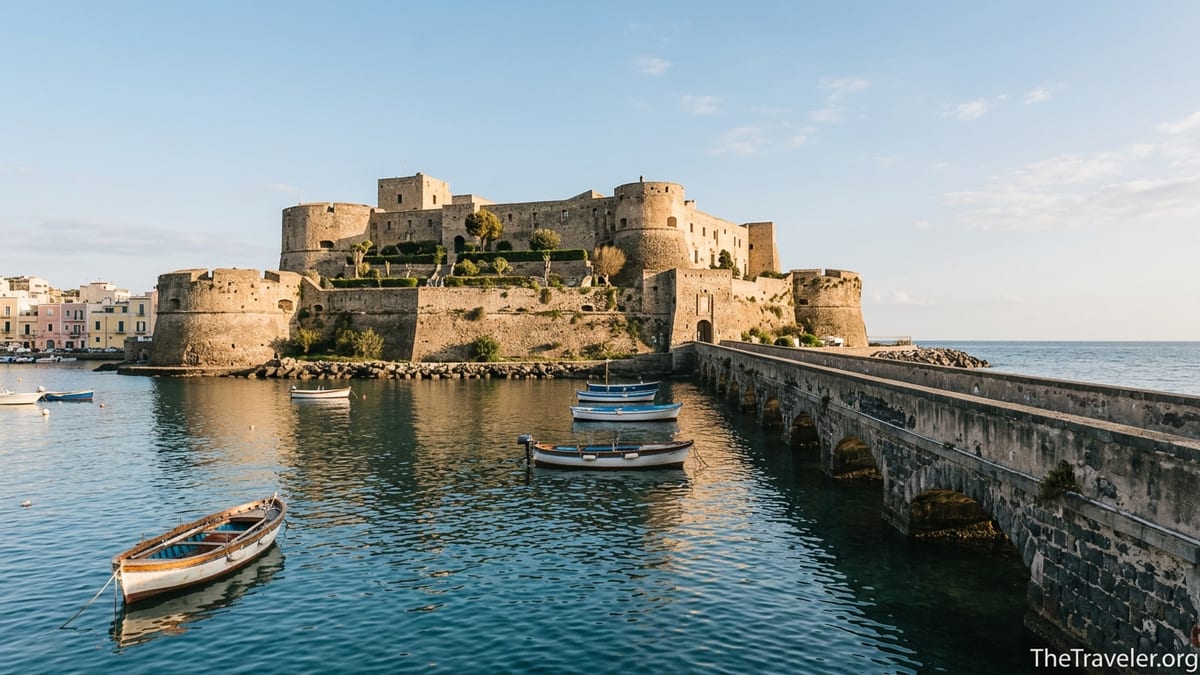
From Volcanic Outcrop to Greek Fortress
The story of Castello Aragonese begins long before the first stone walls were built. The islet on which the castle stands is a volcanic "cupola" of trachytic rock that likely emerged from the sea around 280,000 to 340,000 years ago, part of the restless geology that also feeds Ischia’s famous thermal springs. Today, as you arrive across the 220 meter stone bridge that links the islet to Ischia Ponte, it is easy to see why ancient sailors would have chosen this rock as a lookout point: it rises to about 113 meters above sea level and commands open views over the Gulf of Naples in every direction.
The first known fortress here dates to 474 BC, when Hiero I of Syracuse intervened in a naval conflict off Ischia between the Greek city of Cumae and the Tyrrhenians. According to local histories, Hiero demanded the rocky islet as part of his reward and fortified it with towers to monitor enemy fleets. Standing today on the Belvedere terraces where visitors photograph Procida and Capri on the horizon, you are looking from roughly the same vantage point those early Greek lookouts used to scan for hostile sails.
After the Greek period the rock passed into Roman hands around the 4th century BC. It served as a strategic refuge and observation post, watching over the shipping routes that tied Rome to its southern territories. Little remains visibly from that era, but the basic logic of the site has not changed. Modern visitors arriving by bus from Ischia Porto and walking the final few minutes through Ischia Ponte find themselves funneled along the same narrow approach that would once have concentrated allies and deterred enemies.
Even at this early stage, then, the islet was more than a picturesque rock. It was a piece of military infrastructure at the center of power struggles between Greeks, Romans and the Italic peoples of Campania, a role it would reprise many times over the following centuries.
Medieval Refuge and the Birth of an Island City
With the fall of the Western Roman Empire, the fortress became a prize in the chaotic succession of powers that swept through southern Italy. Visigoths, Vandals, Ostrogoths, Arabs, Normans, Swabians and Angevins all controlled the island at various moments. Each left subtle traces in the fabric of the castle, from buried foundations to reworked walls. Walking through the current entrance tunnel, carved directly into the rock, you are literally passing through centuries of layered fortification.
A decisive turning point came in 1301, when a major eruption of Monte Trippodi devastated much of Ischia. Many islanders fled to the relative safety of the rock, which was easier to defend from both natural and human threats. Over time, this emergency retreat evolved into a permanent community. By the late Middle Ages the fortress had become a small island city, with houses, workshops and places of worship clinging to the steep slopes.
This medieval urbanization is still legible in the layout visitors follow today. After taking the internal elevator or climbing the ramp to the upper level, modern travelers wander along the same narrow lanes where craftspeople once lived and worked. The ruined Church of the Immacolata, the Cathedral of the Assunta and the remains of several smaller chapels speak to a period when religious life on Ischia was concentrated on the rock while the low-lying fishing village of Celsa, today’s Ischia Ponte, remained modest and vulnerable.
For contemporary visitors, one of the most revealing spots is the so-called Terrace of the Immacolata. It offers wide sea views but also looks back toward the main island, allowing you to picture how this high-walled sanctuary would have seemed to medieval villagers during pirate raids: a last safe harbor rising out of the water, its bell towers visible above the smoke of burning coastal settlements.
The Aragonese Transformation and a Fortress at its Peak
The castle entered its most influential phase under the Crown of Aragon in the 15th and early 16th centuries. In 1441, Alfonso V of Aragon ordered major works that reshaped the ancient fortress into something closer to the complex you see today. He replaced the earlier wooden causeway with a permanent stone bridge, reinforced the defensive walls and bastions, and cut the sloping tunnel through the rock that still serves as the main internal artery.
These interventions were not just engineering feats; they were statements of power. From the moment you begin walking across the bridge, with the sea swirling below and the walls towering ahead, you are experiencing a carefully designed approach meant to impress allies and intimidate enemies. Contemporary accounts suggest Alfonso spent some of his happiest days here with Lucrezia d’Alagno, transforming the fortress into both a military bulwark and an elegant court residence.
Under Aragonese rule the population of the rock swelled. By around 1700, sources speak of roughly 2,000 families living within the walls, along with a Poor Clares convent, an abbey of Basilian monks, the bishop’s seat, several seminaries and no fewer than thirteen churches. Walking the modern visitor circuit, the density is striking: within a couple of hours you pass cloistered gardens, the austere remains of the nuns’ cemetery, family chapels and communal squares that once echoed with daily life.
This was also the period when figures such as Costanza d’Avalos, the Marchesa of Pescara, and the poet Vittoria Colonna left their mark. Colonna, who resided at the castle in the early 16th century, corresponded with Michelangelo and other leading minds of the Italian Renaissance. Today, visitors pausing in the tranquil olive groves or on the so-called Terrace of Vittoria Colonna are walking through landscapes that once served as a backdrop for humanist debates and courtly life.
Sieges, Decline and the Castle’s Long Sleep
From the 16th century onward, the strategic importance of Castello Aragonese slowly declined as new artillery technology and changing political frontiers reshaped Mediterranean warfare. Yet the rock still played a role in later conflicts. During the Napoleonic period the castle, held by French troops, came under heavy bombardment from the British in 1809. Several buildings, including parts of the cathedral complex, suffered significant damage. When you step into the roofless remains of the cathedral today, open to the sky and used for concerts, you are also standing inside a testament to that early 19th century bombardment.
After Italian unification the fortress was gradually demilitarized. In 1912, by then largely abandoned and deteriorating, it passed into private ownership. For decades parts of the complex were used for simple agricultural purposes: terraces that had once grown ornamental plants for the Aragonese court supported vines, vegetables and citrus trees. Traces of these more humble uses survive in the network of dry stone walls and pergolas that visitors walk through on the upper levels.
Throughout this long decline, the community on the rock shrank. Families moved down to Ischia Ponte, where trade and tourism were beginning to pick up with the arrival of regular ferries from Naples. By the mid 20th century, the castle was more a romantic ruin than a living town, its silhouette familiar on postcards but its interiors quiet except for a few resident caretakers.
For modern travelers, this interlude gives the site much of its atmosphere. The mixture of roofless chapels, half-hidden staircases and terraced gardens results from centuries of partial abandonment and adaptation rather than a single planned design. Exploring the castle, you are seeing both what power built and what time eroded.
Reborn as a Cultural Landmark and Visitor Experience
In the second half of the 20th century, restoration efforts began to stabilize the buildings and open them to the public. Work has been incremental rather than flashy, aimed at preserving the castle’s lived-in, layered feel. Today, Castello Aragonese is one of Ischia’s most visited sites, functioning as a private historical estate open year-round with an entrance ticket system that funds ongoing maintenance.
Visitors typically pay a mid-range fee that includes access to the entire complex, use of the internal elevator and the option to exit and re-enter the same day during opening hours. For many travelers staying in nearby Ischia Ponte, this re-entry privilege is practical: it allows a morning visit, a break for lunch at a trattoria in the old fishing quarter, and a return in the late afternoon when the light softens and the crowds thin.
Plan on at least two to three hours to walk the full route at a relaxed pace. The circuit winds through the Church of the Immacolata, the panoramic terraces, the Convent of the Poor Clares and their haunting cemetery, small exhibitions on local history, and gardens planted with Mediterranean species. Along the way, viewpoints frame real-world landmarks: ferries threading into Ischia Porto, Procida’s colorful marina across the channel, Vesuvius hazy on the horizon. These serve as reminders that the rock’s strategic angles still structure how visitors see the bay.
The castle has also reinvented itself as a cultural stage. In summer, its courtyards and church ruins host film screenings, philosophy festivals, contemporary art shows and chamber concerts. Travelers who time their visit with one of these events experience the site closer to how it functioned in the Renaissance: not only as a fortress, but as a gathering place for art and ideas.
What Today’s Visitors Will Actually See and Feel
Many guidebook descriptions focus on dates and dynasties, but the power of Castello Aragonese is deeply sensory. The moment you step off the bus or taxi in Ischia Ponte and begin walking toward the bridge, the castle fills your field of vision, changing shape as you approach. Early in the day, fishing boats and small tour launches bob beneath the arches, while in late afternoon the walls glow warm gold in low sunlight.
Inside, the visitor experience is surprisingly varied for such a compact site. One minute you are in the cool gloom of the rock-cut tunnel, the next in the sunlit cloister of the Poor Clares, lined with citrus trees and herbs. In the nuns’ cemetery, skull-shaped niches and simple stone slabs offer a stark lesson in early modern attitudes to death and humility. A few minutes later, you might find yourself on a café terrace sipping an espresso or a glass of local Biancolella wine while looking down at the pastel houses of Ischia Ponte and the little beach of Cartaromana.
Practical details help ground the visit. Footpaths are paved but often sloping, so travelers with limited mobility usually appreciate the elevator included in the ticket. Families with children often take advantage of the shaded gardens and open terraces, where kids can roam relatively safely while adults absorb the views. Independent travelers who want to understand the layers of history frequently download an audio guide or printed map at the entrance, which points out, for example, where artillery once stood or how the rainwater collection systems worked on a rock with no natural springs.
Season matters too. In high summer, the castle can be busy by mid-morning, with small groups following local guides who illustrate the history through anecdotes about pirate attacks or royal romances. In April, May, September and October, the mood is quieter and you are more likely to find a terrace bench to yourself, with just the sound of wind and sea echoing through the old embrasures.
The Takeaway
Castello Aragonese is not merely a scenic backdrop for holiday photos on Ischia. It is a compact archive of Mediterranean history, where Greek generals, Roman commanders, medieval refugees, Aragonese princes, Renaissance poets, French soldiers and 20th century farmers have all inscribed their stories into the stone. For today’s traveler, a visit here offers more than views. It offers a way to feel how a single rock could serve, over time, as fortress, city, convent, prison, garden and cultural stage.
Walking its paths connects you not just with the island’s past but with the lived reality of those who depended on this place for safety and identity. The ruined cathedral, the convent cloister, the battle-scarred bastions and the peaceful terraces all belong to different centuries, yet they coexist in a circuit you can cover in an afternoon. If you are planning time on Ischia, setting aside a few unrushed hours for the castle is one of the most rewarding decisions you can make.
Arrive with comfortable shoes, curiosity and a willingness to pause, look and imagine. By the time you step back onto the bridge and return toward the cafés and gelato stands of Ischia Ponte, the silhouette of the castle behind you will feel less like a postcard and more like an old acquaintance whose story you have finally taken the time to hear.
FAQ
Q1. Where is Castello Aragonese located on Ischia?
It stands on a small volcanic islet off the eastern coast of Ischia, connected to the historic quarter of Ischia Ponte by a stone bridge.
Q2. Who built the original fortress on the islet?
The first known fortress was built around 474 BC by Hiero I of Syracuse after he intervened in a naval conflict near Ischia and took control of the rock.
Q3. Why is it called Castello Aragonese if its origins are Greek and Roman?
The name reflects the major expansion and fortification carried out by the Aragonese in the 15th century, especially under King Alfonso V, which largely shaped the castle seen today.
Q4. How long does it take to visit Castello Aragonese?
Most visitors spend between two and three hours walking the full route, which includes churches, gardens, terraces, exhibition spaces and panoramic viewpoints.
Q5. Is the castle suitable for visitors with limited mobility?
There are many slopes and steps, but an internal elevator included in the ticket helps reduce climbing. Some areas remain challenging, so it is best to check conditions on arrival.
Q6. What are the main sights inside the castle complex?
Key highlights include the Church of the Immacolata, the ruins of the cathedral, the Poor Clares convent and cemetery, terraced gardens, lookout bastions and wide sea-view terraces.
Q7. Can you buy food and drinks inside Castello Aragonese?
Yes, there is at least one café or restaurant inside the complex where visitors can order drinks, snacks or light meals while enjoying the views over the bay and Ischia Ponte.
Q8. Are guided tours available or do you visit independently?
Many visitors explore independently using maps or audio guides, but local guides and small group tours are often available and can add useful historical context and anecdotes.
Q9. Is Castello Aragonese open all year round?
The castle is generally open year-round, with daily hours from morning until around sunset, though specific closing times and any winter maintenance closures can vary by season.
Q10. Why is a visit to Castello Aragonese recommended for travelers to Ischia?
It combines sweeping coastal views with a remarkably layered history, offering a concrete sense of how Ischia’s people have lived, defended themselves and adapted over more than two millennia.