


Walk across the stone causeway from Ischia Ponte and the modern resort island falls away behind you. Ahead, Castello Aragonese rises from a volcanic rock like a self-contained stone village suspended between sea and sky. More than a dramatic photo backdrop, this fortified citadel has shaped Ischia’s history, culture and identity for over two millennia, and today it remains the island’s most compelling place to explore on foot.
Get the latest updates straight to your inbox!
What Exactly Is Castello Aragonese?
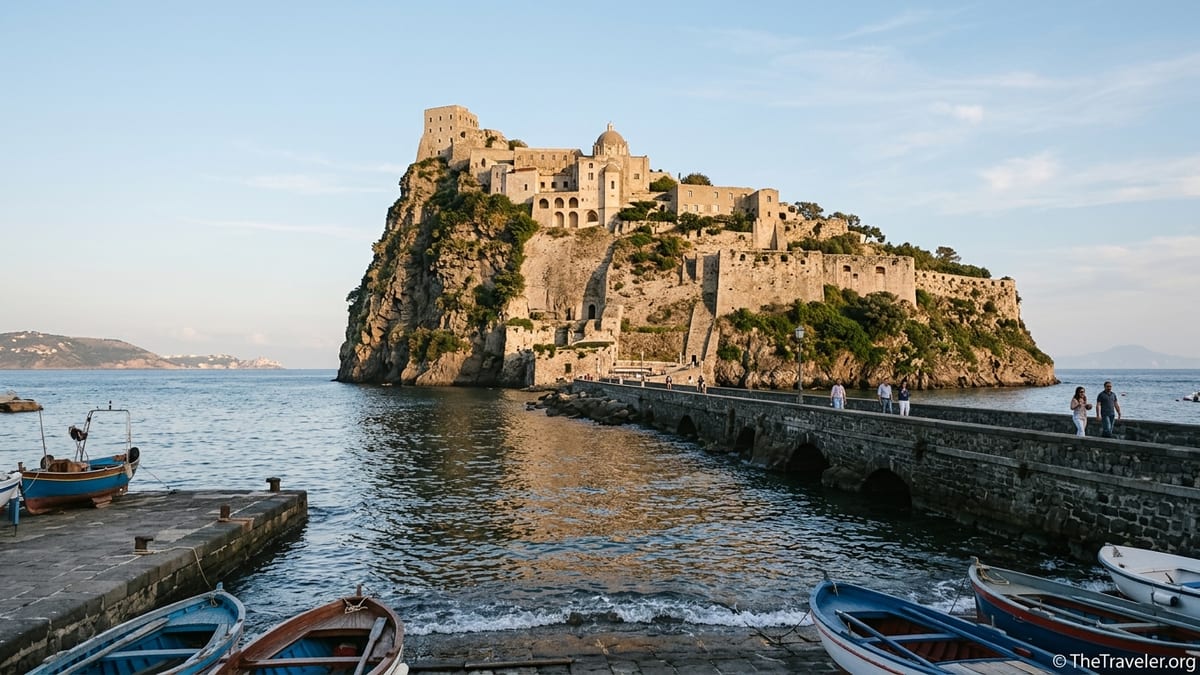
Castello Aragonese is a fortified citadel perched on a rocky islet just off the eastern coast of Ischia, in the Gulf of Naples. Linked to the main island by a 220 meter stone bridge, it looks like a classic storybook castle from afar, but once inside you discover a small fortified town: terraces, churches, convent ruins, underground passages and gardens layered across different levels of rock. It is less one single castle building and more an entire fortified micro-city that once held almost the whole population of Ischia.
The rock itself is of volcanic origin, part of the same complex that created Ischia’s hot springs. Early fortifications here date back to 474 BC, when Hiero I of Syracuse built a stronghold to control sea routes in the Tyrrhenian. The later Aragonese kings of Naples expanded and reinforced these defenses in the 15th century, giving the castle its current name. Today visitors ride a lift carved into the rock or climb stepped paths to reach the upper terraces, where wide views stretch from Procida to Capri and the Sorrento Peninsula.
From a traveler’s perspective, it functions as a privately managed historic complex and open-air museum. You pay an entry ticket and follow a signed one-way route that usually takes 2 to 3 hours, depending on how often you stop for photos, coffee or long pauses on the panoramic benches. Inside you will find a café with sea views, small exhibition spaces, a chapel still used for weddings and events, and quiet corners that feel surprisingly removed from the busy beaches below.
A Fortress That Protected an Island
For centuries the islet was Ischia’s shield against attack. After frequent pirate raids in the late Middle Ages, Alfonso V of Aragon transformed the site in the mid 1400s into a true fortress. He replaced an earlier wooden bridge with a solid stone causeway and wrapped the rock with thick defensive walls and watchtowers. In an era when Turkish and North African corsairs terrorized coastal villages, this compact citadel gave islanders a place to retreat behind fortified gates.
By the early 1700s historical sources describe nearly 2,000 families living packed onto the rock, alongside soldiers, clergy and nobles. Within the walls there were multiple churches, a Poor Clares convent, an abbey, the bishop’s residence and a garrison. For modern visitors, the most tangible reminder of this defensive role is the “Terrace of the Immaculate Conception,” where cannons once pointed out over the channel. When you stand there at sunset, watching ferries pass between Ischia and Procida, it is easy to understand why this high lookout was so strategically important.
This defensive past also explains the castle’s dense network of tunnels and cisterns. On a summer visit you might appreciate them simply as pleasantly cool spaces, but historically they were crucial. Cisterns collected rainwater so that residents could survive long sieges without relying on outside wells. Underground passages allowed movement between different levels while remaining protected. When guides mention that entire communities once stayed here for weeks during raids, you get a sense of how this compact rock was engineered for survival.
Layers of History: From Greeks to Renaissance Poets
The importance of Castello Aragonese lies in the way it condenses 25 centuries of Mediterranean history in a single walkable site. The first fortifications are linked to Greek settlers in the 5th century BC. Later, the Romans used nearby areas as a military and commercial base, and the rock passed through the hands of Byzantine, Norman, Angevin and Aragonese rulers as the Kingdom of Naples changed dynasties. Each era left traces, from fragments of ancient masonry to medieval chapels and Renaissance cloisters.
One of the most evocative stories associated with the castle is that of Vittoria Colonna, a 16th century noblewoman and poet who spent part of her life here. She was a friend and muse of Michelangelo and a central figure in Italian Renaissance culture. The Colonna family turned the fortress into a semi-courteous residence, hosting intellectuals and artists. When you visit the so-called “House of Vittoria Colonna,” now a ruin framed by bougainvillea, it is easy to imagine conversations about art and theology carried on in the shade while the sea crashed far below.
The complex also bears witness to grimmer chapters: sieges, eruptions from Ischia’s restless volcanic system, and plague. The former cemetery for nuns of the Clarisse convent, where bodies were once placed on stone seats for natural decomposition, is one of the most striking and somber stops on the visitor route. Today the crypt is presented in a sober, interpretive way, reminding travelers that this idyllic island also knew hardship and fear.
By the 19th century the military importance of the rock had declined, and in 1912 the Italian state auctioned it to a local lawyer, Nicola Ernesto Mattera. His family began the long process of stabilizing ruins, restoring paths and opening parts of the complex to visitors. In the late 20th century, after decades of careful work, the castle emerged not as a static monument but as a living cultural site integrated into daily island life.
A Symbol of Ischia’s Identity and Landscape
Ask locals what image best sums up Ischia and many will point to the profile of Castello Aragonese, especially as seen from the small fishing harbor of Ischia Ponte. The mass of stone rising from the sea, topped with terraces and churches, has become the island’s visual shorthand, used in hotel brochures, ferry posters and even on the labels of local wines. At sunrise it is often painted in soft pastels; at night it becomes a dark silhouette punctuated by warm yellow lights.
The castle’s setting explains much of its symbolic power. The trachytic rock juts steeply from the water, linked to the shore by the low stone bridge that visitors walk across today. Standing mid-bridge you can look one way toward the pastel facades and bobbing fishing boats of Ischia Ponte, and the other way to the open sea and the faint outline of Procida. On windy days waves crash against the causeway, sending salt spray into the air while locals cycle past in rain jackets and visitors shelter under umbrellas, still taking photos despite the weather.
This visual prominence has also made the castle an anchor for local traditions. Religious processions sometimes pass beneath its walls, and from the terraces residents gather to watch summer fireworks reflected in the bay. Several small hotels and guesthouses in Ischia Ponte market “castle view” rooms at a premium, and with good reason. A mid range waterfront room with a balcony overlooking the castle can cost notably more in August than a similar room facing inland, illustrating how much travelers value the vista.
Practical Visiting Experience: Tickets, Hours and What to Expect
For travelers, Castello Aragonese is one of the most accessible historic sites in the Bay of Naples. It is open every day of the year, typically from around 9 am until sunset, with last entry generally in the late afternoon. Exact closing times vary seasonally and with daylight, so it is wise to confirm the current schedule locally or through official information channels before setting out, especially in winter when days are short or during special events.
Tickets are sold at the base of the rock, just across the bridge from Ischia Ponte. Prices can change, but you can expect an adult ticket to cost roughly what you might pay for a major museum visit in Naples, with reduced rates for children and sometimes for students or seniors. The ticket includes access to the panoramic elevator, the walking paths, the churches and exhibition spaces along the designated route, plus the option to exit and re enter on the same day if you want to return for sunset after a swim or lunch.
A typical visit begins with the elevator that whisks you up through the rock in less than a minute. From the upper station, a paved path leads past the Church of the Immaculate Conception toward open terraces. There are information panels in Italian and English, but many visitors simply wander at their own pace. Comfortable walking shoes are important, as some stretches are steep or uneven, and in high summer the stone can become very hot in the afternoon sun. Even in July and August there is usually a sea breeze, but a hat and water bottle make the experience more pleasant, especially if you linger on the sun exposed viewpoints.
Facilities inside are simple but adequate. A café with outdoor seating offers coffee, drinks and light snacks with sweeping sea views. Prices are a bit higher than in the village below, reflecting the setting, but still reasonable compared with many European waterfront landmarks. There are restrooms at several points along the route. For visitors with limited mobility, the elevator and main paths make it possible to see at least the principal terraces and views, though some of the more remote corners and stair filled sections remain challenging.
Cultural Life: Events, Exhibitions and Everyday Moments
One reason the castle remains important today is that it is not only a static relic but a venue for contemporary culture. Over the last decades, parts of the complex have hosted art exhibitions, photography shows, and occasional literary or music events, especially in the warmer months. Small sculpture installations sometimes appear along the paths, integrating modern works with medieval stone walls and Mediterranean flora.
The restored churches and chapels within the complex are occasionally used for religious ceremonies and intimate concerts. Wedding parties, often Italian but increasingly international, choose the castle’s terraces for symbolic civil ceremonies or receptions, blending centuries of history with a very current celebration of island life. It is not uncommon in summer to encounter a small group of elegantly dressed guests posing for photos against the sea, while day visitors in walking shoes pass nearby on the same paths.
Even without a programmed event, the daily rhythm of the castle provides its own cultural experience. In the morning you might see local school groups on guided tours, listening as teachers explain stories of pirate attacks and the life of cloistered nuns. Around midday, independent travelers spread out on benches to eat simple picnic lunches bought from bakeries in Ischia Ponte. By late afternoon, photographers set up tripods on the highest terrace, waiting for the light to turn golden and for the pastel houses of the village to glow below.
How Castello Aragonese Shapes a Modern Visit to Ischia
For many visitors, exploring Castello Aragonese becomes the organizing anchor of a stay on Ischia. Travelers who come for a spa weekend often structure one day around a morning at a thermal park such as Negombo or Poseidon, followed by a late afternoon walk around the castle. Others arriving on a day trip from Naples or Sorrento aim first for the fortress before relaxing on the nearby Cartaromana or Pescatori beaches where the castle fills the horizon.
This single landmark also influences where travelers choose to sleep and dine. Ischia Ponte developed from a medieval fishing village into one of the island’s most atmospheric quarters, partly because of its castle views. Small family run hotels here might offer balconies looking directly toward the rock, and in the evening restaurants along the waterfront place their outdoor tables so guests can watch the castle slowly light up. Ordering a plate of local seafood such as spaghetti with clams, sipping a glass of Ischian Biancolella wine and glancing up at the illuminated walls has become a signature island experience.
The castle moreover helps orient visitors physically. From many coastal paths and bus routes you can see its shape and use it as a reference point, especially when first arriving and trying to understand the island’s layout. Boat excursions that circle Ischia typically slow as they pass under its cliffs, with guides narrating its history in several languages while passengers crowd the railings for photographs. In this way the fortress is not only an attraction to visit once, but a constant visual companion as you move around the island.
Planning Your Visit: Timing, Weather and Simple Itineraries
To appreciate why Castello Aragonese matters, it helps to experience it in the right light and with enough time. Many travelers aim for early morning or late afternoon to avoid the strongest heat, especially between June and September. In the first hours after opening, the complex is relatively quiet; you might share the terraces with only a handful of other visitors and a few local cats. Late afternoon offers softer light for photography and the chance to stay until close to sunset, when the sky behind Procida and the mainland can turn shades of orange and pink.
A simple half day itinerary from elsewhere on Ischia might involve taking a public bus to Ischia Ponte, walking through the narrow lanes lined with gelato shops and bakeries, then buying tickets and crossing the bridge. After a 2 to 3 hour visit and a coffee at the café, you could descend and swim at the small beaches nearby, where locals often leave their towels on the rocks. For a full day, combine the castle with a leisurely lunch in the village and perhaps a short boat trip or kayak rental in the late afternoon to see the fortress from the waterline.
Weather makes a difference to the experience but rarely cancels it. On clear days views stretch to Vesuvius and the Sorrento Peninsula. On hazy or overcast days the atmosphere is more subdued but still dramatic, with the rock appearing and disappearing in sea mist. Rain can make some paths slippery but the tunnels and interior spaces offer shelter. In winter, when Ischia is quieter and many beach clubs and thermal parks reduce operations, the castle remains one of the island’s most rewarding year round visits, giving a deeper context to the steaming hot springs and terraced vineyards you pass on your way.
FAQ
Q1. What is Castello Aragonese in Ischia?
Castello Aragonese is a historic fortified complex built on a volcanic islet off Ischia’s eastern coast, connected by a stone bridge and functioning today as an open air museum and cultural site.
Q2. Why is Castello Aragonese so important to Ischia?
It served for centuries as the island’s main fortress and refuge against pirate attacks, housed much of the population, and has become the visual and cultural symbol most associated with Ischia.
Q3. How much time do I need to visit Castello Aragonese?
Most visitors spend about 2 to 3 hours walking the full route, stopping at terraces, churches and the café, though photography enthusiasts may want longer, especially near sunset.
Q4. What are the typical opening hours of Castello Aragonese?
The castle is generally open every day from around 9 am until sunset, with last entry in the late afternoon, though exact closing times vary by season and daylight.
Q5. Is Castello Aragonese suitable for visitors with limited mobility?
An elevator and main paved paths make key terraces and viewpoints accessible, but some sections include stairs and uneven surfaces that may be challenging for those with reduced mobility.
Q6. Can I visit Castello Aragonese on a day trip from Naples or Sorrento?
Yes, many travelers take a morning ferry to Ischia, spend several hours at the castle and nearby Ischia Ponte, and then return on an afternoon or evening boat the same day.
Q7. Are there guided tours inside Castello Aragonese?
Information panels in multiple languages line the route, and at certain times of year independent guides or small group tours may be available through local agencies or on request.
Q8. What should I wear and bring for a visit?
Comfortable walking shoes, a hat, sunscreen and water are recommended, especially in summer, as paths can be steep, stone surfaces hot and much of the route exposed to the sun.
Q9. Can I eat or drink inside the castle?
Yes, there is a café with panoramic seating that serves drinks and light snacks, and some visitors bring small snacks or water, though picnicking is usually limited to designated areas.
Q10. Is Castello Aragonese worth visiting if I am mainly interested in beaches and spas?
Even for travelers focused on thermal parks and seaside relaxation, the castle offers essential historical context, sweeping views and one of the most memorable walks on Ischia.