


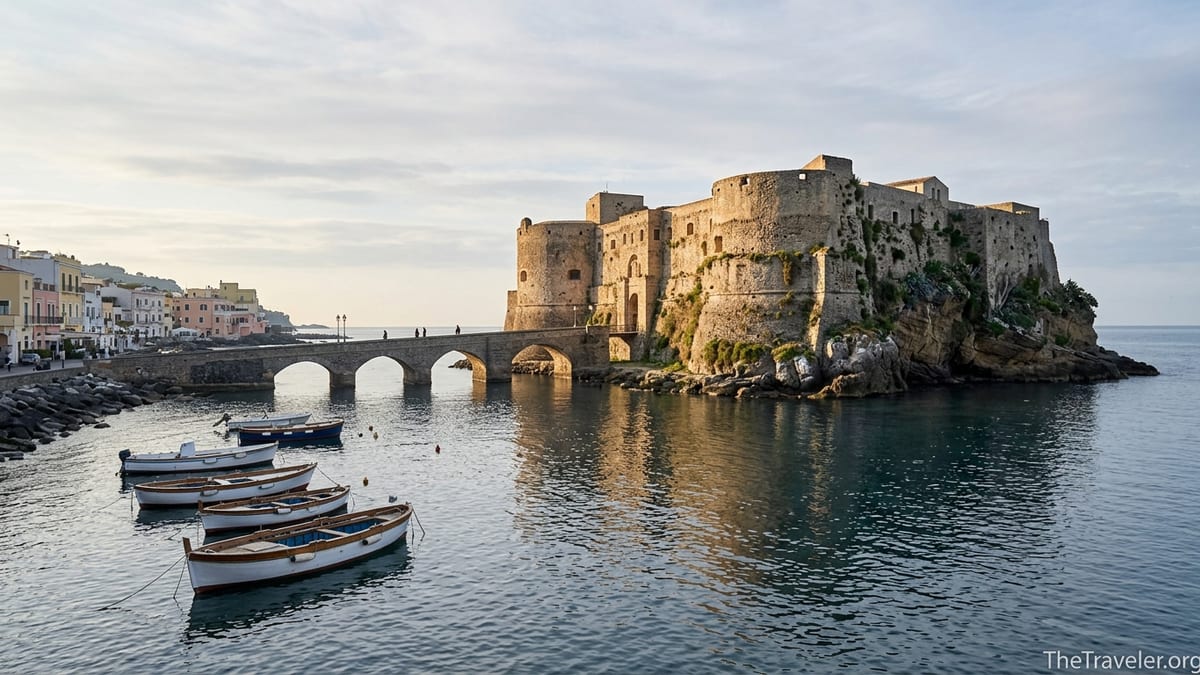
Rising from a rocky islet at the eastern tip of Ischia, connected to the mainland by a slender stone causeway, Castello Aragonese looks every bit the storybook fortress. Yet behind its commanding silhouette is more than a picturesque photo opportunity. For Southern Italy, this castle remains a cultural barometer, a place where the region’s ancient past, fragile coastal landscapes and contemporary creative energy continue to intersect in very tangible ways.
Get the latest updates straight to your inbox!
A Fortress That Holds the Story of the Southern Seas
Castello Aragonese occupies a fortified volcanic islet just off Ischia Ponte, facing the northern end of the Bay of Naples. The first stronghold here dates back to the 5th century BC, when Hiero I of Syracuse built a defensive outpost to control sea routes that linked Greek colonies, Naples and the wider Mediterranean. Later, under the Aragonese in the 15th century, the rock was wrapped in thick bastion walls, tunnels and lookout points designed to resist Ottoman raids and rival fleets. Walking today through the vaulted entrance tunnel, visitors still see cannon embrasures, storehouses and guard posts that once anchored Naples’ maritime defense network.
That long military history matters for more than curiosity. The castle helps explain why Southern Italy’s coastal towns are dotted with watchtowers and fortifications that look similar, from Procida and Capri to Gaeta and Taranto. When a guide in Ischia points out how cannon lines were positioned to crossfire with batteries on the main island, it becomes easier to understand the strategic thinking behind fortresses all along the Tyrrhenian coast. For travelers who also visit Castel Sant’Elmo above Naples or the Aragonese fortress in Taranto, Castello Aragonese becomes a crucial reference point in a chain of coastal strongholds that once guarded the Kingdom of Naples.
On a very practical level, the fortress also illustrates how these structures adapted over centuries. Inside the walls, you still find water cisterns carved into rock, small vineyards, vegetable patches and chapels. Many visitors notice fig trees and low stone terraces as they climb. These details reveal how the castle functioned as a self-sufficient citadel, a theme that repeats in Southern Italian hilltop towns and island villages that had to withstand sieges and isolation. For students, architectural enthusiasts or simply curious travelers, it is a rare opportunity to see this system preserved almost as a small island-city.
Vittoria Colonna and the Intellectual Heart of the Renaissance South
In the early 16th century, Castello Aragonese became an unlikely intellectual salon under Vittoria Colonna, one of Italy’s most influential Renaissance poets. Married into the powerful Colonna family, she retreated to Ischia between 1501 and 1536, turning the castle into a refuge for thinkers and artists. Letters and literary accounts indicate that figures such as Michelangelo Buonarroti, Ludovico Ariosto and other humanists either corresponded with her here or were closely linked to her Ischia circle. For Southern Italy, this was a rare case of a peripheral island acting as a cultural capital, not just a military outpost.
When modern visitors pause in the former convent courtyards or stand on the terraces that look towards Capri and Vesuvius, guides often point out rooms associated with Colonna’s time. While the interiors have changed, the setting helps bring to life her role as a bridge between the conservative politics of Naples and the more experimental currents of Italian humanism. Many travelers combine a visit to the castle with time at Naples’ National Archaeological Museum or the Capodimonte Museum, where Renaissance artworks contextualize the circles she moved in. Seeing Castello Aragonese firsthand makes it easier to grasp that Southern Italy’s contribution to Renaissance culture did not only flow through big cities but also through fortified islands like this one.
The castle’s ongoing use for book presentations, philosophy lectures and small literary festivals deliberately echoes this past. For example, summer evenings during a philosophy festival bring authors and scholars to the terraces for public talks at sunset, with the lights of Ischia Ponte flickering below. Travelers can buy a standard entrance ticket, then pay a modest supplement for these events, often similar in price to a casual restaurant meal on the island. Sitting where Colonna once exchanged ideas, while listening to contemporary debates on ethics or ecology, underlines how the site continues to function as an intellectual hinge between past and present.
From Monastic Citadel to Contemporary Cultural Stage
By the 18th and 19th centuries, the castle had become home to a small city on the rock, sheltering convents, churches, families and even a prison. Some of the most affecting spaces visitors encounter today come from this period. One room recounts the grim history of cloistered nuns, including the now-closed ossuary area where bodies were left to decompose as a memento mori. Exhibits in the Torture Museum, located in part of the complex, draw a direct line between the castle’s once-harsh justice system and wider patterns of punishment in Southern Italy’s feudal society. While not suited for all travelers, these spaces offer context for the region’s often turbulent past and its slow shift towards modern legal norms.
Yet the same structures have been creatively repurposed. Restored chapels and cloisters now host art exhibitions, installations and concerts. In recent years the castle has staged contemporary art shows that weave through its alleys, such as retrospectives dedicated to conceptual and environmental artists whose work engages with the sea and volcanic landscapes. During a typical exhibition, you might find sculptures installed in former gun platforms, photography displayed in small monastic cells or sound pieces quietly animating cistern chambers. The goal is less to transform the castle into a white-cube museum and more to allow visitors to experience the architecture as a living backdrop that shapes how art is perceived.
At the same time, projects by Italian architects have focused on carefully restoring key religious spaces, such as reconfiguring the ruined cathedral and rehabilitating smaller churches within the complex. The approach tends to be conservative and minimalistic, preserving rough stone textures and traces of frescoes rather than recreating lost ornament. For travelers familiar with the grand restorations at Pompeii or the Royal Palace of Caserta, the more intimate, layered restoration work at Castello Aragonese provides a counterpoint that reflects the priorities of local heritage initiatives on smaller sites.
A Daily Lesson in Coastal Resilience and Sustainable Tourism
Castello Aragonese is more than an aesthetic relic. It also serves as a real-time classroom on how Southern Italy’s coastal heritage can adapt to contemporary pressures, from mass tourism to climate stress. The stone causeway that connects the islet to Ischia Ponte is exposed to storms and sea-level variations that are becoming increasingly frequent in the Tyrrhenian. Maintenance of this bridge is not just a practical concern; it is symbolic of the delicate line between accessible heritage and an overtaxed environment. Local authorities and the private family that manages the castle balance structural work with restrictions on heavy traffic and delivery schedules, and most visitors arrive on foot from Ischia Ponte’s pedestrian streets.
Inside, visitor flows are managed with timed ticketing in peak season and clear one-way routes that reduce wear on fragile staircases and tunnels. As of mid 2026, a standard adult entrance ticket typically costs in the range of a casual restaurant lunch on the island, while children, students and seniors often benefit from reduced pricing. Combined tickets may include guided tours in Italian or English that explain not only history but also ongoing conservation. Guides frequently point out areas where rock faces have been reinforced, gardens replanted with native species or drainage systems upgraded to cope with intense rain events. For travelers paying attention, these details make the castle a microcosm of the challenges coastal heritage faces across Southern Italy.
The site also plays a quiet role in diversifying Ischia’s tourism beyond spas and beaches. Local tourism boards increasingly highlight cultural itineraries that connect the castle with smaller sites, such as the archaeological museum at Villa Arbusto or rural churches in the island’s interior. Tour companies based in Naples and Sorrento now routinely offer day trips that pair Castello Aragonese with thermal park visits or vineyard tastings. This blend of historical and wellness tourism mirrors broader trends across Campania, where heritage sites help spread visitor spending throughout the year instead of concentrating everything in the summer beach season.
Local Life, Food Traditions and the Island Identity
For Ischitans, Castello Aragonese is not simply a tourist attraction. It is a constant presence in daily life, framed in nearly every postcard view and visible from ferries as they edge into the island’s ports. Children grow up seeing the fortress lit at night, and many local milestones, from wedding photo sessions to school excursions, take place on its terraces. When storms roll in from the north, residents often describe waves hitting “towards the castle” as shorthand for rough seas. In other words, the silhouette of the Aragonese rock serves as a compass for the island’s emotional geography.
The castle also anchors specific culinary and seasonal traditions. Restaurants in Ischia Ponte, just before the causeway, often use names, motifs and menus that reference the fortress and its history. A traveler might eat coniglio all’ischitana, the island’s signature rabbit stew, on a balcony with a direct view of the fortified islet, or try simple grilled catch of the day while watching visitors make their way across the bridge at dusk. Cafés near the entrance sell lemon granita, espresso and sfogliatelle that fuel early morning climbs up to the castle, while a terrace café inside the complex itself offers light lunches and local wine against a sweeping sea backdrop.
Annual events give the place a particular rhythm. Around mid August, Ferragosto celebrations often include concerts or special evening openings at the castle, with live music echoing between the bastions and fireworks reflecting off the dark sea. On other summer nights, film screenings and small theatre performances take advantage of natural stone courtyards, allowing visitors to experience Southern Italian cinema and music in a setting that feels worlds away from a conventional auditorium. These events are rarely grand productions; they are more often modest but atmospheric evenings that underline how the site remains woven into the cultural calendar of the island.
How Travelers Experience the Castle Today
For most visitors, encountering Castello Aragonese begins with the walk from Ischia Porto or a local bus ride to Ischia Ponte, followed by the short stroll across the stone bridge. Ticket offices typically operate from mid morning, with last entry in the late afternoon or early evening depending on the season, and there is often a clear notice that the final tickets are sold around ninety minutes before closing. This encourages travelers to arrive early, especially in July and August when queues can form. Many opt for a self-guided visit using printed maps or simple audio guides, which allow them to wander at their own pace through gardens, chapels and viewpoints.
The route usually climbs first to panoramic terraces that overlook Procida, Capri and the Sorrento Peninsula before looping through the remains of the cathedral and monastic buildings. Along the way, small exhibition rooms illustrate different layers of history, from ancient Greek fragments to medieval weaponry and religious art. In one area, a modest but thought-provoking museum presents instruments of torture and punishment, framed as a critique of historical cruelty rather than as a spectacle. Parents often choose to bypass this section with younger children, while history enthusiasts linger over the interpretive panels.
Practical facilities inside the complex include simple restrooms, a bookshop and at least one café-restaurant with outdoor seating. Prices for drinks and snacks tend to be slightly higher than in town, reflecting the location, but still in line with other Italian heritage sites of similar stature. Comfortable walking shoes are strongly recommended; many visitors underestimate the number of stairs and sloping paths, especially in the midday heat. A reusable water bottle is useful, as is a light layer for breezy afternoons when the wind funnels through exposed sections of the walls. For photographers, the soft light of early morning or late afternoon, when the sun is lower over the bay, offers the most evocative views without the glare that can flatten mid-day images.
The Takeaway
Castello Aragonese remains central to Southern Italy’s cultural heritage because it concentrates, in one compact and walkable site, many of the forces that have shaped the region. It is a Greek and Aragonese fortress that explains why this coastline bristles with stone defenses. It is the island retreat of a Renaissance poetess whose networks tied Naples to the wider world of Italian humanism. It is a monastic and civic citadel that shows how communities once survived behind thick walls, and a contemporary cultural stage where art, music and ideas continue to unfold.
For travelers, the castle offers more than dramatic panoramas over the Bay of Naples. It provides a concrete way to connect thermal spas, fishing villages, vineyard-covered slopes and bustling Neapolitan streets into a single narrative. Spending two or three unhurried hours on the rock, listening to the wind against the walls and watching ferries trace white lines across the water, can reframe an entire trip to Campania. Castello Aragonese still matters because it is not only a memory of the past, but an active participant in how Southern Italy thinks about its identity, manages its coasts and welcomes the world.
FAQ
Q1. Where exactly is Castello Aragonese located in Ischia?
It stands on a small fortified volcanic islet off the eastern side of Ischia, connected to the historic village of Ischia Ponte by a stone causeway that visitors walk across.
Q2. How much time should I plan for a visit?
Most travelers spend between two and three hours exploring the castle, which allows enough time for the main viewpoints, churches, exhibitions and a short café stop.
Q3. What are typical opening hours through the year?
Opening hours vary by season, but the castle usually opens in the morning and closes around sunset, with last entry roughly ninety minutes before closing; check locally for current times.
Q4. Is the castle suitable for visitors with limited mobility?
The site involves many stairs, slopes and uneven stone paths, so mobility can be challenging; some lower terraces are more accessible, but much of the upper complex is difficult with wheelchairs or walking issues.
Q5. Are guided tours available in English?
Yes, in high season there are often scheduled guided tours in multiple languages, including English, and private guides based on Ischia or in Naples can also arrange customized visits.
Q6. Can I visit Castello Aragonese on a day trip from Naples or Sorrento?
Yes, frequent ferries and hydrofoils connect Naples and Sorrento to Ischia; with an early departure and evening return, a full day trip that includes time at the castle is very feasible.
Q7. Are there restaurants or cafés inside the castle?
There is usually at least one café-restaurant within the complex offering drinks, light meals and local wine, along with plenty of dining options in nearby Ischia Ponte just before the causeway.
Q8. Is the site suitable for children and families?
Families often enjoy the views, gardens and tunnels, but some exhibits, such as the torture displays or ossuary history panels, may be too intense for younger children, so parents may wish to skip those sections.
Q9. What should I wear and bring for the visit?
Comfortable shoes with good grip, sun protection, a reusable water bottle and a light layer for wind are recommended, especially in summer when temperatures and crowds can be high.
Q10. Why is Castello Aragonese considered so important for Southern Italy’s heritage?
Because it brings together military, religious, literary and everyday island history in one place, illustrating how Southern Italy’s coastal communities have defended, imagined and reshaped themselves over many centuries.