


Kaunas rewards more than a rushed day trip from Vilnius. For most visitors, one or two nights is ideal to combine its UNESCO-listed modernist architecture, atmospheric Old Town and moving memorial sites without feeling hurried. Fast trains from Vilnius make logistics simple, but staying over lets you see the streets and riverfront when day-trippers have left and appreciate why Lithuania’s second city now deserves attention in its own right.
Get the latest updates straight to your inbox!
Getting to Kaunas and Deciding How Long to Stay
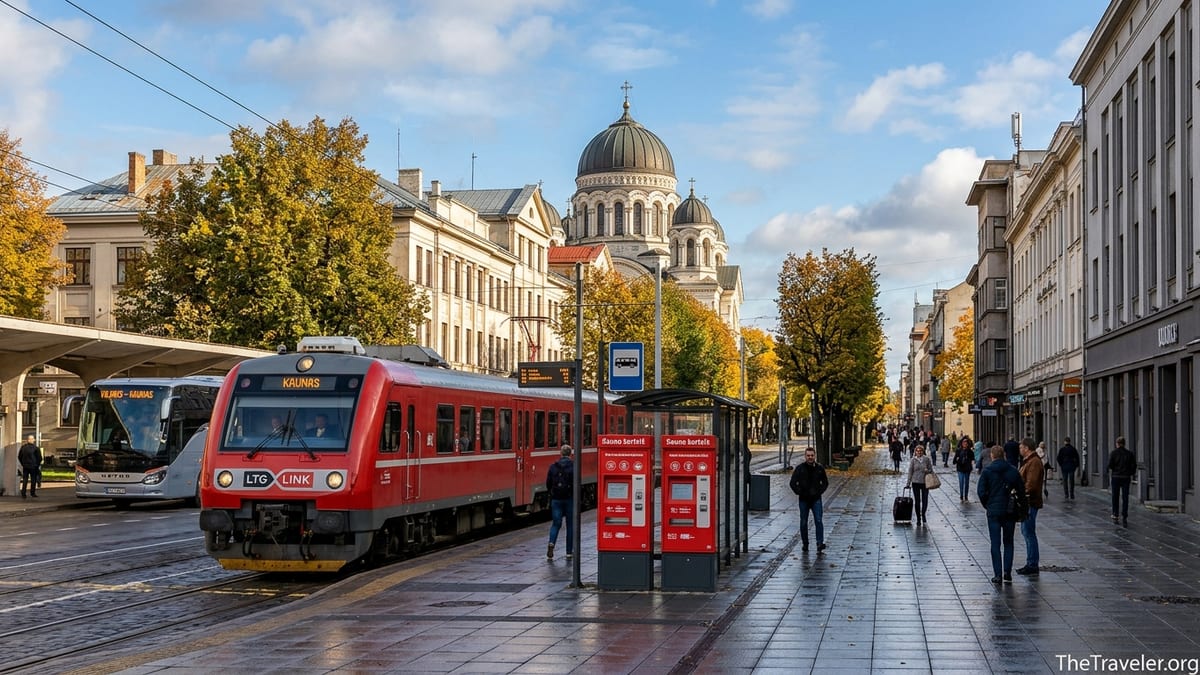
Kaunas is only about 100 kilometers from Vilnius and connected by frequent LTG Link trains. On recent autumn timetables, direct trains between Vilnius and Kaunas typically run at least once per hour during the day, with typical journey times around 1 hour to 1 hour 15 minutes depending on the service. Standard adult fares booked through LTG Link’s online system or ticket machines have recently been around 8 to 10 euros one way in second class for the fastest trains, with cheaper options at slightly less convenient times. Seats are reserved and tickets can usually be bought on the day until a few minutes before departure, although buying in advance is wise on Friday evenings and Sunday afternoons when routes are busier.
If you are flying in, Kaunas Airport sits roughly 14 kilometers east of the center. Regular city buses connect the terminal with central Kaunas, and journey times are commonly about 25 to 30 minutes depending on traffic. Taxis and app-based rides are also available from the arrivals area. A taxi into town often costs in the region of 20 to 25 euros for the car, which can be reasonable for couples or small groups with luggage who prefer to avoid public transport after a flight.
Thanks to these convenient connections, visiting Kaunas as a very long day trip from Vilnius is technically possible. However, to properly explore the Old Town, stroll Laisvės alėja, ride at least one funicular, and visit at least one museum, staying at least one night makes a clear difference. Two nights are even better, allowing time for important but more distant sites such as the Ninth Fort or Pažaislis Monastery without rushing.
For first-time visitors who are already staying in Vilnius, a practical pattern is to travel from Vilnius to Kaunas early on a Saturday, stay Saturday and Sunday nights in Kaunas, visit the Ninth Fort and additional sights on Sunday or Monday, then return to Vilnius. This schedule fits well with current museum opening arrangements, especially for memorial museums that sometimes close or offer limited services on the last Sunday of the month or certain holidays.
Understanding Transport and Tickets in Kaunas
Once in Kaunas, getting around is straightforward. The city relies on buses and trolleybuses operated under the Kaunas public transport system. According to recent fare tables updated in 2026, riders can purchase single tickets directly from drivers in paper form for around 1 euro, but most locals and many visitors now use electronic options such as the Kauno kortelė smart card or the Žiogas mobile app. When using the app, a standard single fare for one journey within the city has recently been around 0.70 euros after activation inside the vehicle, offering savings for anyone taking multiple trips.
For a weekend visit, short-term passes represent good value. Local tariff information in 2026 refers to multi-day electronic tickets, including 3-day products that cost only a few euros more than several single tickets. Depending on your plans, buying an electronic pass for 3 days around the 5 to 6 euro mark means you can ride buses and trolleybuses freely without worrying about individual fares. These passes are loaded onto a Kauno kortelė obtained from kiosks and customer service points around the city, or purchased in-app for phone-based tickets.
Intercity buses also link Kaunas with Vilnius, Klaipėda, Šiauliai and regional towns. Several private operators run modern coaches from the central bus station near the railway station. In practical terms, the bus is useful as a backup if your intended train is full or disrupted. Standard one-way bus fares between Vilnius and Kaunas are often similar to or slightly lower than discount train fares, typically from about 7 euros depending on operator and time of day, and journey times usually fall close to 1 hour 30 minutes.
For visitors staying mainly in the center, you may barely need public transport at all. The Old Town, Town Hall Square, Kaunas Castle, Vilniaus Street and Laisvės alėja all form a compact, walkable area. Public transport becomes more essential for outlying attractions such as the Ninth Fort in Šilainiai district, Pažaislis Monastery near the reservoir, or for travel to and from the airport.
Walking the Old Town and Laisvės alėja
Kaunas reveals itself best on foot. A rewarding walking route begins at the confluence of the Nemunas and Neris rivers, near Kaunas Castle. The red-brick castle complex, whose origins date back to the 14th century, sits in a riverside park that gives a sense of Kaunas’s strategic importance on historic trading routes. From the castle grounds, a short stroll brings you to the broad Town Hall Square, framed by pastel merchant houses and the white Baroque Town Hall building, often nicknamed the “White Swan.”
From Town Hall Square, walk along Vilniaus Street, a cobbled pedestrian thoroughfare lined with cafés, small galleries and churches. It is an ideal place to get coffee at a local roastery or sample Lithuanian pastries in a bakery while watching the slow rhythm of weekend life. At the eastern end of Vilniaus Street, the Old Town merges into the long central promenade of Kaunas, Laisvės alėja, or Liberty Avenue, a centerpiece of the early 20th century city.
Laisvės alėja is a nearly 1.6-kilometer tree-lined pedestrian boulevard running toward the New Town. It is flanked by interwar buildings, shops, restaurants, and cultural institutions. Walking its full length takes around 20 minutes at a relaxed pace, but most visitors linger to step into courtyards, admire façades or stop for lunch at one of the many mid-priced restaurants and bistros. As you proceed east along the avenue, you will gradually transition from medieval Kaunas to the modernist city that later won UNESCO World Heritage recognition.
The New Town stretches beyond the eastern end of Laisvės alėja, anchored by important civic buildings and the Church of St. Michael the Archangel at Soboras Square. Although this church dates from the late 19th century and is more eclectic in style, the surrounding streets hold many of the interwar buildings that define Kaunas’s modernist identity. This simple, linear walk from Old Town to New Town is the backbone of any weekend exploration and links naturally with short diversions to museums and funiculars.
Modernist Kaunas and Its UNESCO World Heritage Architecture
In 2023, Modernist Kaunas was inscribed on the UNESCO World Heritage List, recognizing the city’s exceptional collection of interwar architecture from 1919 to 1939. When Vilnius was part of another state between the World Wars, Kaunas became Lithuania’s temporary capital. That status triggered an ambitious building program, resulting in hundreds of structures that reflect modernist and functionalist trends blended with local motifs.
Among the standout buildings is the Central Post Office, completed in the 1930s. Located near Laisvės alėja, it showcases a restrained façade where horizontal lines, large windows and subtle decorative details demonstrate the clarity of interwar design. Visitors can easily appreciate the exterior during a self-guided architecture walk. While the building still serves its original postal function, interior access may be limited to public service areas, so those particularly interested in architecture should focus on façade details, corner treatments and how the building addresses the street.
The Church of the Resurrection, officially the Basilica of Christ’s Resurrection, is another landmark of the period. Perched on Žaliakalnis hill, the church’s white modernist massing and tall tower are visible from many points in the city. Construction began in the 1930s, though later history interrupted its completion and use. Today, visitors can enter the interior as an active church and, for a small separate fee, access the roof terrace for wide city views when opening times permit. The church therefore serves both as an important modernist monument and as a practical viewpoint for understanding Kaunas’s topography.
Other key interwar buildings include the former Officers’ Club, various former ministries and municipal offices, and a range of residential apartment buildings developed for the new middle class. Many of these line streets branching off Laisvės alėja and can be appreciated primarily from the outside, since most remain in active use as offices or private housing. Architecture lovers can plan a half-day route that links the Central Post Office, former Officers’ Club area, banks and insurance offices near the avenue, and notable residential blocks on streets such as K. Donelaičio and V. Putvinskio, concentrating on façades, entrance portals and original details like balconies and corner windows.
Funiculars and Viewpoints: Aleksotas and Žaliakalnis
Kaunas is one of the few cities in the region to retain historic funicular railways. The Aleksotas Funicular, dating from the 1930s, climbs from the Old Town riverbank to the Aleksotas hill on the south side of the Nemunas. At the upper station, a viewing terrace offers sweeping views of the Old Town, Town Hall, castle and both rivers. The funicular remains in operation, although exact daily schedules and maintenance closures can vary, so checking posted times at the station when you arrive is advisable.
Recent visitor reports and local information indicate that single rides on the Aleksotas Funicular still cost only a few euros per person. Tickets are purchased at the lower station or from staff, and the short trip takes only a minute or two. Since the funicular ride itself is brief, its real value is in providing easy access to the observation platform without a steep climb. For many weekend visitors, riding Aleksotas in the late afternoon and staying for sunset over the Old Town is one of the highlights of a stay in Kaunas.
The Žaliakalnis Funicular, historically important for linking the central city with Žaliakalnis hill and the Church of the Resurrection, has faced closures for renovation and technical work. Local sources and discussions in 2026 noted that it was closed for an extended period, with riders encouraged to use Aleksotas instead. Before including Žaliakalnis in your plans, verify its current operational status once in Kaunas at tourist information points or by checking municipal announcements. While closed, access to the Church of the Resurrection and its rooftop terrace is still possible on foot or by bus, but without the historic funicular experience.
Taken together, the funiculars are not merely transport but part of Kaunas’s heritage landscape. Architecture enthusiasts and photographers will appreciate how the funicular lines, stations and hillside neighborhoods contribute to the broader story of interwar urban planning and adaptations to the city’s terrain.
Ninth Fort Museum: History, Logistics and Emotional Weight
The Ninth Fort Museum and memorial complex stands several kilometers northwest of central Kaunas, in the Šilainiai district. Originally part of the Kaunas Fortress system of the late 19th and early 20th centuries, the Ninth Fort later became a site of imprisonment, Soviet political repression and, under Nazi occupation, mass shootings of Jews and other victims. Today, it combines preserved fortifications, museum exhibitions and a striking concrete memorial sculpture, making it one of the most powerful places to visit in Lithuania.
Official information from the museum indicates that standard adult admission for the museum exhibitions has recently been set at around 6 euros. Special guided tour tickets cost more, often around 11 euros per person, with discounts available for students and other eligible groups. Opening hours vary by season. In colder months, the museum operates shorter hours and may close earlier in the afternoon, while in warmer seasons it generally remains open later. Crucially, the museum notes specific holiday closures, including All Saints’ Day and All Souls’ Day on 1 and 2 November, and there can also be limitations on tours during certain Sundays, such as the last Sunday of the month when some Lithuanian museums offer free entry but reduced guided services.
Reaching the Ninth Fort by public transport is feasible but requires some planning. Several city bus routes run in the direction of Šilainiai along the Žemaičių highway. Typical instructions are to take a bus from central Kaunas toward Šilainiai and disembark at stops near the fort, followed by a walk of approximately 10 to 15 minutes along the access roads to the museum entrance. Travel time from the center usually ranges between 25 and 35 minutes one way including walking, depending on the bus used and traffic conditions.
For couples or small groups short on time, a taxi or ride-hailing service provides a simpler option. Expect to pay roughly 12 to 18 euros each way between the central city and the Ninth Fort, depending on time of day and traffic. Booking a round trip with some waiting time can be useful in winter when bus intervals are longer and walking is less pleasant due to snow or ice. Regardless of how you arrive, it is wise to check the museum’s own announcements for any temporary exhibition closures, guided tour schedules and seasonal time changes just before your visit.
Visiting the Ninth Fort is emotionally intense. Exhibitions and preserved spaces document both Nazi atrocities and Soviet repression, with personal testimonies and artifacts. Many travelers allocate at least two to three hours, including time outdoors at the memorial. It is a place where photography is usually permitted but reflection and respectful behavior are essential. Families traveling with children should consider in advance how much detail to share, as some exhibits and descriptions are graphic and may be distressing.
Key Museums and Cultural Attractions in the Center
Beyond the Ninth Fort, Kaunas offers a cluster of museums near the city center that can be combined over a day or two. Foremost is the M. K. Čiurlionis National Museum of Art, dedicated to Lithuania’s best-known symbolist painter and composer Mikalojus Konstantinas Čiurlionis. Located near the New Town and Laisvės alėja, the museum showcases his dreamy, layered paintings alongside rotating exhibitions of Lithuanian and international art. Regular adult ticket prices in recent seasons have been around 8 to 10 euros, with discounts for students and combined tickets sometimes available for neighboring institutions.
Close by is the Devil’s Museum, officially the Devils’ Collection of Antanas Žmuidzinavičius. This unusual museum contains thousands of devil sculptures, masks and artworks from Lithuania and around the world. It is quirky and humorous as well as insightful about folklore, making it a useful counterpoint to heavier historical sites and an engaging stop for visitors who might not usually prioritize art museums. Admission prices are generally modest, usually somewhat lower than those of the main national art museum, and combined tickets may allow discounted entry if visiting both on the same day.
In the same cultural quarter, the Vytautas the Great War Museum and its surrounding garden highlight Lithuanian military history, from medieval battles to 20th-century conflicts. Outside, the carillon tower and monuments offer a pleasant open-air space along the broader modernist landscape. Inside, exhibits range from historical uniforms to hardware and documents. Visitors particularly interested in the interwar period will appreciate how the museum reflects the spirit of the era when Kaunas was the capital.
For weekend visitors with limited time, a practical order of priority would be M. K. Čiurlionis National Museum of Art, then the Ninth Fort, then the Devil’s Museum and War Museum, adjusting according to personal interests. Architecture enthusiasts might also schedule interior visits to the Church of the Resurrection and a short look inside the Central Post Office during opening hours to see how functionalist spaces were originally envisioned.
Two and Three Day Itinerary Suggestions
A balanced two-day itinerary showcases both Kaunas’s historic quarters and its modernist identity. On Day 1, arrive in Kaunas by early train or bus and drop luggage at your accommodation in the Old Town or near Laisvės alėja. Spend the morning exploring Kaunas Castle, Town Hall Square and Vilniaus Street, pausing for lunch in one of the courtyard restaurants or cafés. In the afternoon, stroll along Laisvės alėja toward the New Town, detouring into side streets to view interwar façades and stopping into shops or galleries as they catch your eye. Time your day to ride the Aleksotas Funicular in the late afternoon or early evening, taking in views over the Old Town before dinner in a riverside or Old Town restaurant.
On Day 2, focus on museums and hills. Start with the M. K. Čiurlionis National Museum of Art, then visit the Devil’s Museum next door. After a lunch break near Laisvės alėja, head up to Žaliakalnis by bus or on foot to visit the Church of the Resurrection. If the rooftop terrace is open, include this in your visit for panoramic viewpoints, whether or not the Żaliakalnis Funicular is operational. End the day with a relaxed evening walk back down through residential streets and the central promenade, perhaps exploring alternative dining options in the New Town.
An optional third day opens room for the Ninth Fort and the eastern side of Kaunas. Dedicate the morning and early afternoon to the Ninth Fort Museum and memorial, traveling by bus or taxi. Allow at least two to three hours on site to avoid rushing such a significant place. In the late afternoon, weather permitting, you can take a bus toward Pažaislis Monastery and the Kaunas Reservoir area. The Baroque monastery complex is located on a forested peninsula and offers a striking contrast to the urban architecture of central Kaunas. In warmer months guests may combine the visit with a walk along the water or a coffee at nearby lakeside venues before returning to the city center by bus.
Within this framework it is easy to adapt for personal interests. For example, architecture lovers may add a self-guided modernist walking loop around K. Donelaičio and V. Putvinskio streets on Day 1, while families might swap one of the museums for more time in the green spaces near the rivers or in playground areas by the Town Hall Square and castle.
Where to Stay, What It Costs and Seasonal Considerations
Kaunas offers three main areas that suit short stays: the Old Town, the central stretch of Laisvės alėja, and the New Town just beyond. Old Town properties place you amid cobbled streets near the castle and Town Hall. Boutique hotels and apartments here are atmospheric but can be livelier at night on weekends due to nearby bars and restaurants. For a mid-range double room in late spring or early autumn, online listings often show prices in the region of 70 to 120 euros per night depending on exact location and standard.
Staying along or just off Laisvės alėja balances character and convenience. You are within easy walking distance of most sights, yet slightly away from the late-night noise of the Old Town’s most popular bars. A range of three and four-star hotels and serviced apartments line side streets, with recent typical double rates around 80 to 130 euros per night in high season and lower prices in quieter months. Food options are abundant, from casual bakeries and coffee shops to mid-range restaurants where main dishes usually cost around 10 to 18 euros and a coffee about 3 euros.
The New Town and areas a little further from the center often provide better value for chains or budget options, at the price of slightly longer walks or short bus rides. Here, comfortable doubles can often be found from around 60 to 90 euros per night even in busier periods. For many couples, staying near the railway and bus stations can be practical if they are arriving late or leaving early, though the immediate surroundings are less picturesque than the Old Town or Laisvės alėja corridor.
A realistic budget for a couple visiting for two nights might run as follows: trains from Vilnius and back at roughly 8 to 10 euros per person each way, totaling about 32 to 40 euros for both; accommodation of 160 to 220 euros for two nights in a solid mid-range hotel near Laisvės alėja; daily meals of around 60 to 80 euros per day for two, assuming café breakfasts, mid-range lunches and dinners with drinks; and admissions of perhaps 40 to 60 euros for two across the M. K. Čiurlionis Museum, Devil’s Museum, Church of the Resurrection rooftop and Ninth Fort. Adding some public transport and funicular rides, a reasonable total for a two-night weekend for two people falls roughly between 350 and 450 euros, excluding flights.
Winter presents special considerations. Kaunas experiences cold temperatures with snow and ice between roughly December and March, making cobbled streets and hill walks more slippery. Museum interiors remain comfortable refuges, but walking distances feel longer in sub-zero conditions and daylight hours are shorter. This makes taxis or buses more attractive for journeys up to Žaliakalnis or out to the Ninth Fort. At the same time, hotel prices are often lower outside major holiday periods, and the Old Town under snow has a quiet charm for those prepared for the cold.
Accessibility, Memorial Sites and Kaunas Versus Vilnius
Accessibility in Kaunas is mixed, reflecting its blend of medieval streets, interwar buildings and Soviet-era infrastructure. Many main sidewalks along Laisvės alėja are relatively smooth and flat, and an increasing number of museums and public buildings have added ramps and lifts. However, cobbled stretches in the Old Town, steps at some historic churches and the design of older trolleybuses and buses can create challenges for visitors with limited mobility. For those needing step-free routes, planning accommodations close to Laisvės alėja and checking individual museum accessibility in advance will remove some uncertainties.
Holocaust and repression memorial sites like the Ninth Fort carry emotional as well as physical weight. Exhibitions discuss mass shootings of Jews from Kaunas and beyond, deportations to Siberia and other atrocities. Audio-visual materials and preserved spaces can be extremely moving. Visitors who have previously found Holocaust museums or camps overwhelming should consider scheduling time afterward for quiet reflection in a park or café, rather than planning another intense museum immediately. Traveling companions should talk in advance about comfort levels, especially when children or teenagers are present.
Comparing Kaunas with Vilnius helps clarify where each city excels. Vilnius has a more extensive Old Town with a dense concentration of Baroque churches and winding lanes, along with a broader restaurant and nightlife scene. Kaunas, on the other hand, stands out for its coherent interwar modernist fabric, compact layout and riverside location. For architecture lovers interested in early 20th century urbanism, Kaunas can feel more focused and legible than Vilnius, where periods and styles intermingle more densely.
For history enthusiasts, especially those concerned with 20th-century conflicts and the Holocaust, Kaunas offers particularly poignant sites in a relatively small radius. The Ninth Fort, the fortress heritage, and museums dedicated to art and war together illustrate how Lithuania’s story unfolded between empires and occupations. For first-time visitors to Lithuania, Vilnius generally remains the best base for a longer trip, but dedicating at least a full weekend with one or two nights in Kaunas is now strongly recommended. Doing so reveals why the country’s “temporary capital” of the interwar period deserves permanent recognition on European travel maps.