


For many visitors to France, high-speed TGVs and glamorous night trains get all the attention. Yet the country’s real day-to-day rail backbone is something more modest: TER trains. These regional services connect big cities with small towns, seaside villages, wine regions and mountain valleys. If you want to explore beyond Paris on a reasonable budget, understanding how TER trains work will make your trip smoother and often cheaper.
Get the latest updates straight to your inbox!
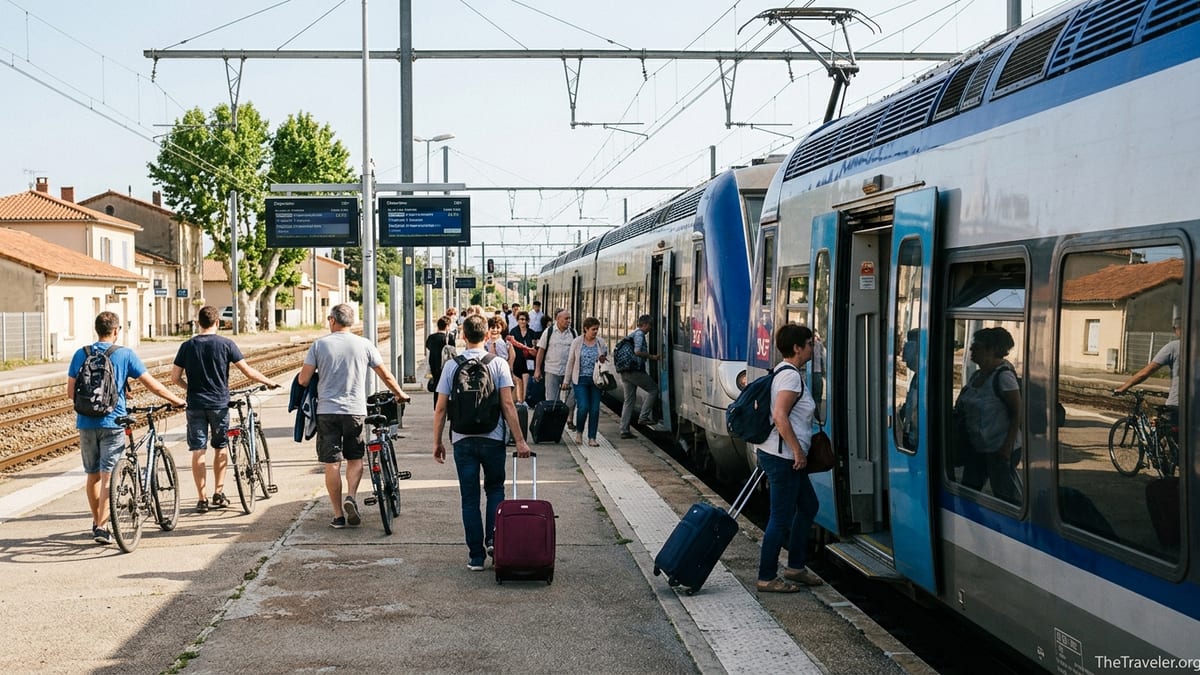
What Exactly Is a TER Train?
TER stands for “Train Express Régional,” the brand SNCF uses for regional trains operated on behalf of France’s regional councils. In practice, a TER can be a modern electric multiple unit, a diesel train serving rural lines, or even a regional coach branded as TER on routes where tracks do not exist or are temporarily closed. The key idea is that TER services focus on shorter and medium-distance trips within a region, plus a few cross-border or interregional links that stop often and serve local communities.
Unlike TGV high-speed trains, TERs do not require seat reservations and generally travel at conventional speeds, often between about 80 and 160 km/h depending on the line. A TER from Lyon to Grenoble, for example, takes roughly 1 hour 20 minutes and stops at intermediate towns such as Bourgoin-Jallieu, while a TGV on a long-distance corridor prioritizes speed and makes far fewer stops. For locals, TERs are everyday commuter trains; for travelers, they are the flexible, budget-friendly way to reach smaller destinations.
Although the TER brand is national, each French region such as Occitanie, Bourgogne Franche-Comté or Grand Est negotiates its own contract with SNCF and sets many aspects of pricing and service. This regional control is why you will notice different color schemes on the trains, distinct discount offers, and even small operational quirks depending on whether you are riding, say, TER Nouvelle-Aquitaine along the Atlantic coast or TER Provence-Alpes-Côte d’Azur near Marseille.
Most TER lines are fully integrated into the national rail timetable. When you search a journey such as Bordeaux to Arcachon or Strasbourg to Colmar on SNCF’s main booking platform or at a station machine, the TER trains appear alongside TGV and Intercités services. For visitors, this means you rarely need to think about who owns the service; what matters is recognizing when “TER” appears on your ticket or departure board so you understand how flexible it is and what rules apply.
Where TER Trains Run and What They Look Like
TER trains cover the bulk of conventional passenger rail lines in mainland France. They radiate from major hubs like Lille, Lyon, Toulouse, Bordeaux and Marseille into suburbs, medium-sized cities and rural areas. Typical examples include the coastal service from Bordeaux to Arcachon, used by beachgoers heading to the Dune du Pilat, or the picturesque route from Nice to Tende that winds through the Roya Valley into the Alps. In wine country, TERs link Dijon to Beaune and Chalon-sur-Saône, making vineyard visits feasible without a car.
The rolling stock is varied but easy to recognize. Many lines use AGC and Régiolis multiple units painted in regional liveries with large “TER” logos along the sides. In Grand Est, for instance, you might ride a silver and blue Régiolis train between Strasbourg and Nancy, while in Occitanie the same type of train carries red and yellow branding reflecting the regional colors. Double-deck TER2N trains operate on busier routes such as Lyon to Saint-Étienne or around Marseille, offering more seats at peak times.
On board, the layout is more utilitarian than a TGV, but comfortable for journeys of one to three hours. Expect a mix of open-plan seating, overhead luggage racks and bicycle spaces. First class exists on some trains, often as a slightly quieter section with 2+1 seating, but many TER services run with only one class. Air conditioning is standard on newer units, yet on older diesel sets or in very hot weather the temperature may fluctuate, something to keep in mind if you are traveling in July or August.
Because TERs serve smaller stations, platform length and accessibility can vary. At a major station such as Rennes or Montpellier, you will likely board from a high, level platform with clear digital displays. At a rural halt in Brittany or the Massif Central, the platform can be shorter or lower, and the train crew will sometimes open only selected doors. Pay attention to visual and audio announcements indicating which coaches will serve short platforms, especially if you are traveling with large luggage.
Tickets, Prices and How to Buy Them
For most travelers, TER trains are attractive because they are comparatively affordable and flexible. Regional authorities often advertise TER fares “from around 9 euro” for shorter trips, although exact prices vary by route and region. A one-way ticket from Lyon to Grenoble, for instance, typically costs in the range of 15 to 20 euro at standard adult fare, while a shorter ride from Toulouse to Carcassonne may be closer to 10 to 13 euro. Some regions introduce promotional tariffs in summer or on weekends, such as day passes that allow unlimited TER travel within a given area for a fixed price.
You can buy TER tickets in several ways: at station ticket counters where they still exist, at yellow or blue SNCF ticket machines, or through the main SNCF Connect app and website. Many travelers now purchase digital TER tickets that appear as QR codes on a smartphone, though paper tickets remain common at smaller stations. What matters is that your ticket clearly indicates “TER” or the regional brand, along with the origin, destination and travel date.
Unlike TGVs, TERs normally have what are known as “open” tickets for a specific date but not a specific departure time. If you buy a TER ticket from Bordeaux to Arcachon for a Saturday, you can usually board any TER on that route on that day, within a defined validity period such as from early morning until the last evening train. This is why locals are relaxed about booking TERs: buying the ticket an hour before departure is usually fine, and if you miss one train you can catch the next without changing the ticket, as long as it is still the same date and route.
However, there are important exceptions and regional rules. Some lines, particularly where TERs run on high-speed tracks or are branded TERGV in the Hauts-de-France region, may operate with compulsory reservations or require you to obtain a zero-cost seat coupon in addition to your pass or ticket. Occasionally, cross-border services or TER trains that share tracks with busy long-distance routes can have stricter controls. When in doubt, simulate a booking in the SNCF Connect app for your intended train and check if a reservation step appears before payment or if a “0 euro” ticket is mentioned.
Using TER With Rail Passes, Cards and Discounts
If you are visiting France with an Interrail or Eurail Global Pass, TER trains are particularly convenient because they almost never require paid seat reservations. In practice, you add the chosen TER service to your travel day in the pass app, generate your QR code and simply board. Ticket inspectors scan the code on board just as they would on a TGV. Travelers report that on some routes, staff may also ask you to obtain a free ticket or coupon from a machine, but this is not the norm and is more likely on unusual or pilot schemes. Leaving a little extra time at the station allows you to follow any local instructions displayed on machines or posters.
For those staying longer in France, SNCF and regional authorities offer a patchwork of discount cards and subscriptions that integrate TER. Popular national cards such as “Carte Avantage Adulte” or youth and senior variants often give percentage reductions on many Intercités and TGV services, and in some cases are also valid on certain TER fares. Whether your card applies to a given TER route depends on the region and the specific pricing policy. For example, Grand Est may allow national discount cards on interregional lines, while another region reserves its deepest reductions for its own local youth card or commuter pass.
Regional websites frequently advertise monthly or annual TER subscriptions targeted at commuters, such as passes between a home town and the nearest big city, sometimes combined with local buses or trams. In Nouvelle-Aquitaine, for instance, there are specific subscriptions for regular travel between Bordeaux and smaller Atlantic coast towns, while in Occitanie you can find products aimed at students shuttling between university cities like Montpellier and Nîmes. Even if you are a visitor, it can be worth checking if a weekly regional pass or a weekend unlimited ticket is available, especially if you plan to base yourself in one city and explore nearby towns by train.
In 2024, France also tested a national “Pass Rail” for young people that allowed unlimited travel on TER and certain Intercités trains during a summer period for a fixed price. While such schemes may change from year to year, they indicate a policy trend: the government and regions are trying to make regional train travel more attractive for both residents and visitors. Before a summer trip, it is worth searching specifically for current seasonal passes or promotional offers that might significantly reduce the cost of extensive TER hopping.
How TER Trains Operate Day to Day
From a traveler’s perspective, using a TER is straightforward once you understand a few operational habits. Most TER trains are “placement libre,” which means free seating. There are no reserved seats except on a handful of special or long-distance services. When the train arrives, you simply board and sit in any unoccupied seat in the class indicated on your ticket. At busy commuter times around large cities, TERs can become crowded, and standing in the vestibule for part of the journey is not unusual, especially on short hops of 20 to 30 minutes.
Because many TER lines are single track or lightly used, punctuality can vary more than on high-speed routes. On some rural lines, passengers familiar with the service comment that particular peak-hour trains are prone to delays or even occasional last-minute cancellations, especially when there are infrastructure works or rolling-stock shortages. For a long-distance connection, say from a TER arriving into Marseille to an onward TGV to Paris, it is wise to allow a realistic buffer rather than planning a tight five-minute interchange. In practice, a connection of 20 to 30 minutes at a major hub is comfortable and gives you time to find the correct platform.
On board, facilities are more basic than on TGVs. Most modern TER units have toilets, but you will not usually find a café bar or trolley service. Travelers heading, for instance, from Nantes to La Rochelle or from Avignon to Arles often bring snacks and water purchased at the station. Power outlets and Wi-Fi are becoming more common on the newest trains, yet they are far from universal, particularly on older diesel sets still used in parts of the Massif Central or Brittany. If you need to work, charge devices before boarding and avoid relying on stable connectivity.
Announcements are generally made in French, with English sometimes added on routes popular with tourists, such as along the Riviera between Marseille, Toulon and Nice. Station stops can be short, particularly at small halts, so it is a good idea to be near the door a minute or two before your stop. Many regular French passengers press the door button well in advance and are ready to step down immediately when the train halts, especially when traveling with bicycles or heavy suitcases.
Practical Tips for Riding TER as a Visitor
First, understand the validation rules. Paper TER tickets bought at stations in France traditionally needed to be stamped in a yellow “compostage” machine before boarding, which printed the date and time. As digital and print-at-home tickets have become standard, many regions now issue TER tickets that are already dated and time-limited, making separate stamping unnecessary. Still, you may encounter older machines in smaller stations and signage reminding you to validate, so check the fine print on your ticket. If in doubt, try the machine; if it does nothing and your ticket already shows a date and QR code, you are usually fine.
Second, plan for variable amenities at smaller stations. Major hubs such as Lyon Part-Dieu, Bordeaux Saint-Jean or Toulouse Matabiau have staffed ticket counters, multiple machines and extensive signage. By contrast, a small station like Sarlat or Millau may have limited opening hours, a single ticket machine or none at all, and few staff on site. In these cases, the recommended approach is to buy your TER ticket on the SNCF Connect app beforehand or, if that fails, board the train and seek out the conductor as soon as possible to purchase a ticket on board. Doing so is generally accepted when a station lacks functioning ticket facilities, though fines remain possible if inspectors believe you ignored available purchase options.
Third, check for regional branding and quirks. Some regions have introduced sub-brands or color codes to describe their TER services. In Nouvelle-Aquitaine, for example, marketing names such as “Liné’R,” “Facilit’R” or “Direct’R” help passengers distinguish between stopping trains, semi-fast services and faster links making limited stops. While these labels mainly matter to locals, they can guide you when choosing between two TER departures: a “Direct” variant between Bordeaux and La Rochelle will usually be faster and make fewer stops than a basic stopping service.
Finally, be flexible and allow for local variations. In border areas such as Alsace or the Riviera, some TER services continue into neighboring countries, linking Strasbourg with Offenburg in Germany or Nice with Ventimiglia in Italy. These cross-border trains may follow slightly different ticketing rules, and at times foreign railways handle part of the booking. If an online booking platform displays “not bookable” for a TER leg that clearly exists in the timetable, it can be easier to purchase the ticket from a station machine in France or from the neighboring country’s operator in person.
Comparing TER With TGV and Intercités
When deciding whether to take a TER, TGV or Intercités train, think about distance, time and budget. TGVs are the high-speed flagships, ideal for long intercity journeys such as Paris to Marseille, Lyon or Bordeaux, where they cruise at up to 300 km/h for much of the route. Intercités are classic “grandes lignes” non-high-speed services that often run between major cities but on conventional tracks, such as Toulouse to Clermont-Ferrand or Nantes to Lyon. TERs, in contrast, are the local and regional backbone, stopping often and serving towns that TGVs pass at speed.
Consider the route from Paris to Rouen. You could take an Intercités service which is faster and has compulsory reservations, or you might find a TER option on part of the route. The Intercités generally costs more but guarantees a reserved seat, while a TER ticket is likely cheaper and more flexible but can be slower and busier at commuter times. On holidays like long weekends in May, travelers might choose a TGV or Intercités for reliability on busy corridors, then switch to TER for the last leg into smaller towns such as Honfleur or Dieppe via nearby stations.
Another example is southern France. Between Marseille and Toulon, several TGV and Intercités trains run daily as part of longer routes to Nice or Paris, offering reservations and faster timings. At the same time, frequent TER services stop at more intermediate stations along the coast. If you hold a long-distance ticket with a reservation from Paris to Marseille and decide to continue to a smaller beach town, that original ticket does not automatically entitle you to board any TER onward; you still need a separate local ticket, pass or valid rail pass covering the regional leg.
For purely regional itineraries, such as exploring the Loire Valley between Orléans, Blois and Tours, TER is usually the logical choice. The trains may be slower than driving on a motorway, but they drop you directly in historic centers without parking concerns and connect neatly with local buses. In mountain areas, including parts of the Alps and Pyrenees, TER lines can offer scenic routes where driving would be tiring, as on the Grenoble to Gap line or the Occitanie services into the foothills south of Toulouse.
The Takeaway
TER trains are an essential part of France’s rail network and an excellent tool for travelers who want to see more than a checklist of big cities. They are local, relatively inexpensive and woven into daily life, from students traveling between university and home to families heading to the beach along the Atlantic or Mediterranean coasts. Once you understand their basic rules, TERs are easy to use and encourage more spontaneous, slower travel.
For visitors, the key points are straightforward. Recognize “TER” on timetables and tickets so you expect free seating, modest speeds and frequent stops. Use SNCF’s digital tools or station machines to buy flexible tickets, and do not worry too much about booking weeks in advance for standard regional journeys. If you are using a rail pass or discount card, check which TER routes are included and whether any zero-cost coupons are required on specific lines.
Most of all, allow a bit of slack in your timing, especially when connecting to long-distance trains, and embrace the variation between regions. A TER ride from Bordeaux through the vineyards to Arcachon, from Lyon into the Alps, or along the Riviera between Marseille and Menton can be as memorable as any high-speed dash across the country, precisely because it shows you the everyday landscapes and rhythms of French life.
FAQ
Q1. What is the main difference between TER and TGV trains in France?
TER trains are regional services that stop frequently and do not usually require reservations, while TGV trains are high-speed long-distance services with compulsory seat reservations and higher fares.
Q2. Do I need to book TER tickets in advance?
You rarely need to book TER tickets far in advance. For most routes you can buy a dated ticket on the day of travel and board any TER that day on the same route, subject to each region’s validity rules.
Q3. Are seats reserved on TER trains?
On almost all TER services seating is free and unreserved. You simply board and choose any available seat in the correct class. Only a few special or high-speed-linked TER services may require reservations.
Q4. Can I use an Interrail or Eurail pass on TER trains?
Yes, Interrail and Eurail passes generally cover TER trains without extra reservation fees. You add the train to your travel day in the pass app and show the QR code to the inspector.
Q5. How much does a typical TER journey cost?
Prices vary by region and distance, but many shorter trips cost roughly 8 to 20 euro one way. Longer regional journeys or interregional lines can be higher, and promotional offers or passes may lower the cost.
Q6. Do TER trains run late at night and early in the morning?
Service levels depend on the line. Around big cities, TERs can start early and run until late evening, while rural routes may have only a few trains per day and limited weekend or late-night service.
Q7. Are TER trains suitable for traveling with luggage and bikes?
Yes. TER trains usually have generous luggage space and many offer dedicated bicycle areas where standard bikes travel either free or at low cost, depending on regional rules and peak times.
Q8. What happens if my TER train is delayed and I miss a connection?
If your journey is on a single ticket that combines TER with a long-distance train, SNCF staff can normally rebook you in case of a missed connection. If you used separate tickets, assistance is more discretionary, so plan generous connection times.
Q9. Do TER trains have Wi-Fi and power outlets?
Some newer TER trains offer power sockets and, increasingly, onboard Wi-Fi, but this is not guaranteed. On older trains you may have neither, so charge devices beforehand and download tickets or maps in advance.
Q10. How can I check TER timetables and disruptions before traveling?
You can view TER timetables and any disruption notices in the SNCF Connect app and on station departure boards. On strike days or during engineering works, these sources provide the latest information on cancellations and replacement buses.