


I arrived in Pozzuoli expecting a simple half-day escape from Naples. What I found instead was a compact waterfront city where Roman ruins, volcanic scenery and everyday Campanian life all unfold without the crowds or pricing of Italy’s better-known destinations. What surprised me most was how underrated it felt: a place that, on paper, should be swamped with visitors, yet still moves at the rhythm of a lived-in port town.
Get the latest updates straight to your inbox!
An Ancient Port That Somehow Escaped the Hype
Pozzuoli was once the main Roman port of the Bay of Naples, a commercial rival to nearby Puteoli and a gateway for goods from across the Mediterranean. You are reminded of that stature the moment you step into the Flavian Amphitheater, the third-largest Roman amphitheater in Italy, where the underground galleries feel almost eerily intact compared with the more famous Colosseum in Rome. Yet on a recent spring visit, I shared those echoing corridors with fewer than a dozen other visitors, a fraction of the numbers you will typically find at major Italian archaeological sites.
That low-key atmosphere continues at the Macellum, often called the Temple of Serapis, even though archaeologists know it was a market complex. The marble columns, streaked with bands left by ancient mollusks, show how the ground here has risen and fallen with volcanic activity over centuries. In many Italian towns this would be the main attraction, ringed by souvenir stands. In Pozzuoli, it sits quietly behind residential streets and a steady stream of locals doing errands, as if having a world-class Roman ruin in the middle of town were no more remarkable than a supermarket car park.
Even Rione Terra, the ancient acropolis where Greek Dicearkia became Roman Puteoli, feels surprisingly unheralded. Parts of the district have reopened for guided visits, with routes that take you through buried Roman streets beneath Renaissance palaces and up to a cathedral built into the shell of a Roman temple. While national outlets and cultural bodies highlight its gradual restoration, there is still little sense on the ground that this is one of southern Italy’s most intriguing urban archaeology projects. You may find that your small tour group has sections of the underground city entirely to itself.
The overall impression is of a destination that, in another region or under a heavier marketing campaign, would be firmly on the international circuit. In Pozzuoli, it remains woven into daily life, which is precisely what makes it so appealing.
Waterfront Life Without Amalfi Prices
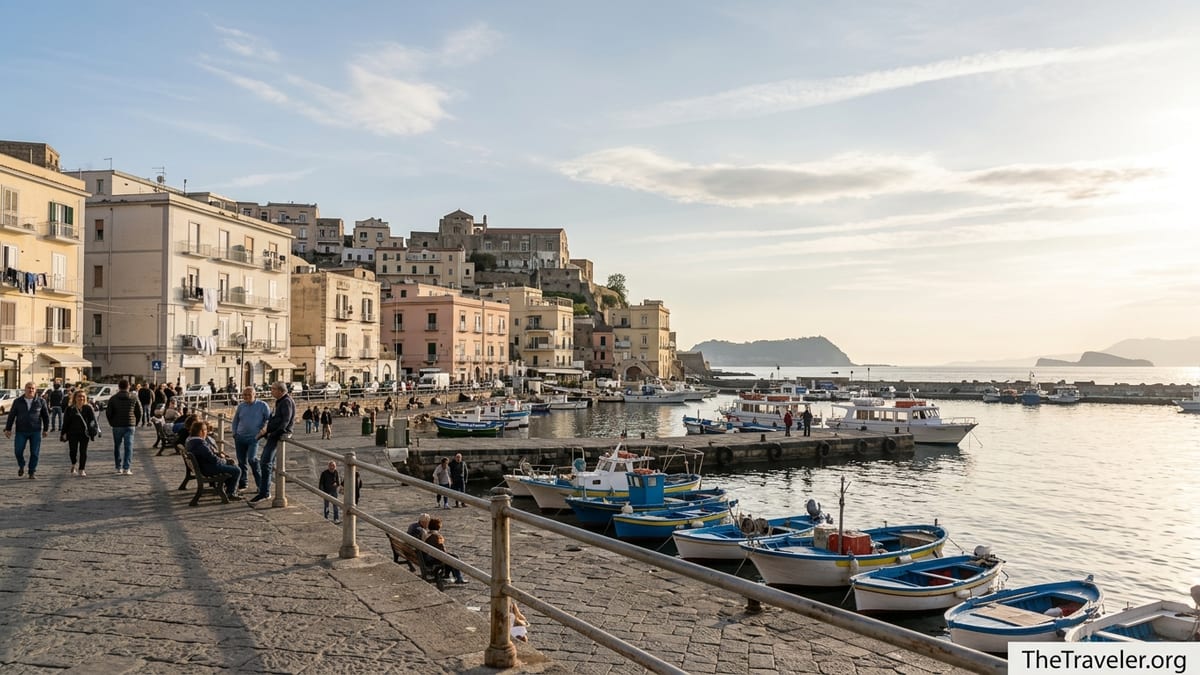
Another surprise is how accessible the waterfront feels compared with more famous Italian coastal spots. The lungomare promenade curves along the harbor, where ferries to Ischia and Procida slide past fishing boats and teenagers sit on the sea wall at sunset. You can stroll from the commercial port to the newer pedestrian areas in 10 to 15 minutes, with views across the bay to the outline of Capri on a clear day, and never once feel squeezed by the kind of luxury boutiques or private beach clubs that dominate parts of the Amalfi Coast.
Prices reflect that difference. A typical espresso at a bar along Via Giacomo Matteotti, just back from the seawall, often stays close to the standard Campania price of around 1.20 to 1.50 euros, rather than the 3 euros or more you might see at a scenic café in Positano. A seafood lunch in a family-run trattoria near the harbor, featuring local favorites like spaghetti alle vongole or impepata di cozze, commonly falls in the 18 to 25 euro range for a generous main course, with a glass of Falanghina or Piedirosso for a few euros more. The check rarely delivers the sticker shock that has become almost expected on the Amalfi Coast in peak season.
In the evening, the promenade fills with families pushing strollers, couples sharing paper cones of fried seafood and groups of friends lingering over aperitivo. Bars and lounge-style venues along the seafront frequently advertise spritzes and cocktails at prices closer to inner Naples than to international resort towns. It feels like a place designed first for people who live here, with visitors welcome to blend in, rather than a stage set scrubbed for tourism.
For travelers used to budgeting carefully in Italy’s high-demand coastal regions, Pozzuoli’s balance of sea views, honest pricing and unfussy service can feel almost like discovering a loophole in the system.
Living With a Volcano in the Backyard
The Phlegraean Fields, the vast volcanic area that surrounds Pozzuoli, give the city a mood you do not quite feel anywhere else in Italy. This is an active caldera, with fumaroles, crater lakes and a long history of bradyseism, the slow rising and sinking of the land. Recent years have brought noticeable seismic swarms and closer monitoring, and local and national outlets regularly report on updated safety plans. Yet when you walk through town, most of what you see is not anxiety but adaptation: older residents chatting on benches in squares, children hurrying to school, fishermen repairing nets at the harbor as they have for generations.
Some of the classic volcanic sights remain more constrained than guidebooks from a decade ago might suggest. The Solfatara crater, once a staple excursion where visitors could walk among steaming fumaroles, is still closed to casual tourism, with local authorities prioritizing safety. Instead, visitors connect with the volcano in subtler ways: by looking out from the amphitheater toward the ring of low hills that marks the caldera, by taking a suburban train past the steaming fields near Agnano, or by visiting the archaeological park at Baiae and realizing that entire sections of the Roman shoreline now lie underwater due to ground movement.
During my time in Pozzuoli, the most striking moments were everyday ones colored by the volcanic setting. A café owner off Piazza della Repubblica casually mentioned “the last swarm” while handing over a cornetto, as if discussing the weather. A local in his 30s, born and raised in the red zone, shrugged when asked about the risk and instead pointed out the best place to watch the sunset over Nisida. As an outsider, you may find yourself more aware of the geology than the people who live with it, a reminder that this is not a disaster spectacle but a lived landscape.
All of this contributes to Pozzuoli’s underrated feel. Travelers are often drawn to volcanic narratives in places like Iceland or Hawaii, where the entire tourism industry leans into that drama. Here, the volcano is a constant presence, but it shares the stage with school runs, church processions and football matches, and that coexistence is part of the city’s quiet fascination.
Easy Access From Naples, Minimal Crowds
Given Pozzuoli’s character and history, another surprise is how simple it is to reach from central Naples. Metro Line 2, operated on railway tracks by Trenitalia, runs west from Napoli Piazza Garibaldi and other central stations directly to Pozzuoli, with trains typically every 7 to 15 minutes at busy times. Standard urban-area tickets for the Naples metro network start around 1.80 euros for 90 minutes, and even when integrated or suburban fares apply, the cost to reach Pozzuoli usually stays well below what you would pay for many regional day trips.
Depending on where you board, the ride to Pozzuoli can take roughly 35 to 45 minutes, yet it feels like a genuine change of scene: one moment you are in a packed downtown station, the next you are stepping out into a low-rise port city with a working harbor and open views of the bay. This ease of access makes Pozzuoli an obvious candidate for a day trip, and in practical terms it rivals better-known outings such as Pompeii or Sorrento in terms of transit time.
What you often do not find, however, are the long queues that characterize those destinations in high season. Even on weekends, ticket lines at the Flavian Amphitheater or the archaeological sites around town tend to move quickly, and you can usually buy entrance on the spot rather than reserving far in advance. Local tourism offices and cultural bodies periodically offer combined tickets that include multiple Campi Flegrei sites, allowing visitors to move between Pozzuoli, Baiae and Cuma at a measured pace without negotiating heavy crowds.
Transport within the wider volcanic area relies on a combination of metro trains, regional lines such as the Cumana and local buses, and it is worth checking current routes and any temporary suspensions before you set out. Still, compared with the peak-season congestion you may encounter when trying to board coastal buses along the Sorrento Peninsula, Pozzuoli and the surrounding towns generally feel calmer, with more room to adjust your plans as you go.
Everyday Campania: Markets, Cafés and Local Rituals
Beyond the ruins and the volcano, what most underlines Pozzuoli’s underrated nature is how resolutely local it feels once you step a few blocks back from the waterfront. Morning brings a flurry of activity around produce markets and small food shops, where vendors stack crates of artichokes, tomatoes and citrus at prices that remind you this is a city feeding itself rather than catering exclusively to visitors. Fishmongers along streets leading up from the port display the morning’s catch on ice, with locals queuing to buy anchovies, squid and clams destined for home kitchens.
Cafés in the center quickly fill with regulars: pensioners working steadily through newspapers, office workers downing a quick espresso at the counter, teenagers sharing pastries before school. A typical cornetto and cappuccino combination often comes in under 4 euros, less if you stand at the bar rather than sit at a table. Service can be brisk but rarely feels performative; you are stepping into someone’s daily routine more than a staged experience.
In the late afternoon, small piazzas near Rione Terra and along Corso Garibaldi turn into informal living rooms. Children race around on bicycles, older residents claim the shadiest benches and street vendors sell roasted nuts or slices of pizza a portafoglio folded in paper. On certain evenings you may walk into a local religious procession or hear a brass band warming up near one of the churches that dot the hillside. These are not events timed for tour groups, yet visitors are generally welcomed as long as they observe basic respect.
What is striking is how infrequently English dominates the soundscape. You will hear it at the port and occasionally at restaurants used to weekend visitors from Naples, but much of the city still operates in Italian and local dialect. That can require a bit more effort from travelers, but it also means that Pozzuoli remains, at heart, itself.
How Pozzuoli Compares With Its Famous Neighbors
Standing on the harbor wall in Pozzuoli, it is tempting to draw comparisons with the Bay of Naples destinations that dominate travel itineraries and social media feeds. Naples itself, with its thriving food scene and art-filled metro stations, justifiably attracts urban explorers. Pompeii and Herculaneum are on almost every classical history enthusiast’s list. The Amalfi Coast and Capri have become bywords for Mediterranean coastal glamour. Against that backdrop, Pozzuoli can seem, on first glance, like a secondary choice.
Spend a day or two here, though, and its strengths become clear precisely in the spaces those other destinations leave open. If you find Capri’s lanes too polished, Pozzuoli offers a waterfront where laundry still hangs from balconies overlooking the sea and fishing boats edge out past ferries in the early morning. If Amalfi’s staircase alleys and designer storefronts feel removed from ordinary life, Pozzuoli’s streets, especially uphill from the port, show you a Campanian city that works, studies and commutes in full view.
In terms of heritage, Pozzuoli gives you high-impact ruins in a compact, easily walkable area. You can visit the Flavian Amphitheater, the Macellum and Rione Terra in a single day without feeling rushed, then sit down to dinner overlooking the bay. By comparison, a full visit to Pompeii requires several hours on foot in intense sun, and adding another major site the same day can be exhausting. For travelers who appreciate depth but also value moderation in their itinerary, Pozzuoli offers an appealing balance.
Perhaps most importantly, Pozzuoli allows room for serendipity. Without a rigid checklist of must-see spots, you can afford to follow whatever catches your eye, from a side-street bakery turning out trays of fresh-scented taralli to an impromptu football game in a waterfront square. In a region where so many destinations now feel like they are struggling under the weight of their own success, that element of surprise is part of what makes Pozzuoli feel so refreshingly underrated.
The Takeaway
What surprised me most about Pozzuoli was not any single sight, but the combination of world-class archaeology, dramatic volcanic setting and authentic daily life that continues largely outside the spotlight. Here is a city where you can wander through one of Italy’s largest Roman amphitheaters with minimal crowds, sip a reasonably priced coffee facing the Bay of Naples and watch residents go about their day under the shadow of an active caldera.
Its easy access from Naples, fair everyday prices and balance of history and normalcy make Pozzuoli an obvious candidate for travelers seeking something beyond the usual circuit of Pompeii, Capri and the Amalfi Coast. Yet for now, it remains a place where the buses are still mostly full of locals, the promenade fills with families rather than tour groups and the grand narratives of antiquity play out amid supermarket runs and school pick-ups.
In a country of iconic destinations, Pozzuoli’s great strength may be precisely that it has not become one of them. It is an Italian coastal city that feels, above all, lived in rather than curated. For travelers willing to look just a little beyond the biggest names on the map, that might be its greatest surprise.
FAQ
Q1. How long should I spend in Pozzuoli?
Many visitors come on a day trip from Naples and see the main sights in 6 to 8 hours, but an overnight stay allows you to enjoy quieter evenings along the waterfront and explore nearby sites in the Campi Flegrei such as Baiae and Cuma at a more relaxed pace.
Q2. What is the easiest way to get to Pozzuoli from Naples?
The most straightforward option is usually Metro Line 2, which runs from central Naples stations such as Piazza Garibaldi to Pozzuoli in roughly 35 to 45 minutes. Suburban and integrated tickets are widely available at station machines and newsstands; always validate any paper ticket before boarding.
Q3. Is Pozzuoli safe for visitors, given the volcanic activity?
Pozzuoli lies within the monitored Phlegraean Fields area, and authorities maintain detailed emergency plans and closely track seismic and volcanic activity. For most travelers, the practical impact is minimal, though you may occasionally feel small tremors or see local safety information. It is sensible to follow official guidance, but everyday life continues much as normal.
Q4. What are the must-see attractions in Pozzuoli?
The Flavian Amphitheater is a highlight for anyone interested in Roman history, as are the Macellum and the historic Rione Terra district. Many visitors also combine these with a trip to the nearby archaeological park at Baiae or the ancient site of Cuma, both of which help put Pozzuoli’s past into a wider context.
Q5. Can I visit the Solfatara crater?
Access to the Solfatara crater has been restricted in recent years and it has not fully reopened for casual tourism. Instead, visitors experience the volcanic landscape through viewpoints around the city and other sites in the Campi Flegrei. Check the latest local information before planning any visit specifically around Solfatara.
Q6. How expensive is Pozzuoli compared with the Amalfi Coast or Capri?
Day-to-day costs in Pozzuoli are generally lower than in the region’s most famous coastal resorts. Coffee, pastries, seafood meals and local transport tend to be priced more like greater Naples than like high-end holiday destinations, which makes Pozzuoli attractive for travelers watching their budget.
Q7. Is English widely spoken in Pozzuoli?
You will usually find some English spoken at hotels, major restaurants and tourist sites, but much of the city functions primarily in Italian and local dialect. Learning a few basic Italian phrases and being patient with communication can make interactions smoother and more rewarding.
Q8. What is the best time of year to visit Pozzuoli?
Spring and early autumn are particularly pleasant, with milder temperatures and fewer crowds than the peak summer months. In high summer, expect strong sun and higher humidity, especially when exploring archaeological sites, and plan accordingly with water, sun protection and earlier or later sightseeing hours.
Q9. Is Pozzuoli suitable for families with children?
Yes. Children often enjoy the amphitheater, open waterfront spaces and the visible signs of volcanic activity in the surrounding landscape. The city’s compact size and pedestrian-friendly waterfront make it manageable with strollers, though some historic areas and archaeological sites include steps and uneven surfaces.
Q10. Can Pozzuoli work as a base instead of Naples?
For travelers who prefer a quieter base with sea views, Pozzuoli can be an appealing alternative. It offers frequent train connections into Naples, access to ferries for the islands and proximity to Campi Flegrei sites, though it has fewer accommodation options and late-night services than the regional capital.