


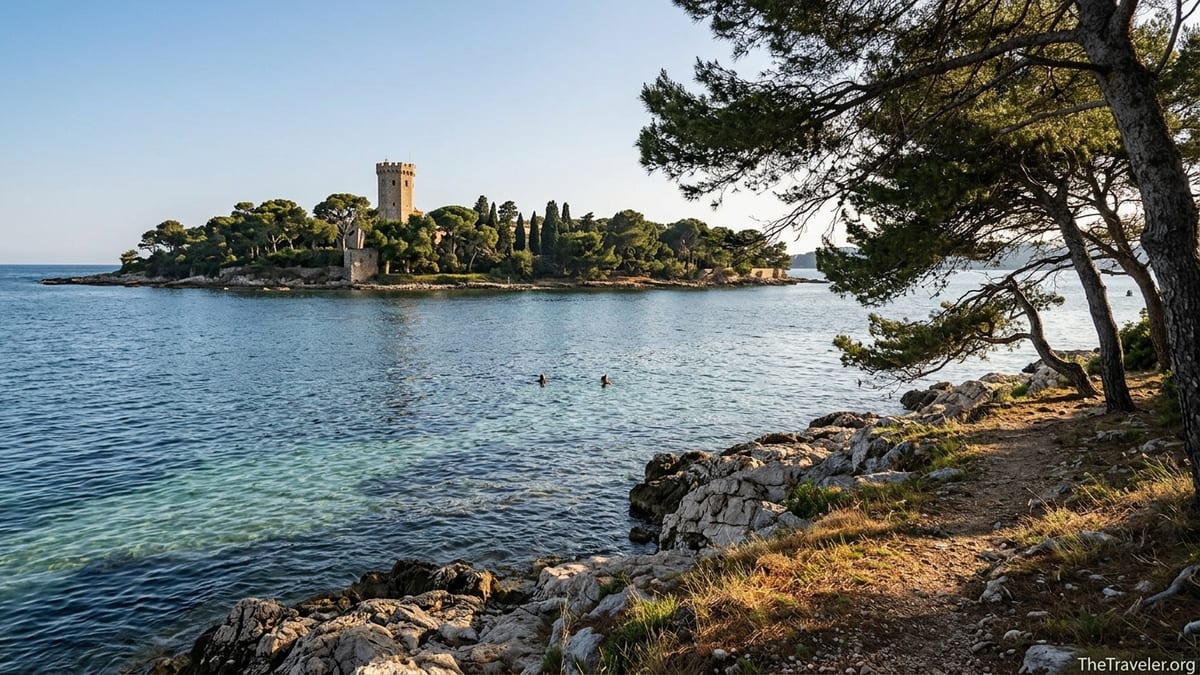
From the Croisette in Cannes, the Lérins Islands look like two low green lines on the horizon, a classic day-trip for beach picnics and a cooling swim. Most visitors land, walk straight to the nearest cove, then catch the afternoon ferry back. What they do not realize is that Sainte-Marguerite and Saint-Honorat hide fortified monasteries, flooded Roman cisterns, solemn prison cells, rare wetlands and even an underwater sculpture museum just a short detour from the main sand. With a little planning, you can turn a simple beach outing into one of the most memorable cultural days on the French Riviera.
Get the latest updates straight to your inbox!
Understanding the Lérins Islands: More Than a Beach Break
The Lérins archipelago sits a 15-minute boat ride off Cannes, yet it feels far removed from the city’s boutiques and beach clubs. Two islands matter for visitors: Sainte-Marguerite, the larger and wilder, and tiny Saint-Honorat, occupied by Cistercian monks since late antiquity. Regular ferries from the Port of Cannes usually run several times a day in high season, and as of 2026 a return ticket typically costs the equivalent of a casual restaurant lunch in town, which makes the islands feel like an easy add-on. That affordability is exactly why most people treat them as a half-day beach escape instead of a destination in their own right.
Walk a few minutes from the main landing piers and the crowds thin out. On Sainte-Marguerite, the familiar sound of café cutlery and children playing quickly gives way to wind in Aleppo pines and the clack of cicadas. On Saint-Honorat, the mood is even more contemplative: the entire island is essentially a living monastery, with bells marking the hours. It is in these quieter interior spaces, rather than along the nearest strip of pebbles, that the islands reveal their real character.
Planning your day with this in mind is crucial. The first and last ferries are often the busiest, filled with beach bags and parasols. Arriving on an early mid-morning crossing and deliberately walking away from the obvious beaches gives you the best chance of experiencing the islands as more than just another Côte d’Azur swimming spot.
Walking Sainte-Marguerite’s Forgotten Interior: Pines, Wetlands and Views
Most day-trippers on Sainte-Marguerite never leave the northern shoreline facing Cannes. Yet the island’s interior is crisscrossed by sandy tracks and waymarked nature trails that make an easy half-day hike. A popular option is to follow the coastal path clockwise from the pier, then cut inland on one of the forest tracks toward the Étang du Batéguier, a shallow lagoon on the western end of the island. Protected as a sensitive natural area, this small wetland is an important stopover for migratory birds. Even without binoculars you are likely to spot herons or cormorants resting on the low branches along the water’s edge.
The terrain here is gentle and family-friendly. You walk on soft pine needles and compacted sand rather than steep rocky paths, and the canopy offers welcome shade in midsummer. Several clearings open suddenly to views back toward the Estérel hills or across the channel to Saint-Honorat’s palm-framed silhouette. Benches and low stone walls double as picnic spots; if you pack a simple lunch from a Cannes bakery before boarding the ferry, you can eat in complete quiet while the main coves are at their busiest.
Because there are almost no vehicles on the island, sound carries differently. You hear the muffled thud of waves against offshore rocks, the creak of tree trunks, the distant chug of the Cannes shuttle. In practical terms, this means you should bring everything you need for a mini-hike: comfortable walking sandals or trainers, a refillable water bottle and basic sun protection. There are a few taps and snack kiosks near the main pier, but once you head west across the island you are largely on your own.
History in the Stone: Fort Royal, Prison Cells and Underground Cisterns
Even visitors who know Sainte-Marguerite for its famous prisoner, the so-called Man in the Iron Mask, often stop at a quick look at the fortress walls before returning to the beach. Fort Royal, however, rewards a slower visit. Inside the thick ramparts you can explore the former state prison, stepping into bare cells that once held political detainees. Interpretive panels in French and English explain how the island was used as a detention site across different centuries, giving context beyond the romanticized legend.
Within the same complex is the Iron Mask and Royal Fort Museum, which was previously called the Museum of the Sea. The exhibition occupies vaulted rooms and ancient underground cisterns that once stored precious freshwater for the garrison. Today these cool stone spaces hold amphorae and artifacts recovered from Roman and medieval shipwrecks in the surrounding waters, along with fragments of frescoes and everyday objects. For travelers used to bright, modern galleries, the atmospheric setting can be a surprise: these are low-lit, echoing rooms where dripping water and the weight of history feel almost tangible.
Because most beach-focused visitors either skip the museum or rush through, it is rarely crowded outside peak midday hours. Tickets are modestly priced compared with big-city museums, and you can typically walk in without advance booking. If you are already on the island for the day, setting aside an hour or two for the fort turns a simple swim into a journey through centuries of Mediterranean trade, warfare and incarceration.
Under the Surface: The Cannes Underwater Eco-Museum
One of the least expected experiences on the Lérins Islands lies beneath the waves just off Sainte-Marguerite’s southern shore. Here, at a depth suitable for basic snorkeling, British artist Jason deCaires Taylor has installed an underwater eco-museum, the first of its kind in France and the Mediterranean. The project consists of six monumental sculptures based on the faces of local residents, each several meters tall and weighing multiple tons. Over time, they are designed to be colonized by marine life, acting as artificial reefs as much as artworks.
The site, about a hundred meters from shore, is in an area where boat traffic has been restricted to protect both visitors and the fragile seagrass meadows that surround the statues. Water visibility is often good in calm weather, which means that on a clear summer morning you can float above ghostly stone visages framed by schools of small fish. Unlike some tropical underwater sculpture parks that require a scuba dive, this one is intentionally accessible: a mask, snorkel and a bit of confidence in the water are enough to see it on your own when sea conditions are safe.
Practically, this is an experience that demands planning beyond a standard beach day. There is no rental hut directly above the eco-museum, so most people either bring their own basic snorkeling set from Cannes sports shops or invest in an inexpensive mask and snorkel before they travel. You also need to check local conditions on the day: strong winds can stir up sand and reduce visibility, and lifeguards may advise against venturing too far from the shore. When the water is calm, though, this underwater gallery offers a completely different perspective on the islands, blending art, ecology and physical immersion.
Saint-Honorat: Monastic Life, Vines and Quiet Stone
While Sainte-Marguerite is often marketed for its prison legend, smaller Saint-Honorat remains one of the French Riviera’s most quietly impressive spiritual sites. Monks have lived here almost continuously since the early 5th century, and today a community of Cistercians still follows a rhythm of prayer and manual work. From the moment you step off the boat at the tiny jetty, the mood changes. There are no beach clubs and no loud bars, just a cluster of stone buildings, bell towers and carefully tended gardens leading into vineyards and pine woods.
Many visitors stop at the first patch of rocks to swim and sunbathe, but walking the island’s circular path is what reveals its depth. Within minutes you reach the fortified medieval monastery right at the water’s edge, a honey-colored structure that rises directly from the rocks. Climbing its narrow staircases takes you through simple chapels and open-air walkways with views back toward Cannes, a striking contrast between luxury towers and this stark monastic outpost. Higher terraces, where monks once kept watch for pirates, now act as quiet viewing platforms over the bay.
Further inland, neat rows of vines remind you that Saint-Honorat is also a working wine estate. The monks produce limited quantities of white, red and fortified wines, as well as liqueurs, which you can sample or purchase at the island shop. Prices reflect the small-scale, artisanal production and the uniqueness of the setting, so a bottle is more of a special souvenir than a casual purchase. Even if you are not buying, wandering the vineyard paths offers a rare combination of Mediterranean agriculture and contemplative calm, punctuated only by the distant sound of chanting from the abbey.
Eating, Drinking and Staying Mindful of the Setting
Food on the Lérins Islands often surprises those who arrive expecting only picnic tables. On Sainte-Marguerite, simple snack bars near the pier serve items such as sandwiches, salads and cold drinks in high season, typically at prices similar to casual beach cafés on the mainland. However, once you move away from the landing area you will not find much in the way of supplies, so it is still wise to bring your own picnic and plenty of water if you plan to explore the interior or the western beaches.
On Saint-Honorat, the dining atmosphere is different. A restaurant close to the landing stage offers set menus and dishes focused on regional flavors, often showcasing seafood and local produce, while respecting the monastic context. Expect prices that align with the Riviera’s mid-range restaurants rather than budget snack bars, and consider reserving in advance in peak months. The experience of eating under the pines with a view of the sea, knowing that monks are tending vines just behind you, feels worlds away from the bustle of central Cannes.
Whatever you choose to eat, it is important to remember that both islands are protected natural areas with limited infrastructure. Rubbish bins are fewer than on city beaches, and waste collection is more complex. Packing reusable containers, carrying your own water bottle and taking all trash back to Cannes is not only courteous but essential to preserving the fragile ecosystems you came to enjoy. The same goes for noise: playing music on speakers or shouting across coves undermines the quiet that makes these places special for everyone else.
Practical Ways to Go Beyond the Main Beaches
Transforming a standard Lérins outing into something deeper does not require special gear or insider connections, just a different set of choices. One simple tactic is to time your visit around the typical flow of day-trippers. Arriving on a mid-morning boat and staying until a late-afternoon or early-evening return often means you have the quieter hours, when many visitors are already heading back to Cannes. In shoulder seasons such as May, June or late September, you may find entire stretches of path or coastline almost empty once you leave the immediate pier area.
Another strategy is to pick a theme for your day rather than trying to do everything. For instance, you might dedicate a visit to history, focusing on Fort Royal’s museum and tracing the old defensive walls around Sainte-Marguerite, pausing at viewpoints and former gun positions above the sea. On a different day, you could come back with a snorkel mask and plan around the underwater eco-museum and quiet swimming spots on the southern shore. Or you might design a contemplative itinerary on Saint-Honorat: walking its perimeter path, visiting chapels, taking time to sit in silence in the abbey church and perhaps buying a small bottle of monastic liqueur as a reminder.
Finally, consider how you move. Many beach visitors carry bulky gear and settle close to the pier because it is simply easier. Traveling lighter, with a compact towel, a refillable bottle and minimal valuables, makes it realistic to walk further and improvise. The reward is a version of the Lérins Islands in which you are sharing a forest path with a handful of hikers or listening to waves inside a stone fort, rather than jostling for space on the closest strip of sand.
The Takeaway
From Cannes, the Lérins Islands can look like a postcard backdrop for a quick swim and a picnic. Yet the real appeal of Sainte-Marguerite and Saint-Honorat lies away from the busiest beaches, in shadowy prison cells, restored wetlands, monastic cloisters and underwater statues colonized by fish. By walking a little further, staying a little longer and paying attention to the stories embedded in the stone and seagrass, you experience a very different side of the French Riviera.
Whether you are a first-time visitor or returning to Cannes after many years, treating the Lérins as more than a half-day beach trip repays the effort. Give yourself at least one full day to explore, take breaks under the pines, listen for the bells of Saint-Honorat drifting across the water, and look back at the mainland with fresh eyes. The next time you see the islands from the Croisette, you will no longer see anonymous green shapes on the horizon but a small world of history, silence and art that most of the crowd still hurries past.
FAQ
Q1. How long should I plan to spend on the Lérins Islands if I want to see more than the beaches?
A full day is ideal. This gives you enough time to walk the trails on Sainte-Marguerite, visit Fort Royal’s museum and prison cells, and still enjoy a quiet swim. If you also want to experience Saint-Honorat’s monastery and vineyards, consider dedicating a separate morning or afternoon to that island or returning on another day.
Q2. Can I visit both Sainte-Marguerite and Saint-Honorat in one day without rushing?
It is technically possible to visit both islands in a single day by coordinating ferry times, but it often feels compressed. Many travelers find that focusing on one island per day allows for slower walks, museum visits and unhurried swimming. If your schedule is tight and you do both in one day, plan your route in advance and accept that you will sample rather than deeply explore each place.
Q3. Do I need to book ferry tickets in advance, or can I just show up at the port?
In shoulder seasons you can usually buy tickets on the day at the ticket booths in the Port of Cannes. During peak summer or on busy weekends, advance booking or arriving early is wise to secure your preferred departure time, especially for the first morning boats. Schedules and frequency can vary, so always check updated information shortly before your trip.
Q4. Is the underwater eco-museum suitable for children and beginners at snorkeling?
The underwater eco-museum is designed to be accessible to confident swimmers using only a mask and snorkel, but conditions at sea can change quickly. Older children who are comfortable in open water and supervised closely often enjoy the experience. Non-swimmers, very young children or anyone uneasy in deep water are better off staying in shallower coves. Checking the weather forecast, sea state and any local safety notices on the day is essential before planning a visit.
Q5. What should I wear and bring if I want to walk the interior trails instead of staying on the beach?
Comfortable closed shoes or sturdy sandals, a hat, sunscreen and a refillable water bottle are the basics. The paths are not difficult, but they are uneven in places, and shade is not guaranteed on every stretch. If you plan to picnic away from the main pier, bring simple food from Cannes, a lightweight towel to sit on and a small daypack so your hands remain free while you walk.
Q6. Are there any rules I should be aware of on Saint-Honorat because it is a monastic island?
Saint-Honorat is both a tourist destination and a functioning monastery, so respectful behavior is important. Modest clothing is recommended in and around the abbey and chapels, and loud music, shouting or drone flying are inappropriate. Photography is generally allowed in outdoor areas, but you should avoid photographing monks at close range without clear permission, and remain quiet during services.
Q7. Can I stay overnight on the Lérins Islands?
There is no conventional hotel infrastructure on the islands. Sainte-Marguerite has limited accommodation such as a youth hostel-style facility linked to the fort complex, often used by groups and requiring advance arrangements. Saint-Honorat can sometimes host retreat guests under specific conditions governed by the monastery. Most visitors, however, return to Cannes in the evening and use the islands purely as day-trip destinations.
Q8. How expensive is food and drink on the islands compared with Cannes?
Snack bars on Sainte-Marguerite typically charge prices comparable to mid-range beach cafés in Cannes for items like sandwiches and drinks. The sit-down restaurant on Saint-Honorat is closer to a standard Riviera restaurant in price, reflecting its setting and service. To control costs, many visitors bring a picnic for lunch and then treat themselves to a coffee, ice cream or glass of wine at an island establishment later in the day.
Q9. Is it possible to visit if I have limited mobility?
Access can be challenging but not impossible, depending on your needs. Ferries involve steps for boarding, and many paths on the islands are unpaved and uneven. The areas around the main pier on Sainte-Marguerite and parts of Fort Royal are more manageable, though still not fully accessible. Before you travel, it is sensible to contact ferry companies and local tourism services to discuss current conditions and any assistance options.
Q10. When is the best time of year to visit if I want to avoid crowds but still swim?
Late May, June and late September are often the most pleasant compromises. Sea temperatures are usually warm enough for swimming, but visitor numbers are lower than during the school holiday peak in July and August. On sunny days in these shoulder periods you can often find quiet coves and nearly empty forest trails while still enjoying long, light evenings back in Cannes.