

In Cannes, most visitors make a beeline for the famous La Croisette, with its designer hotels and tightly packed private beach clubs. Yet just a short stroll west of the old port, Plages du Midi offer a very different way to experience the Riviera: more local, more relaxed, and far easier on the wallet, without giving up the soft sand and dreamy Mediterranean light people come here for in the first place.
Get the latest updates straight to your inbox!
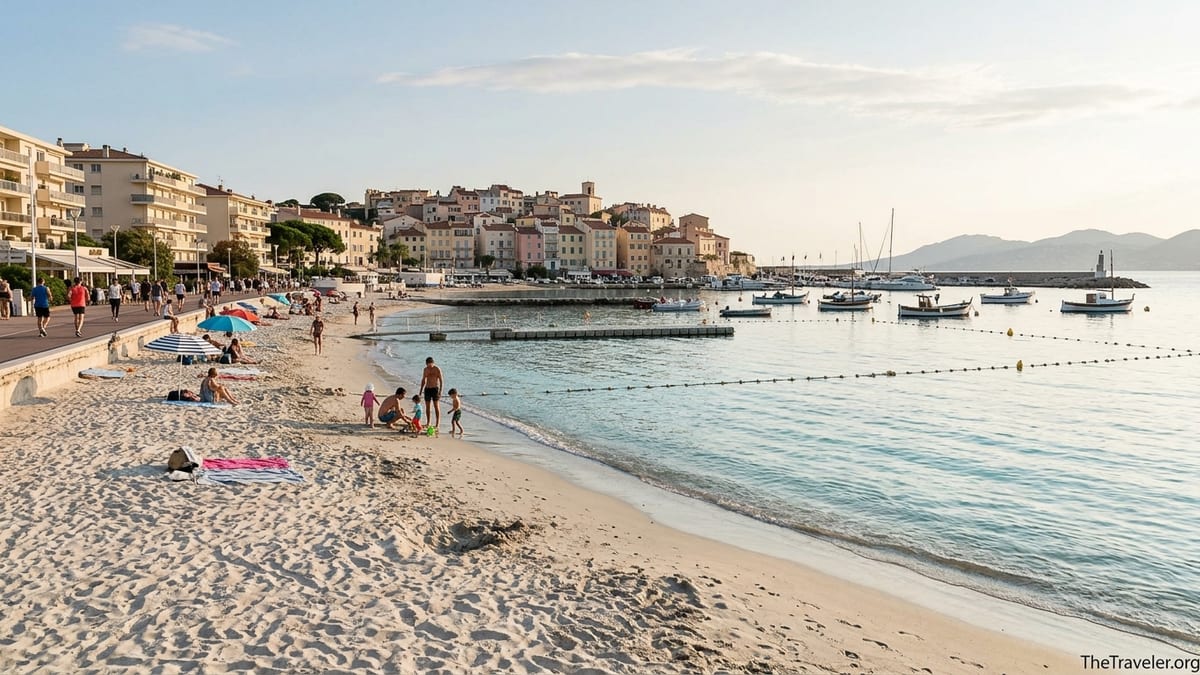
A Different Side of Cannes by the Sea
Plages du Midi stretch west from the Vieux Port along Boulevard du Midi Jean Hibert, forming a long ribbon of mostly public sand that feels a world away from the high-gloss scene on La Croisette. Where the Croisette is lined with palace hotels and luxury boutiques, the Midi waterfront is backed by residential buildings, small hotels, pizza counters and local cafés. You are more likely to share the sand with Cannes families and year-round residents than with film delegates or guests from five-star hotels.
This change in backdrop alone shapes the atmosphere. On a July afternoon, La Croisette’s private clubs can feel like a catwalk, with waiters threading between dense rows of branded sun loungers. At Plage du Midi, you might see grandparents unpacking Tupperware picnics, teenagers playing paddleball near the waterline and local office workers stretching out on towels after work. The same sea and soft golden sand are there, but the stage and the cast are different.
For visitors, that means you can step off the tender from a cruise ship or wander out from a budget hotel near the station and reach a proper beach in ten minutes on foot, without negotiating a hostess stand or a minimum spend. The Midi beaches offer a rare combination on this stretch of coast: central location, free access and a resolutely unpretentious mood.
Geography also helps. Plage du Midi faces southwest, catching long, warm light well into the evening. While La Croisette looks out more directly to the Lérins Islands, the Midi stretch frames the hills of the Esterel further west, so sunset swims here glow in shades of gold and pink against a low, serrated horizon rather than the silhouettes of yachts anchored off the Croisette.
Space, Sand and Sea: How the Beach Itself Feels Different
One of the first differences visitors notice at Plages du Midi is simply how much space there is. The main public section, commonly referred to as Plage du Midi, runs for roughly 700 meters, with additional pockets of public sand like Plage Laugier, Plage Mistral and Plage Madrigal scattered further along Boulevard du Midi. In practice that means that even in August, if you keep walking west for ten or fifteen minutes, you usually find room to spread out a large towel or a family-sized beach mat without brushing elbows with your neighbors.
The sand here is soft and pale, similar in feel to the better-known Croisette beaches but generally wider and more open. Parts of the shoreline are protected by low rocky structures, particularly near the La Bocca end, which break the waves and create a calmer swimming zone. In summer, some beach clubs along the strip install floating pontoons just off the shore. Travelers often use them as little escape platforms, swimming out with a mask and snorkel, then lying in the sun away from the busiest stretch of sand before diving back into the water.
The sea on settled days tends to be shallow and gentle close to shore, which makes Plages du Midi especially attractive for families with younger children or less confident swimmers. The slope into deeper water is gradual; in many sections adults can walk out 15 to 20 meters before needing to tread water. Lifeguards watch over the main public areas in high season, and the presence of rafts and buoys clearly marking the supervised swimming zone gives nervous swimmers a reassuring frame of reference.
The promenade that runs just behind the sand is another subtle point of difference. Rather than a glamorous, boutique-lined boardwalk, the Midi promenade is narrow and practical, edged by the road and punctuated by public showers, snack kiosks and benches. It is busy with joggers in the early morning, rollerbladers in late afternoon and locals walking home with shopping bags from the neighborhood supermarkets. That day-to-day life, constantly in the background, reinforces the feeling that this is not just a tourist stage set; it is the everyday seaside for a real town.
Relaxed Prices and a Softer Kind of Luxury
Cost is where Plages du Midi most clearly separate themselves from the Croisette. On Cannes’ most famous strip, first-row sunbeds at big-name hotel clubs can climb toward or above 80 to 100 euros per day in high season, not including lunch or drinks. At Plages du Midi, visitors routinely report far gentler prices at the cluster of modest beach clubs: a standard sunbed is often closer to the 25 to 40 euro range in summer, depending on row and the exact venue, with slightly lower rates in June and September.
That difference adds up quickly for a couple or family planning several beach days. A family of four might easily spend more than 300 euros on loungers at one of the prestige Croisette clubs in July, whereas at Plages du Midi, choosing a smaller local concession could bring that down toward 120 to 160 euros for the same number of beds. Many travelers therefore mix and match: enjoying one splurge day at a marquee Croisette beach, then returning to Midi for subsequent days to save money while still enjoying service, parasols and food deliveries to their loungers.
The style of service also feels more relaxed here. Beach restaurants behind the loungers often lean toward simple Mediterranean menus: grilled fish of the day, niçoise salads, pizzas for about 14 to 18 euros, carafes of rosé, and kid-friendly plates of pasta. Staff know they are serving a blend of locals and visitors rather than just hotel guests, and conversations around you are more likely to be in French or Italian than purely in English. It is still very much the Côte d’Azur, so expect a mark-up on soft drinks and cocktails compared with inland cafés, but the overall feel is less of a luxury performance.
For travelers on tight budgets, the best value at Plages du Midi is of course the free public sand. Many visitors simply pick up baguette sandwiches from a bakery on Rue Meynadier or a supermarket near the station, stop for fruit at the Marché Forville, and bring a picnic to the beach. You can expect to pay only for occasional coffees or ice creams from the kiosks behind the promenade, which often charge just a little more than equivalent spots in the town center while offering a front-row view of the sea.
A Family-Friendly Playground Without the Fuss
Cannes’ tourism board actively presents Plages du Midi as a family beach, and the infrastructure bears that out. During the summer months, lifeguards supervise the main swimming areas, and the gently shelving seabed means children can paddle and splash near the shore with parents still standing easily in waist-deep water. The clear zoning of swimming and boating lanes, along with buoys that define how far you can safely go, helps keep the waterline from feeling chaotic.
On land, the area around Square Mistral, just behind the beach, functions almost like a neighborhood park beside the sea. Shaded play structures, a small public garden and a pétanque area give kids and grandparents something to do away from the water during the hottest hours. Parents can split time between the swings and the sand without trekking back into town. A little further along, two free beach volleyball courts set into the sand attract teenagers, groups of friends and occasionally informal local tournaments.
Compared with La Croisette, where many people dress up to walk between luxury hotels and high-end bars, beachwear norms at Plages du Midi are looser and more practical. Families wheel strollers along the promenade in flip-flops, locals arrive with folding chairs and umbrellas, and nobody bats an eye at sandy children queuing for ice cream. For parents used to policing outfits and decorum in more rarefied settings, the Midi beaches can feel like a relief.
Accessibility also plays a role. Several points along the boulevard have ramps and designated accessible beach areas with adapted equipment in season, which can make it easier for travelers with mobility issues to reach the sand and the water. While the exact arrangements and opening dates can vary from year to year, Cannes has been working in recent seasons to improve accessible entries, and Plage du Midi is one of the stretches flagged on city maps as suitable for visitors who need step-free access.
Sunset Views and Everyday Riviera Life
What truly sets Plages du Midi apart may not be any single facility, but the daily rhythm you feel when you linger from late afternoon into evening. Because this stretch of sand faces southwest, it holds the sun longer than some other corners of the bay. Around 6 or 7 p.m. in high summer, when the Croisette crowds begin drifting off to dress for dinner, the Midi promenade fills with locals out for their end-of-day walk, while the beach itself shifts into a gentler, golden-hour mood.
It is common to see small groups of friends gathering with simple aperitif picnics: a bag from a nearby supermarket with a bottle of chilled rosé, plastic cups, olives and a baguette; someone brings a portable speaker at low volume; a dog walker pauses to let their pet splash in the shallows outside the strictest hours of summer restrictions. For visitors used to more polished Riviera scenes, that everyday conviviality can be unexpectedly charming.
The long perspectives also make Plages du Midi particularly photogenic. Looking east, you see the towers of the Le Suquet old town rising above the port, with yachts and fishing boats framed against the curve of the bay. Turn west, and the coastline curves away toward Cannes La Bocca and eventually the red rocks of the Esterel. Photographers often favor the end of the day when the low sun lights the waves from the side and throws long shadows across the sand, giving texture to footprints and ripples that can be lost in the harsher midday glare.
Even outside high season, the Midi beaches continue to function as a local open-air living room. On sunny winter weekends, you will find residents sitting on benches in coats, reading or chatting, and hardy swimmers doing quick dips in 13 or 14 degree water. That year-round local use gives the place a continuity that many purely seasonal resort beaches lack. For travelers visiting in shoulder months like April, May, late September or October, Plages du Midi can therefore offer a sense of place even when sunbed rows are reduced or some kiosks are closed.
Comparing Plages du Midi to La Croisette and La Bocca
To understand what makes Plages du Midi distinctive, it helps to compare them directly with Cannes’ other main beach zones. La Croisette, wrapping around the bay east of the port, is dominated by private beach clubs attached to grand hotels and independent operators. Public beaches exist there, like Zamenhof and Macé, but they occupy only a fraction of the frontage. The mood is glossy: menus name-check champagne houses, loungers are branded, and a large part of the appeal is being in the heart of Cannes’ luxury postcard image.
Plages du Midi, by contrast, flip that ratio. Most of the sand along this stretch is public and free, punctuated by a series of smaller, more casual private concessions. While you can still rent a lounger and order a seafood platter if you choose, there is no single “it” beach club that dominates the narrative. Many regulars choose a favorite more for its staff and the spacing of its beds than for prestige. Visitors who stay in mid-range hotels in the old town or near the station often adopt Plages du Midi as their “home” beach for the week, walking over in flip-flops each morning without feeling they have to cross any social threshold.
Further west still lies Plage de la Bocca, along Boulevard du Midi Louise Moreau. This area has an even more residential feel and, for some stretches, a slightly wilder edge, with fewer facilities and more open sand broken by rocky outcrops. La Bocca attracts locals who want space, easy street parking and a neighborhood atmosphere. For travelers without a car, though, reaching it usually involves a short bus or train hop, whereas Plages du Midi are directly walkable from central Cannes in ten to fifteen minutes.
In practice, many visitors sample all three. They might spend a morning on a Croisette public beach to check off the classic view of palm trees and palace hotels, then retreat in the afternoon to Plages du Midi to escape the densest crowds. On another day, they might ride a bus to La Bocca for a change of scenery and then walk back east along the sand toward the port at sunset. Seen that way, Plages du Midi become the versatile middle ground: more rooted and local than the Croisette, more central and equipped than La Bocca.
Practical Tips for Enjoying Plages du Midi
For cruise passengers arriving into Cannes, Plages du Midi are particularly convenient: the main public stretch begins just west of the tender drop-off and old port. Many day visitors simply walk five to ten minutes along the waterfront, pass the parking area, and step directly onto the sand without needing transport or reservations. If you plan a full beach day in July or August, it is still wise to arrive by late morning if you want a front-row towel spot near the waterline, but unlike some narrower Riviera beaches, you rarely need to rush down at dawn.
Facilities are scattered along Boulevard du Midi, so it pays to take a brief reconnaissance stroll before settling in. You will find public showers at intervals, snack kiosks selling drinks, sandwiches and ice cream, and small cafés just across the road where you can sit on a terrace for coffee. The eastern end, closest to the port, generally has the highest concentration of services and a slightly livelier feel. Walking further west toward La Bocca, the beach gets progressively quieter, with more room but fewer amenities directly behind you.
Travelers sensitive to noise may appreciate that the Midi strip usually remains calmer than the Croisette at night. While beach restaurants here sometimes host live music or themed evenings, the area is not as thick with late-night bars. That makes it a good option for families staying in nearby apartments who want to put children to bed without ongoing bass from beach clubs. During festival periods like the Cannes Film Festival in May or peak summer fireworks nights, expect a busier atmosphere, but even then Plages du Midi tend to attract a more mixed, resident-heavy crowd than the Croisette spectacle.
A few practical notes: dogs are generally not allowed on public beaches in Cannes during the core summer months, so plan accordingly if you are traveling with a pet. The midday sun can be intense, and while you can rent parasols with loungers from private sections, the free public areas offer limited natural shade. Bringing or buying a simple beach umbrella, or timing your main stay for morning and late afternoon with a long lunch break away from the sand, can make the experience more comfortable.
The Takeaway
Plages du Midi are not the beaches that star in Cannes’ festival news footage, and that is precisely their appeal. They offer the same soft Mediterranean sand and clear, swimmable water as the Croisette, but frame them with apartment blocks, playgrounds and jogging paths instead of palace hotels and red carpets. For many travelers, that mix of everyday life and holiday atmosphere feels more human and more sustainable, especially across a week’s stay.
If you imagine Cannes only as a narrow strip of expensive loungers in front of famous hotels, spending a day at Plages du Midi can reset your sense of the city. Here, schoolchildren stop by after class, retirees chat on benches, teenagers meet for volleyball and visitors quietly discover that Cannes can be as approachable as any seaside town. Whether you come with a full-service lounger budget or just a towel and a takeaway sandwich, the Midi stretch lets you dial down the performance and focus on the essentials: warm sand, a wide bay and long, late-afternoon light over the sea.
FAQ
Q1. Where exactly are Plages du Midi in Cannes?
Plages du Midi begin just west of the Vieux Port, along Boulevard du Midi Jean Hibert, and continue toward the La Bocca district, remaining within easy walking distance of central Cannes for much of their length.
Q2. How do Plages du Midi differ from the beaches on La Croisette?
La Croisette is dominated by high-end private beach clubs in front of luxury hotels, while Plages du Midi are mostly public, with a more local, relaxed feel and generally lower prices for sunbeds and food.
Q3. Are the Midi beaches suitable for families with young children?
Yes. The sand is soft, the water usually shelves gently, and lifeguards supervise key sections in high season. Nearby playgrounds and a promenade with kiosks make it easy to manage naps, snacks and breaks from the sun.
Q4. Do I need to pay to use Plages du Midi?
The majority of the sand is free public beach, so you can simply bring a towel and sit wherever there is space. You only pay if you choose a private section with sunbeds and waiter service or if you buy food and drinks from nearby cafés.
Q5. How much do sunbeds typically cost at Plages du Midi?
Prices vary by venue and season, but a standard lounger on this stretch is often in the approximate range of 25 to 40 euros per day in summer, usually cheaper than equivalent beds at many Croisette clubs.
Q6. Is there food and drink available right on the beach?
Yes. Several small beach restaurants and snack kiosks operate along Plages du Midi, serving items like salads, pizzas, grilled fish, cold drinks and ice cream. Many visitors also bring picnics from nearby bakeries and supermarkets to keep costs down.
Q7. How busy do Plages du Midi get in high season?
In July and August, the sections closest to the port can be lively and quite full by midday, but the beach is long enough that walking ten or fifteen minutes west almost always reveals more space, even on very popular days.
Q8. Are there showers and toilets at Plages du Midi?
Public freshwater showers are dotted along the promenade, and you will find public toilets at certain access points, as well as facilities inside beach restaurants for their customers. They are not as dense as on some city beaches, so a quick recon walk helps you locate them.
Q9. Can I reach Plages du Midi without a car?
Yes. From the Cannes train station or old town, it is a simple ten to fifteen minute walk to the main stretch. Local buses that serve the La Bocca area also run along Boulevard du Midi if you want to venture farther west along the beaches.
Q10. Are Plages du Midi a good choice outside the summer months?
They can be excellent in spring and autumn, when the weather is often still warm but the crowds are thinner. Some beach clubs reduce operations then, yet the promenade and public sand remain open, popular with locals for walks, picnics and off-season swims.