


Most travelers arrive at Cannes’ Plages du Midi, spread out a towel and assume they have seen everything this long strand of sand has to offer. In reality, this 1.5‑kilometre sweep west of the Old Port hides a surprising number of quiet corners, local rituals and small design details that shape how the beach really works. Look a little closer and the Midi reveals itself as one of the most characterful stretches of coast on the French Riviera.
Get the latest updates straight to your inbox!
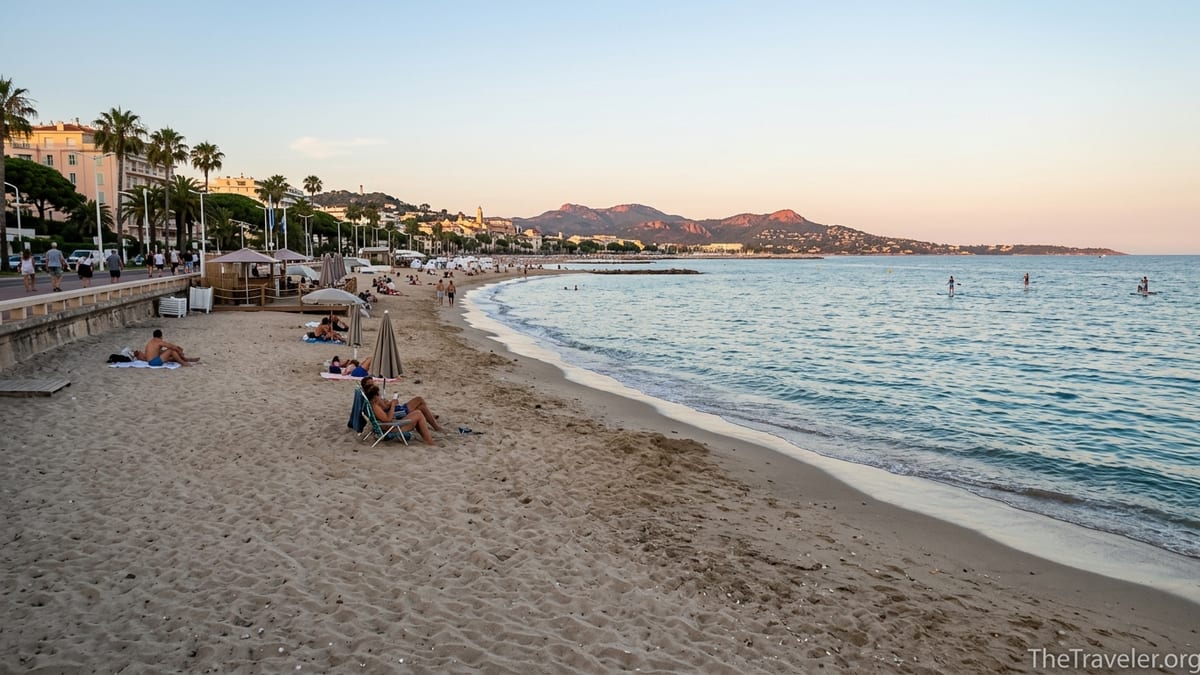
The Geography Behind the Crowds
The first hidden detail of Plages du Midi is simply how big and varied it is. Officially, the main public section runs for roughly 700 metres, but in practice the wider “Midi” area continues west past the Old Port almost all the way to La Bocca. As you walk away from the Palais des Festivals the sand subtly changes, the sounds of traffic fade and the atmosphere shifts from festival overflow to neighbourhood beach.
Most visitors drop their bags near the Vieux Port end because it is the first sand they see when walking from the station or La Croisette. Yet just a 10 to 15 minute stroll west along Boulevard du Midi Louise‑Moreau takes you past the busiest private beach clubs and into quieter public stretches. By the time you reach the section near the Mistral and Madrigal beaches, you may find long gaps between umbrellas even in July, especially before late morning.
Another easily missed detail is how the beach interacts with the infrastructure behind it. The railway line and the main coastal road run directly inland of Plages du Midi, but a narrow promenade and a low wall help screen much of the noise. This is not just cosmetic. The wall and the slightly raised road act as a barrier during winter storms, protecting the sand from being swept inland. In high summer, those same structures become windbreaks that make the Midi noticeably more comfortable on mistral days than fully exposed beaches farther along the coast.
If you pay attention to the way the shoreline kinks around small groynes and rock jetties, you will notice that some sections hold their sand better than others. Locals quietly favour the wider pockets near these structures, where the water tends to stay a little clearer after heavy boat traffic and where children have more room to paddle without waves slapping directly onto a steep slope.
Where Locals Actually Spread Their Towels
Ask a Cannes resident which part of Plages du Midi they use and many will describe a specific landmark rather than a beach name. One popular local trick is to bypass the first rows of sunbathers near the Old Port and aim for the area opposite Square Mistral, a small park with playground equipment just inland. Here, the sand widens, and there is usually a mix of families and year‑round residents who come down with foldable chairs in the late afternoon.
Farther west, near the free beach volleyball courts around the lower numbers of Boulevard du Midi, the crowd shifts again. In the mornings you might see local school groups jogging here or seniors doing gentle exercises on the BoccaCabana fitness equipment. By late afternoon, groups of friends show up with their own balls and a bag of groceries from the small supermarkets along Avenue Francis Tonner, eating simple beach dinners of baguettes, tomatoes and olives instead of ordering from a restaurant terrace.
Another underappreciated detail is how people use the promenade behind Plages du Midi. While most visitors gravitate to La Croisette for their evening stroll, the westward section along the Midi fills with joggers, dog walkers and parents pushing strollers once the heat drops. It is flatter and quieter than the old town streets, yet still offers wide views to the Esterel hills turning pink at sunset. If you are staying near the station or in Le Suquet, walking out along this promenade after dinner is an easy way to feel the everyday rhythm of Cannes rather than the festival façade.
Even the timing follows a local pattern. During peak summer, many residents avoid the hottest hours, slipping down instead around 8 or 9 in the morning for a quick swim before work, or returning after 5 in the afternoon when the angle of the sun softens and the kids can play without burning their feet on the sand. If you match your schedule to theirs, you will experience a very different, more relaxed Midi than the midday peak most short‑stay visitors encounter.
Quiet Pockets and Micro‑Environments Along the Sand
Although Plages du Midi looks like one continuous beach, it contains several micro‑environments that feel distinct once you know where to look. Near the Old Port end the sand is more compacted from constant footfall and municipal cleaning, which makes it good for jogging or beach fitness at dawn. As you continue west, the texture gradually becomes softer and slightly coarser, better for young children to dig channels that will not collapse immediately under a bucket of water.
Between clusters of private beach clubs you will notice narrow public access strips, often only a few metres wide but crucial for anyone who prefers to stay outside the pay‑to‑enter zones. These little corridors are easy to overlook when the sand is crowded with loungers, yet if you walk them in the early morning you can see how carefully the city has preserved legal access points all along the shore. On busy days, they also double as quieter belts of sand once you move a few metres away from the club loudspeakers.
One of the most tranquil corners hides in plain sight close to where Plages du Midi transitions toward La Bocca. Here, low rock groynes and the slight curvature of the bay shelter the water from the wake of passing ferries. Early in the day you may find paddleboarders quietly crossing the glassy surface parallel to the shore while only a handful of people sun themselves on the sand. There are still snack kiosks and showers every hundred metres or so, but the mood is more residential than resort.
Another overlooked feature is how the beach changes with the tide and weather, even though Mediterranean tides are small. After a night of stronger swell, a narrow ridge of shells and pebbles often forms along the high‑water line. Local beachcombers walk this band slowly at first light, looking for small sea glass fragments or unusual shells. By noon it is usually trampled flat and invisible to most visitors, so if collecting natural souvenirs appeals to you, set an alarm and enjoy the quietness of a nearly empty Midi at sunrise.
Facilities Most Visitors Never Realize Exist
From a distance, Plages du Midi can look relatively simple compared with the tightly packed rows of loungers on La Croisette, but a network of low‑key amenities sits just behind the sand. Public showers and foot‑rinsing stations are spaced at regular intervals, and many of them remain in place outside the absolute high season. This matters if you are visiting in late September or May, when the water is still inviting but some Riviera beaches elsewhere have already removed their installations.
Most travelers see the obvious kiosks selling sandwiches, ice creams and cold drinks facing Boulevard du Midi. What they may not notice is how the prices here tend to be a notch below those on La Croisette, reflecting a more local clientele. A simple pan bagnat or ham and cheese baguette might cost several euros less than a similar snack near the big hotels. Combined with the free access to the sand, this makes Plages du Midi one of the most budget‑friendly ways to spend a full day in Cannes without feeling you are compromising on the Riviera setting.
Families in particular benefit from a few details that rarely make it into quick guidebook descriptions. The children’s play area close to the central part of the Midi, plus the play structures at Square Mistral just across the road, let younger kids alternate between the sea and shaded climbing frames. Lifeguard supervision typically operates during the main summer months, with watch towers placed at strategic points along the busiest sections. While schedules change from year to year, the principle remains the same: by swimming within sight of these posts you gain an extra layer of security that many casual day‑trippers simply do not factor into their choice of spot.
Accessibility is another point where the Midi quietly outperforms its reputation. Certain stretches use gently sloping ramps instead of stairs from the promenade to the sand, making it easier for people with limited mobility or families with strollers to reach the waterline. In the core season, temporary walkways sometimes extend partway onto the sand so you do not have to struggle across soft dunes while carrying bags or beach tents. These small practical details transform the experience for anyone who does not move as easily as a sun‑chasing twenty‑something.
The Subtle Culture of Plages du Midi
Spend enough time on Plages du Midi and you will begin to notice an unspoken code of behaviour that differs slightly from what you might see on La Croisette. For one thing, the Midi is less about being seen and more about simply being. You are more likely to sit next to a retired couple reading paperbacks or a group of local teenagers sharing a bluetooth speaker at low volume than to find fashion shoots or branded events unfolding beside you.
Food culture at the Midi also feels different. While there are private beach restaurants with full lunch service, many regulars treat them as occasional indulgences instead of daily habits. It is common to see people unpacking Tupperware filled with pasta salad or roasted vegetables, accompanied by a chilled bottle of rosé or sparkling water wrapped in a cool bag. Because the beach is lined with small grocery stores and bakeries just inland, you can assemble a picnic for a fraction of the cost of a sit‑down meal without sacrificing quality. Choosing a patch of shade against the wall in late afternoon, you can watch the light soften over the Lérins Islands while slowly picking through olives and fresh fruit.
The social rhythm shifts through the week in ways first‑time visitors rarely anticipate. On weekdays outside of school holidays, the Midi can feel almost sleepy by midday, with space to spare between towels and a gentle murmur from the promenade. Come Saturday and Sunday, especially in July and August, residents of Cannes and nearby towns descend in greater numbers, bringing beach umbrellas and cool boxes for full, multi‑generation family days. If you value peace above all else, aim your visit for a Monday or Tuesday and target the western end of the beach before 11 a.m. If you are curious about local family life, swing by on a sunny Sunday afternoon instead and watch generations interact in a way that hotel‑lined strips rarely show.
Evenings reveal another layer of culture. After the most intense heat, teenagers gravitate toward the volleyball courts and open sand closer to La Bocca, playing informal matches as the sky turns orange. Couples and small groups settle on towels with takeaway pizza from nearby pizzerias, eating it slice by slice straight from the box. Meanwhile, older residents may simply sit on the promenade benches, facing the sea and chatting as cruise ships anchor offshore. For a visitor, blending into this understated routine can be one of the most rewarding experiences in Cannes, far removed from red carpets and crowded beach clubs.
Seasonal Shifts and How They Change the Experience
One of the most overlooked aspects of Plages du Midi is how dramatically it changes with the season and even time of day. In high summer, temporary pontoons extend out from some private clubs, creating extra space for sunbathing above the water and altering the view from the sand. Sections of beach may shrink slightly as rows of loungers appear, but in compensation the services on offer grow, from water sports rentals to extended opening hours at kiosks.
Visit in late spring or early autumn, however, and you could feel as if you have discovered another beach entirely. Many of the temporary structures come down, revealing a simpler, cleaner line of sand broken only by the permanent groynes and public access paths. The air temperature stays warm enough for swimming into October most years, yet you may find only a scattering of people enjoying the water outside of weekends. This shoulder‑season calm is when the hidden details of the Midi emerge most clearly: the pattern of footprints in the wet sand, the way shadows from the promenade railings stretch across the beach, the smell of pine resin carried down from the hills behind Cannes.
Winter, too, has its devoted fans. While the sea can be cool, hardy swimmers and members of local cold‑water clubs still meet for quick dips. The city often undertakes beach maintenance in the off‑season, bringing in fresh sand where storms have bitten into the shoreline and reshaping small dunes to prepare for the following summer. Observing this work from the promenade offers a reminder that the soft surface under your towel is not entirely natural but the result of ongoing effort to preserve a fragile strip between sea and city.
Light is another seasonal detail worth planning around. In midsummer, the sun sets late and far to the west, bathing the entire bay in gold for an extended period. In spring and autumn, by contrast, the lower arc of the sun creates long, dramatic shadows on the sand even in mid‑afternoon. Photographers often prefer these shoulder seasons to capture the Midi’s character: fisherman silhouettes against the horizon, children’s footprints leading to the water and the pastel facades of Le Suquet glowing softly across the harbour.
The Takeaway
Plages du Midi is more than a strip of public sand tacked onto the western edge of Cannes. It is a living, layered space where infrastructure, local habits and natural forces quietly intersect. Once you understand its hidden details, you can move beyond the first crowded patch of towels and choose your own version of the Midi: family‑friendly and supervised near the central posts, almost wild and residential toward La Bocca, or socially vibrant around the volleyball courts at sunset.
For travelers willing to walk a little farther, visit outside peak midday hours or simply pay closer attention, the reward is significant. You spend less, gain more breathing room, and experience Cannes as a city with real residents and routines rather than an endless festival stage. Next time you arrive at the Old Port and see that first sweep of sand, resist the urge to stop immediately. Follow the curve of the boulevard, listen as the noise falls away, and let Plages du Midi reveal the subtler Riviera it has been hiding in plain sight.
FAQ
Q1. How do I get to Plages du Midi from central Cannes?
From Cannes station, walk about 10 to 15 minutes through the Old Port area toward Boulevard du Midi. Once you pass the harbour and cross the coastal road, stairs and ramps lead directly down to the sand.
Q2. Is Plages du Midi really less expensive than La Croisette?
Yes, in general you spend less here. Access to the public sections is free, snack kiosks and nearby bakeries are usually more affordable, and private beach clubs along the Midi tend to charge slightly lower rates than those in front of the big Croisette hotels.
Q3. Which part of Plages du Midi is best for families with children?
The central public stretch near the lifeguard posts and close to Square Mistral works especially well for families. The sand is wide, the slope into the water is gentle, and you have quick access to a playground, snacks and toilets.
Q4. Are there showers and toilets on Plages du Midi?
Yes. Public showers and foot‑rinsing stations are dotted along the promenade just behind the sand, and several toilet facilities are available near main access points and beach restaurants, though some may charge a small fee.
Q5. When is the quietest time to enjoy Plages du Midi?
Early mornings before 10 a.m. and weekdays outside school holidays are usually the calmest. If you walk toward the western end near La Bocca at these times, you can often find plenty of personal space even in summer.
Q6. Can I bring my own food and drinks to the beach?
Bringing your own snacks, soft drinks and picnics to the public sections is common and accepted. Glass bottles and barbecues are discouraged or prohibited for safety reasons, so stick to reusable plastic or metal containers and cold food.
Q7. Is Plages du Midi suitable for people with limited mobility?
Certain access points include ramps rather than only stairs, and in high season temporary walkways are sometimes laid on the sand. While not every section is fully accessible, planning around these ramped entries makes the beach more manageable for visitors with reduced mobility.
Q8. What should I know about safety and lifeguards?
During the main summer season, lifeguards supervise designated zones along the busier parts of the Midi. Swim within the flagged areas, pay attention to warning flags that indicate sea conditions and keep an eye on children as there can be boat traffic farther offshore.
Q9. Are there water sports available at Plages du Midi?
Yes, depending on the period, you may find rentals for paddleboards, kayaks or pedal boats, particularly near the private beach clubs. Availability varies by season, so check locally once you arrive in Cannes.
Q10. How does Plages du Midi compare to nearby La Bocca beach?
Plages du Midi sits closer to the Old Port and feels more connected to central Cannes, while La Bocca, farther west, is broader and often even quieter. Many locals use both, choosing the Midi for convenience and La Bocca when they want extra space and a slightly more secluded atmosphere.