


On paper, Plages du Midi is exactly what you expect from Cannes: a long ribbon of pale sand curving along a bright blue bay, a promenade, a backdrop of pastel buildings and palm trees. What surprised me most, walking there for the first time, was not the scenery but the feeling. For a town famous for red carpets and VIP ropes, the beaches along the Boulevard du Midi feel almost stubbornly, reassuringly local. This is where Cannes drops the pose and goes to the beach for real.
Get the latest updates straight to your inbox!
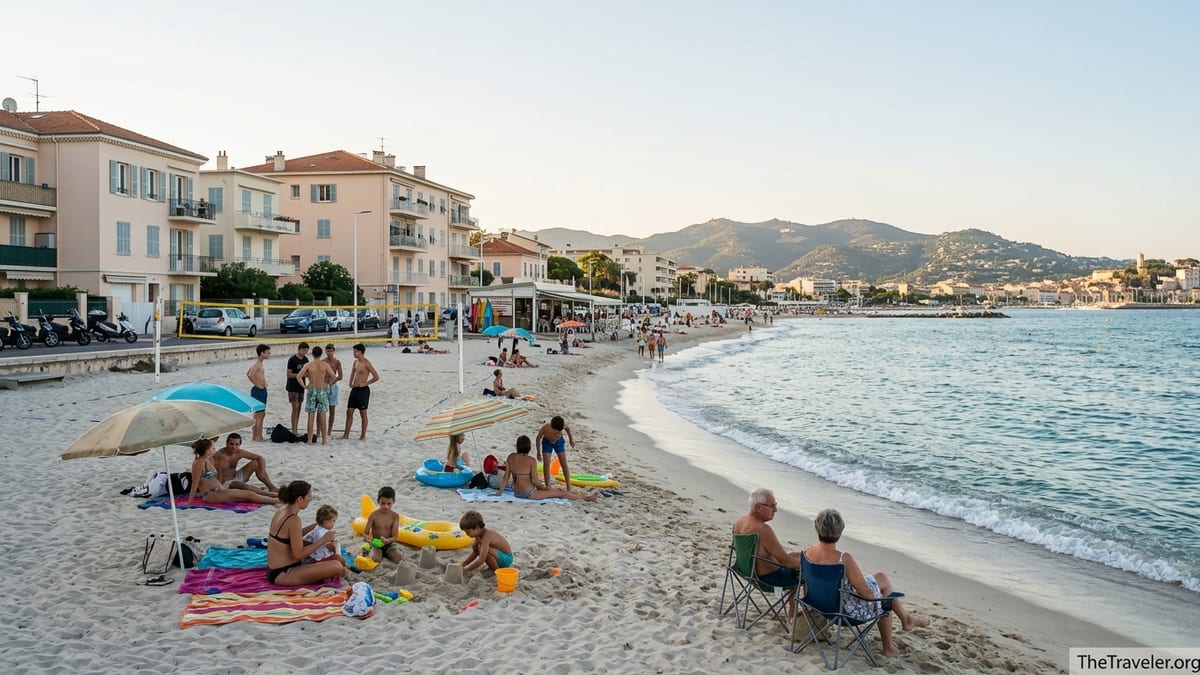
A Cannes Beach That Belongs to Its Residents
If you arrive in Cannes expecting only the manicured precision of La Croisette, Plages du Midi feels like a quiet plot twist. The Midi beaches start just west of the Old Port, at the foot of Le Suquet’s hill, and run for well over a kilometre toward Cannes La Bocca. Much of this shoreline is free public sand, with only a scattering of low-key private concessions in between. Families from the apartment blocks behind the boulevard walk down in flip-flops, towels over shoulders, in a way that feels far removed from hotel concierges and reserved sunbeds.
On a June weekday morning, I watched an older couple set up under a faded parasol they had clearly owned for years, their shopping trolley parked carefully by the wall. Next to them, a group of teenagers from the local lycée arrived with Bluetooth speakers and baguette sandwiches wrapped in paper from the bakery on Rue Georges Clemenceau. Office workers on their lunch break sat on the low seawall in shirtsleeves, looking more interested in the view of the Lérins Islands than in impressing anyone around them.
The local tourism materials describe Plages du Midi as one of Cannes’ main public beaches, popular with families and residents because of its soft sand, gentle water and easy access from town. In practice that translates into details you notice quickly: people greeting each other by name, parents chatting in French while keeping half an eye on toddlers building sand forts, groups of friends coordinating picnic plans rather than debating which beach club to book.
The absence of big-brand hotels directly behind the sand reinforces the feeling. Instead of chains and luxury boutiques, you see shuttered apartment buildings, corner cafés and the odd neighbourhood pharmacy. The soundscape is French chatter, seagulls and the occasional scooter on Boulevard du Midi, rather than champagne corks and DJ sets.
Public Sand, Real-Life Budgets
One of the clearest signals that you are on a local beach is what people are paying, or not paying, to be there. Along Plages du Midi you can, quite literally, put your towel down almost anywhere on the soft pale sand without opening your wallet. Public stretches extend between smaller private concessions, and the distinction is clear: simple municipal showers and beach access on one side, waiter-service loungers and menus on the other.
In recent seasons, travelers have reported that a front-row sun lounger on a marquee Croisette club, such as Carlton Beach Club or La Môme Plage, can climb into three‑figure territory for a full summer day, especially during peak events. By contrast, the more modest beach clubs on Midi often price a standard lounger at levels that feel high but not outrageous for the Riviera, especially if you consider you are buying both a seat and an all-day base with shade, showers and food service. Crucially, you do not have to pay anything at all to enjoy the same seawater and sunset if you are happy with your own towel.
That price gap shapes who you see. On Plages du Midi, students and young couples spread out supermarket picnic lunches. Families bring their own parasols and inflatable toys bought at the kiosks along the boulevard. Retirees arrive early, claim a favorite patch close to the water and leave by mid-afternoon before the sun gets fierce. There are tourists, of course, but the overall rhythm is that of a municipal beach that locals use regularly, not a set-piece for a single glamorous afternoon.
Even add-ons feel grounded in everyday budgets. An espresso or café crème at a simple bar just off the sand can be only slightly more than in town. A scoop of ice cream or a cone from a kiosk costs roughly what you would pay in a normal French beach town, not a curated resort. You are more likely to see children devouring supermarket-brand ice lollies than branded gelato in designer cups.
Everyday Rituals on a Blue Flag Beach
Another surprise is how Plages du Midi manages to be both local and carefully looked after. The main stretch holds a coveted Blue Flag label, a European certification that rewards clean water, good facilities and responsible environmental management. For a visitor, that plays out in practical ways: visible lifeguard posts during the high season, clearly marked swimming zones, and water that is usually clear and gentle enough for hesitant swimmers.
Locals build their routines around these conditions. Early in the morning, before the sun warms the sand, you will see regulars taking brisk sea swims, some in lightweight wetsuits even in late spring, others in standard swimwear year-round. Around breakfast time, parents arrive with prams and strollers to let toddlers paddle at the edge where the sea shelves gradually. Grandparents set up folding chairs by the low wall, content to supervise and talk while the younger generations rotate between the sea and the sand.
The beach is also quietly set up for activity. Toward the central sections of Boulevard du Midi, a pair of public beach volleyball courts stays busy with informal matches, from serious local teams in coordinated jerseys to impromptu games made up on the spot when someone brings a ball. Along the narrow promenade behind the sand, joggers and cyclists weave between dog walkers and families pushing scooters.
What stands out is the lack of spectacle. These are not Instagrammable sunrise yoga classes or branded wellness activations. They are simple, repeatable rituals: a swim before work, a post-school dip, a stroll at sunset. Travelers who tap into this rhythm, even for a few days, often discover that the most memorable part of their Cannes stay is not the festival palace or the designer storefronts, but this daily life unfolding on the sand.
How Plages du Midi Differs from La Croisette
To understand why Plages du Midi feels so local, it helps to contrast it with Cannes’ best-known strip of sand along La Croisette. There, a dense line of private beach clubs, attached to grand hotels and standalone restaurants, occupies much of the shoreline. Loungers are laid out in regimented rows, menus carry recognizable luxury cues and staff are used to serving conference delegates and festival guests. The atmosphere can be enjoyable and glamorous, but it is unmistakably curated.
On Plages du Midi, the aesthetic softens. The beach is wider and more open, the buildings behind lower and more residential. Private concessions exist, but they are interspersed with broad, clearly public sections where the only infrastructure is a municipal shower, a lifeguard hut in season and occasionally a playground. Instead of festival branding, you are more likely to see children’s buckets, modest windbreaks and a flotilla of colorful inflatables bought from the same local shop.
The orientation adds another subtle difference. Midi faces southwest, catching the last of the light as the sun drops behind the Esterel hills in the distance. While Croisette evenings can be about aperitif terraces and people-watching, Midi evenings are about families lingering in the water until the very last minute, friends picnicking directly on the sand, and locals taking one final swim in the golden hour. If you stay nearby, you may notice how the promenade fills with strollers and joggers after the day’s heat has eased, in a pattern that feels much more like a neighborhood park than a resort stage.
Service expectations also shift. On the Croisette, ordering lunch on the beach often means multi-course menus, sushi platters and polished rosé lists. On Midi, many people simply walk across the boulevard for a slice of pizza, a paper-wrapped panini or a bag of fresh fruit from a greengrocer, then return to eat on their towel. The mix of languages also changes: English, Italian, German and Scandinavian voices blend with French, but on Midi the baseline is clearly local French, from schoolchildren to shop staff on break.
Getting There the Way Locals Do
Another reason Plages du Midi feels so rooted in local life is how easy it is to reach without a car. From Cannes train station it is a straightforward walk: you exit toward the sea, cross past the Old Port and then follow the coastal road west. Within a few minutes, the sand of Plage du Midi begins. This simple route also explains why regional commuters and day trippers from nearby towns like Antibes or Nice often end their day here with a quick swim before their train home.
Public buses run along the same shoreline, and local riders use them heavily. Services that follow the coast make frequent stops on Boulevard du Midi, which makes it simple for residents of Cannes La Bocca or even Mandelieu to ride in, hop off near their preferred patch of sand and be in the water within minutes. The ticket cost for a single ride is low enough that regular beach visits are part of normal life, not a special treat.
For drivers, there are long rows of parking spaces along the boulevard and, further out toward La Bocca, larger lots that act as overflow. Regular visitors know that these fill quickly on summer afternoons and plan accordingly, arriving early or opting for the bus. You can also see the local cycling culture in action: people chaining their bikes to railings or using dedicated racks, then heading down to the sand with nothing more than a towel and a small bag.
Walking along the promenade behind the beach, you pass a practical line-up of everyday services: small groceries, bakeries, snack bars, beach-gear kiosks, a pharmacy or two and unpretentious cafés offering daily menus chalked on boards. This is not a stretch dominated by designer brands and hotel entrances. It is a corridor of neighborhood businesses that happen to sit beside the sea, and their pricing and clientele reflect that.
Small Beach Clubs, Big Local Character
While Plages du Midi is best known for its generous public sections, its handful of private beach clubs also contribute to the local feel. Instead of grand hotel names, you encounter independent or small-chain establishments that focus on families and residents as much as on tourists. They provide the extras many people want for a long day in the sun: reserved loungers, umbrellas, showers, proper bathrooms and table-service meals.
These clubs typically lean into Mediterranean menus that balance seafood dishes with simpler favorites. It is common to find grilled fish of the day, Niçoise salads, pastas, burgers and children’s menus that include familiar basics. The pricing, while still reflecting Riviera realities, is generally more approachable than the marquee addresses along La Croisette. Locals might book a few days each summer at their favorite Midi club instead of making a habit of the Croisette’s most famous names.
On busy weekends, you will often see multi-generational groups set up for the day at the same club they have been visiting for years. Grandparents settle into front-row loungers while parents take turns swimming with the children. Staff greet returning customers with easy familiarity, switching between French and English as needed. The atmosphere is more relaxed than theatrical, with music kept at a level where conversation remains easy.
For travelers, these clubs offer an accessible middle ground. You can experience the convenience of a serviced beach day, with food delivered to your lounger and a guaranteed spot in high season, without fully entering the world of high-price Croisette luxury. Yet you remain surrounded by the same mix of locals and visitors that defines Plages du Midi, rather than a crowd made up almost entirely of out-of-towners and conference guests.
The Quiet Luxury of Space and Time
One of the most underrated aspects of Plages du Midi is its sense of space. The long, continuous curve of sand means that even on busy August afternoons, you can usually walk a little further and find a patch that feels comfortable. Families spread out towels and parasols without touching their neighbors. Groups of friends set up Frisbee games or paddleball matches in the wider sections without constantly apologizing to people on nearby loungers.
This space changes the atmosphere. People linger, reading paperback novels in French and English, playing cards on beach blankets, or simply lying back with hats pulled over their faces. Children have room to race from the water’s edge back to their parents without weaving through tightly packed rows of chairs. Couples find corners of relative quiet for long conversations, even in peak season.
Time behaves differently here too. Because Midi catches the evening light so well, the day stretches. It is common to see people arriving just as the heat starts to soften in late afternoon, planning only for a swim and an hour or two on the sand before heading home for dinner. Others arrive in the morning and stay almost until dark, pausing only to fetch takeaway salads, rotisserie chicken and a chilled bottle of local rosé from shops across the road.
This unhurried rhythm is the closest thing Plages du Midi has to luxury. It is not about rare vintages or celebrity DJs, but about being able to treat the Mediterranean as an extension of your living room or balcony. For a visitor used to paying premium prices for a few tightly scheduled hours at the beach, that freedom can feel quietly extravagant.
The Takeaway
What surprised me most about Plages du Midi was how quickly it stopped feeling like a destination and started feeling like a neighborhood routine. The soft sand and gentle sea are certainly appealing, and the view across the bay to the Lérins Islands is as photogenic as anything on the Riviera. Yet the true charm lies in the ordinary: schoolchildren sharing bags of crisps after a last-day-of-term swim, grandparents folding up their chairs with practiced efficiency, teenagers perfecting handstands in the shallows at sunset.
For travelers, choosing Plages du Midi means trading some of the high-gloss glamour of La Croisette for a different kind of Cannes experience. You still have access to clear water, lifeguards in season, and even a choice of beach clubs if you want a lounger and lunch by the sea. But you also gain a chance to slip, however briefly, into the daily life of the city, sharing the shoreline with the people who call Cannes home.
If you are planning a visit, consider structuring at least one day around Midi instead of defaulting to the more famous names. Walk from the station or your hotel through Le Suquet, pick up supplies at a bakery and a supermarket, and claim a spot on the public sand. Swim when the sun is high, linger as the light softens, and watch how the beach transforms from a family playground into an evening promenade. You may find, as I did, that this long, lived-in stretch of sand is where Cannes finally drops its guard and lets you in.
FAQ
Q1. Where exactly are Plages du Midi in Cannes?
Plages du Midi begin just west of Cannes’ Old Port, below the historic Le Suquet district, and run along Boulevard du Midi toward Cannes La Bocca, forming one of the city’s main public beach areas.
Q2. Are Plages du Midi free to access?
Yes. Most of Plages du Midi consist of free public sand where you can lay down your towel without charge, with a few separate private beach clubs where sun loungers and services cost extra.
Q3. How do Plages du Midi differ from the beaches on La Croisette?
La Croisette is lined with high-profile private beach clubs attached to luxury hotels, while Plages du Midi feel more residential, with long public stretches, simpler services and a noticeably more local crowd.
Q4. Is the water safe for children and less confident swimmers?
The shoreline along Plages du Midi generally shelves gently, and in high season lifeguards supervise designated swimming areas, making it a popular choice for families with young children.
Q5. How can I get to Plages du Midi without a car?
From Cannes train station you can walk via the Old Port in around 10 to 15 minutes, or take local buses that run along Boulevard du Midi and stop close to different sections of the beach.
Q6. Are there showers and toilets on Plages du Midi?
Yes. Public sections are equipped with simple freshwater beach showers, and there are toilets either directly on the beach in certain areas or nearby along the promenade and side streets.
Q7. Can I rent sun loungers and umbrellas on Plages du Midi?
You cannot rent them on the completely public stretches, but several small private beach clubs along Midi offer loungers, umbrellas and food service for a daily fee.
Q8. What is the atmosphere like in the evening?
Evenings are relaxed and local, with people coming for sunset swims, picnics on the sand and walks along the promenade, as the southwest-facing beach holds the light late into the day.
Q9. Are there restaurants and shops near Plages du Midi?
Behind the beach on Boulevard du Midi you will find neighborhood cafés, snack bars, bakeries, small supermarkets and beach-gear kiosks, so it is easy to buy food, drinks and essentials nearby.
Q10. Is Plages du Midi a good base for a Cannes beach holiday?
Yes. If you prefer a more local, budget-conscious atmosphere with plenty of public sand and straightforward access to town, staying near Plages du Midi can be an excellent choice for a Cannes beach stay.