


Just fifteen minutes by boat from Cannes, the Lérins Islands feel like a different world. While the French Riviera is famous for crowded promenades, designer boutiques and late-night beach clubs, this small archipelago trades noise and glitz for pine forests, chapel bells and quiet coves lapped by turquoise water. For travelers looking for an escape that feels authentically Mediterranean yet still easy to reach, the Lérins Islands offer one of the most distinctive experiences on the Côte d’Azur.
Get the latest updates straight to your inbox!
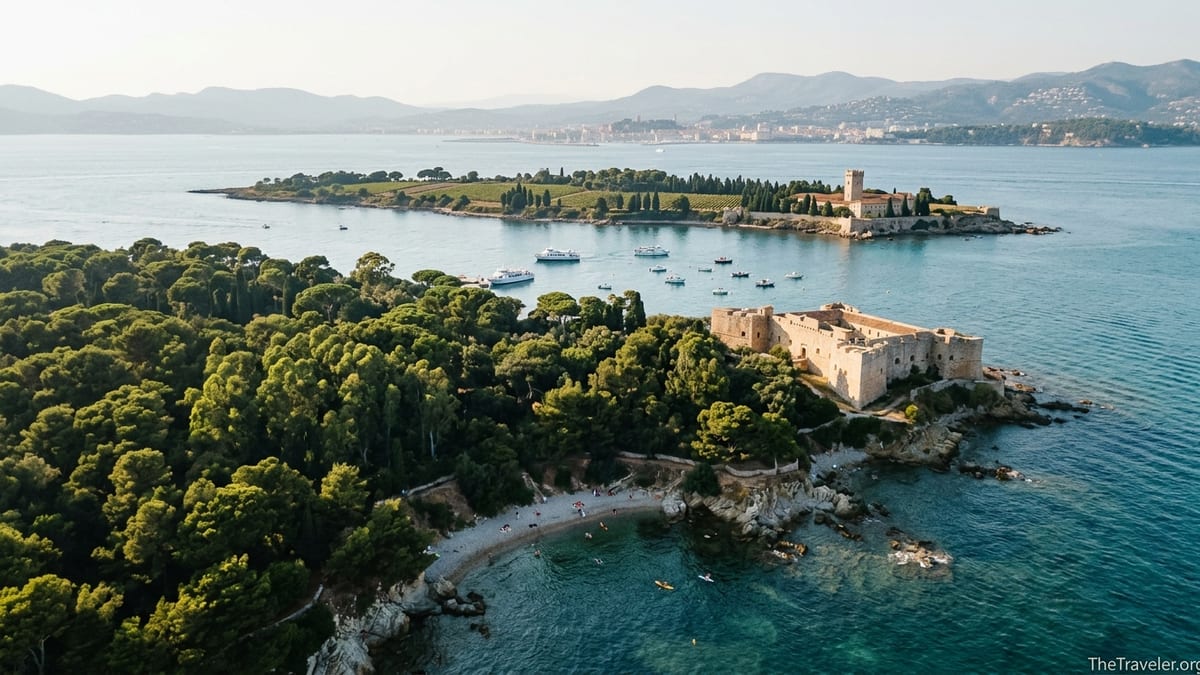
An Archipelago Hiding in Plain Sight off Cannes
The Lérins Islands sit in the Bay of Cannes, just off the busy Croisette, yet most visitors never get beyond a quick look from the promenade. The public ferries that run from Cannes’ old port to Île Sainte-Marguerite and Île Saint-Honorat typically take around 15 minutes, making these some of the easiest island day trips on the entire French Riviera. Return tickets to Sainte-Marguerite from Cannes in 2025 are often advertised in the range of about 18 to 20 euros per adult, with similar pricing to Saint-Honorat, a modest outlay compared with the cost of a lounger at a private beach club on the mainland.
What sets the Lérins apart from many other Riviera escapes is their scale and simplicity. Sainte-Marguerite, the larger island, stretches roughly 3 kilometers long and less than 1 kilometer wide, covered in pine and eucalyptus forest rather than villas and hotels. Saint-Honorat is smaller still, a compact oval ringed by low cliffs, vineyards and chapels. There are no cars, no nightclubs, and no resort complexes here, just walking paths, a handful of small eateries and the sea on all sides.
Compared with better-known island destinations such as Porquerolles or Port-Cros near Hyères, which can feel busy at the height of summer and require longer ferry crossings, the Lérins offer a low-effort, low-stress escape. You can finish a morning coffee in central Cannes, walk to the quay, and be wandering under maritime pines on Sainte-Marguerite before many visitors have found a spot on the mainland beach.
Because of their proximity to Cannes, the Lérins are also easy to build into a flexible itinerary. Day-trippers staying in Nice, Antibes or even Monaco often hop a regional train to Cannes, walk down to the port and treat the islands as a one-day reset from city sightseeing and coastal traffic.
Wild Nature and Quiet Beaches Instead of Beach Clubs
For many travelers, what truly makes the Lérins Islands different is how wild they feel. Instead of the groomed sands and sunbed rows common in Cannes or Saint-Tropez, Sainte-Marguerite offers a series of pebbly coves and small rocky inlets tucked between pine roots and low cliffs. A few larger beaches sit close to the ferry landing, but anyone willing to walk 20 to 30 minutes along the island’s perimeter paths can usually find quieter spots even in mid-season.
The water here is particularly clear, helped by the absence of large harbors and major construction. Shallow turquoise patches alternate with darker seagrass beds, and it is common to see small fish just offshore. Families often bring masks and snorkels to explore near the rocks, while locals spread simple picnic blankets in the shade rather than renting loungers. In high summer, shade along the forest paths can feel several degrees cooler than the mainland promenade.
Unlike many Riviera beach destinations that revolve around music and cocktails, the Lérins are managed with preservation in mind. Local authorities encourage visitors to take all rubbish back to the mainland, and signage reminds swimmers and boaters to protect the protected Posidonia seagrass meadows. If you are used to the constant background hum of jetskis and beach bars in places like Juan-les-Pins, the relative quiet of Sainte-Marguerite comes as a surprise. You are more likely to hear cicadas, wind in the trees and the occasional church bell from Saint-Honorat than amplified music.
Saint-Honorat is even calmer. There are rocky access points to the sea and a small swimming area near the main jetty, but much of the coastline is left natural. It is a good choice for travelers who prefer meditative walks among vineyards and chapels to long days sunbathing, and for anyone who wants to experience the Mediterranean coast without a wall of apartment blocks behind the shoreline.
Living Monastic Heritage You Can Actually Experience
While many French Riviera resorts trade on a modern image of luxury, Saint-Honorat’s identity is built around a very different story. A monastery was founded here in the early 5th century, and today the island is still home to a community of Cistercian monks. This continuity gives Saint-Honorat an atmosphere that you simply will not find in places like Saint-Tropez or Monaco, where the focus is on yachting and nightlife.
As you step off the ferry on Saint-Honorat, you immediately see the difference. A simple stone quay leads to shaded paths flanked by vines, olive trees and low stone walls. Signs politely ask visitors to dress modestly and respect the calm of the island. Cars are absent, and the only regular mechanical noise tends to be the monastery’s small tractors working in the vineyards. The monks produce wine and liqueurs that are sold on the island, and many visitors combine a walk with a tasting, often booking in advance for the more structured experiences.
The fortified monastery on the southern shore of Saint-Honorat, with its thick walls and towers rising directly from the rocks, is one of the most striking sights on the Riviera. Entrance is usually free, and you can climb the narrow staircases to small chapels with sea views. It is a powerful contrast to the glass towers of Cannes and the luxury hotels just across the water. Instead of handbags and champagne, the island’s “luxury” is time, silence and a sense of continuity.
For a deeper experience, some travelers arrange overnight spiritual retreats at the abbey guesthouse, where full-board stays, based on recent information, are typically priced in a modest range compared with Riviera hotels. These stays emphasize participation in monastic life rather than conventional tourism and are more about contemplation than convenience, but they highlight just how different Saint-Honorat is from the rest of the coast.
Layers of History: From the Iron Mask to an Underwater Museum
The Lérins Islands also stand apart from many other Riviera escapes because of the concentration of history in such a compact area. On Sainte-Marguerite, Fort Royal dominates a rocky headland above the sea. Originally part of France’s coastal defenses, it later served as a state prison. Today it houses the Musée du Masque de fer et du Fort Royal, where visitors can see the small stone cell long associated with the mysterious “Man in the Iron Mask,” who was held on the island in the late 17th century.
Inside the museum, simple corridors open into rooms displaying artifacts from Roman and Saracen shipwrecks discovered around the archipelago. You walk through vaulted cisterns and past heavy doors that remind you this was once a serious fortress, not just a scenic ruin. For travelers used to the polished museum spaces of Nice and Monaco, this weathered stone complex, still facing directly onto the Mediterranean, feels raw and tangible.
In recent years, the waters around Sainte-Marguerite have gained a new cultural landmark: an underwater eco-museum, created by British artist Jason deCaires Taylor. Several large sculpted faces, modeled on local residents, rest on the seabed a short distance from the shore. Snorkelers can view the pieces in situ, where they are gradually becoming colonized by marine life. It is the first installation of its kind in the Mediterranean and illustrates how the islands mix heritage with contemporary environmental art.
Elsewhere in the archipelago, you find traces of earlier military structures, from old cannonball ovens on Saint-Honorat to watch posts along the coastline. Yet because most of the islands remain covered by forest and low vegetation, these remnants appear almost unexpectedly along walking paths rather than as fenced, ticketed attractions. The effect is very different from more urban Riviera heritage sites such as the fort in Villefranche-sur-Mer or Monaco’s old town, where history is framed by dense development and major roads.
A Slower, Simpler Day Trip than Other Riviera Islands
Porquerolles, Port-Cros and the Îles d’Hyères are often described as the Riviera’s “wild” islands, but reaching them typically involves a journey to Hyères or nearby ports and ferry crossings closer to 30 to 45 minutes. By contrast, the Lérins can be more spontaneous. Ferries from Cannes generally run several times a day throughout much of the year, with later evening departures in high season but last boats usually leaving late afternoon or early evening, which keeps the islands quiet at night.
A typical day on Sainte-Marguerite might involve catching a mid-morning boat, walking along shaded forest tracks to a secluded cove, picnicking near the water, then visiting Fort Royal and the museum before taking an afternoon ferry back to Cannes. Food options on the island include a few simple restaurants and snack bars near the landing stage and paths, but many locals prefer to bring their own provisions to keep costs down and to be free to stop wherever a view appeals.
On Saint-Honorat, the rhythm is slower still. After landing, visitors often follow the circular path around the island, stopping at the seven small chapels, each facing the sea. Many schedule lunch at the island’s restaurant, which focuses on regional products and wines produced by the monastery. Prices are in line with good-quality seaside dining in Provence: not inexpensive, but typically better value than the most fashionable addresses along the Croisette.
Because there are no hotels or holiday apartments, the Lérins are primarily day-trip destinations. This keeps the experience compact and contained, ideal for travelers who want a “detox” day between heavier sightseeing or shopping. Unlike mainland towns, where a simple stroll might lead from a historic lane into a high-traffic boulevard in minutes, the islands offer a complete change of pace from the moment you step off the boat.
A Different Kind of Riviera Luxury: Silence, Space and Sea Air
On much of the French Riviera, the most visible forms of luxury are material: large yachts moored in Antibes, designer storefronts in Cannes, exclusive beach clubs with minimum spends. On the Lérins Islands, luxury is measured differently. Here, it is the ability to hear waves against rocks without traffic noise, to walk shaded paths without crowds, and to swim in clear water without speedboats passing close to shore.
For couples staying in Cannes, a day on Saint-Honorat can feel like a romantic retreat at a fraction of the cost of a private cruise. Sitting on the low stone walls near the fortified monastery at sunset, watching the last ferry depart while the abbey bells ring, offers a memory at least as powerful as a night at a rooftop bar. Families with children appreciate that there are no cars and very limited commercial distractions, so younger visitors can explore safely along marked paths.
The Lérins also appeal to travelers who care about sustainability. With no large-scale construction, limited services and clear expectations around waste and behavior, the islands provide a glimpse of what much of the Riviera coastline might have looked like before mass tourism. Informational panels around the paths explain local flora, seabirds and marine habitats, and seasonal programs occasionally include guided nature walks or educational activities focused on the underwater environment.
Even for visitors who still want a taste of classic Riviera nightlife, the islands work well as a counterbalance. You can spend an evening in Cannes enjoying a waterfront dinner or summertime fireworks, then dedicate the next day to walking and swimming on Sainte-Marguerite to recover. This duality is one of the region’s great strengths, and the Lérins exemplify it better than almost anywhere else.
Practical Tips: Making the Most of a Lérins Islands Escape
Planning a visit to the Lérins Islands is straightforward, but a few details can significantly improve the experience. Ferries to Sainte-Marguerite and Saint-Honorat depart from the old port in Cannes, usually near the base of the Suquet hill. In high season, buying tickets in advance or arriving at the quay 30 to 40 minutes before your intended departure helps avoid queues, especially around late morning when many day-trippers arrive.
Weather on the islands is similar to Cannes, but shade is not always so close to the water, so bring a hat, sunscreen and a refillable water bottle. Public fountains exist, yet they can be busy in summer, and carrying your own water reduces strain on local supply. Comfortable walking shoes or sturdy sandals are more practical than flip-flops, as many paths are stony and some beach access points require scrambling over rocks.
On Saint-Honorat, dress modestly out of respect for the monastic community, especially if you intend to visit the abbey church or fortified monastery. Shoulders covered and swimwear reserved for the shoreline is the norm. Alcohol is available primarily in the form of the monks’ wines and liqueurs, and visitors are asked to keep noise levels low, particularly near the religious buildings.
In terms of timing, late spring and early autumn are often ideal, offering warm seas, milder temperatures and lighter crowds. During the Cannes Film Festival in May, ferries can be busier and accommodation in Cannes more expensive, but the islands themselves often remain calmer than the city. In July and August, arrive on one of the first morning boats if you want quieter coves before midday.
The Takeaway
What makes the Lérins Islands different from other French Riviera escapes is not a single spectacular monument or a famous beach club, but a rare balance of accessibility, simplicity and depth. In a region associated with display, the islands offer restraint: no cars, few buildings and a focus on nature and contemplation. Sainte-Marguerite delivers wild coves, forest walks and a fortress steeped in stories, while Saint-Honorat adds the living presence of a monastic community and vineyards framed by chapels.
For travelers who want to experience the Riviera beyond its clichés, a day on the Lérins offers an authentic counterpoint to the glitz of Cannes and the yacht marinas further east. You can still return to a comfortable hotel or a lively restaurant on the mainland in the evening, but for a few hours you live at island pace, following shaded paths, swimming in clear water and listening to the sound of bells over the sea. In a crowded and highly commercialized coastline, that combination of ease and tranquility is perhaps the greatest luxury of all.
FAQ
Q1. How do I get to the Lérins Islands from Cannes?
Ferries leave from the old port in Cannes and typically take around 15 minutes to reach either Île Sainte-Marguerite or Île Saint-Honorat. In high season there are multiple departures per day, so you can usually choose between morning and afternoon sailings.
Q2. Which island should I choose if I only have one day?
If you prefer forest walks, small coves and a mix of nature and history, Sainte-Marguerite is the best choice. If you are drawn to monastic heritage, chapels and vineyards in a more contemplative setting, Saint-Honorat is ideal. Both can be visited on separate days if you have the time.
Q3. Are the beaches on the Lérins Islands sandy?
Most of the shoreline is rocky or pebbly, with a few small sandy sections, especially near some of the coves on Sainte-Marguerite. Water shoes or sturdy sandals make getting in and out of the sea more comfortable than bare feet.
Q4. Can I stay overnight on the islands?
There are no conventional hotels or resorts on the Lérins Islands. Saint-Honorat offers limited retreat-style accommodation at the monastery guesthouse for those interested in a spiritual stay, but most visitors base themselves in Cannes or nearby towns and visit the islands on day trips.
Q5. Is swimming safe and suitable for children?
In calm weather, swimming is generally safe along designated areas, and many families visit with children. However, beaches are mostly natural, without lifeguards or extensive facilities, so parents should supervise closely and choose sheltered coves with gentle access to the water.
Q6. What should I wear when visiting Saint-Honorat?
Out of respect for the monastic community, visitors are asked to dress modestly on Saint-Honorat. This usually means covering shoulders and avoiding beachwear away from the shoreline. Swimwear should be reserved for the sea and immediate beach areas, and a light cover-up is recommended elsewhere.
Q7. Are there places to eat on the islands?
Both islands have options, including a restaurant and snack bars on Sainte-Marguerite and a restaurant plus a small shop on Saint-Honorat. Prices are similar to mid-range seaside dining on the Riviera. Many visitors also bring picnics to enjoy more flexibility and to keep costs down.
Q8. How does a visit to the Lérins Islands compare to Porquerolles?
Porquerolles is larger, with more sandy beaches and bike rentals, but it requires a longer journey and can be busy in peak season. The Lérins are closer to Cannes, smaller and simpler, with no cars and a stronger focus on quiet walks, history and monastic life rather than classic resort activities.
Q9. Do I need to book ferry tickets in advance?
Outside the busiest summer weeks and major events in Cannes, it is often possible to buy tickets on the day. During July, August and around the Cannes Film Festival, booking in advance or arriving at the ticket office early is wise, especially for late-morning departures.
Q10. Is the Lérins Islands underwater eco-museum easy to visit?
The underwater eco-museum off Sainte-Marguerite is located a short distance from the shore in shallow water. Confident swimmers with masks and snorkels can view the sculptures in suitable sea conditions, but access depends on weather and visibility, and there are no formal viewing platforms on land.