


Rome is famous for its generous green spaces, from the sweeping lawns of Villa Borghese to the wild expanses of Villa Doria Pamphilj. Yet one garden in the city stands apart from all the rest: the Vatican Gardens. Enclosed within the tiny sovereign state of Vatican City, these historic grounds blend nature, art, and faith in a way that no other park in Rome can quite match. For travelers deciding whether a Vatican Gardens tour is worth squeezing into a packed Roman itinerary, understanding what makes these gardens different from other historic parks is the key.
Get the latest updates straight to your inbox!
A Garden That Is Also a Country
The first and most obvious difference is geographical. The Vatican Gardens occupy roughly half of Vatican City’s territory, covering about 22 hectares of the 44-hectare microstate, which itself is entirely encircled by the city of Rome. In other words, when you walk under the pines below St Peter’s dome, you are not simply in a park but inside a separate sovereign country. By contrast, celebrated Roman green spaces like Villa Borghese or Villa Doria Pamphilj are municipal parks belonging to the city and freely accessible to residents and visitors alike during opening hours.
This geopolitical status has a direct impact on how the gardens feel. To enter Villa Borghese, you might stroll up from Piazza del Popolo or the top of the Spanish Steps and simply wander in through a gate. The transition from city to park is casual and porous. Entering the Vatican Gardens, however, means passing through Vatican security, having your ticket scanned, and joining an officially escorted tour group. The psychological shift is real: many visitors describe a sense of crossing an invisible threshold from bustling Rome into a compact, self-contained enclave.
The small scale of Vatican City also means that the gardens form part of the functional core of the state, not just a recreational addon. Around certain bends in the paths you glimpse administrative buildings, the Vatican Radio antennae, and service areas that support the daily operations of the Holy See. In Villa Doria Pamphilj or the Orto Botanico in Trastevere, the institutions surrounding the gardens are Italian and civic; in the Vatican Gardens, they are the working heart of a global church.
For many travelers, this combination of park and country is precisely the attraction. In the space of a single morning you might line up in St Peter’s Square, step into the papal state, and within minutes find yourself on a shaded path overlooking the tiled roofs of Rome. Few other urban gardens in the world can offer this immediate, almost seamless transition between international pilgrimage site and quiet, state-level back garden.
From Papal Retreat to Modern Pilgrim Experience
The Vatican Gardens are also distinct in their original purpose. Dating back to the late 13th century, when Pope Nicholas III moved his residence to the Vatican and created orchards and lawns behind the new palace, these grounds were conceived as a private papal retreat. Successive popes expanded and embellished them over the centuries, adding formal parterres, fountains, and chapels. Even today, they remain primarily a place of rest and contemplation for the pontiff and Vatican residents, opened to visitors under controlled conditions.
Other historic gardens in Rome began as aristocratic villas or experimental spaces and only later became public parks. Villa Borghese, for instance, was laid out in the early 17th century as the country estate of Cardinal Scipione Borghese, nephew of Pope Paul V, and was only turned into a public park by the city in the early 20th century. Villa Doria Pamphilj developed around a 17th-century villa and Baroque gardens created for the powerful Pamphilj family, and it was gradually expropriated and opened to the public in the 20th century. The Orto Botanico, Rome’s botanical garden on the slopes of the Janiculum, originally served scientific and medicinal purposes, supplying the University of Rome with plants.
For visitors, this difference in origin translates into a distinct atmosphere. A Sunday jog around the lake in Villa Borghese or a picnic on the lawns of Villa Doria Pamphilj feels very much like taking part in the life of a modern European city. In the Vatican Gardens, you are always conscious that you are a guest in someone else’s private realm. Group sizes are limited, conversations tend to be hushed, and guide commentary often shifts toward the history of the papacy and the devotional meaning of particular shrines. Rather than a casual park visit, the experience feels closer to a behind-the-scenes tour of a royal residence.
That difference is also evident in the way time is structured. In Villa Borghese you can wander freely for hours, rent a bike by the Pincian Terrace, or linger over an espresso on a café terrace without a schedule. In the Vatican Gardens, tours usually run 90 minutes to two hours, often starting in the morning, and move along a set route that must fit around papal activities. When the tour ends, you are gently steered back into the mainstream Vatican Museums visitor flow or out of the city-state altogether.
Access: Guided Tour Versus Open Park
Perhaps the most practical distinction for travelers is how you access the Vatican Gardens compared with Rome’s other historic gardens. There is no option to simply wander in. Entry is only permitted with an official Vatican Museums ticket that includes a garden visit, either on foot or on an open-top minibus. As of mid 2026, full-price Vatican Gardens tour tickets typically range from about 32 to 40 euros, often bundled with standard entry to the Vatican Museums and the Sistine Chapel. External tour operators may charge more by adding their own guiding services and mark-up.
By contrast, entry to Villa Borghese, Villa Doria Pamphilj, and the Orto Botanico is generally inexpensive or free. Villa Borghese and Villa Doria Pamphilj are public parks with no admission fee; you simply walk in from streets like Via Veneto or Via di San Pancrazio. Costs arise only if you choose extras such as renting a rowboat on Borghese’s little lake or taking children to the small amusement areas. The Orto Botanico, run by Sapienza University, charges a modest admission that is usually under 10 euros per adult, making it a budget-friendly option for plant lovers.
The rules once inside also differ. Vatican Gardens visitors must stay with their guide or seated on the tour bus, follow a dress code similar to that in the basilica and museums, and respect restrictions on food, smoking, and wandering off the path. The experience is curated and controlled. In Villa Doria Pamphilj, locals walk dogs off-leash in some areas, families spread out blankets, runners tackle the hills at sunrise, and you can improvise your route along gravel drives and dirt trails that feel far from the city center.
These contrasts matter when planning a day in Rome. If you have only one morning free and want flexible time in the shade, a public park might suit you better. If you are willing to commit to a specific time slot and cost in exchange for seeing a normally hidden side of Vatican City, then the gardens become a more compelling choice. Many travelers pair an early Vatican Gardens tour with a leisurely afternoon in Villa Borghese, allowing them to experience both the highly regulated and the casual faces of Rome’s green spaces in a single day.
Layers of Sacred Symbolism and International Devotion
The Vatican Gardens stand apart not only as an administrative and historical space but also as a tapestry of religious symbolism. Scattered among the cypresses and umbrella pines are Marian shrines, grottos, and small chapels dedicated to apparitions of the Virgin Mary from around the world. You might pass a Lourdes Grotto constructed in the late 19th century, a small chapel honoring Our Lady of Guadalupe from Mexico, or a statue recalling Fatima in Portugal. Each site reflects Catholic devotions that span continents, making the gardens a kind of living atlas of global faith.
Other Roman gardens, while sometimes associated with churches or convents, rarely concentrate this level of spiritual iconography in such a small area. Villa Borghese is dotted with classical-style statues, romantic follies, and neoclassical temples such as the Temple of Aesculapius on the lake. These monuments speak more to Enlightenment-era aesthetics and aristocratic taste than to liturgical devotion. Villa Doria Pamphilj’s centerpiece is the elegant Casino del Bel Respiro and its Baroque parterre, with clipped hedges and fountains arranged in ornamental patterns for visual pleasure rather than prayer.
For visitors, this means that a walk in the Vatican Gardens often includes moments of quiet reflection encouraged by the guides. Groups may pause for a few minutes at a Marian shrine while the guide briefly recounts the story of the apparition it commemorates, or invite those who wish to take a silent moment. It is not a religious service, but the tone can be more meditative than in a typical city park where music, bicycle bells, and children’s games set the soundscape.
The international character of the Vatican Gardens also comes through in the gifts of trees and monuments from foreign leaders and Catholic communities. One section might feature an olive tree planted by a visiting head of state, another a monument gifted by a national bishops’ conference. Few other Roman gardens function as a diplomatic arboretum in this way. While Villa Borghese hosts foreign cultural institutions such as the British School at Rome or the National Gallery of Modern Art, the focus there remains on arts and education rather than symbolic plantings that mark international religious and political relationships.
Art, Architecture, and Views: Different Kinds of Beauty
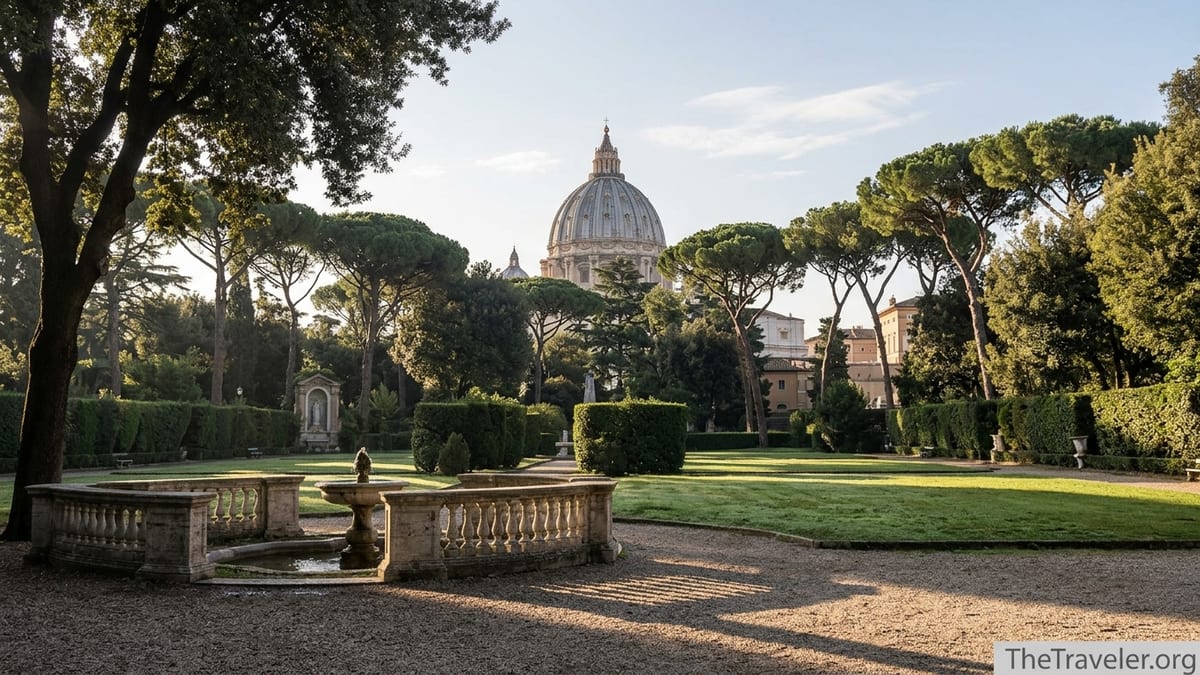
Art and architecture weave through almost every green space in Rome, but the emphasis differs. In the Vatican Gardens, the visual climax is often the view back toward St Peter’s Basilica. From several vantage points, the immense dome rises above the treetops, framed by stone balustrades and fountains. Many visitors consider these perspectives some of the most memorable views of the basilica because they combine the iconic skyline with a sense of seclusion impossible in the packed square below.
Inside the gardens themselves, the art tends toward religious statuary, papal coats of arms, and fountains with allegorical themes. Renaissance and Baroque elements coexist with 19th and 20th-century additions, reflecting centuries of piecemeal development. The mood is layered and occasionally eclectic, as one passes from formal hedges to rock grottos to open lawns.
By contrast, Villa Borghese’s artistic centerpiece is indoors: the Galleria Borghese. Travelers who book a timed-entry ticket to the museum step into a lavish villa housing masterpieces by Bernini, Caravaggio, and Canova. Outside, the park’s sculptures, fountains, and pavilions act as elegant scenery for picnics, concerts, and open-air cinema events. The Orto Botanico’s built features are more restrained, with historic greenhouses, stone staircases, and fountains that support its scientific and educational mission rather than dominate it.
Even the way you experience views differs. In Villa Borghese, the Pincian Terrace offers sweeping panoramas over Piazza del Popolo and the domes of central Rome, often shared with crowds of sunset-watchers and street musicians. In Villa Doria Pamphilj, hilltop clearings reveal distant city skylines beyond wide meadows. In the Vatican Gardens, lookouts are more intimate and controlled, accessible only for a few moments as your group pauses. Photographers must make the most of those brief stops and respect the pace of the tour, which favors quiet appreciation over long private photo sessions.
Botanical Diversity and Landscape Styles
Botanically, the Vatican Gardens are surprisingly varied for their size. Popes from the 17th century onward ordered the planting of species from across Europe and beyond, enriching the grounds with pines, cypresses, oaks, citrus espaliers, and ornamentals chosen as much for symbolism as beauty. Portions of the garden are laid out in formal Italian style, with geometric beds and clipped hedges, while other areas feel more like an English landscape park, with winding paths and irregular plantings. The result is a patchwork of styles layered over centuries of papal tastes.
However, if your primary interest is plant collections, Rome’s Orto Botanico arguably offers a deeper dive. Spread over the Janiculum hillside above Trastevere, the botanical garden dedicates separate zones to Mediterranean scrub, bamboo forests, succulents, and medicinal plants. Labels identify species and their origins, and shaded benches encourage visitors to linger and study. Admission is inexpensive, and you can move at your own rhythm, making it a favorite for travelers who enjoy slow, observational travel rather than guided commentary.
Villa Doria Pamphilj presents yet another landscape personality. It is Rome’s largest landscaped public park, with an area around 180 hectares, and combines remnants of a Baroque formal garden near the central villa with extensive lawns, woods, and even semi-rural stretches that feel surprisingly wild for a capital city. Locals treat it as an outdoor gym, dog park, and countryside substitute. While there are historic plantings and an interesting botanical heritage, they are spread across a huge area, and many visitors focus more on movement and space than on individual species.
For the average traveler, this means that Vatican Gardens provide a curated botanical sampling within a tight frame of time and space, supported by a guide who may point out specific trees or grottos but will rarely dwell on scientific details. Orto Botanico, by contrast, invites self-guided exploration and satisfies those who like to read plant labels and compare different ecological zones. Villa Borghese, with its ponds and ornamental trees, sits somewhere in between, providing a lush backdrop for leisure rather than a structured plant collection.
Planning a Visit: When the Vatican Gardens Make Sense
From a practical standpoint, the Vatican Gardens are neither an everyday green escape nor a last-minute decision. Tickets are limited and tied to specific time slots, and in busy months they can sell out days or weeks ahead. Because garden access is bundled with Vatican Museums entry, many travelers choose the tour as a way to secure a guaranteed museum visit when standard tickets on certain dates show as unavailable. Compared with buying a simple museum ticket, this route costs more, but it adds a quieter outdoor component to a day that might otherwise be spent entirely indoors.
By contrast, if you arrive in Rome on a sunny afternoon with no reservations, Villa Borghese and Villa Doria Pamphilj are your spontaneous options. You can rent a bike, buy gelato from a kiosk, and follow the crowd to popular view points with no prior planning. The only timed commitments you might face are separate reservations for attractions like Galleria Borghese, which uses a strict timed-entry system and can book out, especially on weekends and holidays.
Travelers with mobility considerations should factor in the different experiences as well. Vatican Gardens walking tours involve slopes and uneven paths and require staying with the group, which may move at a fixed pace. There are also open-bus tours that reduce walking but still require climbing on and off the vehicle and sitting for extended periods; some formats are not suitable for very young children or visitors with significant mobility limitations. Public parks in Rome generally offer more flexibility: at Villa Borghese, for example, broad paved avenues are popular with wheelchair users and families with strollers, and you can pause or turn back whenever you wish.
Budget and time are also deciding factors. A family of four paying for Vatican Gardens access, museums, and perhaps a guided city tour elsewhere in the day will notice the cumulative cost. Choosing instead to combine a standard Vatican Museums visit with a free afternoon in Villa Doria Pamphilj offers a more economical mix of culture and green space. On the other hand, for travelers who may only visit Rome once, the prospect of seeing the “hidden half” of Vatican City often justifies the extra expense.
The Takeaway
In a city blessed with grand green spaces, the Vatican Gardens occupy a category of their own. They are not a local jogging haunt, a picnic lawn, or a purely botanical institution. Rather, they are a private papal retreat, a diplomatic landscape, and an outdoor extension of the Vatican Museums, opened to visitors on the Vatican’s terms and timetable. This makes them more structured, more expensive, and less spontaneous than Rome’s beloved public parks, but also more intimate in their connection to the papacy and global Catholicism.
Travelers choosing between the Vatican Gardens and other Roman gardens are not deciding which is “better,” but which fits their expectations. If you want to spread a blanket, watch local life, and let children run, Villa Borghese or Villa Doria Pamphilj will serve you far better. If you are curious about the inner life of Vatican City, interested in religious sites even outside church walls, and comfortable joining an organized tour, the Vatican Gardens will feel like a privileged glimpse behind the Vatican’s stone ramparts.
In practice, the ideal Roman itinerary often includes both. A morning among papal pines and Marian shrines, followed by an evening bike ride past the lake in Villa Borghese or a sunset walk above Trastevere in the Orto Botanico, reveals the full range of the city’s relationship with nature. From private devotion to public leisure, Rome’s gardens tell parallel stories, and the Vatican Gardens are the quiet, guarded chapter that most travelers only discover once they step inside.
FAQ
Q1. Do I need a separate ticket to visit the Vatican Gardens?
Yes. Entry to the Vatican Gardens is only possible with a specific ticket or tour that includes the gardens, usually sold through the Vatican Museums and bundled with museum and Sistine Chapel access.
Q2. Can I wander the Vatican Gardens on my own?
No. Unlike public parks in Rome, you must stay with an official guided walking group or on an authorized open-bus tour and cannot explore independently.
Q3. How much time should I allow for a Vatican Gardens visit?
Most garden tours last between 90 minutes and two hours, after which you can continue into the Vatican Museums. Plan at least half a day in total if you want to see both gardens and major museum highlights.
Q4. Are the Vatican Gardens suitable for children?
Yes, but the structured format may feel long for younger children. There is no playground, and kids must stay with the group. Active play is better suited to places like Villa Borghese or Villa Doria Pamphilj.
Q5. How do the Vatican Gardens compare with Villa Borghese?
Villa Borghese is a free public park ideal for strolling, cycling, and picnics, with museums and views over central Rome. The Vatican Gardens are a paid, guided, and more contemplative experience inside Vatican City.
Q6. Is a Vatican Gardens tour worth it if I have already visited the Vatican Museums?
If you are interested in the papacy, religious symbolism, or quieter viewpoints of St Peter’s, many travelers find it worthwhile. If your priority is art and you are short on time, an additional museum-focused visit may offer more value.
Q7. What should I wear to visit the Vatican Gardens?
Dress as you would for the Vatican Museums or St Peter’s Basilica: shoulders and knees covered, no beachwear, and comfortable walking shoes suitable for uneven paths.
Q8. Can I take photos in the Vatican Gardens?
Yes, photography for personal use is generally allowed, but you must follow your guide’s instructions and keep pace with the group. Tripods and drones are not permitted.
Q9. Are the Vatican Gardens accessible for visitors with limited mobility?
Accessibility varies by tour format. Walking tours involve slopes and cobblestones, which can be challenging. Open-bus tours reduce walking but may still present boarding steps. It is advisable to check current options in advance.
Q10. Do the Vatican Gardens stay open in bad weather?
Most tours run in light rain, so bring appropriate clothing. In cases of severe weather or unforeseen Vatican activities, itineraries can be modified or, rarely, canceled, with arrangements handled through the ticket office or tour provider.