


From the moment I joined the slow, shuffling queue outside the Vatican Museums, I assumed my visit would be a familiar Roman story of crowds, selfies and sore feet. Yet less than an hour later I was standing in a shaded avenue high above St Peter’s dome, listening to nothing more than birdsong and the soft whir of an electric minibus. What surprised me most about the Vatican Gardens was not their beauty, which I expected, but the depth of the peace hidden behind those famous walls.
Get the latest updates straight to your inbox!
Discovering a Different Vatican
Most visitors arrive at the Vatican prepared for sensory overload. On a busy summer morning, the line for the museums can wrap along Viale Vaticano and the chatter of tour groups in a dozen languages fills the air. That is why the contrast, once you step into the Vatican Gardens, is so startling. Capacity is tightly controlled and visits are only possible on guided tours, so you move from the packed museum entrance into a space where groups are small, voices are low and there is suddenly room to breathe.
The gardens cover more than half of the territory of Vatican City, a patchwork of lawns, woodland and formal vistas spreading up the slope of Vatican Hill. Even though the walls are only a few meters thick, they work like a sound curtain. The honk of Roman traffic on Via della Conciliazione drops away, replaced by the rustle of leaves and the splash of fountains. After navigating security checks and ticket scanners, the quiet feels almost like stepping backstage at a theatre where the show has paused.
On my first visit I booked an official open bus tour, now one of the most common ways to see the gardens. The eco-friendly minibuses weave along narrow paved lanes in a loop of about 45 minutes, with a multilingual audio guide explaining what you see. The guide’s voice is gentle, the pace unhurried. There are short stops for photos, but no frantic herding. Looking around at my fellow passengers, many still clutching museum maps, I saw the same slightly dazed expression. We had expected more culture, more art, more effort. Instead, we had been handed something much rarer in Rome: uninterrupted calm.
Tickets, Tours and the Practicalities of Finding Quiet
Part of what makes the Vatican Gardens unexpectedly peaceful is how difficult they are to access compared with the museums next door. You cannot simply wander in. There are no last-minute “garden only” tickets sold at the door and, as of 2026, every visitor must book a timed tour in advance, usually through the Vatican Museums’ official system or a reputable tour operator. The booking window opens about 60 days before the date of your visit and, during peak seasons like spring and the Jubilee year of 2025, many morning slots sell out quickly.
Prices vary depending on the type of visit. Open bus experiences marketed by agencies typically start around 40 to 45 euros per adult, including the subsequent entry to the Vatican Museums and Sistine Chapel. Guided walking tours of the gardens, which last closer to two hours and often continue into the museums with a live guide, can cost more, especially when booked through international platforms that add service fees. If you see offers for “quick entry” or “special access,” read the fine print. In most cases, you are paying for the same carefully regulated experience, not a secret shortcut known only to insiders.
To preserve the garden’s atmosphere, numbers are kept low compared with the tens of thousands who pour into the museums daily. That has a side benefit for travelers: even in high season, garden tours feel much less crowded than the Raphael Rooms. Families with young children often choose the open bus option, which avoids the steepest paths, while serious garden lovers opt for walking tours that pause longer in key areas like the Italian Garden and Rose Garden. In both cases, you enter via the museum security checkpoint, then peel off from the main crowd at a designated meeting point where a staff member collects only those booked for the garden experience.
First Glimpses: The Sound of Water and Wind
My first sense that the Vatican Gardens would not be just another checklist stop came within minutes of boarding the minibus. We glided past the back of the Vatican Museums, then turned into a narrow lane lined with stone walls. On the right, a small fountain sent a thin arc of water into an ancient basin, catching the mid-morning light. There were perhaps twenty of us on the bus, but as the audio guide began to speak, everyone instinctively hushed.
As we climbed Vatican Hill, the views opened like a slow reveal. Between cypress trunks, I could see the giant colonnade of St Peter’s Square curving gently around an almost invisible crowd. Seagulls traced lazy circles above the dome. Yet up on the garden roads, all I heard was the crunch of gravel and the soft hum of the electric engine. Rome is famous for its fountains, from Trevi to Piazza Navona, but the fountains here feel more private. One, in the Italian Garden, sends a steady cascade down mossy steps into a pool where a single goldfish circles. It is not spectacular for cameras, but it is endlessly soothing when you are standing close enough to feel the cool spray.
The guide pointed out details I would have missed alone. A cluster of olive trees near the Papal Apartments, gifts from different Mediterranean countries. A small shrine dedicated to the Virgin, set into a rock grotto that echoes the famous site at Lourdes. Each stop added layers of meaning to the surroundings, yet the commentary never broke the spell of quiet. At one point, the bus paused near the Vatican Radio building and the audio guide fell silent. All that remained was the murmur of wind in umbrella pines and, faintly, the distant swell of voices from St Peter’s Square. The contrast was almost surreal.
Walking the Hidden Paths: Where the Peace Deepens
On a later trip I chose a walking tour, curious whether the gardens would still feel as peaceful without the cushion of the bus windows. The answer was yes, and then some. Walking brings you onto smaller paths that vehicles cannot reach, including long, shaded corridors of greenery where the rest of the city feels unimaginably far away. Our group was limited to around fifteen people. After the initial introductions, conversation faded. Our guide encouraged us to walk a few meters apart if we wished, “to hear the place as popes have heard it for centuries,” as she put it.
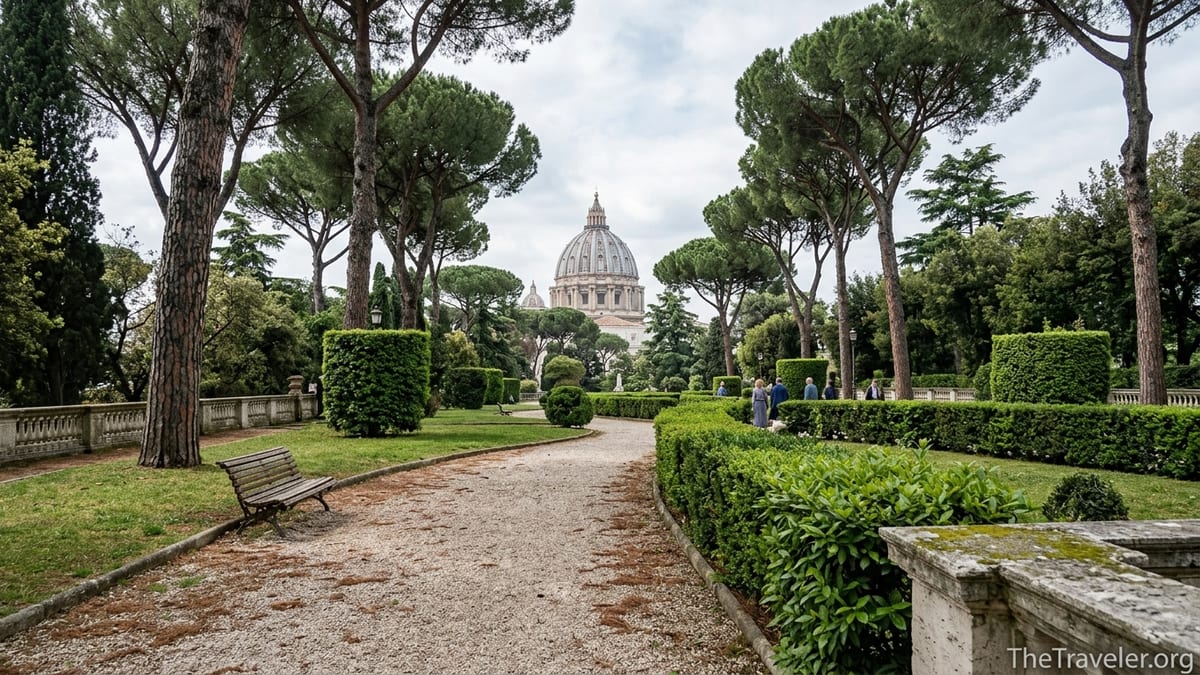
One stretch that stayed with me was a simple gravel path between tall hedges, leading gently uphill. Halfway along, the guide stopped speaking and let us continue in silence. At the top, the hedges opened onto a lawn with an unbroken view of St Peter’s dome, perfectly framed by pines. I had seen that dome from every possible angle over several trips to Rome, yet this perspective felt new. From here, the basilica did not dominate the scene but rose quietly out of the landscape, like a reminder that even great monuments are rooted in a very human need for stillness.
We passed the Rose Garden, where archways of climbing roses form natural tunnels of fragrance in late spring. Beyond it, the path curved past Mater Ecclesiae, the former monastery where Pope Benedict XVI lived after his resignation. The building itself is modest, but the surrounding groves of olive and fruit trees make it easy to imagine a retired pope walking slowly under their branches at dusk. The guide mentioned that, for Vatican staff, the gardens have long been a refuge from office stress, a place for lunchtime walks and quiet conversations away from formal meeting rooms.
Designing Peace: Italian, English and French Influences
The serenity of the Vatican Gardens is not accidental. Over centuries, popes and landscape architects have deliberately shaped this patch of land into a kind of living retreat. As you move through the estate, the style shifts almost imperceptibly from formal Italian geometry to softer English romanticism and precise French parterres. Each style affects how you feel in the space.
In the Italian Garden, near the Governor’s Palace, trimmed box hedges outline perfect geometric shapes around low fountains. Potted lemon trees mark the edges of stone terraces. Standing there feels like inhabiting an architectural drawing, every line and curve in careful balance. It encourages a particular kind of peace, the orderliness of a space where nothing is left to chance. Garden enthusiasts often linger here, comparing the layout to villas outside Florence or the terraces at Tivoli.
Further along, the mood relaxes. The so-called English Garden uses winding paths, irregular clumps of trees and small lawns that appear and disappear as you walk. Benches are tucked into corners with views toward the city walls or up to the Vatican Observatory domes. The asymmetry invites wandering and personal reflection. You are no longer looking at a grand design so much as discovering one small, intimate scene after another: a lone cypress silhouetted against the sky, a stone bench warmed by the sun, a stray cat dozing in a patch of thyme.
Near the Governor’s Palace you encounter a more French sensibility: neat gravel, clipped hedges and flowerbeds arranged like embroidery in front of official buildings. This section feels a little more ceremonial, yet even here the limited number of visitors keeps the mood gentle. Occasionally you will see a small maintenance team trimming or replanting. Their presence reinforces that this is not a museum set frozen in time, but a working landscape constantly adjusted to nurture the atmosphere of repose.
When to Go and How to Protect the Quiet
Timing matters greatly if you want to experience the gardens at their most peaceful. Early morning tours often benefit from cooler air and softer light, especially between April and October when Rome’s afternoons can be brutally hot. Midday visits, while still calm compared with the museums, may bring slightly more background noise from the city and busier paths as maintenance teams go about their work. Late afternoon tours, when available, can be especially atmospheric; the low sun catches the dome of St Peter’s and bathes the lawns in a golden haze.
Because tours run on a tight schedule and involve security procedures, you should arrive at the Vatican Museums entrance at least 20 to 30 minutes before your garden start time. If you arrive late and miss the group, staff are rarely able to slot you into another tour that day because numbers are capped. In peak months, many independent travelers find that garden tours are sometimes easier to book than general museum tickets, which can sell out entirely. A garden ticket usually includes standard museum entry afterward, allowing you to visit the galleries at your own pace once the tour concludes.
Once inside the gardens, visitors play a role in preserving the peace they came to find. Guides will usually ask groups to keep conversations low and to switch phones to silent. Selfie sticks and large tripods are strongly discouraged. Simple etiquette goes a long way: step aside for wheelchair users on narrow paths, avoid loud calls or video chats, and resist the impulse to turn every corner into a photo session. There are many viewpoints where your memories will be stronger if you simply lean on a railing for a minute and look, rather than rush to capture every angle.
The Gardens After the Gardens: How the Peace Lingers
What struck me most about the Vatican Gardens was how the sense of calm lingered long after I had rejoined the city. Exiting the gardens, you typically find yourself back at the threshold of the Vatican Museums, funneled into corridors of sculpture and tapestry. The crowds return. Yet the memory of the quiet hilltop lawns and shaded avenues changes how you experience the rest of the visit. Instead of feeling trapped in a single crescendo of art and history, the day acquires its own rhythm: noise, then silence, then noise again.
I noticed it most clearly in the Sistine Chapel. After the garden tour, standing shoulder to shoulder under Michelangelo’s ceiling, I felt less overwhelmed than on previous visits. The stillness I had felt outdoors gave me a mental foothold. I could look up, absorb a single panel, and then close my eyes for a moment, recalling the sound of the garden fountains. For some visitors seated along the walls, eyes closed, I suspected the same mental retreat was taking place, using their recent garden experience as a counterbalance to the intensity of the chapel.
Back outside on the streets around the Vatican, the contrast sharpened again. Pilgrim groups hurried across the cobbles, souvenir sellers called out prices for rosaries and magnets, and police whistles cut through the din. Yet I was walking with the slow step the gardens had taught me. That is perhaps their greatest gift: they do not change Rome, but they quietly change the way you move through it.
The Takeaway
If your image of the Vatican is limited to dense crowds, ornate ceilings and packed security lines, the Vatican Gardens will come as a genuine surprise. They reveal an entirely different face of the world’s smallest state, one where carefully tended trees, modest shrines and long vistas of lawn take precedence over gold and marble. The peace here is not accidental. It is the product of centuries of thought about how landscape can support contemplation, layered over with modern decisions to limit numbers and require guided visits.
For travelers, this means the gardens are both a logistical challenge and a rare luxury. You must plan ahead, book a specific tour and accept that you will be part of a small group rather than wandering alone. In return, you receive something unexpectedly precious in Rome: a protected pocket of quiet where you can hear your own footsteps and the murmur of water more clearly than any tour guide. Whether you choose the open bus or a slower walking route, make space in your itinerary to simply stand still somewhere on Vatican Hill, between the cypresses and the dome. That stillness may well become the moment you remember most vividly long after your trip ends.
FAQ
Q1. Can I visit the Vatican Gardens without a guided tour?
Independent visits are not allowed. Access is only possible on official guided walking tours or open bus tours booked in advance, typically including museum entry.
Q2. How far in advance should I book a Vatican Gardens tour?
The booking window usually opens about 60 days before the visit date. For popular months such as April to October, it is wise to reserve as soon as slots appear.
Q3. Are Vatican Gardens tours suitable for children and older travelers?
Yes. The open bus tour is ideal for those who prefer less walking, while reasonably fit visitors often enjoy the two-hour walking tours with frequent stops and shade.
Q4. What should I wear for a visit to the Vatican Gardens?
Dress codes are more relaxed than inside St Peter’s, but modest clothing is still recommended. Comfortable walking shoes, a hat and light layers work well in most seasons.
Q5. Can I stay in the Vatican Museums after my garden tour?
In most cases, yes. Garden tickets typically include standard entry to the museums and Sistine Chapel afterward, allowing you to continue your visit at your own pace.
Q6. Are the Vatican Gardens accessible for wheelchair users?
Accessibility is improving, and open bus tours can be more suitable than walking routes. It is best to check current options when booking and mention any mobility needs.
Q7. Is photography allowed in the Vatican Gardens?
Photography for personal use is generally permitted, but large tripods, drones and elaborate photo shoots are not. Guides may ask you to limit photos in narrow or sacred areas.
Q8. What time of day is most peaceful in the gardens?
Morning and late afternoon tours usually feel calmest, with softer light and fewer background noises. Midday can be warmer and slightly busier with maintenance activity.
Q9. Do Vatican Gardens tours run in bad weather?
Tours operate in light rain, so bring a compact umbrella or rain jacket. In cases of severe weather, the Vatican may modify or cancel tours and offer alternative arrangements.
Q10. Is a Vatican Gardens visit worth it if I am short on time in Rome?
If you value quiet and nature, the gardens are an excellent use of a morning, especially because your ticket usually includes museum entry, combining two experiences in one.