


On most Vatican itineraries, the Museums and the Sistine Chapel steal the spotlight, while the vast green heart of the tiny city state remains little more than a backdrop. Yet behind the high walls and domes lies a sanctuary of winding paths, fountains, grottoes, and secluded terraces that have sheltered popes for centuries. With access strictly controlled through guided visits, the Vatican Gardens conceal corners that even many repeat visitors never realize exist. For travelers willing to plan ahead, these hidden spaces offer some of Rome’s most contemplative views and intimate encounters with history.
Get the latest updates straight to your inbox!
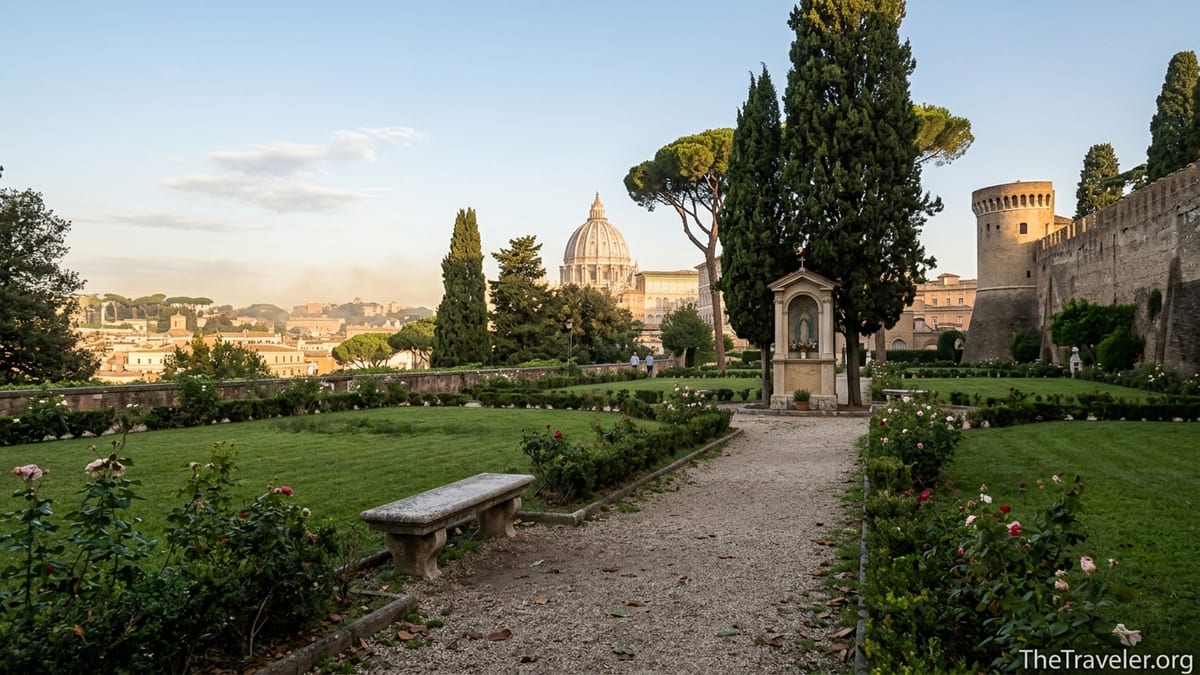
Why the Vatican Gardens Feel So Hidden
Although they cover roughly half of Vatican City, the Gardens remain invisible from most public areas. High medieval and Renaissance walls encircle the hill, and from St Peter’s Square only treetops and a few statues peek over the stone ramparts. This physical separation preserves a level of quiet that can feel startling after the queues and security lines outside, and it is one reason so many visitors leave Rome without ever setting foot among the lawns and wooded slopes.
Access is limited by design. You cannot simply wander into the Vatican Gardens after visiting the Museums; entry is only possible on a booked tour, either on foot with an official guide or by open-top minibus following a fixed circuit. As of mid 2026, standard garden tours generally cost in the region of 32 to 40 euros per adult, usually including same-day entry to the Vatican Museums and Sistine Chapel. Tickets must be purchased in advance for a specific time slot, typically early in the morning when the light is soft and the air still cool.
This controlled access is a mixed blessing for travelers. It means that you share the paths with a relatively small group rather than the thousands moving through the Museums at any given moment. It also means, however, that certain corners remain known only to those who choose the garden route, and that crisp decisions about tour type and timing can determine how much of this green world you actually get to see.
The Medieval Walls and Forgotten Fortifications
One of the most atmospheric hidden aspects of the Vatican Gardens is not a single spot but a continuous presence: the old defensive walls and bastions that still snake across the hillside. In places they rise directly from the lawns and flowerbeds, a reminder that this oasis began life as a fortified stronghold rather than a park. Sections of the Leonine Wall, first raised in the 9th century to protect the papal enclave from raids, still stand embedded amid cypress trees and pines.
On a walking tour, your guide may lead you along paths that press right up against the stone. Here, with ivy clinging to the blocks and the distant hum of Roman traffic faint through the masonry, it becomes easier to imagine the Vatican as a hilltop citadel. From certain angles, especially near the western edges, you can look back through narrow openings to catch oblique, almost secret views of the dome of St Peter’s rising above the battlements.
Few visitors know that small towers and bastioned corners once formed part of a continuous defensive circuit, some later adapted as quiet lookouts over the city. Standing at one of these vantage points, travelers can often see both the tangled roofs of the Borgo district outside the walls and, in the opposite direction, sheltered lawns that seem reserved for no one but the gardeners and the occasional strolling cleric. It is this tension between fortress and garden that gives these edges their particular charm.
The Lourdes Grotto: A Pilgrimage Corner in Miniature
Perhaps the most evocative of the Vatican Gardens’ devotional sites is the Lourdes Grotto, a faithful replica of the famous sanctuary in southern France. Tucked along the base of the hill near the old walls, this artificial cave was a gift to Pope Leo XIII in the early 20th century and soon became a favored place of evening prayer. Popes from Pius XI to John Paul II have visited this corner to recite the rosary or preside over Marian ceremonies away from the public gaze.
When you approach on a walking tour, the mood shifts noticeably from the manicured terraces elsewhere in the Gardens. Benches line a small piazzale, often shaded and quiet even when other paths are busy with groups. A statue of the Virgin stands in the rocky niche above the altar, with flickering candles sometimes left from recent liturgies. The setting is intimate but not theatrical: rough-hewn stone, climbing greenery, and the gentle sound of water from a nearby fountain invite a pause rather than a photo rush.
Many visitors report that this is one of the few places inside the Vatican where they experience real stillness. On slower tours, guides sometimes allow several minutes of silence here, and if you linger at the back of your group you may catch a moment when the space empties out entirely. It is in those brief interludes, with only birdsong and the distant tolling of bells, that the Gardens feel least like a destination and most like a working place of prayer.
Casina Pio IV and the Secret Culture of Papal Retreats
Another corner that many visitors glimpse only in passing is the Casina Pio IV, a small but richly decorated palace set within the lawns. Built in the 16th century, it once served as a papal retreat and today houses the headquarters of the Pontifical Academy of Sciences. From the outside it resembles a compact suburban villa, yet its stucco reliefs and loggias hint at the wealth of art concealed inside.
Standard group tours typically do not enter the building itself, but walking routes often curve close enough for travelers to study the façades and peek into the surrounding courtyards. The geometry of the adjacent Italianate garden, with its tight boxwood hedges and classical statuary, contrasts sharply with the wilder slopes higher up the hill. On some itineraries, guides also point out how the alignment of paths and sightlines was designed to connect the Casina visually with St Peter’s Dome, reinforcing the idea of a unified papal landscape.
For most travelers, the intrigue lies in imagining the building’s quieter moments. Scientists and scholars still come here for closed-door conferences, arriving through side entrances far from the main tourist flows. From certain angles along the hedged paths, you can picture dignitaries stepping out onto the terraces for coffee breaks, with Rome unfurling beyond the walls and the murmur of visiting groups barely audible in the distance.
The Rose Garden and Overlook Above the City
At one of the highest points of the Vatican hill lies a rose garden and associated overlooks that reward those who choose the more physically demanding walking options. While open-bus tours may pass near this zone, it is the slower pace on foot that allows travelers to appreciate the subtleties: the different varieties of roses, the scent that gathers in warm weather, and the slightly cooler breeze that rises from the city below.
The Rose Garden has changed over the decades, but it remains a space where fountains, sculptures, and terraces interact with carefully managed beds of flowers. On clear days, you can sometimes catch surprisingly expansive views across Rome, including distant ridgelines and the tangle of domes in the historic center. Unlike the grand axial views from the front of St Peter’s, these perspectives feel more like secrets, partially framed by cypresses and stone balustrades.
In practical terms, this is also the part of the Gardens where visitors feel the slope most strongly. Comfortable shoes with good grip are essential, and in summer a refillable water bottle makes the climb more pleasant, as guided tours rarely linger long near vending machines or cafés. The reward for the effort is a sense of having briefly stepped into the everyday vantage points of Vatican staff and residents, who might cross these terraces on their way to offices or residences few outsiders ever see.
Towers, Heliport and the Unexpected Signs of a Modern Microstate
The Vatican Gardens are often described in terms of silence and prayer, but they are also a working landscape threaded with discreet infrastructure. Nowhere is this more evident than near the Vatican heliport and the medieval Torre San Giovanni, a cylindrical tower that once formed part of the defenses. Today the tower has been restored and occasionally hosts private papal meetings, while the adjacent modern landing pad allows helicopters to connect the tiny state with the wider world in minutes.
From the garden paths, visitors on a walking tour may suddenly glimpse the incongruous sight of a painted landing circle set among cypresses and lawns. The heliport is not usually active during tour hours, and security rules keep groups at a respectful distance, yet its presence is unmistakable. This corner offers a rare visual reminder that the Vatican is not only a pilgrimage goal but also a sovereign state managing its own transport, communications, and logistics.
Nearby, the Torre San Giovanni rises over the tree canopy, its stone mass weathered by centuries of wind and sun. While access inside is closed to the public, guides often point it out while explaining how the Vatican’s defensive architecture has been repurposed for diplomatic and ceremonial functions. For photographers, this juxtaposition of tower and landing pad can make for some of the most memorable images of the Gardens, capturing both continuity and change in a single frame.
Fountains, Symbols and Details Most Visitors Miss
Beyond the obvious showpieces, some of the most rewarding hidden corners in the Vatican Gardens are really details: a sculpted coat of arms half-obscured by foliage, a small shrine tucked beside a path, or a fountain whose spray is heard before it is seen. One example is the Fountain of the Eagle, associated with the heraldic symbol of a historic papal family, where water cascades amid carved rock and greenery. Standard bus routes may glide past at a distance, but only on foot can you fully appreciate the play of light on the wet stone and the way the fountain’s sound muffles the city beyond the walls.
Elsewhere, small chapels and statues dedicated to saints punctuate the lawns. A chapel honoring Saint Thérèse of Lisieux, who was named patroness of the Gardens in the 1920s, stands close to the old walls, its simple lines inviting personal reflection more than grand ceremony. Travelers who stay alert to such features often come away with a stronger sense that the Gardens function as an outdoor extension of the Vatican’s spiritual life rather than a mere ornamental park.
Many of these elements are easy to miss if you are absorbed in conversation or focused solely on distant views of St Peter’s Dome. Guides sometimes point them out, but groups can be large and the pace brisk. A good strategy is to walk near the back of your group, letting a little space open between you and the guide so that you can pause momentarily at an intriguing detail without losing sight of the others. These few seconds of semi-solitude are often where the Gardens’ most personal impressions are formed.
Planning Your Visit: Tours, Timing and Practical Tips
Because access is only possible on a booked visit, planning ahead is crucial if you want to explore the Vatican Gardens’ quieter corners. As of 2026, official garden tours are commonly scheduled in the morning, with some starting around 8:30 or 9:00 a.m. Walking tours typically last around two hours, while open-bus circuits are shorter, often under an hour. In both cases, admission to the Vatican Museums and Sistine Chapel is usually bundled with the same ticket, making the overall price more cost effective if you intend to visit both.
Prices vary depending on provider and inclusions, but travelers can expect typical adult rates for combined garden-and-museum experiences somewhere in the mid-30 to low-40 euros range, with reduced fares for children and students. Private or semi-private garden tours, which may offer more time to linger in specific areas, tend to be significantly more expensive, sometimes several hundred euros per group. It is important to read the inclusions carefully, as some products add early access, hotel pickup, or specialist guides, which may or may not be worth the premium for your style of travel.
Tickets must normally be booked online in advance; you cannot walk up to a Vatican ticket counter on the day and add a Garden visit to a standard Museum pass. Availability is limited, particularly in peak seasons from April to June and September to October, so booking six to eight weeks ahead gives the best chance of securing your preferred date and language. On the day, aim to arrive at the Museums entrance at least 20 to 30 minutes before your scheduled tour to clear security and locate the meeting point without rushing through the crowds outside the walls.
Dress codes for the Gardens follow the same principles as those for the Museums and St Peter’s Basilica: shoulders and knees should be covered, and low-cut tops or short shorts are discouraged. Comfortable walking shoes are strongly recommended, especially for the hillier sections and cobbled or gravel paths. In summer, a hat, sunscreen, and light layers will make the experience more comfortable, while in cooler months a windproof jacket is wise, as the higher terraces can feel noticeably breezier than the streets below.
The Takeaway
For most travelers, the Vatican Gardens will always remain partly unseen. Strictly controlled access, dense planting, and the private nature of many buildings mean that large portions of this enclave are reserved for residents, staff, and invited guests. Yet even within the boundaries of standard guided routes, there are enough hidden corners, overlooked details, and unexpected vistas to reward anyone who makes the effort to include the Gardens in their Vatican day.
What sets this experience apart is not only what you see, but how you see it. Instead of the constant press of the Museum corridors, you move at a more human pace along shaded paths, catching glimpses of stone towers, Marian grottoes, and rose terraces that speak of centuries of quiet ritual behind the public face of the papacy. The presence of modern infrastructure, from the heliport to discreet service roads, only sharpens the sense of the Vatican as a living, working state rather than a frozen monument.
If you plan carefully, choose a tour that matches your interests, and leave room in your schedule to absorb the atmosphere rather than simply ticking off sights, the Vatican Gardens can become one of the most memorable parts of a Roman itinerary. They offer a rare chance to step behind the famous façade and encounter a more intimate side of the world’s smallest country, where faith, history, and everyday life all find space among the trees.
FAQ
Q1. Can I visit the Vatican Gardens without a guided tour?
In practice, no. Access to the Vatican Gardens is reserved for visitors on pre-booked walking or open-bus tours, which must be arranged in advance for a specific date and time.
Q2. How far in advance should I book a Vatican Gardens tour?
Availability is limited, especially in spring and autumn, so booking six to eight weeks ahead is advisable. For peak dates such as around Easter or major papal events, even earlier planning is sensible.
Q3. What is the difference between the walking tour and the open-bus tour?
The walking tour covers more paths at a slower pace, allowing closer views of fountains, chapels, and overlooks. The open-bus tour follows a fixed circuit with audio commentary and does not allow passengers to get off along the route.
Q4. How much does it cost to visit the Vatican Gardens?
As of 2026, typical adult prices for combined Vatican Gardens and Museums tickets usually fall in the mid-30 to low-40 euros range, with reduced rates for children and students. Private tours are significantly more expensive.
Q5. Are the Vatican Gardens suitable for visitors with limited mobility?
Some areas involve slopes, uneven paths, and steps, which can be challenging. Open-bus tours may be more comfortable for those who prefer not to walk long distances, but not all vehicles or routes are fully accessible, so it is wise to check details when booking.
Q6. Can children visit the Vatican Gardens?
Yes, but age rules apply. Children under a certain age, often under six years old, may not be allowed on some tour types, particularly open-bus circuits. Families should verify current age policies before purchasing tickets.
Q7. Is photography allowed in the Vatican Gardens?
Photography for personal use is generally permitted along the tour route, but the use of tripods, drones, or professional equipment is restricted. Visitors are expected to respect the quiet atmosphere, especially near devotional sites like the Lourdes Grotto.
Q8. Do Vatican Gardens tours include the Sistine Chapel?
Most garden tickets bundle same-day entry to the Vatican Museums and Sistine Chapel, which you visit on your own after the tour. It is important to confirm this inclusion when you book, as some third-party packages may differ.
Q9. What is the best time of year to visit the Vatican Gardens?
Spring and early summer offer lush greenery and milder temperatures, while autumn brings softer light and fewer crowds. Midday in high summer can be very hot on exposed paths, so early morning tours are usually more comfortable then.
Q10. Can I stay in the Gardens after my tour ends?
No. Once the guided or bus tour finishes, you continue your visit inside the Vatican Museums complex rather than lingering in the Gardens. The green areas are not open for free roaming beyond the scheduled visit.