


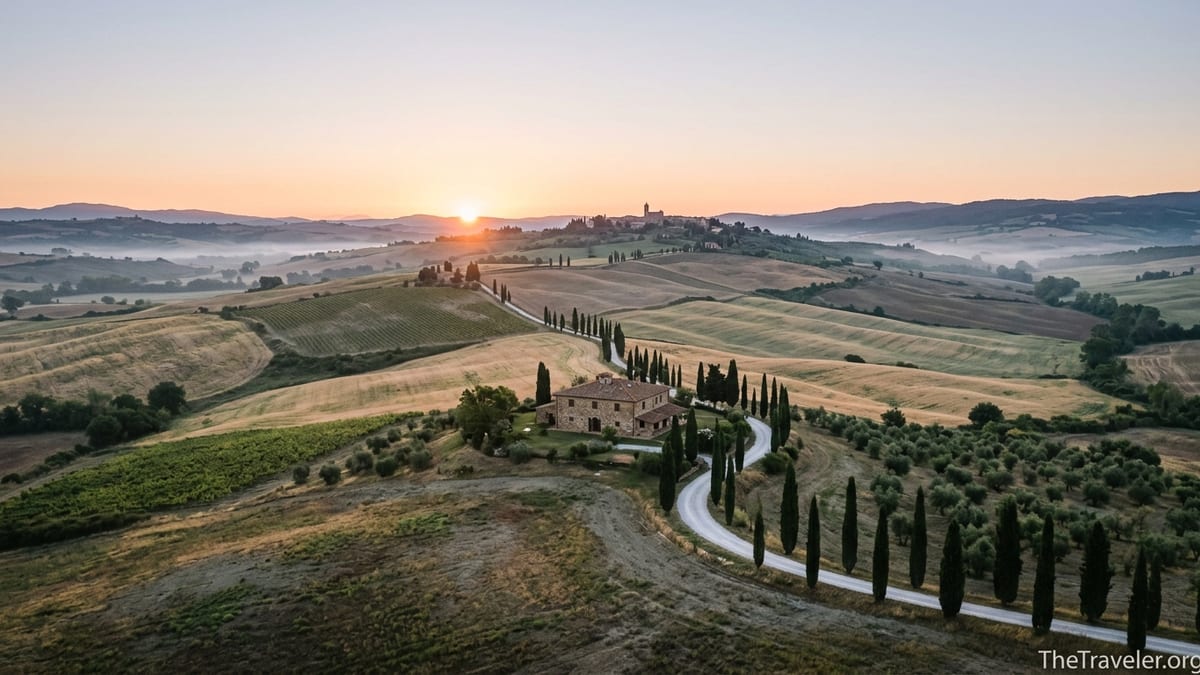
Ask a traveler to picture Tuscany and a very specific image appears: soft clay hills, a lone farmhouse on a ridge, a gravel lane drawing a dark green line of cypress trees to the horizon. It looks simple and timeless, yet this landscape is the result of centuries of deliberate shaping. Set it beside the lavender seas of Provence, the manicured châteaux gardens of the Loire or the wild glens of the Scottish Highlands, and Tuscany stands out as something different: a rural scene designed almost like a painting, but still lived in and worked every day. Understanding how and why it looks this way will change the way you experience it on the ground.
Get the latest updates straight to your inbox!
A Landscape Literally Designed as a Painting
The single biggest difference between Tuscany and many other European regions is that parts of its countryside were consciously planned to be beautiful. The Val d’Orcia, south of Siena, is a UNESCO World Heritage Site not just for its medieval villages but for the surrounding agricultural landscape, which was reorganized in the 14th and 15th centuries to reflect Renaissance ideas of harmony and good governance. Gentle, almost conical hills, grain fields and pastures were laid out so that views from towns like Pienza and Montalcino formed a balanced, almost theatrical backdrop.
If you stand by the little stone Chapel of the Madonna di Vitaleta between San Quirico d’Orcia and Pienza, the composition around you feels intentional: a foreground of wheat, a midground of dark cypress, and pale hills rolling away under a wide sky. That is not an accident. Renaissance city-states such as Siena saw the countryside as a showcase, and landowners shaped farms, tree lines and access roads to look orderly from the main routes, including the old Via Francigena pilgrim road that still runs through the valley.
By contrast, the famous lavender landscapes of Provence, while striking, were not planned in the same pictorial way. Around Valensole or Sault, broad purple fields spread across plateaux and up rough hillsides, broken by scrub and oak. The effect is dramatic, but the geometry comes from maximizing sun and soil conditions for lavender, not from an overarching visual plan. Similarly, in the Loire Valley the scenery is arranged around the Loire River and its tributaries, with châteaux and gardens positioned primarily to control water and trade rather than to create the kind of continuous, painterly horizon you encounter almost everywhere in southern Tuscany.
This “designed but still working” quality is what many visitors feel without quite naming. When you drive a winding white road near La Foce, where an iconic S-shaped cypress lane curls down a bare clay hill, you are literally following a line drawn into the landscape in the 20th century to lock in a visual rhythm that had already made the Val d’Orcia famous in Renaissance painting.
Cypress Lines vs Forests, Hedges and Stone Walls
Every region has its signature vegetation. In Tuscany it is the tall, dark, pencil-thin cypress, used almost like punctuation marks in the view. From Florence down through the Chianti hills and into the Crete Senesi and Val d’Orcia, cypress trees are planted in rows along access drives, clustered around farmyards or standing alone on ridge crests. They act as vertical exclamation points in an otherwise soft, horizontal landscape of fields and low hills.
Compare that to the Scottish Highlands, where the emotional power of the scenery comes from rugged slopes of heather and grass broken by rocky outcrops, peat bogs and scattered Scots pines. There, trees tend to appear in natural clumps or reforested patches, while long stone walls or wire fences cut across the glens. The drama is wild and uncontained. In the English Cotswolds, field patterns are enclosed by hedgerows and honey-colored dry stone walls that criss-cross small rolling hills, giving an intimate, almost domestic scale to the countryside. You rarely get the long, sweeping sightlines found near Asciano or San Quirico in Tuscany.
In wine-growing regions like the Loire or Germany’s Moselle Valley, the visual rhythm is established by the tight, repeated patterns of vines on slopes running down to rivers. These are beautiful in their own right but feel more industrial and repetitive. Tuscan vineyards, especially around Montepulciano, Montalcino and the Chianti Classico area, tend to be broken up by olive groves, small woods and fallow fields. The classic view from a hillside agriturismo near Castellina in Chianti might show rows of vines in the foreground, but beyond that you will see a patchwork of silvery olive orchards and dark woods, stitched together by lines of cypress and narrow dirt tracks. That mosaic gives Tuscany a layered depth many visitors notice when they stop at a random roadside lay-by to take a photo and realize every direction looks like a postcard.
Human Scale: Hill Towns, Farmhouses and the Distance Between Them
Tuscany’s landscapes are defined by a very human scale. Medieval and Renaissance hill towns such as Montepulciano, Volterra, San Gimignano and Cortona sit on separate hilltops within visible, walkable distance of each other, usually with cultivated land running right up to their walls. From the ramparts of Montepulciano you can see fields, farms and another village in a single, uninterrupted view. The distances are short enough that, in cooler months, confident hikers can walk between smaller villages like Monticchiello and Pienza in a half day, following gravel farm tracks through tilled fields and vineyards.
In the Scottish Highlands or the Dolomites, by contrast, settlement is often strung along loch shores or valley bottoms, with steep, uninhabitable slopes rising sharply on either side. Villages may lie many kilometers apart, and whole tracts of mountain are uninhabited. The sense is of nature dominating and people tucked in at its edges. In the Dutch or Belgian lowlands, towns are closer together but the land is flatter and more heavily engineered with dikes and canals, so when you stand on a dyke near Kinderdijk the focus is on the sky and water, not on clusters of buildings punctuating hills.
Tuscans also built relatively large, self-contained farmsteads called poderi or fattorie, which still shape how the land feels today. Typical agriturismo properties near places like Buonconvento or Radda in Chianti occupy these old farm complexes, often set alone on a hill with 360-degree views. Travelers who book a week there get the oddly luxurious experience of being surrounded by open agricultural land but never feeling lost in it. Everything is at a legible distance, from the next ridge-top villa to the white track that will eventually bring you back to the main paved road.
In the Loire Valley, many estates center on a château and manicured parkland, with villages and tenant farms scattered in a looser halo beyond. The core view from a terrace at Château de Chaumont-sur-Loire, for instance, takes in the formal gardens and the broad Loire River, with settlement detail receding into the distance. In Tuscany the hierarchy is flatter: a single stone farmhouse or a small parish church on a knoll can command as much visual attention as a town, because the surrounding fields have been kept purposefully open.
Light, Seasons and Color: Why Photos Look “More Tuscan”
Travelers often comment that their photographs from Tuscany look strangely close to tourism posters, even on a basic smartphone. Part of this is the quality of light. Central Italy’s latitude and often clear air produce strong, low-angled morning and late afternoon sun that rakes across ridges and picks out the textures of ploughed clay, wheat and vineyard rows. In late May and June, young grain turns the hills a soft green, while rolled hay bales appear by early summer, adding round, sculptural forms to the slopes.
Color also sets Tuscany apart from other regions. Around Siena and the Crete Senesi, bare clay can make the land appear almost lunar in early spring, shifting to golden-brown by August. Dark cypress and stone farmhouses in warm, earthy tones act as counterpoints. Provence’s palette, by comparison, peaks when lavender is in bloom between late June and mid July, flooding fields with purple, then fades to more neutral tones once the crop is harvested. In the Highlands or Scandinavian fjord country, much of the drama depends on fast-changing weather and the contrast of dark rock, green grass and often grey water, creating moody, high-contrast scenes rather than the softly graded bands you see driving from Siena to Montalcino.
Winter and autumn in Tuscany remain visually legible in ways some regions do not. Vineyards around Greve in Chianti turn orange and red, olive groves keep their muted silver-green, and ploughed fields mark slopes in neat arcs. In northern wine regions like Germany’s Rheingau or Burgundy, vines drop their leaves and hills can sit in a brown-grey lull until spring. In Scotland or Ireland, winter colors flatten into dark greens and browns under low, often wet skies. In Tuscany, even on a cloudy January day, the structural elements of the landscape cypress lines, terraced fields, lone pines on knolls are still clearly drawn.
For practical travelers, this means shoulder seasons can be visually rewarding. A November drive from Florence to Pienza might cost significantly less in accommodation than an August trip and still deliver classic views, especially in the early morning when mists collect in the valleys and hill towns appear like islands. The same journey in a flat, intensively farmed region might show little beyond stubble and bare earth.
Living Agricultural Heritage vs Open-Air Museum
UNESCO describes the Val d’Orcia as a “cultural landscape,” meaning that the scenery is valued not just for its natural features but for how people have shaped it over time. Crucially, it is still a working countryside. Fields are farmed for wheat, sunflowers, vines and olives, and many of the stone farmhouses you see from the roadside are either inhabited or used seasonally. This ongoing use distinguishes Tuscany from some other famous scenic areas which feel more like open-air museums.
In parts of the Loire, for example, châteaux gardens are restored to historical designs and managed as visitor attractions. While they are impressive, the wider agricultural matrix can feel secondary to the visitor experience, which often centers on guided tours of interiors and formal lawns. In certain Alpine valleys, traditional hay meadows are cut primarily to preserve biodiversity and heritage, while much of the economic activity occurs in ski tourism. The result is a landscape that, though stunning, is structured more around seasonal tourism cycles than everyday farming life.
By contrast, if you stay at a farmhouse near Pienza or in the hills above Lucca, your day might start with the sound of a tractor or the bark of farm dogs. In late September, you may see grape harvest crews moving through the rows, while November brings the olive harvest. You can watch crates of just-picked olives arrive at a village frantoio, where locals come to press a family’s crop into peppery new oil. These small, repetitive actions preserve not just techniques but the visual rhythm of groves and terraces.
That is not to say Tuscany has escaped change. In some corners of the Chianti hills, old farm buildings have become high-end villas and boutique hotels, and small patchwork fields have been consolidated into larger vineyards. Yet strict building regulations and a strong cultural attachment to the “classic” look of the countryside have slowed the pace and form of change compared with, say, the rapid expansion of resort complexes in parts of coastal Spain or the wholesale replacement of hedgerows by large open fields in some northern European plains.
Experiencing Tuscan Landscapes on the Ground
Many travelers “see” Tuscany mainly from the window of a rental car, on the Florence–Siena superstrada or the main road from Siena to Rome. To understand what makes it different from other regions, it helps to slow down. Base yourself, for example, at an agriturismo between San Quirico d’Orcia and Bagno Vignoni. From there, an early-morning walk along a farm track might bring you past hayfields, a line of cypresses, a small vineyard and a patch of scrubby woodland, all within an hour. At almost every bend, a different combination of these elements forms a new, ready-made photograph.
If you try a similar experiment in Provence, basing yourself near the Luberon, the loop walk might cross terraced olive orchards, lavender and abandoned stone bories. The shapes are more irregular, the vegetation slightly wilder. In the Scottish Highlands, leaving a B&B in Glencoe on foot, you would quickly find yourself on rough moorland, with few traces of current agriculture beyond sheep and perhaps deer fences. The comparison is not about which is more beautiful, but about how the human presence in Tuscany feels constant and finely grained, even when you are far from a town.
On a practical level, exploring Tuscany’s countryside is also simpler than in many wild regions. White gravel strade bianche branch off from paved roads in almost every valley, connecting farm to farm and providing countless legal walking and cycling routes without the need for technical gear. Local bus networks link hill towns reasonably well, so you can, for example, take a bus from Siena to Montalcino, walk a stretch of quiet lanes in the afternoon, then return by a later bus or taxi. In the Highlands or the Alps, reaching some of the most scenic glens or high pastures often demands long hikes with significant elevation gain or a car journey on single-track roads, which can limit casual, low-effort contact with the landscape.
The way food and wine tourism intersects with the land also feels distinct. In the Loire, visitors might spend a day driving between large château estates and tasting rooms, often parking in dedicated lots and bypassing the surrounding fields. In Tuscany, winery visits near Montepulciano or Castellina in Chianti frequently involve short walks through vineyards or olive groves to reach small cellars, sometimes attached to family homes. A truffle-hunting excursion near San Miniato leads you through mixed woodland that you might have driven past without noticing, suddenly revealing the “hidden” part of the landscape that underpins a famous local product.
The Takeaway
Tuscan landscapes are not just another set of pretty European hills. They are the visible outcome of centuries of conscious design layered onto everyday farming. Cypress lines, hill towns, vineyards and golden fields are not isolated attractions but interlocking pieces of a cultural landscape that was meant to look harmonious from a distance and still functions at close range. When you compare this with the bold, wild drama of the Scottish Highlands, the ornate riverine stage of the Loire or the seasonal blaze of lavender in Provence, Tuscany’s distinctiveness becomes clear.
For travelers, this means two things. First, you can experience the “iconic” Tuscan view without chasing a single famous spot. Step off almost any country road between Siena and Montepulciano or between Florence and San Gimignano and you will find the elements that define it. Second, the more time you spend moving slowly through this landscape on foot, by bicycle or along back roads, the more you notice how art, agriculture and daily life continue to shape it together. That quiet, lived-in beauty is what truly sets Tuscany apart from other celebrated regions in Europe.
FAQ
Q1. What part of Tuscany best shows the classic landscape everyone imagines?
P Many travelers find the Val d’Orcia south of Siena, including towns like Pienza, Montalcino and San Quirico d’Orcia, to be the most instantly recognizable version of the “postcard” Tuscan landscape, with rolling hills, solitary farmhouses and cypress-lined lanes.
Q2. How is Tuscany’s countryside different from Provence?
P Tuscany’s hills are more softly rolling and deliberately structured, with cypress-lined drives and mixed crops of vines, olives and grain, while Provence tends to have rougher plateaux and scrub, with lavender fields that appear in distinct purple blocks during a short summer season.
Q3. Why did UNESCO recognize the Val d’Orcia but not some other European valleys?
P UNESCO cited the Val d’Orcia as an outstanding example of a Renaissance cultural landscape, where the layout of farms, roads and settlements was consciously planned to create both an efficient agricultural system and an idealized, harmonious view that has influenced painting and landscape design for centuries.
Q4. Is Tuscany more “natural” or more “man-made” than regions like the Scottish Highlands?
P Visually, Tuscany is more clearly shaped by human hands: fields, terraces, olive groves and cypress lines are all products of long-term cultivation, whereas the Highlands and similar regions emphasize rugged, less intensively managed terrain where settlement is sparse and nature appears to dominate.
Q5. Are there places in Europe that look very similar to Tuscany?
P Certain parts of Umbria or Le Marche in Italy share similar hill-town and farmland patterns, and some wine regions in southern France resemble Tuscan vineyard hillsides, but the specific combination of cypress lines, clay ridges, Renaissance-planned valleys and dense clusters of hill towns remains quite characteristic of Tuscany.
Q6. When is the best season to appreciate Tuscany’s landscape?
P Late April to early June brings soft green hills and wildflowers, July shows golden wheat and sunflowers, and autumn colors the vineyards and olive groves; even winter can be atmospheric, with clear sightlines and mist in the valleys, so the landscape remains interesting outside peak summer.
Q7. Do I need a car to experience Tuscany’s countryside properly?
P A car gives the most flexibility for reaching remote viewpoints and agriturismi, but you can still experience the landscapes using regional buses between hill towns, local taxis for short hops and organized walking or cycling tours that follow quiet back roads and farm tracks.
Q8. How does wine tourism in Tuscany affect the landscape compared with other regions?
P In Tuscany, many small to medium-sized wineries are integrated into long-established farm complexes, so cellar doors are often reached via existing vineyard tracks and do not usually involve large-scale new construction, helping maintain the traditional patchwork of vines, olives and fields.
Q9. Are there still authentic working farms, or has everything turned into villas and resorts?
P While some properties have been converted into high-end villas or agriturismi, a significant number of farms still operate as working agricultural businesses, producing grain, wine, olives and livestock, which keeps much of the day-to-day structure and rhythm of the landscape intact.
Q10. If I only have one day from Florence, where should I go for the best landscape views?
P With a single day, many visitors choose a loop through the Chianti hills between Florence and Siena or a focused trip to the Val d’Orcia area around Pienza and Montalcino, both of which offer classic Tuscan vistas within a manageable driving or tour radius.